Listen through the publisher, then discuss the episode here or arrange an in-person Roundtable. Your city determines where to meet.
Roundtables are designed for groups of four, with a shared subject and room for everyone to speak. Come for discussion, with no dating expectation.
P.S. Behold, Advent! Have someone on your heart who would be blessed by journeying with you through the Behold Advent series? Use our Buy One, Sow One offer to make it happen: 1. Visit seedbed.com/behold 2. Add two copies of Behold to your cart. 3. - - - - - - - J. D. Walt opens with a prayer of surrender and then turns to Romans 13:1–3, under the title "Why We Must Pay Our Taxes." He acknowledges that it feels like a hard turn from the Jesus Manifesto. He uses Nero, the emperor who persecuted and killed Christians, to show how hard the passage is. He stresses that Paul is not laying out a theology of church and state. Paul is telling Christians to be subject to governing authorities, which means paying taxes. It does not mean obeying the government in everything. Christians obey Jesus alone, and if they choose to disobey unjust laws, they must accept the penalties, as Shadrach, Meshach, Abednego and the martyrs did. Governments also answer to God. JD explains that Paul is addressing the problems of first-century churches. Interpreting Scripture means asking what it meant in its original context, not starting from today's politics. He says he is not afraid of politics and calls Jesus fiercely political but never partisan, and he looks for theology rather than ideology. He then hands off to his father, David Walt, for the closing hymn. CHAPTERS: 00:04 Introduction and Morning Prayer 01:09 Understanding Romans 13: Authority and Submission 07:25 The Role of Government and Christian Responsibility 10:19 Interpreting Scripture in Contemporary Context 12:24 Politics, Theology, and Partisan Ideologies 14:07 Singing Together: A Family Tradition 17:02 Reflections on Age and Legacy 19:02 The Meaning Behind the Song - - - - - - - - - - - - - - - - - - - Sing along with us! ► https://seedbed.com/hymnal/
Episode information is provided by the publisher. Listening takes place on the publisher’s service.
Hey Carpool Crew! You've asked God for the same thing every night since October, and this morning it looks exactly the same. Today we read Luke 18:1, hear about a woman who kept knocking on a judge's door, and learn one sentence you can say out loud tonight. About 5 minutes, made for the car. Today's One Thing: Keep asking. Do not quit early. Scripture: Luke 18:1 (CSB) SAVE A SEAT FOR THE NEXT FAMILY Carpooling with Jesus is a nonprofit. Give here: https://carpoolingwithjesus.com/give FOR YOUR KIDS Book a Shout Out (https://carpoolingwithjesus.com/shoutout) CARPOOLING WITH JESUS+ Everything is on our website (https://carpoolingwithjesus.com/) FOLLOW ALONG • Instagram (https://bit.ly/carpooling-insta) • TikTok (https://www.tiktok.com/@carpoolingwithjesus) • YouTube (https://bit.ly/YoutubeCPWJ) • Facebook Group (https://bit.ly/CPWJFB) Download the ROAD TRIP game (https://apple.co/4xFb21N) ABOUT THE SHOW
Good morning, “I’m the king, and she’s my queen… she doesn’t get to usurp the throne.” Not words from a Shakespearian tragedy, but the words of Aaron Edwards, the Christian theologian and father of seven who features in a new documentary on the BBC this week. Edwards and his wife Molly are one of the families in filmmaker Poppy Jay’s Young British and Tradwife, exploring women embracing traditional gender roles, often showcased on Instagram. For some, this is more than a choice to stay at home rather than go to work – feminism’s aim was to give women choice, after all. But rather for some it’s also a belief rooted in their reading of the Bible that wives should submit to their husbands. As a Christian feminist, I won’t get into the debate here, but what struck me was how questions of sovereignty, submission and power are finding their ways into much of our public debate. In the home, in the Church, in the nation, in our politics, we’re asking: who exactly is in charge? Who should submi
What happens when you pray Fajr, and why is this beautiful prayer so important in Islam? Fajr is more than the first prayer of the day. It is an opportunity to strengthen your connection with Allah, begin your morning with remembrance, and seek His blessings before the distractions of daily life begin. The Prophet Muhammad ﷺ taught us that the two Sunnah rak'ahs before Fajr are better than the world and everything in it. Imagine the immense value of a prayer that takes only a few minutes but carries such an extraordinary reward. In this powerful Islamic reminder, Sheikh Samih Jad explains the importance of Fajr Salah, the incredible rewards of its Sunnah and obligatory prayers, and why every Muslim should make protecting Fajr a priority. Discover the spiritual benefits of waking up for Fajr, how this daily act of worship can transform your relationship with Allah, and practical ways to overcome laziness, build consistency, and stop missing this precious prayer. Whether you struggle to
The debate over Christian nationalism raises some uncomfortable questions about faith, politics, and the role of government. Al, Zach, John Luke, and Christian examine how Christianity transformed the Roman Empire and why the early church flourished despite intense persecution. The guys also revisit the Garden of Eden, questioning whether Adam's failure to protect Eve was the first sin and what his actions reveal about responsibility and obedience. They consider what history teaches us about the dangers of unchecked power and why Christians must put their allegiance to God's kingdom above any earthly government. In this episode: Genesis 2, verses 15–17; Genesis 3, verses 1–7; Daniel 2; John 1, verses 4–5; Matthew 5, verses 27–30; Matthew 28, verses 18–20; John 11, verses 49–52; Luke 23, verses 6–12; Galatians 3, verse 28; 1 Timothy 2, verses 11–14; Romans 13, verses 1–7 Today’s conversation is about Lesson 6 of Western Heritage: From the Book of Genesis to John Locke taught by various
The universe is so vast that a single grain of sand can represent more stars than we can comprehend, yet the God who made it all knows His people by name. Ray, Mark, Oscar, and Eric Hovind begin by looking at the breathtaking scale of creation through James Webb telescope images and the sheer number of stars in the universe. But creation isn't meant to impress us with size alone. The guys explain that the heavens point beyond themselves to the glory of their Creator and consider how that truth shapes conversations with people who reject God. That leads to the difficult question: what happens to people who have never heard of Jesus? The guys challenge the idea that people are simply neutral toward God, explaining that our problem is not merely a lack of information but a tendency to suppress the truth we already know. They discuss how our presuppositions shape how we interpret evidence and why evangelism must go beyond winning an intellectual argument. People need to understand both the
️ TODAY'S RESOURCE: BOOKS - for adults and kids, fiction and non-fiction : https://CareyGreen.com/books TODAY'S SCRIPTURE: Deuteronomy 10:12–22 - And now, Israel, what does the LORD your God require of you, but to fear the LORD your God, to walk in all his ways, to love him, to serve the LORD your God with all your heart and with all your soul, [13] and to keep the commandments and statutes of the LORD, which I am commanding you today for your good? [14] Behold, to the LORD your God belong heaven and the heaven of heavens, the earth with all that is in it. [15] Yet the LORD set his heart in love on your fathers and chose their offspring after them, you above all peoples, as you are this day. [16] Circumcise therefore the foreskin of your heart, and be no longer stubborn. [17] For the LORD your God is God of gods and Lord of lords, the great, the mighty, and the awesome God, who is not partial and takes no bribe. [18] He executes justice for the fatherless and the widow, and loves the
- - - - - - - P.S. Happy Birthday, David Sr.! Today is a red-letter day in Sower Nation as we celebrate my dad turning 86. And to mark the occasion, he and Mom (Susan) are matching the first $500 given to our Harvest Campaign to help sow seeds for a great awakening! You can also send a note along with any gift you give. Click here to give and join Dad's $500 Matching Gift Challenge: https://givebutter.com/david500 - - - - - - - - - - - - - - - - - - - JD Walt opens the Sower Nation wake-up call wearing a shirt that reads "Ask Me About My Band." The entry of that name is based on Romans 15:14-22, where Paul describes his priestly duty of proclaiming the gospel so that the Gentiles might become an offering acceptable to God, and his ambition to preach where Christ was not yet known. JD says the shirt, designed by his friend Nick, lets him talk about his country band, JD and the Dukes, or his Seedbed band, and he saves the Dukes story for another day. He tells how he, Mark, and Omar start
- - - - - - - P.S. Fall Harvest We are officially kicking off our seven-week Ordinary Sowing, Extraordinary Seeds: Fall Harvest Campaign for Seedbed! Over the coming weeks, we'll be sharing stories of how Jesus is multiplying your generosity through the Wake-Up Call, Bands, and New Room. We’d love for you to join us on this journey. You can learn more about the campaign or sow your gift here: https://givebutter.com/fallharvest2026 - - - - - - - - - - - - - - - - - - - JD Walt contrasts the Old Testament’s shepherding imagery with the New Testament’s “massive fishing expedition,” where the church becomes a net made of strong, loving relationships. He argues that these close, covenantal bonds—not simply attracting people to church—are how believers help others encounter Jesus. “Our relationships are the mission,” he says, encouraging listeners to build small groups, or “bands,” where people grow together in faith. JD and his father, David, sing “God Will Take Care of You” and talk about
P.S. Fall Harvest We are officially kicking off our seven-week Ordinary Sowing, Extraordinary Seeds: Fall Harvest Campaign for Seedbed! Over the coming weeks, we'll be sharing stories of how Jesus is multiplying your generosity through the Wake-Up Call, Bands, and New Room. We’d love for you to join us on this journey. You can learn more about the campaign or sow your gift here: https://givebutter.com/fallharvest2026 - - - - - - - JD Walt reflects on Romans 15:5–6 and the phrase Unus Christianus, nullus Christianus—“one Christian, no Christian.” He argues that Christian growth requires more than attending church or learning information: it takes close, trusted relationships where people help one another become more like Jesus. He calls these small groups “bands” and says that practicing faith together can deepen transformation and help believers live out love in everyday life. JD and his father, David, sing “Lord, I Want to Be a Christian in My Heart” and talk about letting Jesus trans
Retailers should show a product's recent normal price alongside advertised discounts.
Share your view, then see how readers voted. No sign-in required. This poll is shared across stories.
Do you agree or disagree?
Common Quandary
A Common Quandary to discuss
Another conversation to explore, separate from this news story.
Your anonymous gift could inspire millions more if you reveal your name. Do you?
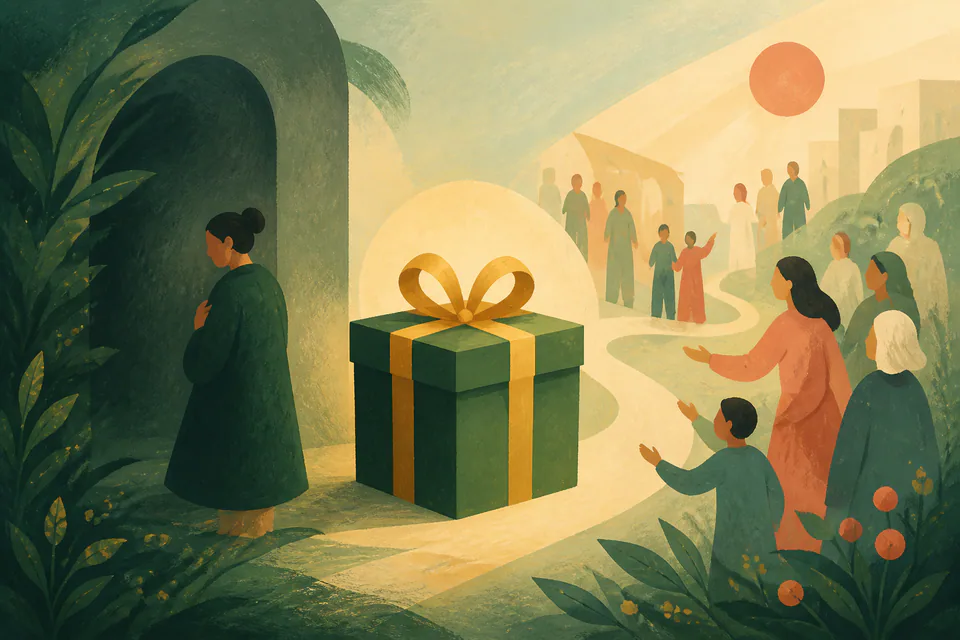
A donor wants to make a transformative gift without recognition. The charity believes announcing the gift and the donor's identity would encourage matching contributions and help far more people.
Can the opportunity to create more good outweigh a preference for privacy?