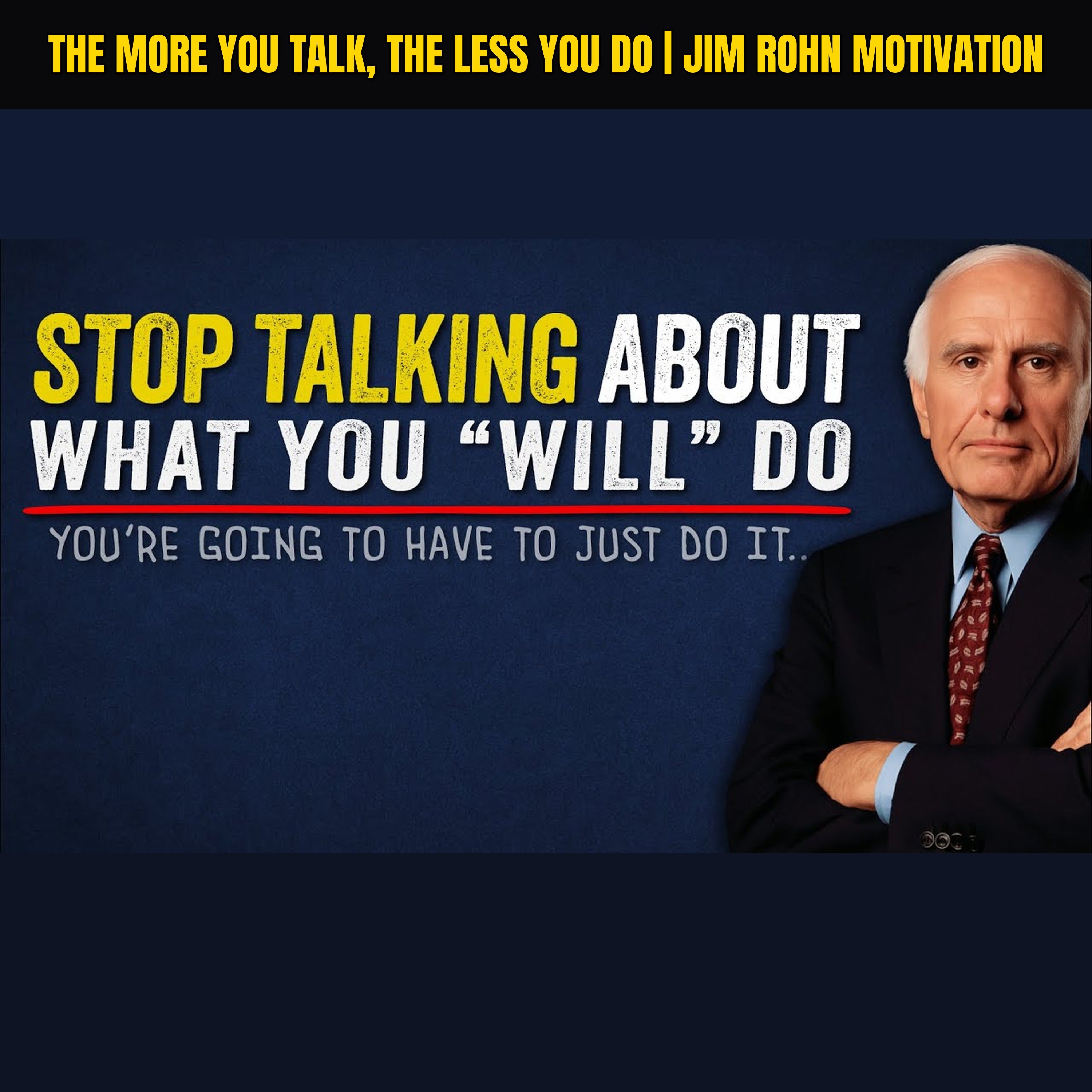
#JimRohnMotivation #JimRohn #JimRohnSpeech In this Jim Rohn Motivation video, Jim dives deep into the powerful distinction between talking and doing — exposing how many mistake conversation for progress. If you've ever felt stuck while making grand plans, this message will help you shift from saying to executing. Key Topics From This Motivational Video: Why talking about goals isn't the same as achieving them The illusion of progress through words The importance of execution over expression Building credibility through consistent action The discipline of silence and restraint This powerful Jim Rohn speech reminds us that life rewards execution — not intention. Words can excite, but only action creates momentum and results. Jim explains how silence, restraint, and consistent effort build trust, while over-promising and under-delivering create credibility debt. If you want your actions to speak louder than your announcements, this message is for you. This Jim Rohn Motivational Video Is P
ChatGPT launched as a quiet "research preview" whose own staff badly underestimated how popular it would be, and it became one of the fastest-growing apps in history. We tell the seven-year story behind it, from a nonprofit with a big mission through GPT-1, GPT-2, GPT-3, and the training trick that taught a model to follow instructions. Then we explore why the chat interface mattered as much as the technology, and how one launch set off a "code red" at Google and an industry-wide race. This episode includes AI-generated content.
What do Bitcoin and inflation reveal about the future of money—and why does Jeff Booth believe the financial system is working against the very people it should serve? Technology makes products faster, cheaper, and more accessible. A smartphone can replace cameras, calculators, music players, and countless other products that once required separate purchases. Artificial intelligence promises even greater productivity. So why does the cost of living keep rising when technology should be making so many things cheaper? In this episode of The Rich Dad Radio Show, Robert Kiyosaki sits down with Jeff Booth, entrepreneur, technology investor, and author of The Price of Tomorrow, to challenge conventional thinking about inflation, economic growth, and the future of money. Jeff argues that technological progress naturally pushes prices lower as businesses find ways to produce more value with fewer resources. But he believes the existing monetary system interferes with that process. Instead of a
When WHOOP first launched its wearable tech more than a decade ago, it was mainly for elite athletes. Now, the company has reported more than three million users worldwide and raised $575 million in Series G funding earlier this year. Its signature product, the WHOOP Band, can track everything from your blood oxygen, sleep data, and stress levels. Host Rana el Kaliouby sat down with WHOOP’s chief product officer, Ed Baker, in front of a live audience at the Boston Museum of Science. They talked health-maxxing vs. emotion-maxxing, wearables as a “doctor in your pocket,” and heard Ed’s incredible story of how his WHOOP saved his life. Learn more about Pioneers of AI:http://pioneersof.ai/
#303: Chris shares 150+ holiday gift ideas across tech, kitchen, home, clothing, fitness, games, kids and more. Plus, tools and tactics to save 5–25% on holiday shopping. For all the products, links, deals and more, check out the full 2026 Gift Guide here: https://chrishutchins.com/gifts Partner Deals Bilt Rewards: Earn the most valuable points when you pay rent (https://chrishutchins.com/bilt) Gelt: Skip the waitlist on personalized tax guidance to maximize your wealth (https://chrishutchins.com/gelt) Long Angle: Navigate wealth with a private community of vetted peers (https://www.longangle.com/)For all the deals, discounts and promo codes from our partners, go to: chrishutchins.com/deals (https://bit.ly/44XgYo3) Resources Mentioned 2026 Gift Guide (https://chrishutchins.com/gifts): Find all the products, links, deals and more at https://chrishutchins.com/gifts ATH Podcast #255: 2025 Holiday Gift Guide and Ways to Save This Season (https://www.chrishutchins.com/gift-guide-2025/) #271
1067. Auto insurance rates have become one of the most expensive items in a typical household budget. If you haven’t reviewed your policy or shopped around in years, you may be overpaying. Host Laura Adams explains how to review your policy and see if you can pay less without sacrificing coverage. You’ll get a guide for shopping, comparing, and switching auto policies like a pro. Key Takeaways Compare insurance using your current policy’s declarations page before requesting quotes so you can match exact liability limits, deductibles, and endorsements. State auto insurance minimums are often too low and leave your personal savings exposed in a serious crash. Consider purchasing at least 100/300/100 liability coverage plus uninsured/underinsured motorist protection, and a personal umbrella policy if you have significant assets. If the combined annual cost of collision and comprehensive coverage exceeds 10% of your car’s current market value minus your deductible, consider dropping those
Working harder won’t fix a schedule that’s out of control. In this episode, John Felkins sits down with Ramsey Solutions Executive Director Katie Crenshaw to walk through seven steps to better time management so you can stop feeling overwhelmed, focus on the right priorities, and make real progress in your business. Next Steps: · Bad hires. Strategies that never get off the ground. 60-hour workweeks. Sleepless nights. Don’t wait until seats are sold out. · End the chaos and get time back on your side with EntreLeadership’'s Ultimate Guide to Time Management (https://ter.li/hrwqfu). · · Not sure what to do next in your business? Let’s figure it out together. · Have a question for the show? · · · Stop guessing. Connect With Our Sponsors: Listen to More From Ramsey Network: ️ The Ramsey Show (https://ter.li/gpny1a) The Ramsey Show Highlights (https://ter.li/430qk2) The Dr. John Delony Show (https://ter.li/w9syza) Smart Money Happy Hour (https://ter.li/k3waa1) George Kamel (https://ter.li/
What if hitting your biggest passive income goal is undoing the tax advantage that made you incorporate in the first place? Many successful Canadian business owners keep more money in the corporation than they need, invest it, and eventually set a big goal: enough passive income for the business to be “financially free” on its own. It feels like the ultimate safety net. But passive income inside a corporation is taxed at roughly 50% from day one, and once it passes $150,000 it grinds down the small business deduction. At that point you may be paying more tax than if you had earned the money personally. In this episode, Jon Orr and Kyle Pearce unpack a real client case. The household spends $200,000 to $250,000 a year after tax and now generates about $1 million of passive income a year, much of it from real estate and private lending inside the corporation. They show: why a 12% private lending return can shrink to about 6% after corporate tax, how integration leaves Ontario owners payi
It’s 1985, and in the aftermath of the launch of the Mac, Apple is in turmoil. Steve Jobs and CEO John Sculley are clashing and the Mac business is in crisis. It’s the beginning of the end of Jobs’s first tenure at the company he co-founded. This episode of Designed in California is sponsored by: Forest & Bird (https://www.forestandbird.org.nz/): Giving Nature a Voice Links and Show Notes: Presented by Jason Snell and Myke Hurley. Written by Jason Snell. Script development by Kelly Turner. Thanks to John Buck, Matt Deatherage, Jim Hunkins, Scott Knaster, Harry McCracken, Mike Murray, David Shayer, John Siracusa for script assistance. Audio editing by Myke Hurley and Jim Metzendorf. Video production by Jamie Snell. Designed in California theme by Christopher Breen. References/Further Reading: Steve Jobs (https://link.amazon/B07YvsjhV) by Walter Isaacson Steve Jobs in Exile (https://link.amazon/B09CBFcdp) by Geoffrey Cain Steve Jobs: The Journey is the Reward (https://isbn.nu/97815580237
Dan Nathan and Guy Adami record immediately after NVIDIA’s earnings and conference call, praising the quarter’s growth and margins while arguing the market may be underpricing major legal, regulatory, and national-security risks tied to export controls, Singapore revenue concentration, CEO Jensen Huang’s resignation, and probes including an SEC inquiry and potential congressional scrutiny; they question interim CEO/CFO Colette Kress’s role, discuss inventory and margin pressures, and debate whether the move marks a capitulation or just a tradable bounce, then broaden to implications for hyperscalers, cybersecurity names, software weakness, and Anthropic’s IPO pricing and sentiment impact. After the break, Dan interviews InKind co-founder/CEO Johann Moonesinghe, who explains InKind’s two-sided marketplace that finances restaurants by buying future food-and-beverage credit and drives customer traffic with ~20% dining rewards, recounts his path from government security work and Techstars
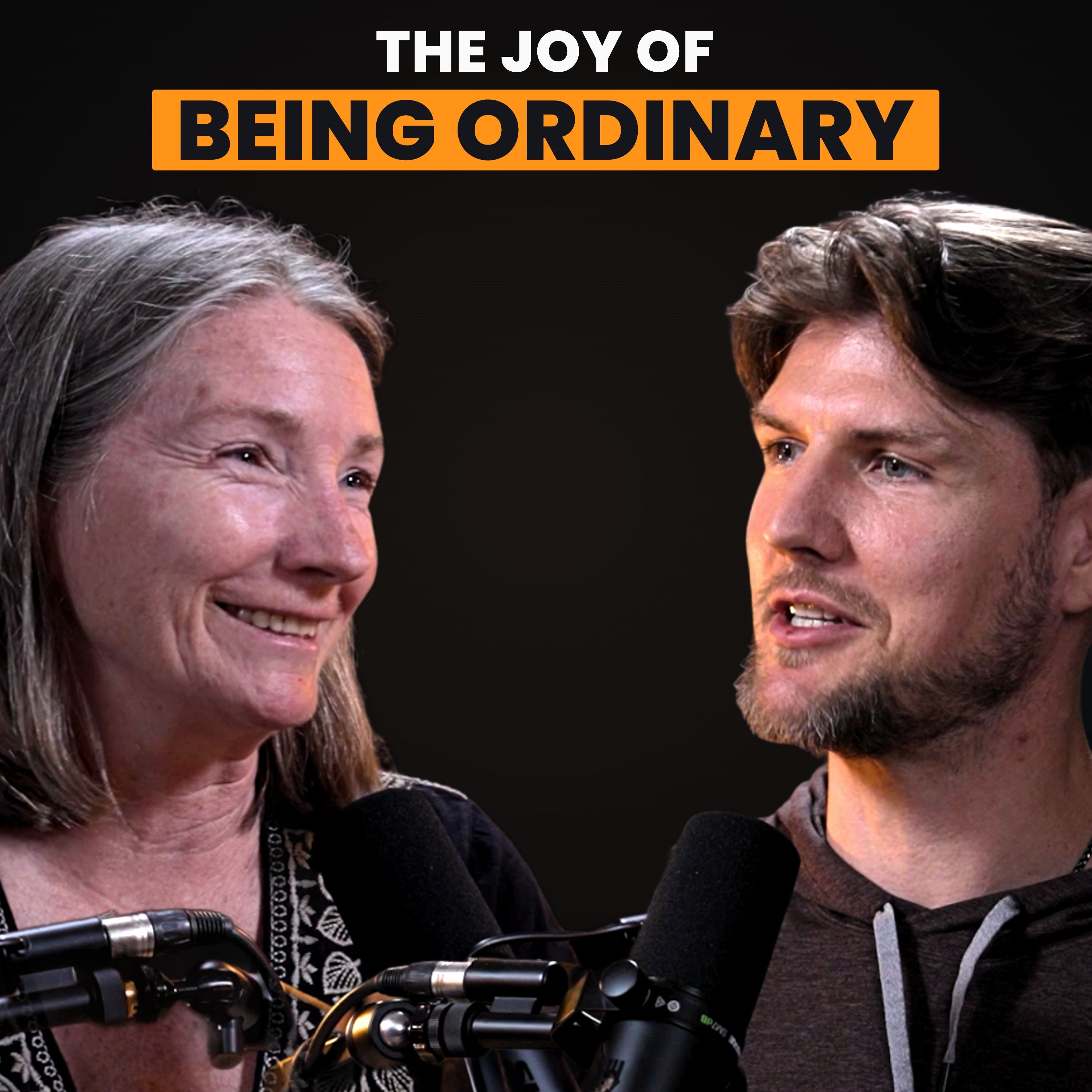
Many of us carry a quiet terror of being ordinary. While it can drive us toward constant achievement, it also makes us feel uniquely broken, or leave us feeling like no one ever truly gets us. In this episode, Brett sits down with Tara to explore the three faces of the need to be special, where they come from, and what becomes possible when we let the trap door drop out beneath them. They explore why this pattern is at its heart a relational wound, why the strategies that protected us as kids leave us profoundly isolated as adults, and how welcoming our ordinariness can paradoxically open us to an extraordinariness we've been missing all along. Together, they explore: The three faces of needing to be special: superlative achievement, unique brokenness, and I'm-just-different How to recognize this pattern in yourself Why this is fundamentally a relational wound, and a beautiful protection a young mind devised The way family stories and school culture can pass this pattern down How the p
This week Chris sits down with Jim Belosic, Founder and CEO of SendCutSend, the company where you upload a design and get custom metal parts back, often the next day. Jim started it in 2018 as a side project to cover the payment on one machine, which he bought to make better parts for the cars and motorcycles he worked on in his garage. He says it's now grown to almost 800 people and about $200 million a year in revenue. They talk about why he keeps millions of dollars of inventory on the floor when every finance person tells him not to, why he wants more machines instead of faster ones, and why the money he raised this year hasn't made him any faster. Timestamps: (00:00) Intro (00:56) From Garage Side Hustle to a $200 Million Manufacturer (05:19) Growing from Laser Cutting into Full-Service Manufacturing (09:27) When Reindustrialization Became a Movement (15:19) Stocking Millions in Inventory to Ship Faster (19:28) From VC Skeptic to a 30-Day Series A (27:05) What the Best Investors A
Airport Security Tip / Medicare “DisAdvantage” Presents Opportunity Before you head to the airport for holiday travel, Clark shares an urgent security line warning (https://www.engadget.com/2288969/why-shouldnt-put-phone-tsa-bin/) — and a personal theft story — explaining why tossing your phone, watch, and valuables loose into a TSA bin is a big mistake, and the simple backpack habit you should use instead. Also, Clark dives into the massive Medicare open enrollment (https://www.nytimes.com/2026/10/17/business/medicare-coverage-retirement.html?smid=em-share) shakeup affecting millions of Americans (https://www.nytimes.com/2026/10/09/business/medicare-private-health-care-costs.html?smid=nytcore-android-share) as insurers drop coverage, slash supplemental benefits, and raise out-of-pocket costs. Clark breaks down why he often calls Medicare Advantage "Disadvantage" plans, highlights a free community-built tool (https://ismyplanending.com/) to check your coverage, and reveals a rare open
Senior Editor Michael Feinberg sits down with Nick Harkaway, author and son of John le Carré, to discuss the enduring legacy of George Smiley, one of spy fiction’s most indelible characters. They talk about fact and fiction in the world of spy novels—and about Nick’s new book, “The Taper Man: A Novel of John le Carré's Circus (https://www.penguinrandomhouse.com/books/865730/the-taper-man-by-nick-harkaway/9798217356249/).” Hosted on Acast.
America’s ability to project power anywhere in the world begins at sea. An aircraft carrier moves an airfield across an ocean. A submarine disappears beneath the surface while maintaining nuclear advantage. Destroyers defend a fleet, strike targets hundreds of miles away, and protect the sea lanes that connect the global economy. When access disappears, bases become vulnerable, or a crisis erupts thousands of miles from American shores, the United States Navy (https://www.navy.com/) can arrive without asking for permission. The US Navy may have the most sophisticated hardware on the seas, but the sailor is the most important weapon system. From the Delbert D. Black National Chief’s Mess at the United States Navy Memorial (https://www.navymemorial.org/) in Washington, D.C., Fran Racioppi (https://www.linkedin.com/in/francisracioppijr/) sat down with Master Chief Petty Officer of the Navy John Perryman (https://www.navy.mil/Leadership/Flag-Officer-Biographies/BioDisplay/Article/4296771/)
TRANSFORM YOUR LIFE WITH 21 DAYS SUCCESS PLAN – Jim Rohn Motivation #jimrohn #motivation #21dayschallenge #successplan #discipline #personaldevelopment ► Speaker: Jim Rohn (AI Voiceover by Jim Rohn Academy) Change doesn’t take forever—it just takes commitment. In this motivational blueprint for growth, Jim Rohn shares the power of a focused, intentional 21-day success plan that can reshape your habits, upgrade your mindset, and ignite lasting transformation. If you’re ready to stop talking about change and start living it, this is your moment. Uploaded 22-04-25 Key Topics Covered: The Power of 21 Days – Why focused consistency creates real change. Building Strong Habits – How to replace weakness with discipline. Creating Momentum – Small wins that stack into unstoppable progress. Designing a Daily Plan – Set goals, manage time, and execute with clarity. Becoming the Person You’ve Always Wanted to Be – One day at a time. You don’t need more time—you need more focus. Give yourself 21 day
Follow the podcast & turn on notis Leave your review for this episode in the Q&A Section. Join the 10k Accelerator Course -------------- ------------ Keywords: alpha male mindset, men's lifestyle, high status men, millionaire mindset, masculine leadership, men's mental health, high value men, high frequency living
Sam Blond is the co-founder and CEO of Monaco. Before that, he was a VC at Founders Fund where he evaluated over 200 AI sales startups. This is what he learned, what he got wrong, and what he built instead. Two traps that killed most of the companies he saw. The first: building a feature, not a company. If your entire product is "we take call recording content and update CRM fields," that should be a feature of Gong or Salesforce, not a standalone business. The second: solution in search of a problem. Great technology, zero customer pull. Both graveyards are full. Why Monaco is AI-native and why that matters. Pre-AI CRM platforms like Salesforce were architected to be reactive to user input. Monaco was architected so agents do the work before the user ever touches the interface. It is very difficult, if not impossible, for a pre-AI system architecture company to pivot to this. You have to start from scratch. What AI is better at than humans in GTM. Building and scoring your TAM. Enrich
You are not where you want to be. You know it. You have known it for years. And you have a set of explanations — good ones — for why: the economy, your family, your background, the bad break, the boss who held you back, the relationship that took years from you. Uploaded 18-06-26 Here is the truth: every one of those might be partially true, and not one of them is the real reason. The real reason is that you have been outsourcing the responsibility for your life to circumstances, to other people, to the past, to bad luck — to anything outside of you. And as long as the cause sits outside of you, the solution sits outside of you too, so you wait for the external world to change while doing very little to change yourself. The explanations are not free. Every story you tell about why you are stuck is keeping you stuck, because the story replaces the action that would have moved you. After fifteen or twenty years of describing instead of changing, the description starts to feel like realit
How can coaching become more inclusive—not just in principle, but in the way each conversation is hosted and in the way we welcome each person? In this episode of The Coaching Inn, host Claire Pedrick speaks with Dr. Aikyna Finch, Vice President of Diversity, Equity, Inclusion and Belonging at the International Coaching Federation. She shares how finding community through ICF Tennessee shaped her coaching journey and grew her commitment to inclusive coaching. Aikyna talks about how equity means people may need different things to thrive; a one-size-fits-all approach can leave people feeling unseen. Rather than rely on a fixed script or checklist, coaches can ask, “What do I need to know to help coach you better?” and adapt access, communication and pace to the person and context. That curiosity supports partnership, trust and belonging without turning the coach into a rescuer or diagnoser. Aikyna calls for stronger coaching communities, inclusive time zones, multilingual learning and l
We like to assume someone will be there when we need care: a spouse, a child, a sibling. But that plan has more holes than we’d like to admit. Maybe you never had kids. Maybe they live across the country. Maybe your partner will pass away before you do. Or maybe your closest family simply can’t be the caregivers you imagined. The truth is, even with a big family, you could end up aging alone. The good news? When you plan for that possibility, you get to design your future support system on your own terms. On a special episode of the HerMoney Podcast, sponsored by LIMRA (https://www.limraconsumer.com/), Jean sat down with Joy Loverde, author of Who Will Take Care of Me When I’m Old? (https://www.amazon.com/dp/0738219630?plpRedirect=mhFallback&ref=clp_hp_h_pc) Loverde has spent decades helping people build care networks, make smart money and housing decisions, and put the right legal protections in place so they can age with confidence. In this episode, Jean and Joy cover: When you shoul
Follow the podcast & turn on notis Leave your review for this episode in the Q&A Section. Join the 10k Accelerator Course -------- Keywords: men's mental health, masculine energy, stoicism men, male entrepreneurship, men's self improvement, millionaire mindset, inner strength
Most people wait for the year to be good to them. They hope. They resolve. They set intentions in January and abandon them in February. And then they wonder why the next December looks exactly like the last one. Uploaded 25-09-26 But the year didn't fail them. They lived it the same way they lived the one before. And a year lived the same way produces the same result. That's not bad luck. That's just arithmetic. Here is the truth: there is a small set of habits that, once you build them, quietly make every year better than the one that came before. Not dramatically. Not overnight. But steadily, so that after five years you're standing somewhere the old version of you could never have reached. This seminar walks through 10 things you must understand about the habits that make every year climb instead of repeat. CHAPTERS 0:00 Intro — a year lived the same way 1:07 The invisible arithmetic underneath every year 5:00 #1 — Review the year before you plan the next 5:24 #2 — Learn one new thi
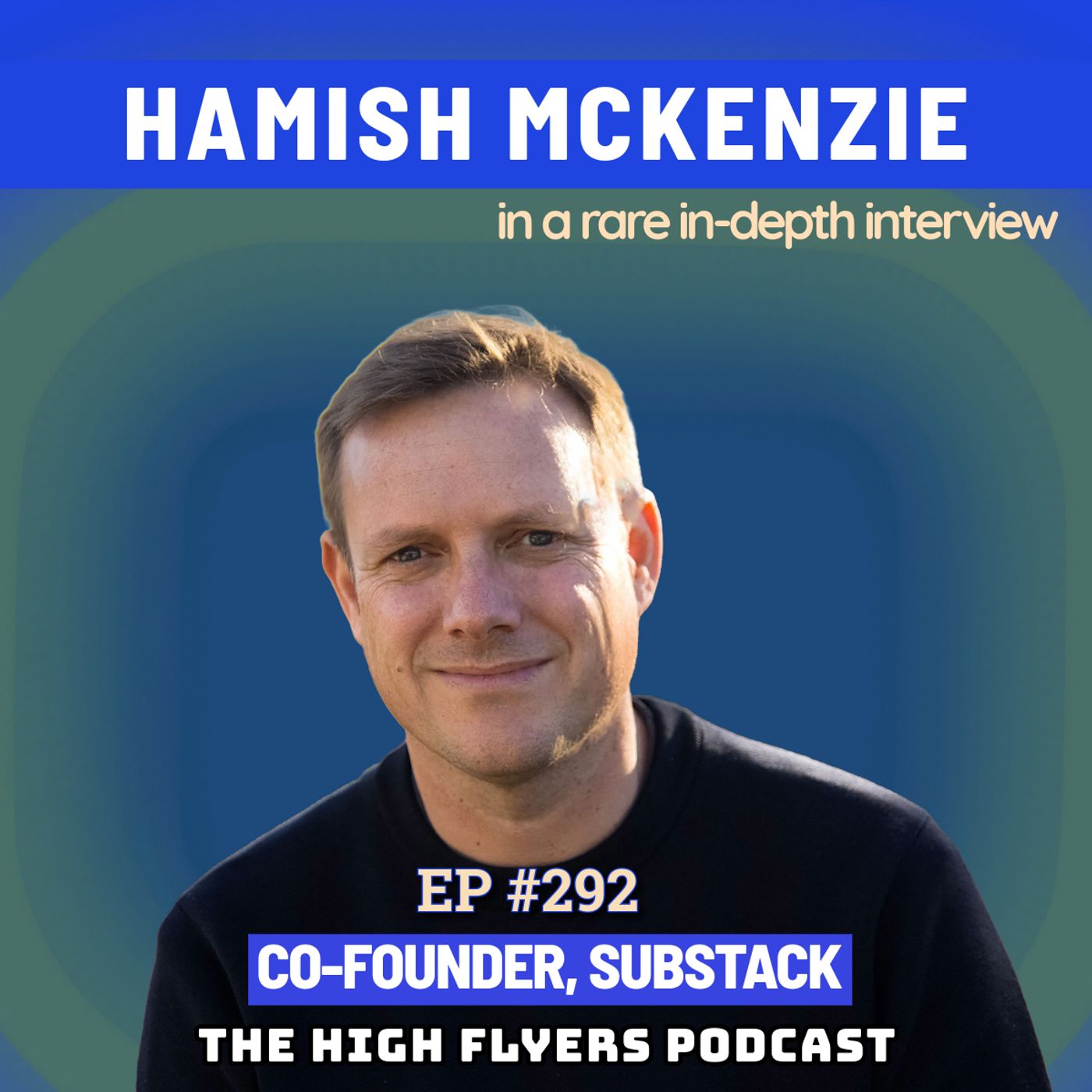
________ What does it take to go from a small town in New Zealand to building a billion-dollar company that is transforming the global media industry? And what happens when your journey takes you from working for Elon Musk to fighting to publish your own book, before accidentally becoming a Silicon Valley founder? Meet Hamish McKenzie, Co-founder of Substack, the billion-dollar publishing platform helping millions of writers, journalists and creators build audiences and earn a living independently. A former journalist who worked at Tesla, Hamish helped build Substack into one of the most influential companies reshaping how information is created, distributed and monetised, with over five million paid subscriptions. In this rare and deeply personal conversation, Hamish shares his remarkable journey. From growing up in a small New Zealand town and losing his 14-year-old brother in a tragic accident when he was just 11, to pursuing journalism across New Zealand, Canada, Hong Kong and the