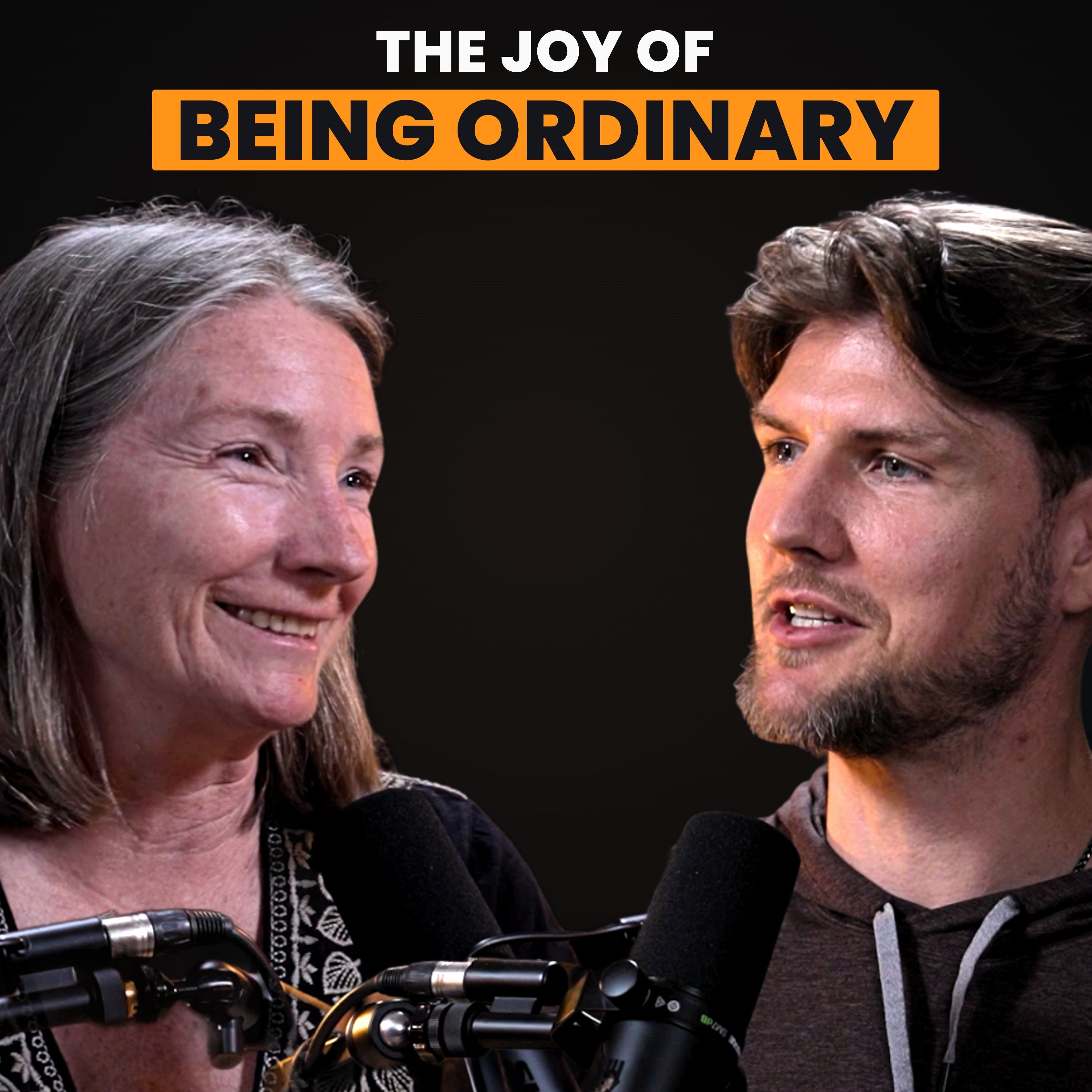
Terrified of Being Ordinary? You’re in Good Company
27 min
Listen through the publisher, then discuss the episode here or arrange an in-person Roundtable. Your city determines where to meet.
Roundtables are designed for groups of four, with a shared subject and room for everyone to speak. Come for discussion, with no dating expectation.
Many of us carry a quiet terror of being ordinary. While it can drive us toward constant achievement, it also makes us feel uniquely broken, or leave us feeling like no one ever truly gets us. In this episode, Brett sits down with Tara to explore the three faces of the need to be special, where they come from, and what becomes possible when we let the trap door drop out beneath them. They explore why this pattern is at its heart a relational wound, why the strategies that protected us as kids leave us profoundly isolated as adults, and how welcoming our ordinariness can paradoxically open us to an extraordinariness we've been missing all along. Together, they explore: The three faces of needing to be special: superlative achievement, unique brokenness, and I'm-just-different How to recognize this pattern in yourself Why this is fundamentally a relational wound, and a beautiful protection a young mind devised The way family stories and school culture can pass this pattern down How the pattern cuts us off not just from others but from parts of ourselves The grief underneath: mourning how alone you've felt all along The both/and move: fully owning that you're special and fully owning that you're ordinary "Who am I if I don't have to get anywhere?" Using VIEW (vulnerability, impartiality, empathy, wonder) to find sameness and belonging Hosted by Simplecast, an AdsWizz company.
Episode information is provided by the publisher. Listening takes place on the publisher’s service.
Imagine if every big change in our lives came with a whole community stepping up beside us… In this episode, I sit down with Dr Arne Rubinstein, former GP and emergency doctor, founder of the Rites of Passage Institute, and a man who's spent more than 30 years walking young people across the threshold into adulthood. Arne's work began around a fire at his very first men's gathering, listening to a hundred men wrestle with the same handful of wounds. Then in the Emergency Dpt, he kept meeting teenagers who'd pushed it one step too far... kids trying to become adults with nobody there to hold them. He came to believe every young person will go through a rite of passage either way. The question is whether we leave them to create their own, or gather around and help. We talk about why our culture is so good at turning away from the big moments - from first periods to menopause to death - and what opens up when we turn towards them. We explore: Separation, transformation and integration, an
"Are You Being Assertive… or Just Pushy?" - Listen to my Morning Monologue: I’m sharing my take on pressing issues, enlightening research on human behavior, answering questions I get by email, and my favorite, most instructive interactions with callers. It’s the free therapy you need! Got a dilemma? Follow on social media: Facebook.com/DrLaura (http://facebook.com/DrLaura) YouTube.com/DrLaura (http://youtube.com/DrLaura) Join the Dr. Laura Family!! >> Receive my weekly newsletter, perks, and more! Sign up now, it's FREE > DrLaura.com (https://www.drlaura.com/) Hosted by Simplecast, an AdsWizz company.
You've gotten very good at pretending you don't feel it. Uploaded 21-08-26 Maybe it's a conversation with someone you love. Someone you work for. A partner, a parent, a friend who's been quietly taking more than they give. Or the hardest one of all — a conversation with yourself, the one where you finally admit something you've refused to say out loud for years. You know exactly which one I'm talking about. You felt it the moment I said the word. A name came up, or a face, and your stomach did something small and unpleasant, and you pushed it back down where it's been living. That flinch is the most honest thing that's happened to you all day. Here is the truth: the life you say you want — the freedom, the peace, the relationship, the income, the respect — there's a very good chance it's on the other side of one conversation you keep refusing to have. Not ten. One. This seminar unpacks the single mechanic behind a stuck life: the necessary conversation you keep treating like a locked d
Happy Sunday! Welcome to Heal Squad’s The Sunday Set Up. Life lessons to help you start the week. How much of success comes down to simply showing up? This week, we talk keeping an open mind, taking chances, and recognizing the doors that open along the way. From Olympic athletes appearing on national television alongside Mercedes Moné to performers who keep showing up week after week hoping for their big break, we explore why success isn't always about talent or luck. Sometimes it's about making connections, putting in the effort, and being willing to try without knowing what we'll get in return. We talk knowing when to stop investing time in people who aren't willing to help themselves, and why even experiences that don't work out can teach us something valuable. The takeaway: don't wait for the perfect moment or expect someone else to make things happen. Be willing to take a chance, walk through the doors that open, and remember that half of life is just showing up. Plus, a little b
One of the most beautiful images of a guardian angel I’ve ever seen is an icon of an old woman standing in the snow. Beside her, an angel bends down to tie her shoelaces. I love that detail. It reminds me that even the smallest things in our lives matter. In this Sunday Reflection, I explore what the Franciscan tradition teaches us about guardian angels. What does it mean to have a companion who walks beside us through difficulty? And when did you last ask your guardian angel for help? I also reflect on the seraphim, the angels we describe as being on fire with love, and on how St Francis shared that same warmth with those around him. I invite you to take a quiet moment today to ask for a little of that love in your own heart, for yourself, for others and for the whole of creation. Peace be with you. Timestamps 00:00 Angels and the image of a love that burns 01:20 Guardian angels and unseen companionship 03:09 The angel tying an old woman’s shoelaces 04:02 An invitation to open ourselv
Why is the manosphere so appealing to young men? What does it actually mean to be a good man? To join our journaling club, with 10,600 + others, subscribe to my imperfect email - https://www.theimperfects.com.au/sign-up-to-our-newsletter/ Journalist Marc Fennell joins us in the studio to talk about the manosphere: what is it? what are its consequences? and how can we talk to our kids about it? Marc explores with Hugh, Ryan and Josh why the manosphere is so appealing to young men, especially those who think they have little value to offer, and Josh questions what his reaction would have been, if he had of been exposed to the manosphere at a vulnerable time. We look at ‘toxic masculinity,’ and the impact of being right versus making change, and in a moment of vulnerability, Marc discusses the importance of self reflection of your own behaviour. Chapters: Chapters 00:00:00 – Marc Fennell on the Manosphere [TRAILER] 00:01:01 – Ryan’s doppelganger (and media buff etc) 00:04:24 – The State o
"Why can't I get any movement in my life?" Joe hears the real question underneath and asks him to do something unusual: say everything the voice in his head says, out loud, to Joe, using Joe's name. Then Joe answers back. What follows shows three ways to relate to a voice you can't shut off — respond to it, fact-check it, and notice it hasn't worked in 40 years. → If the voice in your head is always bracing, judging, and rehearsing, the Connection Course is three weeks of live practice in relating to yourself, and everyone else, differently: https://yt.artofaccomplishment.com/rapid-coachinginner-critic → A game based on rapid coaching, try it here: https://yt.artofaccomplishment.com/game-rapid-coaching Hosted by Simplecast, an AdsWizz company.
Many people with high empathy experience it as a burden, like getting overwhelmed in crowds, losing themselves in others' emotions, feeling exhausted by social situations. But what if empathy itself isn't the problem? In this episode, Joe and Alexa explore how to turn empathy from something that drains you into one of your greatest superpowers. Joe draws distinctions between empathy, sensitivity, and porousness, and traces how childhood dynamics can shape how we use (and overuse) our empathetic capacity. They explore why the path forward isn't to shut empathy down but to develop the self-referencing, boundary-setting, and clarity that lets it flow without catching. Together, they explore: The important distinction between empathy, sensitivity, and porousness Why highly empathetic people often feel the thing underneath the thing (the fear beneath the anger) The question that cuts through confusion: "Is this mine or is this someone else's?" How your empathy shows you exactly where your u
Users should have access to human review when a platform restricts their account.
Share your view, then see how readers voted. No sign-in required. This poll is shared across stories.
Do you agree or disagree?
Common Quandary
A Common Quandary to discuss
Another conversation to explore, separate from this news story.
You know the relationship is over, but the vacation is nonrefundable. Do you wait to break up?
You have decided to end a year-long relationship. In five days, you are both leaving on an expensive vacation that cannot be refunded or transferred. Your partner is excited and believes the relationship is thriving.
Can avoiding financial waste justify delaying a painful truth?