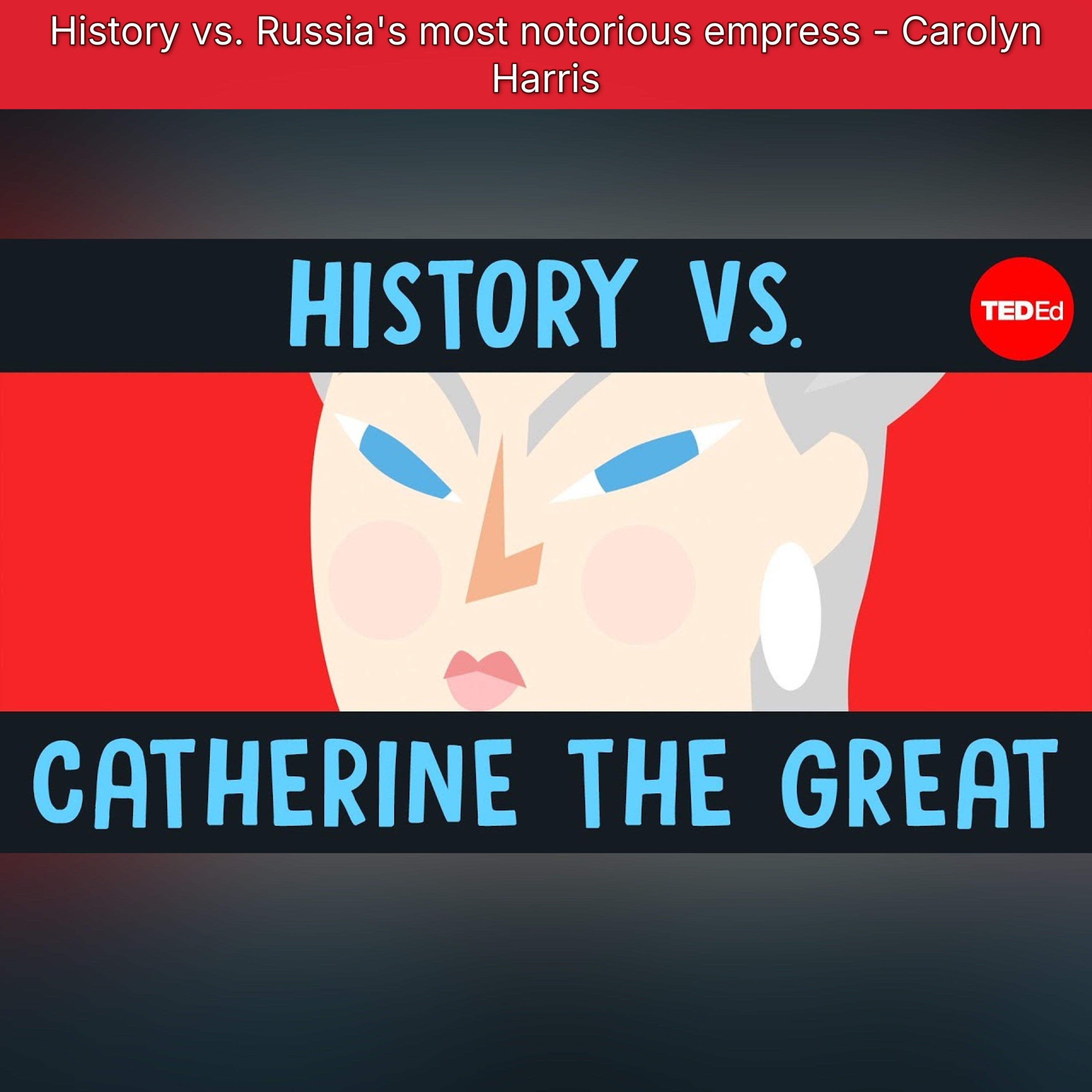
Catherine the Great presided over a golden age of Russian expansion — but was she a dedicated ruler or a ruthless oppressor? -- Catherine the Great, Empress of Russia for over three decades, used strategic dalliances, military might, and cutting-edge philosophy to modernize, expand, and transform the Russian Empire. But was she a dedicated ruler determined to move Russia into the future, or a ruthless monarch who oppressed anyone who questioned her? Carolyn Harris puts this controversial figure on trial. Lesson by Carolyn Harris, directed by Brett Underhill, PorkchopBob Studio. Support Our Non-Profit Mission ---------------------------------------------- Support us on Patreon: http://bit.ly/TEDEdPatreon Check out our merch: http://bit.ly/TEDEDShop ---------------------------------------------- Connect With Us ---------------------------------------------- Sign up for our newsletter: http://bit.ly/TEDEdNewsletter Find us on Twitter: http://bit.ly/TEDEdTwitter Peep us on Instagram: http:
Most people don’t fail because they lack motivation. They fail because their days go unexamined. This video isn’t about getting fired up. It’s about creating awareness that actually changes behavior. When you don’t stop to measure your days, you end up repeating them—busy, tired, and wondering why nothing is moving forward. The Daily Review is a quiet, private discipline. It’s how you build accountability without pressure, clarity without overwhelm, and progress without drama. Small daily adjustments, made consistently, reshape your direction over time. If motivational content gives you energy but not traction, this lesson explains why—and what to do differently. Go deeper and apply the lesson: Deep Dive (Distraction-Free Video): Free Action Guide: This practice isn’t about judgment. It’s about alignment. When you review your actions honestly, excuses lose their grip and intention takes their place. That’s how habits form. That’s how self-respect is built. And that’s how progress becom
Strongmen, tyrants, and dictators have marked Latin America’s history — and literature — for hundreds of years. In this episode of Crash Course Latin American Literature, we dive into some of the novels that have challenged authoritarian governments in real time and in their aftermath. Introduction: The Power of Stories 00:00 Novelas de la Tierra 0:34 "Facundo" 2:16 Novelas del Dictador 4:58 “El Señor Presidente” 6:12 "In the Time of Butterflies" 8:09 Review & Credits 10:50 Sources: https://docs.google.com/document/d/1eE7g4-k6PD7C6wNBzeJIO8GCDHpoJl8ldDjKyq_2yYg/edit?tab=t.0 To learn more, check out these videos: Geopolitical history of Latin America: War and Nation Building in Latin America: Crash Course World History 225 https://youtu.be/v6xi8_7Fy6Y?si=paRg7m_G3tMAX4vW , Latin American Revolutions: Crash Course World History #31 https://youtu.be/ZBw35Ze3bg8?si=P4HnEqr1_rEP2YGv *** Support us for $5/month on Patreon to keep Crash Course free for everyone forever! https://www.patreon.co
Hank introduces us to the "simplest" of the animals, complexity-wise: beginning with sponges (whose very inclusion in the list as "animals" has been called into question because they are so simple) and finishing with the most complex molluscs, octopuses and squid. We differentiate them by the number of tissue layers they have, and by the complexity of those layers. Table of Contents: 1) Porifera 1:33 2) Cnidaria 2:36 a) Diploblasts 2:48 3) Platyhelminthes 3:33 a) Triploblasts 3:56 b) Coelom 4:36 4) Biolography 5:36 5) Nematoda 7:26 6) Rotifera 7:57 7) Molusca 8:33 References: Crash Course is on Patreon! Want to find Crash Course elsewhere on the internet? Facebook - http://www.facebook.com/YouTubeCrashCourse Twitter - http://www.twitter.com/TheCrashCourse Instagram - https://www.instagram.com/thecrashcourse/ CC Kids: http://www.youtube.com/crashcoursekids
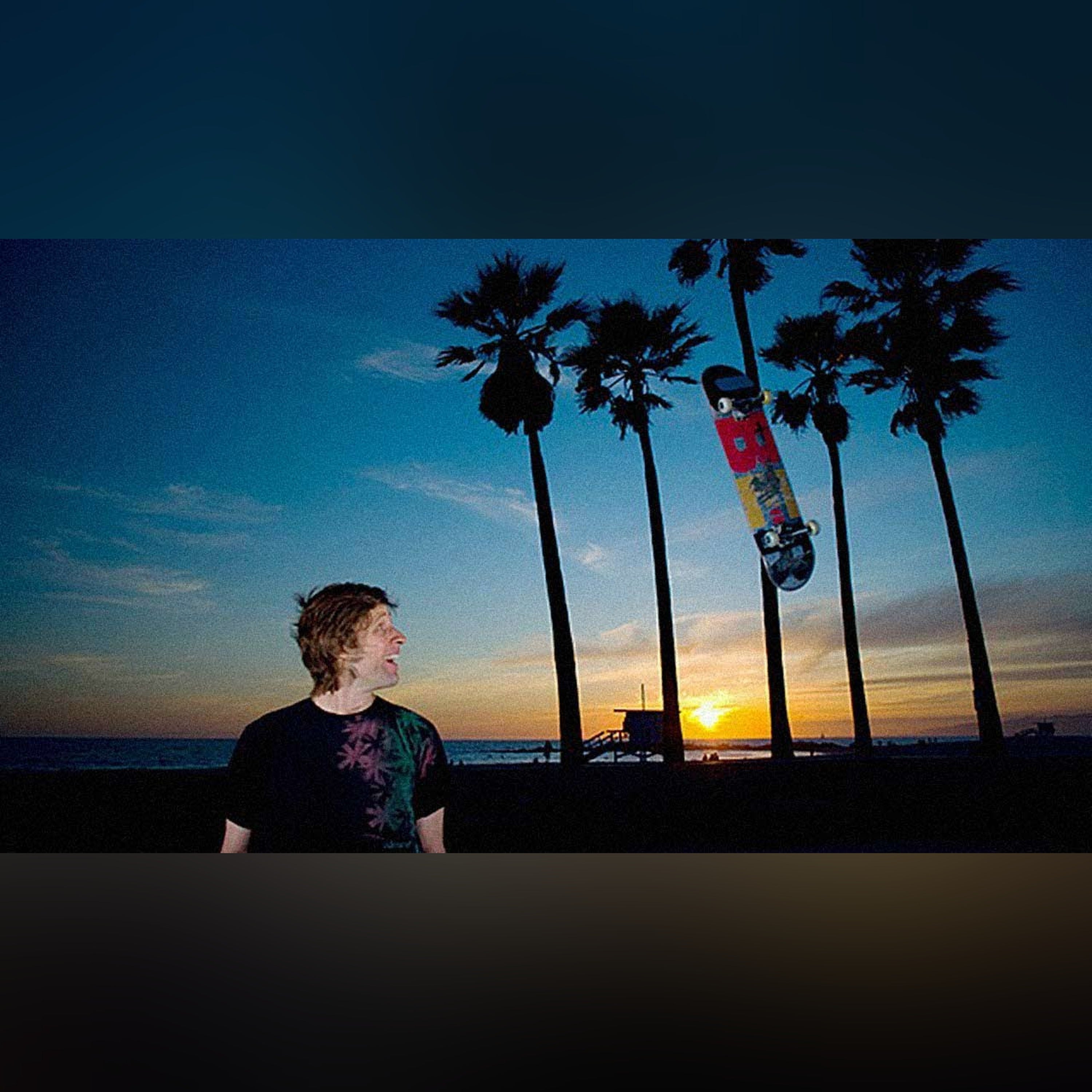
The last thing Rodney Mullen, the godfather of street skating, wanted were competitive victories. In this exuberant talk he shares his love of the open skateboarding community and how the unique environments it plays in drive the creation of new tricks -- fostering prolific ingenuity purely for passion's sake. (Filmed at TEDxUSC.) Uploaded 21-08-13 Talk by Rodney Mullen.
In this Jim Rohn Motivation speech, discover how small, consistent habits and powerful mindset shifts can transform your life in the next 12 months. Jim Rohn delivers timeless wisdom on personal development, discipline, energy, finances, relationships, and purposeful living. Key Topics From This Motivational speech: Why most people repeat the same year 10 times The true cost of standing still vs. taking action How discipline creates freedom and confidence The role of energy and health in success Building vision and aligning your life with purpose This compelling Jim Rohn speech reminds us that growth is not automatic—it’s intentional. Through small acts of discipline, financial awareness, curated environments, and focused effort, you can design a life of purpose, confidence, and progress. Jim challenges us to begin before the new year and to take full ownership of our development. The time to act is now. This Jim Rohn Motivational speech Is Perfect For: Anyone feeling stuck and wanting
I had my hair cut. I had my car fixed. I got my phone repaired. I had Jenny fix my computer. Wait a minute. Why do we say I had my hair cut instead of something like I cut my hair, if another person actually did the work? And why can we also say I had Jenny fix my computer? These are two very useful patterns for talking about services and situations where another person does something for us. So today, we’re going to look at how you can use them naturally in everyday English. The Happy English Podcast Helping people speak English better since 2014 Over 1,000 episodes • 8 million downloads Learn more about my English lessons and courses https://www.myhappyenglish.com (https://www.myhappyenglish.com/)
Who has the power in your business... you, or the customer? If you're stuck working with a difficult customer, jump whenever a customer says "I need you", or chase payments weeks after the job's done, your customer has the power. You've got no choice over who you work with, and that's a hard way to run a business. In this episode, Tony and Phil show you how to take the power back, so you run things on your terms, with the right price, the right people and the right projects. What you'll gain from this episode: Why "choice" matters more than cash flow: the hidden reason you can't say no to difficult customers, late payers or discounts How to take the power back: more leads, better closing and tracking which customers actually make you money, so you can reprice or walk away on your terms Fire, fix or keep? Tony and Phil rule on the customers we all secretly want to ditch, so you know exactly what to do when you're stuck with one LINKS MENTIONED IN THIS EPISODE: Follow Profitable Tradie s
In which John Green teaches you about the Holy Roman Empire by teaching you about Charles V. Charles Hapsburg was the Holy Roman Emperor, but he was also the King of Spain. And the King of Germany. And the King of Italy and the Lord of the Netherlands and Count Palatine of Burgundy. In short, Charles was runnin' thangs in much of the world during his reign. Charles ruled a lot of countries, and he was also known for encouraging intellectual discourse and even spoke out against slavery, in a limited way. So why did he consider himself a failure, and why did he break up the Empire when he abdicated in 1556? Mainly because the Holy Roman Empire didn't work very well. It was huge, and it didn't have any means of directly raising taxes. Plus, it was a pretty crazy time in Europe anyway, and Charles found himself in charge of the Catholic-Church-Endorsed Empire during the time of Martin Luther and the Protestant Reformation. John will teach you a bit about how Charles put the Empire together
Download a free audiobook and support TED-Ed's nonprofit mission: https://www.audible.com/ted-ed -- Bizarre things happen in dreams: you fly, or conjure an all-you-can-eat buffet out of thin air, or get chased by witches through the halls of your school. But the strange things that happen in dreams don’t seem strange at the time. So, how do you know you’re not in a dream right now? Is there a way to prove that you're awake? Daniel Gregory digs into the philosophical theories of wakefulness. Lesson by Daniel Gregory, directed by Daniel Stankler. Support Our Non-Profit Mission ---------------------------------------------- Support us on Patreon: http://bit.ly/TEDEdPatreon Check out our merch: http://bit.ly/TEDEDShop ---------------------------------------------- Connect With Us ---------------------------------------------- Sign up for our newsletter: http://bit.ly/TEDEdNewsletter Find us on Twitter: http://bit.ly/TEDEdTwitter Peep us on Instagram: http://bit.ly/TEDEdInstagram ----------
In this episode, Jim Rohn discusses the essential role of discipline in achieving success. He emphasizes how daily habits shape our destiny, urging listeners to take action and make decisions that drive them towards their goals. Key Topics : - The importance of discipline in achieving success - How daily habits shape your future - Making a true decision and committing to it - Overcoming comfort zones for personal growth - Surrounding yourself with the right people for success Discipline is the bridge between thought and achievement, says Jim Rohn. Success doesn’t happen by accident; it requires the consistent practice of small daily habits. Whether it’s waking up 30 minutes earlier or planning your day, these actions compound over time, bringing you closer to your goals. Rohn also highlights the need to have a clear vision and purpose, which fuels discipline and hard work. Perfect For: - Anyone struggling with motivation and self-discipline - Individuals looking to build better daily h
The Machines Do Not Need to Wake Up to Take Control What if the AI Singularity does not arrive with killer robots, flashing lights or one dramatic machine awakening? What if it is already developing quietly as humans delegate more work, knowledge and decision-making to systems they cannot fully understand? In this episode of A Beginner’s Guide to AI, we examine the technological Singularity, artificial superintelligence and recursive self-improvement. Ray Kurzweil predicts that the Singularity could arrive around 2045. Many researchers remain sceptical. But the date may be less important than the changes already taking place. AI does not need consciousness to transform society. It only needs to become faster, cheaper or more capable than people in enough valuable activities. This can create a soft Singularity, where machines gradually shape business, science and human choices faster than our institutions can adapt. We also examine AlphaEvolve, Google DeepMind’s algorithm-discovery syst
Hello, it's Teacher editor Jo Earp jumping in your podcast feed to let you know about a new episode of our Research Files series that's going live tomorrow. We'll be talking about maths anxiety with ACER Senior Research Fellow Dr Sarah Buckley – what it looks like for students and teachers, what we know from the research about the impact and the strategies and supports that can make a difference.
Uploaded 29-01-18 View full lesson: https://ed.ted.com/lessons/why-is-nasa-sending-a-spacecraft-to-a-metal-world-linda-t-elkins-tanton In 2026, an unmanned NASA spacecraft is scheduled to arrive at 16 Psyche, a massive, metallic asteroid floating somewhere between the orbits of Mars and Jupiter. Why is NASA so interested in this heavy metal asteroid? Are we going to mine all that metal, or build a giant space magnet? Linda T. Elkins-Tanton explains how the real answer can be found right under our feet. Lesson by Linda T. Elkins-Tanton, animation by Eoin Duffy. Thank you so much to our patrons for your support! Without you this video would not be possible! Simon Holst Ravn, Doreen Reynolds-Consolati, Rakshit Kothari, Melissa Sorrells, Antony Lee, Husain Mohammad, Dino Hrnjić, Max Shuai Tang, Côme Vincent, Astia Rizki Safitri, Alan Froese, Zhufeng Wang, alessandra tasso, Daniel Mardale, Jamerson Chingapanini, Gerald Onyango, Dalton Valette, Katrina Harding, Ezgi Yersu, Al the Scottish Wi
What’s really happening inside a black hole? Imagine that you’re flying through space, when suddenly you start to get dragged toward a dark abyss. Reality as you know it starts to change. Time begins to warp. And you start to feel this strange sort of sensation of being stretched and squashed… You’re falling into a black hole, one of the most astonishing places in our universe. Some are so big they can fit over 60 of our solar systems across them, with masses up to 100 billion times our Sun. And once you fall into one past a certain point, nothing can escape. ... Or can it? I wanted to know the latest cutting edge research about black holes, so I called up my favorite physicist, Dr. Brian Cox to answer the question: If you fell into a black hole, what would actually happen to you? What would it feel like? And what does our newest science tell us is really happening inside a black hole? Chapters: 0:00 What if you fall into a black hole? 1:20 What is a black hole, really? 2:20 How do we
Explore the science of how corticosteroids sneak into our cells to help fight allergic reactions, rashes, asthma, and harmful immune responses. Uploaded 17-06-20 -- Steroids: they’re infamous for their use in sports. But they’re also found in inhalers, creams to treat poison ivy and eczema, and shots to ease inflammation. The steroids in these medicines aren’t the same as those used to build muscle. In fact, they’re all based on yet another steroid— one our body produces naturally, and we can’t live without. Anees Bahji explores the science of corticosteroids. Lesson by Anees Bahji, directed by Nick Hilditch. Animator's website: http://nickhilditch.com (http://nickhilditch.com/) Sign up for our newsletter: http://bit.ly/TEDEdNewsletter Support us on Patreon: http://bit.ly/TEDEdPatreon Find us on Twitter: http://bit.ly/TEDEdTwitter Peep us on Instagram: http://bit.ly/TEDEdInstagram View full lesson: https://ed.ted.com/lessons/can-steroids-save-your-life-anees-bahji Thank you so much to
#JimRohnMotivation #JimRohn #JimRohnSpeech In this Jim Rohn Motivation video, discover the timeless truth behind real success: it’s not found in shortcuts, quick fixes, or effortless hacks—it's rooted in the power of daily discipline and consistency. Key Topics From This Motivational Video: The illusion of shortcuts vs. the reality of effort Discipline as the real shortcut to success How habits compound over time Emotional mastery through consistent action The power of structure and routine In a world full of “magic pills” and quick wins, Jim Rohn reminds us that the fastest path is rarely the easiest. True progress doesn’t come from skipping the work—it comes from embracing it. Discipline might seem slow at first, but it builds momentum, trust, and long-term transformation. Every choice to act, no matter how small, compounds into the extraordinary. This Jim Rohn Motivational Video Is Perfect For: Anyone feeling stuck in a cycle of procrastination and false starts Entrepreneurs and bus
In which John Green teaches you about the beginning of the so-called Age of Discovery. You've probably heard of Christopher Columbus, who "discovered" America in 1492, but what about Vasco da Gama? How about Zheng He? Columbus gets a bad rap from many modern historians, but it turns out he was pretty important as far as the history of the world goes. That said, he wasn't the only pioneer plying the seas in the 1400s. In Portugal, Vasco da Gama was busy integrating Europe into the Indian Ocean Trade by sailing around Africa. Chinese admiral Zheng He was also traveling far and wide in the largest wooden ships ever built. Columbus, whether portrayed as a hero or a villain, is usually credited as the great sailor of the 15th century, but he definitely wasn't the only contender. What better way to settle this question than with a knock-down, drag-out, no holds barred, old-fashioned battle royal? We were going to make it a cage match, but welding is EXPENSIVE. Chapters: Introduction 00:00 No
Discover how much electricity humanity uses, and how clean energy sources could help revolutionize our energy supply in the future. Uploaded 09-03-21 -- All around the world, millions of people are flipping a switch, plugging in, and pressing an ‘on’ button every second. So how much electricity does humanity use? And how much will we need in the future? Discover how much energy it takes to power the world, and how clean energy sources could help revolutionize our electricity supply. Directed by Lisa LaBracio. Animation and art direction: Vicente Nirõ, AIM Creative Studios In partnership with Bill Gates, inspired by his book "How To Avoid A Climate Disaster": http://bit.ly/PlanForZero Support Our Non-Profit Mission ---------------------------------------------- Support us on Patreon: http://bit.ly/TEDEdPatreon Check out our merch: http://bit.ly/TEDEDShop ---------------------------------------------- Connect With Us ---------------------------------------------- Sign up for our newslett
In this motivational speech, Jim Rohn explores the subtle trap of comfort, explaining how routines that offer safety and ease can quietly stifle ambition and limit personal growth. Learn how to break free from stagnation, embrace calculated discomfort, and discover the endless opportunities that come from venturing into the unknown. Key Topics From This Motivational speech: - The hidden risks of staying in your comfort zone - How small, manageable risks build resilience and confidence - Turning fear into a tool for growth and progress - The importance of disrupting routine to unlock creativity - Finding meaningful connections and opportunities through bold living Breaking out of the comfort trap doesn’t mean abandoning what you love—it means recognizing when ease turns into complacency. Jim Rohn’s insights teach us to view discomfort as a gateway to discovery, showing how small, consistent steps outside the familiar help build self-trust, courage, and purpose. This video will inspire y
How does a former atheist become the most influential Christian apologist of the past century? And why do his books and stories still resonate with believers and skeptics alike after all this time? Frank welcomes C.S. Lewis scholar, professor, and author, Dr. Jerry Root, to uncover some fascinating details about Lewis's life, conversion, and lasting legacy. With decades of research and a personal story of how Lewis changed his own life, Jerry has plenty to share about the man behind 'Mere Christianity', 'The Chronicles of Narnia', and so much more! Tune in as they answer questions like: How and when did Jerry first become a voracious student of C.S. Lewis's writings? What life experiences pushed C.S. Lewis toward atheism as a child? What did J.R.R. Tolkien mean when he told C.S. Lewis that Christianity is "the one true myth"? What do movies like Terminator 2, Titanic, and Avatar have in common with the Gospel? What was one of the last things Lewis wrote before he died and who did he wr
A client was injured by someone driving a stolen U-Haul van. The resulting civil case produced a $21 million judgment in DeKalb County, Georgia. Yet the likelihood of recovering that money was extremely small. In this excerpt from See You In Court, the hosts discuss why obtaining a civil judgment can matter even when collecting the award is unlikely. The conversation connects to a larger discussion with guests Tedra Cannella and Rob Snyder about bench trials, accountability, and the role civil courts can play in recognizing the harm people have suffered. Listen to the complete Episode 56 conversation:
How much of your life are you wasting trying to control things that were never yours to control? One of the biggest sources of stress, frustration and emotional exhaustion in life is our constant desire to control outcomes, circumstances and other people’s behaviour. We want people to think a certain way, behave a certain way and make decisions that align with what we believe is right. When they don’t, we become frustrated, disappointed and sometimes resentful. But here’s the reality. You cannot control what other people think, say or do. You cannot control the past, predict every future outcome or guarantee that life will unfold according to your expectations. The more energy you invest in trying to control these things, the less energy you have available to control the one thing that genuinely matters: yourself. In this episode of The Strong Life Project, we explore the importance of letting go of control and developing the emotional intelligence to recognise the difference between w