Throughout this series, and in our real lives, we've seen the chaos and devastation that outbreaks can cause. But there's good news! Eventually, outbreaks come to an end. In this episode, we'll look at some of the important tools of outbreak response, particularly vaccines, and also discuss the important work that happens in the aftermath of an outbreak. This episode of Crash Course Outbreak Science was produced by Complexly in partnership with Operation Outbreak and the Sabeti Lab at the Broad Institute of MIT and Harvard—with generous support from the Gordon and Betty Moore Foundation. Episode Sources: https://www.cdc.gov/foodsafety/outbreaks/investigating-outbreaks/investigations/decision.html#:~:text=An%20outbreak%20is%20over%20when,the%20investigation%20continues%20or%20restarts. (https://www.cdc.gov/foodsafety/outbreaks/investigating-outbreaks/investigations/decision.html) https://www.lung.org/lung-health-diseases/lung-disease-lookup/severe-acute-respiratory-syndrome-sars#:~:text
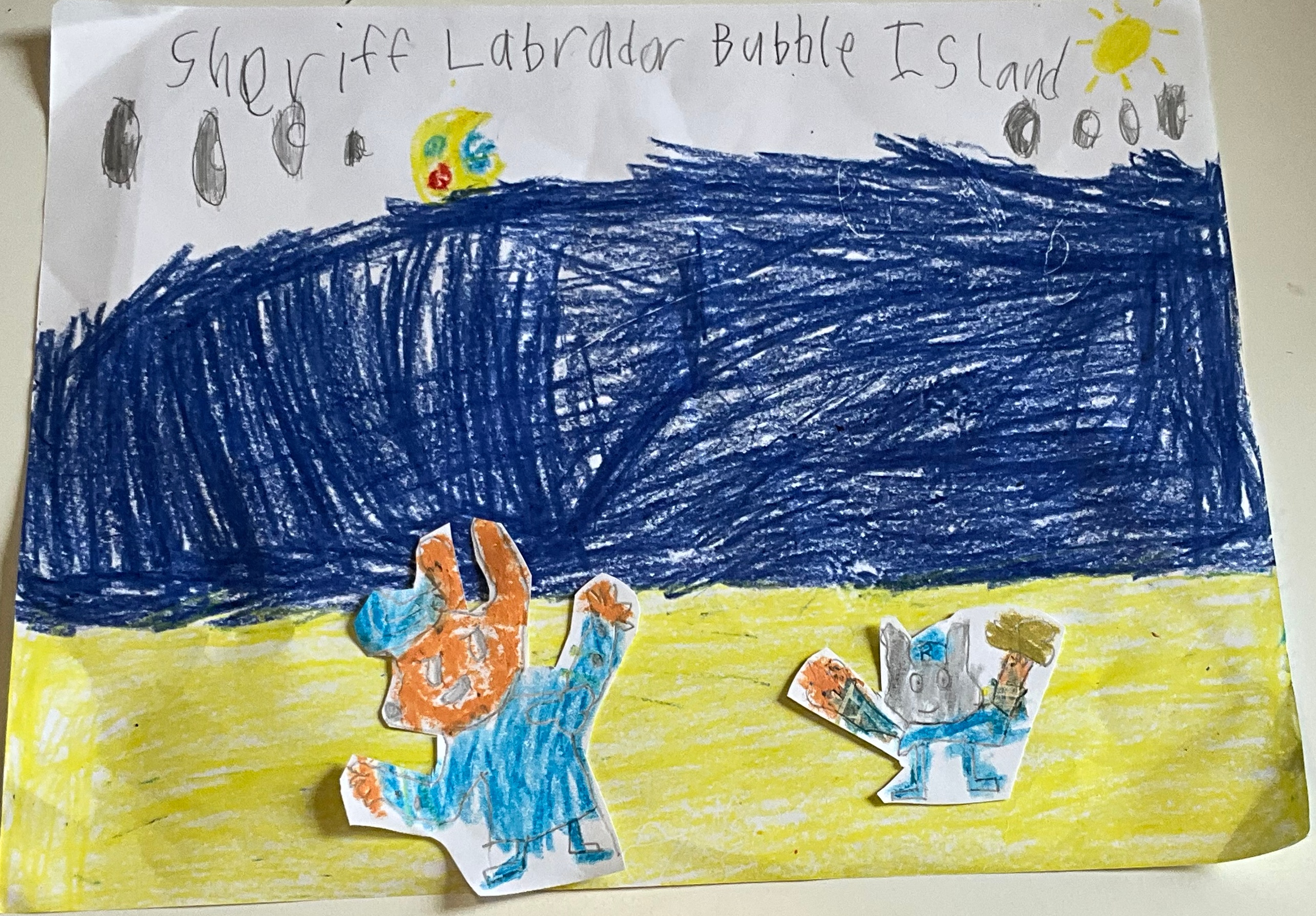
What a creative Bubble Island entry from 7-year-old Annika in the Philippines! We love how you've cut out Sheriff Labrador and Officer Doberman and placed them right into the picture—it almost feels like they're about to jump off the page and start moving in their very own cartoon! And wait a minute… is Officer Doberman turning into a kitty again?! Thank you for sharing your wonderful creativity with us, Annika—keep those imaginative ideas coming!
In the aftermath of an 8-20 solar mass star’s demise, we find a weird little object known as a neutron star. Neutron stars are incredibly dense, spin rapidly, and have very strong magnetic fields. Some of them we see as pulsars, flashing in brightness as they spin. Neutron stars with the strongest magnetic fields are called magnetars and are capable of colossal bursts of energy that can be detected over vast distances. Check out the Crash Course Astronomy solar system poster here: http://store.dftba.com/products/crashcourse-astronomy-poster -- Chapters: Introduction: Neutron Stars 00:00 Electron Degeneracy 0:51 Neutron Degeneracy 1:28 Neutron Star Characteristics 2:24 Pulsars 5:56 Magnetars 8:15 Review 11:48 -- PBS Digital Studios: http://youtube.com/pbsdigitalstudios Follow Phil on Twitter: https://twitter.com/badastronomer Want to find Crash Course elsewhere on the internet? Facebook - http://www.facebook.com/YouTubeCrashCourse Twitter - http://www.twitter.com/TheCrashCourse Tumblr -
Artist, naturalist, and crossing guard Christine Tyler Hill on turning a daily practice of noticing into The Cloud Report, how constraints and play sustain her work, accepting support as an artist, using social media without letting it steer the art, and not waiting for permission to create. You'll learn Why ordinary, overlooked places reward those who keep returning to them. How attention can become a creative practice, and a way of changing how you see the world. What a strict format and a monthly deadline can do for an overwhelmed creative mind. The role of play, experimentation, and feeling lost in making new work. A case for sincerity over polish when sharing your work. When accepting support for your art feels uncomfortable, and why it matters to let people help. What Leonard Woolf's irises can teach us about making art in dark times. How to use social platforms without letting them dictate the direction of the work. Writing about the things you love without worrying about being
Dig into how scientists are attempting to revive the functionally extinct northern white rhino through artificial reproduction. Uploaded 13-08-20 -- In the savannahs of Kenya, two female northern white rhinos, Nájin and Fatu, munch contentedly on grass. They are the last two known northern white rhinos left on Earth. Their species is functionally extinct— without a male, they can’t reproduce. And yet, there’s still hope to revive the northern white rhino. How can that be? Jan Stejskal dives into the science of reviving a dying species. Lesson by Jan Stejskal, directed by Denis Chapon. Animator's website: http://denischapon.com/ Producer's website: https://animationworkshop.via.dk/ Sign up for our newsletter: http://bit.ly/TEDEdNewsletter Support us on Patreon: http://bit.ly/TEDEdPatreon Find us on Twitter: http://bit.ly/TEDEdTwitter Peep us on Instagram: http://bit.ly/TEDEdInstagram View full lesson: https://ed.ted.com/lessons/the-last-living-members-of-an-extinct-species-jan-stejskal
Today we're going to talk about how and why floods happen both in spite of, and because of, us. Specifically, we'll take a closer look at the island of Java, and its largest city, Jakarta, and explain the factors that lead to serious flooding almost annually. We'll also show you how mangroves can help protect us from flooding, and how wetlands along floodplains act like the kidneys of the Earth filtering out impurities and pollutants. Watch our videos and review your learning with the Crash Course App! Download here for Apple Devices: https://apple.co/3d4eyZo Download here for Android Devices: https://bit.ly/2SrDulJ Crash Course is on Patreon! Thanks to the following patrons for their generous monthly contributions that help keep Crash Course free for everyone forever: Toni Miles, Oscar Pinto-Reyes, Erin Nicole, Steve Segreto, Michael M. Varughese, Kyle & Katherine Callahan, Laurel A Stevens, Evan Lawrence Henderson, Vincent, Michael Wang, Krystle Young, Michael Dowling, Alexis B, Rene
Today we're going to talk about SPAAAAAACE, but not like stars and satellites and stuff. Instead, we're going to talk about geographic space. In geography, we can look at the world and the places and spaces we inhabit with four distinct lenses: space as a container, topologically, socially, and how we perceive it. On this journey, we'll make stops in Antarctica, Haiti, and China as we introduce the tools you'll need from surveying and remote sensing to community-created maps to help us better understand and navigate our world. If you want to help create maps for your community visit: https://www.openstreetmap.org (https://www.openstreetmap.org/) https://tasks.hotosm.org (https://tasks.hotosm.org/) Watch our videos and review your learning with the Crash Course App! Download here for Apple Devices: https://apple.co/3d4eyZo Download here for Android Devices: https://bit.ly/2SrDulJ Crash Course is on Patreon! Thanks to the following patrons for their generous monthly contributions that he
In this episode of Crash Course Astronomy, Phil takes you through the cause and name of the Moon's phases. Check out the Crash Course Astronomy solar system poster here: http://store.dftba.com/products/crashcourse-astronomy-poster -- Chapters: Why does the Moon Have Phases? 00:00 New Moon 2:26 Waxing Crescent 4:17 First Quarter 4:35 Waxing Gibbous 5:15 Full Moon 5:32 Waning Gibbous, Third Quarter, and Waning Crescent 6:26 Earthshine 7:20 Review 8:58 -- PBS Digital Studios: http://youtube.com/pbsdigitalstudios Follow Phil on Twitter: https://twitter.com/badastronomer Crash Course is on Patreon! Want to find Crash Course elsewhere on the internet? Facebook - http://www.facebook.com/YouTubeCrashCourse Twitter - http://www.twitter.com/TheCrashCourse Instagram - https://www.instagram.com/thecrashcourse/ CC Kids: http://www.youtube.com/crashcoursekids -- PHOTOS http://en.wikipedia.org/wiki/Moon#mediaviewer/File:FullMoon2010.jpg (http://en.wikipedia.org/wiki/Moon) http://en.wikipedia.org/wiki
Is software development becoming a code factory - and what could that mean for developer salaries? Two Toronto job postings spark a conversation about pay, AI, outsourcing, and the future of tech careers. In this edition of the Web News, Matt and Mike discuss the salary figures shared for AI roles at Canadian Tire and OpenTable, then explore whether cheaper code production could mean smaller teams and less bargaining power for developers. They debate whether AI could make offshoring easier, how competition for jobs affects pay, and why trust, communication, and tailored solutions still matter when hiring developers. Plus, they discuss how Toronto’s cost of living and commuting demands complicate the salary conversation. Show Notes: https://www.htmlallthethings.com/podcast/are-software-engineers-going-to-get-paid-less Hosted by Simplecast, an AdsWizz company.
Discover how alcohol impacts your body’s processes and causes hangovers, and find out what causes the most common hangover symptoms. -- The molecule responsible for hangovers is ethanol, which we colloquially refer to as alcohol. Ethanol is present in all alcoholic beverages, and generally speaking, the more ethanol, the greater the potential for a hangover. So, how exactly does alcohol cause a hangover— and is there any way to prevent one? Judy Grisel explores the surprising ways that alcohol affects the body. Lesson by Judy Grisel, directed by Anton Bogaty. Support Our Non-Profit Mission ---------------------------------------------- Support us on Patreon: http://bit.ly/TEDEdPatreon Check out our merch: http://bit.ly/TEDEDShop ---------------------------------------------- Connect With Us ---------------------------------------------- Sign up for our newsletter: http://bit.ly/TEDEdNewsletter Find us on Twitter: http://bit.ly/TEDEdTwitter Peep us on Instagram: http://bit.ly/TEDEdInsta
Vancouver's housing market is entering a period of extraordinary political and economic change. With a new BC Premier, a new Mayor and a dramatically reshaped Vancouver City Council, and Democrats taking control of both chambers of the US Congress, the policies governing housing development, affordability, and investment could be heading for a major reset. Meanwhile, October's real estate statistics reveal a market under mounting pressure, with home prices falling to levels not seen in more than five years. Vancouver's newly elected council brings 121 housing policy proposals into focus. The Green Party, holding five seats, is prioritizing affordable housing, co-operatives, tenant protections, and greater public involvement in development. COPE, with four seats, is proposing more than 20,000 affordable homes, expanded rent controls, additional property taxes, and an increase in the Empty Homes Tax to 9%. OneCity is advocating sweeping zoning reforms, including four-storey buildings thr
Is software development becoming a code factory - and what could that mean for developer salaries? Two Toronto job postings spark a conversation about pay, AI, outsourcing, and the future of tech careers. In this edition of the Web News, Matt and Mike discuss the salary figures shared for AI roles at Canadian Tire and OpenTable, then explore whether cheaper code production could mean smaller teams and less bargaining power for developers. They debate whether AI could make offshoring easier, how competition for jobs affects pay, and why trust, communication, and tailored solutions still matter when hiring developers. Plus, they discuss how Toronto’s cost of living and commuting demands complicate the salary conversation. Show Notes: https://www.htmlallthethings.com/podcast/are-software-engineers-going-to-get-paid-less Hosted by Simplecast, an AdsWizz company.
"The Big Sink" In this episode, John and Katie take a break from talking through the universe's timeline to focus on a mystery of our cosmos: black holes. Head to https://policygenius.com/crashcourse to get your free life insurance quotes and see how much you could save. *** Support us for $5/month on Patreon to keep Crash Course free for everyone forever! https://www.patreon.com/crashcourse Or support us directly: https://complexly.com/support Join our Crash Course email list to get the latest news and highlights: https://mailchi.mp/crashcourse/email Get our special Crash Course Educators newsletter: http://eepurl.com/iBgMhY Thanks to the following patrons for their generous monthly contributions that help keep Crash Course free for everyone forever: Forrest Langseth, Emily Beazley, Neeloy Gomes, oranjeez, Rie Ohta, Jack Hart, UwU, Leah H., David Fanska, Andrew Woods, Stephen Akuffo, Ken Davidian, Toni Miles, AmyL, Steve Segreto, Kyle & Katherine Callahan, Laurel Stevens, Krystle Youn
In which Jacob and Adriene teach you about the evils of fiscal policy and stimulus. Well, maybe the policies aren't evil, but there is an evil lair involved. In this episode we learn how government use taxes and spending influence the economy. Sometimes the government gives, and sometimes it takes. And the giving and the taking can have a profound effect on how economies behave. Crash Course is on Patreon! Thanks to the following Patrons for their generous monthly contributions that help keep Crash Course free for everyone forever: Mark , Elliot Beter, Moritz Schmidt, Jeffrey Thompson, Ian Dundore, Jacob Ash, Jessica Wode, Today I Found Out, Christy Huddleston, James Craver, Chris Peters, SR Foxley, Steve Marshall, Simun Niclasen, Eric Kitchen, Robert Kunz, Avi Yashchin, Jason A Saslow, Jan Schmid, Daniel Baulig, Christian , Anna-Ester Volozh Want to find Crash Course elsewhere on the internet? Facebook - http://www.facebook.com/YouTubeCrashCourse Twitter - http://www.twitter.com/TheCr
In this episode of Crash Course Art History, we’ll keep digging into the myth of the Great Artist, with whether we can—or should—separate artists’ personal actions and beliefs from the art they create. Art historians are exploring new ways to think about artists’ relationship to their work and how to talk about controversial art. Introduction: Great Artists or Monsters? 00:00 "Great Artists" 00:48 The Romantics & Self-Portraits 01:53 The Avant-garde & Surrealism 03:10 Van Gogh & Gaugin 04:59 Artistic Collaboration 06:39 Separating Art from the Artist 07:48 Review & Credits 10:07 Image Descriptions: https://docs.google.com/document/d/1ETiCxe4GrVzFii7dBhF42oHx1EUCCh5y12wbtUjsH8A/edit Sources: https://docs.google.com/document/d/1GW2NKzhpMNMmRyAFJVhFJG9cSfUOMRL-QrcWuHcWcIA/edit?usp=sharing *** Crash Course is on Patreon! Thanks to the following patrons for their generous monthly contributions that help keep Crash Course free for everyone forever: Leah H., David Fanska, Andrew Woods, DL Sin
View full lesson: http://ed.ted.com/lessons/why-does-ice-float-in-water-george-zaidan-and-charles-morton Uploaded 22-10-13 Water is a special substance for several reasons, and you may have noticed an important one right in your cold drink: ice. Solid ice floats in liquid water, which isn't true for most substances. But why? George Zaidan and Charles Morton explain the science behind how how hydrogen bonds keep the ice in your glass (and the polar ice caps) afloat. Lesson by George Zaidan and Charles Morton, animation by Powerhouse Animation Studios Inc.
In this sequel episode, we unpack six more counterintuitive truths about the elite college admissions process, from why weaker applicants can get better results to why following instructions can hurt your application. Pulling together many different aspects of the process that might seem paradoxical, we demonstrate why elite admissions––unlike high school––isn’t a checklist and more achievement or following the standard rules will often not produce better outcomes. —— “The Game” is hosted by Sam Hassell and brought to you by Great Minds Advising. Great Minds Advising’s unique, hands-on mentorship program and its deep strategic insight into the application review process have earned the company a nation-leading track record of excellence, with 100% of its students gaining admission to a top-choice school in the 2025–26 application cycle. Its students have recently gained admission to Stanford, Princeton, Yale, Columbia, Penn, Brown, Dartmouth, Cornell, Duke, Georgetown, Vanderbilt, John
What if we lost everything tomorrow and had to start our homestead over from scratch? No land, no livestock, no stocked pantry, and very little money. Where would we begin? After decades of homesteading and raising our family, we've learned a thing or two about what really matters when it comes to building a productive homestead. And if we had to start over today, there are some things we'd do exactly the same and others we'd approach very differently. In this episode of the Everyday Homesteading Podcast, we're sharing our top priorities for starting a homestead with limited resources, including: What we'd look for when choosing land (and why the house wouldn't be our biggest concern). How we'd stretch a tight grocery budget while investing in long-term food security. Why a productive garden would be one of our very first investments. Which livestock we'd prioritize and which animals we'd avoid. What we wouldn't waste our time or money on. Why building relationships with your neighbors
In which John Green ACTUALLY teaches about the Civil War. In part one of our two-part look at the US Civil War, John looks into the causes of the war, and the motivations of the individuals who went to war. The overarching causes and the individual motivations were not always the same, you see. John also looks into why the North won, and whether that outcome was inevitable. The North's industrial and population advantages are examined, as are the problems of the Confederacy, including its need to build a nation at the same time it was fighting a war. As usual, John doesn't get much into the actual battle-by-battle breakdown. He does talk a little about the overarching strategy that won the war, and Grant's plan to just overwhelm the South with numbers. Grant took a lot of losses in the latter days of the war, but in the end, it did lead to the surrender of the South. If you want to learn more about the Civil War, we recommend these books: Battle Cry of Freedom by James McPherson: https
Uploaded 01-05-18 View full lesson: https://ed.ted.com/lessons/how-to-build-a-dark-matter-detector-jenna-saffin More than 2 kilometers below the surface of northern Ontario, suspended in 345,000 liters of ultra-pure water, there’s a perfect sphere. Scientists continuously monitor this chamber, looking for a glimmer of light in the darkness. Why? Because that light would indicate the presence of one of the universe’s greatest mysteries: dark matter. Jenna Saffin describes how this dark matter detector works. Lesson by Jenna Saffin, animation by TED-Ed. Thank you so much to our patrons for your support! Without you this video would not be possible! Jordan Tang, Christopher Jimenez, Juan, Tracey Tobkin, Sid, emily lam, Elliot Poulin, Noel Situ, Oyuntsengel Tseyen-Oidov, Latora Slydell, Sydney Evans, Victor E Karhel, Bernardo Paulo, Eysteinn Guðnason, Andrea Feliz, Natalia Rico, Josh Engel, Bárbara Nazaré, Gustavo Mendoza, Zhexi Shan, Hugo Legorreta, PnDAA, Marcel Trompeter-Petrovic, Sandr
Throughout this series we’ve mostly talked about pairs of electrons, but electrons don’t always have a buddy. An atom or group of atoms with a single unpaired electron is called a radical. In this episode of Crash Course Organic Chemistry, we’ll learn all about radicals including the three key steps in a radical reaction and Hammond’s Postulate, an important tool to help us understand these reactions. We’ll also see ways radicals can react with alkanes, alkenes, and alkynes. Episode Sources: Davies, K. J., & Doroshow, J. H. (1986). Redox cycling of anthracyclines by cardiac mitochondria. I. Anthracycline radical formation by NADH dehydrogenase. Journal of Biological Chemistry, 261(7), 3060-3067. Ball, P. (Interview with Nick Lane) Yes, life in the fast lane kills you. May 5, 2016. Bond Dissociation Energies https://chem.libretexts.org/Bookshelves/Physical_and_Theoretical_Chemistry_Textbook_Maps/Supplemental_Modules_(Physical_and_Theoretical_Chemistry)/Chemical_Bonding/Fundamentals_of_C
In which John Green teaches you about the Industrial Economy that arose in the United States after the Civil War. You know how when you're studying history, and you're reading along and everything seems safely in the past, and then BOOM you think, "Man, this suddenly seems very modern." For me, that moment in US History is the post-Reconstruction expansion of industrialism in America. After the Civil War, many of the changes in technology and ideas gave rise to this new industrialism. You'll learn about the rise of Captains of Industry (or Robber Barons) like Cornelius Vanderbilt, Andrew Carnegie, John D Rockefeller, and JP Morgan. You'll learn about trusts, combinations, and how the government responded to these new business practices. All this, plus John will cover how workers reacted to the changes in society and the early days of the labor movement. You'll learn about the Knights of Labor and Terence Powderly, as well as Samuel Gompers and the AFL. Chapters: Introduction: American
View full lesson: http://ed.ted.com/lessons/the-cancer-gene-we-all-have-michael-windelspecht Uploaded 19-05-14 Within every cell in our body, two copies of a tumor suppressor gene called BRCA1 are tasked with regulating the speed at which cells divide. Michael Windelspecht explains how these genes can sometimes mutate, making those cells less specialized and more likely to develop into cancer. Lesson by Michael Windelspecht, animation by Zedem Media.
Nachi Gordon sits down with Julia Blum, a singer, songwriter and Yale graduate who grew up performing in Los Angeles and Beverly Hills, in a home where God simply wasn't part of the conversation. After a college interview left her unable to answer one question, "who are you?", a trip after graduation brought her to the Kotel and to a Shabbos table in the Old City, where one dropped platter changed the course of her life. Julia shares what she found at Neve Yerushalayim, the choices she made about Shabbos, tznius and kol isha, why she stepped away from the stage for decades to be there for her kids, and what brought her back to music today. This episode is sponsored by: ► PZ Deals Never pay full price again when you download the PZ Deals app. _________________ ► Colel Chabad Pushka App The easiest way to give Tzedaka. _________________ ► Ceremian Financial Advice built on experience. Moshe Alpert and Ceremian Financial are fiduciary financial advisors offering wealth management, financi