On the DSR Daily for Tuesday, we break down the main stories from Election Day including final polls spelling doom for Trump, the Supreme Court rejecting a DOJ effort to segregate Californian ballots, Trump claiming the US will stop funding Israel, and more.
On the DSR Daily for Tuesday, we break down the main stories from Election Day including final polls spelling doom for Trump, the Supreme Court rejecting a DOJ effort to segregate Californian ballots, Trump claiming the US will stop funding Israel, and more.
The Federal Circuit reviews LPP Combustion's challenge to rulings in its patent dispute with General Electric. The patents address how fuel burns and how to prevent premature ignition. One patent uses an inert diluent, a lower-oxygen gas intended to keep fuel from igniting before the combustion chamber. The dispute is whether inert, or non-reactive, excludes every gas containing hydrocarbons, common fuel components. The trial court read the term to exclude those gases. LPP will argue that reactivity depends on the conditions, not just a gas's hydrocarbon content. Patent claims are the written statements that define what a patent protects; claim construction is interpreting them. The other issue involves two patents that sense fuel or combustion characteristics and trigger an additive to adjust combustion when a reading falls outside an acceptable range. The trial court held the challenged claims ineligible under Section one oh one: it viewed them as an abstract idea of sensing, compari
Winning the AI race takes more than building the best model. It demands hardened infrastructure, reliable energy, and the public's confidence. As AI accelerates cyberattacks and China establishes footholds inside American pipelines, ports, and power grids, will policymakers and industry leaders act before a crisis forces their hand? In this inaugural Cyber Focus: Unplugged roundtable, Frank Cilluffo convenes McCrary Institute senior fellows Bill Evanina, Alison King, Cynthia Kaiser, and Rob Joyce. Drawing inspiration from The McLaughlin Group, the panel debates AI's advantage for attackers, Congress's cyber priorities, how to impose costs on China, and whether CISA has the resources to deliver on its new strategy. The discussion closes with blunt predictions on Taiwan, Russian aggression in Europe, and the future of U.S. cyber policy. Main topics Is AI giving attackers the upper hand? What does winning the AI race require? Can the U.S. build public support for AI? What should Congress
A Puerto Rico developer says the public water and sewer authority is using a privately built sewage pump station without paying the costs it imposes. The developer built the station for a residential project. A nearby housing community was then connected, sending additional wastewater through it. The developer says the authority refuses to take over the station, leaving it to pay for operation and maintenance while the authority continues collecting sewer fees. It filed a federal lawsuit in twenty twenty, seeking compensation and other relief. The Fifth Amendment requires the government to pay just compensation for private property taken for public use. The dispute includes whether the company has a protected property interest in the station, and whether the authority's conduct is a physical taking or instead a restriction on how property may be used. Physical takings concern occupation or appropriation of property; regulatory takings concern restrictions that go far enough to require
As Americans head to the polls for the midterm elections, we explore the renewed push for the Keystone X-L pipeline route, track the contradictory messaging between Washington and Ottawa, and speak with Saskatchewan Trade and Export Development Minister Warren Kaeding on how the province is navigating the geopolitical turmoil.
A federal prisoner's effort to finish his sentence outside prison becomes a Supreme Court dispute over access to judicial review. Maxwell is serving a twenty-year sentence for racketeering and related offenses arising from a scheme to take over a mortgage-loan company and drain its assets. The First Step Act lets eligible prisoners earn time credits through qualifying programs and productive activities. Maxwell says his credits entitle him to move to home confinement or a halfway house, a supervised residence in the community. That would not erase his sentence: those placements still impose restrictions and remain under Bureau of Prisons control. To challenge his continued imprisonment, he filed a petition for habeas corpus, a procedure asking a court to examine whether custody is lawful. The district court dismissed his First Step Act claim because it found he had not properly presented it through the prison's administrative grievance process. The Fifth Circuit affirmed on a different
Our guest for this episode is Darryl Plummer, programmes director at Groundwork Five Counties. The charity works with local authorities and social housing providers across the East Midlands to help residents stay warm, healthy and safe in their homes through energy advice and support. Darryl discusses the growing pressures facing households as energy costs continue to rise and explains how many people are still being forced to choose between heating and other essential living costs. He shares insights from the charity's work visiting homes, supporting vulnerable residents and tackling issues such as fuel poverty, damp and mould. The conversation explores the charity's Green Doctor service, which provides free, tailored energy advice to households. Darryl explains how simple measures such as reviewing energy tariffs, improving heating controls, installing draught-proofing and switching to LED lighting can help residents reduce energy costs and improve comfort in their homes. He also hig
Scout Motors is a new, reborn brand with Volkswagen support bringing off-road trucks to the US in the form of the Traveler and Terra SUV and pickup truck. You may remember them from the last century under the International Harvester name. Max speaks with the startup's State principal of Government Affairs, Shannon Fender, to learn how Scout is approaching direct-to-consumer sales, as well as forging new regulatory categories like Extended Range EVs or EREVs, which their upcoming vehicle will offer with an auxiliary gas generator to get more range off-grid. Extended-range EVs are electric vehicles. In an EREV, electric motors drive the wheels at all times, and the onboard gas generator only recharges the battery. How states define that category is a big part of this conversation. Some highlights of the convo: - The venerable history of the Scout brand and how they kicked off SUVs last century - How Scout got reborn under Volkswagen and what it's bringing to market in 2027 - The legislat
The Federal Circuit reviews Jefferson Street Holdings' challenge to patent rejections involving a protective phone case. The design uses lower side edges alongside higher sections, intended to preserve screen access while protecting the device. The Patent Office reexamined the issued patent against earlier case designs, and its appeal board upheld the rejections now challenged in court. A patent claim defines the features for which protection is sought. Here, much turns on whether a height that continuously spans a side must stay constant, or may curve while never dropping to zero. The lawyers will compare differently worded claims, including dependent claims that add restrictions to a broader claim. That is claim differentiation: differences between claims can help determine their scope. Anticipation asks whether one earlier reference already disclosed every claimed feature in the required arrangement. Obviousness asks whether the claimed arrangement, as a whole, would have been an or
A case in which the Court will decide whether a law lacks general applicability under the Free Exercise Clause only if it permits unfettered discretion or secular exemptions, and whether the rule against excluding religious institutions from public benefits applies only to explicit government bans on participation.
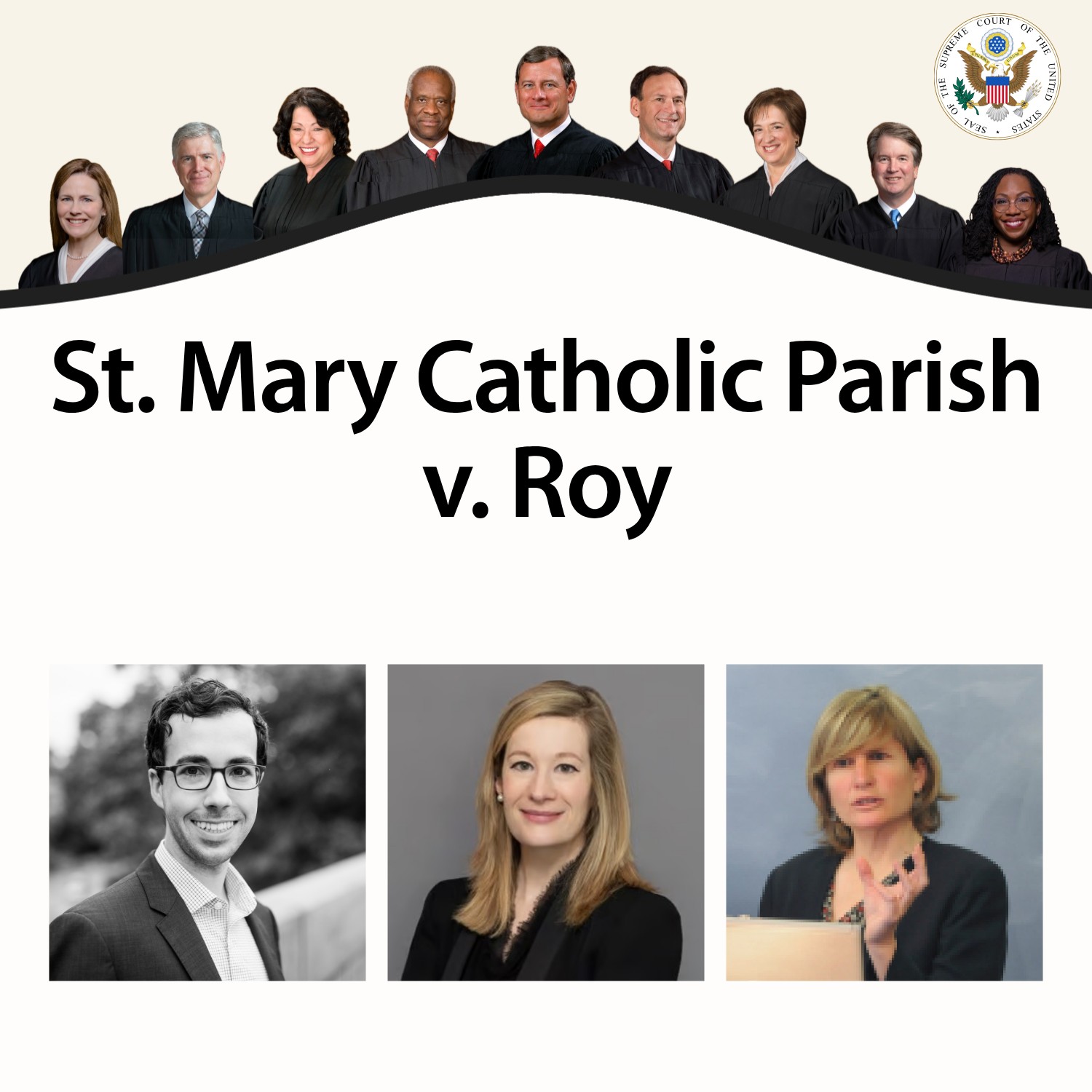
St. Mary Catholic Parish v. Roy Justia (https://supreme.justia.com/cases/federal/us/2026/25-581/) · Docket (https://www.supremecourt.gov/docket/docketfiles/html/public/25-581.html) · oyez.org (https://www.oyez.org/cases/2026/25-581) · YouTube (https://www.youtube.com/watch?v=8mEkIO1si04) Argued on Nov 3, 2026. Petitioner: St. Mary Catholic Parish, Littleton, Colorado. Respondent: Lisa Roy, in Her Official Capacity as Executive Director of the Colorado Department of Early Childhood. Advocates: Nicholas R. Reaves (for the Petitioners) Sarah M. Harris (for the United States, as amicus curiae, supporting the Petitioners) Helen Norton (for the Respondents) Facts of the case (from oyez.org) Colorado voters established the Universal Preschool Program (UPK) to provide free preschool services through a “mixed delivery system” of public and private providers. To receive state funds, providers must sign a nondiscrimination agreement that requires them to enroll students regardless of their sexual
With America hours from voting, Christiane and Tina unpack a midterm that has become a referendum on Donald Trump. The polls point to a blue wave - but unless the win is "too big to rig", can anybody feel secure? As Tina says: Trump has a PhD in chaos, and he thrives on a close result. They also examine whether MAGA itself is now drifting. Fox News ratings are down and Trump’s former supporters are reconsidering their choices. What could be the consequences of an angry and defeated Trump? Plus, Christiane reports from Doha on warnings of a new strike on Iran, Senator Chris Murphy's alarm that the plan he was briefed on would breach international law, and the volatile dance between Trump and a Netanyahu still struggling to build a coalition. Make sure you subscribe so you never miss an episode. For more content, please follow us: Watch us: https://www.youtube.com/@AmanpourPod Instagram: https://www.instagram.com/amanpourpod X: https://x.com/AmanpourPod BlueSky: https://bsky.app/profile/
On this WPN Call #600, Dr. Jim Garlow is joined by Ralph Reed, a political consultant, lobbyist, and the founder and chairman of The Faith and Freedom Coalition, a conservative political advocacy non-profit organization. He brings a crucial update on the current polling of the 2026 midterm elections. Their website: https://www.ffcoalition.com/# (https://www.ffcoalition.com/) Dr. Jim Garlow has partnered with Pastor Mario Bramnick and Terry Barnes to bring you World Prayer Network (WPN), which seeks out Holy Spirit given strategies for how to be an effective and contagious Christ-follower in our present national situations. facebook.com/wellversedworld Twitter: @wellversedworld Instagram: @wellversedworld www.wellversedworld.org (http://www.wellversedworld.org/)
On this WPN Call #600, Dr. Jim Garlow is joined by Chad Connelly, the former chairman of the South Carolina Republican Party and the founder of Faith Wins, an organization dedicated to educating, activating, and mobilizing faith leaders, helping them leverage their influence and impact within the governmental and political arena. Having met with thousands of pastors in over a hundred locations around the country, he gives us a spiritual overview of what is at stake in the 2026 midterm elections. Website: https://faithwins.org/ Dr. facebook.com/wellversedworld twitter: @wellversedworld instagram: @wellversedworld www.wellversedworld.org (http://www.wellversedworld.org/)
The Federal Circuit considers patents for mobile-device location services asserted against Uber. The patents describe ways to request location data within geographic regions and determine whether devices are moving together. The patent owner says these methods address network overload and tracking problems. It sued Uber for infringement, but the district court dismissed the case without a trial, finding the patent claims ineligible because they covered abstract information processing rather than a technological improvement. A related appeal involving Lyft is being heard alongside it. Eligibility concerns what patent law protects, not simply whether an invention is new. A patent claim defines the invention's legal boundaries. Under the Supreme Court's Alice framework, a claim directed to an abstract idea needs an additional inventive concept to qualify, considering its elements both individually and together. Merely using ordinary computer components is not enough. The patent owner's la
Physical assaults sometimes emerge from escalating behavior that can be recognized before an attack begins. This episode examines personal-space violations, threatening movements, blocked exits, and changes in interpersonal behavior. Learn how recognizing combinations of warning signs can create opportunities to disengage without treating every unusual behavior as dangerous
The First Circuit considers when Puerto Rico can be sued over alleged police misconduct. A woman brought federal civil-rights and Puerto Rico tort claims alleging excessive force by police officers. She also sought to hold the Commonwealth and its police agency liable. The district court dismissed the claims against those government defendants on immunity grounds, without deciding whether the officers had used unlawful force. The appeal is being heard together with a second police-related case. The plaintiffs will ask the court to reconsider treating Puerto Rico like a state for sovereign immunity, a protection against being sued in federal court. They will rely on a Supreme Court decision about Puerto Rico's powers and double jeopardy, the constitutional protection against repeated prosecutions for the same offense. That criminal-law ruling did not itself decide this civil-immunity question. The judges will also focus on Section nineteen eighty-three, which allows suits for violations
Alex Jones built InfoWars into a conspiracy empire. Then a jury ordered him to pay the Sandy Hook families over $1.4 billion. Now, the satirical site The Onion has launched its own parody version of InfoWars, and Alex Jones is furious—and suing. But the legal battle is a procedural mess. The Onion is operating the brand, a court-appointed receiver is fighting for control, and the Texas Supreme Court just blocked a key transfer of assets. Meanwhile, Jones has moved to a new studio and is broadcasting again. This episode explains who actually owns what, why the parody is legally protected, and what happens next in the billion-dollar fight. General information only, not legal advice. Based on public records and news reports. Thanks for listening to Gavel & Gazette. Legal news, explained. General information only, not legal advice. This episode includes AI-generated content.
Today's Digest covers supermarket and Ukraine cyberattacks, Qeshm strikes, Houthi strategy, Syria-Mecca pact, Poland border conflict, Ron Paul midterm thoughts, Lucas scandal, UK satellite raid, French Internet tax, Anthropic losses, DOE loans, Utah ID checks, NY assisted suicide. Click Here for Peak Prosperity (https://peakprosperity.com/cyberattacks-hit-refrigeration-in-9-countries-u-s-strikes-iran-and-anthropic-loses-104-b-in-9-months/)
The Fifth Circuit considers whether federal Medicaid funding rules reach private agreements among hospitals. Texas allows local governments to tax healthcare providers to help finance its share of Medicaid, a joint federal-state healthcare program. Federal matching funds are added, and hospitals receive Medicaid payments. CMS, the Centers for Medicare and Medicaid Services, is targeting private agreements that redistribute those payments so taxpaying hospitals recover their tax costs. This is the hold-harmless issue: whether providers are being protected from the cost of the tax. CMS says private redistribution can amount to an indirect government guarantee. Texas says the statute requires a guarantee from the state or local government itself, not merely a private agreement. A district judge set aside the challenged rule provisions and bulletins, and the federal government now appeals. Its lawyer will argue that private intermediaries do not remove these arrangements from Congress's pr
Military readiness depends on the energy that powers the force and the speed at which useful technology reaches service members. Dale Marks, Assistant Secretary for Energy, Installations, & Environment at DoW, says those priorities belong in one connected effort that begins with the warfighter. In his conversation with Francis Rose at the Energy Sentry Expo, Marks explains that installations are essential to preparing and deploying combat capability. Their energy requirements are directly connected to operations, weapons platforms, and the people who depend on them. Treating installation energy and operational energy separately can obscure those relationships.
On June 29, the Supreme Court overruled Humphrey’s Executor, the 1935 case that let Congress shield the heads of independent agencies from removal at will. That decision came with full briefing, argument, and a signed opinion. But the case arrived at the Court as something much smaller: a request to pause a district court order reinstating Rebecca Slaughter to the Federal Trade Commission. No merits briefing. No argument. The Court granted the stay in September 2025 and didn’t rule until the following June, and for those nine months the Commission operated as though the question were already settled. Everyone watching could see how it would come out. That gap is the subject of this episode. Gwen and Marc step away from the threshold series to look at the emergency docket, where cases get decided fast, usually without argument, and often in short unsigned orders that formally resolve nothing. The threshold doctrines from the last several weeks are all built on the idea that a court shou
Have you ever wondered why one veteran receives a favorable VA disability decision while another veteran with what appears to be the same condition gets denied? In this episode of Ask the Attorney, attorney Rebecca Deming of ProVet legal joins Leah Bucholz, PA-C, to explain why no two VA disability claims are exactly alike. They discuss the factors that influence VA decisions, including medical evidence, service records, nexus opinions, credibility, legal standards, and the quality of supporting documentation. You'll learn why comparing your claim to another veteran's can be misleading and what you can do to build the strongest case possible. In this episode, you'll learn: Why similar VA disability claims can have different outcomes How medical evidence impacts VA decisions The importance of service treatment records and lay statements Why nexus opinions can make or break a claim How VA applies the law to individual cases Common reasons claims are approved, denied, or underrated Practi