Dr. Christof Koch joins Dr. Scott Barry Kaufman to explore one of the deepest questions in science: what is consciousness, and why does anything feel like something from the inside? They discuss integrated information theory, how consciousness might be measured in patients who cannot respond, the distinction between intelligence and consciousness, and whether artificial intelligence could ever become conscious. They also explore the possibility that consciousness may not simply be created by the brain, including Dr. Koch's own near-death experiences, mystical experiences, idealism, and the possibility that consciousness could be fundamental to reality. The conversation moves between neuroscience, artificial intelligence, philosophy, and firsthand experience to examine what science can ultimately tell us about the mystery of consciousness.
This is a Grave Talks CLASSIC EPISODE! From an early age, Andi Roe felt a presence around her that wasn’t frightening, but protective. That quiet awareness became the foundation of a lifelong connection to the paranormal — one shaped not by fear, but by empathy. As someone sensitive to energy and emotion, Andi doesn’t just sense spirits; she feels drawn to understand them. Her experiences led her to explore the stories behind the spirits she encounters, often uncovering forgotten histories and unfinished emotions. Rather than approaching the paranormal as something to confront, Andi approaches it as something to listen to, believing many spirits simply want to be acknowledged and heard. In 2018, she brought that perspective to a broader audience by joining Road Trip Paranormal. There, she balances active investigations with public events designed to educate others about the paranormal, empathy, and what it means to share space with the unseen. To learn more about Road Trip Paranormal,
All of the different plants on Earth have come about thanks to the simple rules of genetic inheritance, which determine how traits are passed on from one generation to the next. In this episode of Crash Course Botany, we’ll explore the remarkable story of Gregor Mendel, a botanist and mathematician who laid the groundwork for modern genetics with little more than some peas and a paintbrush. Chapters: Peas & a Paintbrush 00:00 Gregor Mendel 1:05 Mendel's Experiments 2:57 Phenotype & Genotype 4:40 Mendel's Principles of Inheritance 5:38 Effects of Mendel's Research 9:14 Review & Credits 12:14 Check out PBS Food here: https://www.youtube.com/@PBSFood Sources: https://docs.google.com/document/d/1PB6WdUJcABAccO-U-t6ic7WbfP2z0Pr5P9a8HMr6zh4/edit?usp=sharing *** Crash Course is on Patreon! Thanks to the following patrons for their generous monthly contributions that help keep Crash Course free for everyone forever: Tawny Whaley, Sean Saunders, DL Singfield, Ken Davidian, Stephen Akuffo, Toni
The cell membrane is a protein-studded phospholipid bilayer that not only protects our cells, but also regulates what goes in and out. In this episode of Crash Course Biology, we’ll look at the structure of the bilayer, learn about its discovery, and explore the many ways substances can be transported into and out of cells. Chapters: Introduction to the Cell Membrane 00:00 Membrane Structure 2:10 Membrane Proteins 4:53 Membrane Transport 7:07 Review & Credits 11:54 This series was produced in collaboration with HHMI BioInteractive, committed to empowering educators and inspiring students with engaging, accessible, and quality classroom resources. Visit https://BioInteractive.org/CrashCourse (https://biointeractive.org/CrashCourse) for more information. Are you an educator looking for what NGSS Standards are covered in this episode? Check out our Educator Standards Database for Biology here: https://www.thecrashcourse.com/biologystandards Check out our Biology playlist here: https://www
In this episode of The Feldman Protocol, what does it actually cost — personally and professionally — to practice medicine from the inside? Lily Johnston (MD), vascular surgeon and author of *Disconnected*, joins Dave for a deep-dive through her book, covering the evolution of doctor-patient relationships, the Women's Health Initiative and how Lily Johnston argues its findings were misapplied, the intelligence community's approach to uncertainty versus medicine's culture of false confidence, the three myths of informed consent, and physician mental health and suicide. Lily's book is now available: https://www.amazon.com/Disconnected-Surgeons-Search-Healing-Broken/dp/B0H86K1T7R Mentioned in this episode: • 1:41 – Dr. Lily Johnston's book: Disconnect: `https://amplifypublishinggroup.com/product/nonfiction/industries/healthcare-and-medical/disconnected/` • 1:00:00 – DOPS — Danish Osteoporosis Prevention Study (oral estradiol, all-cause mortality): `https://doi.org/10.1136/bmj.e6409` • 2:0
Hesh's website: https://www.heshkestin.com (https://www.heshkestin.com/) _______________________________________ To order Suicidal Empathy: https://lnk.to/SuicidalEmpathy _______________________________________ If you appreciate my work and would like to support it: _______________________________________ This clip was posted on November 10, 2026 on my YouTube channel as THE SAAD TRUTH_2123: https://youtu.be/c5Mru_xgrgc _______________________________________ I count on my fans to support my efforts. You can donate via Patreon, PayPal, and/or SubscribeStar. _______________________________________ Dr. In addition to his scientific work, Dr. _______________________________________
In which Stan Muller teaches you about our third branch of Intellectual Property, trademarks. A lot of people confuse trademark and copyright. Trademarks apply to things like company and product names and logos, packaging designs, and commercial designs. Basically, copyright protects ideas, but trademarks protect the things that help consumers tell companies apart. This ensures that consumers know the source of the goods they're buying. Without trademarks, it would be really difficult to buy the same product twice, and very easy for unscrupulous companies to pass off fakes and knock-offs of the products you want. I'm telling you, you like trademarks. Thank you so much to all of our awesome supporters for their contributions to help make Crash Course possible and freely available for everyone forever: Pablo Soares, Brad Mohr, Stephen DeCubellis, Ian Gallagher, Vanessa Benavent, Lázaro Clapp, James Hood, Damian Shaw, James, H.G. Redekop, Carl Ayres ***** Crash Course is on Patreon! Want
View full lesson: http://ed.ted.com/lessons/carl-honore-praises-slowness Uploaded 26-07-13 Journalist Carl Honoré believes the Western world's emphasis on speed erodes health, productivity and quality of life. But there's a backlash brewing, as everyday people start putting the brakes on their all-too-modern lives. Honoré is best known for his advocacy of the Slow Movement. His book "In Praise of Slowness" dissects our speed-obsessed society and celebrates those who have gotten in touch with their "inner tortoise." Talk by Carl Honore.
In Darwin, the birds don't stay in the background. Liz Trevaskis, Brittany Hayward-Brown and Dr Amanda Lilleyman share local bird stories in our first ever live show. Birds featured: Bush-stone Curlew, Common Greenshank, Far Eastern Curlew, Magpie Goose, Masked Lapwing, Orange-footed Scrubfowl, Torresian Imperial Pigeon Episode illustration: Far Eastern Curlew -- Facebook - https://facebook.com/weekend.birder Theme music is Swing Joyful Tune by Audiosphere -- Hosted on Acast.
A 1,000-turbine European reliability study finds pitch systems, controllers and power converters fail most often. Plus why failures climb in year nine and an offshore farm blind to lightning. Have a question we can answer on the show? Email us!
View full lesson: http://ed.ted.com/lessons/what-is-leukemia-danilo-allegra-and-dania-puggioni Uploaded 30-04-15 Stem cells found in the bone marrow are crucial for our health because they are needed to become new blood cells that sustain and protect our bodies. But when the transformation goes wrong, harmful mutations can cause the cells to start replicating without control -- a type of cancer known as leukemia. Danilo Allegra and Dania Puggioni explain how this happens and how certain treatments provide hope for those suffering from the disease. Lesson by Danilo Allegra and Dania Puggioni, animation by Zedem Media.
So how do we apply the scientific method to psychological research? Lots of ways, but today Hank talks about case studies, naturalistic observation, surveys and interviews, and experimentation. Also, he covers different kinds of bias in experimentation and how research practices help us avoid them. Want more videos about psychology? Check out our sister channel SciShow Psych at https://www.youtube.com/scishowpsych! -- Chapters: Introduction: Intuition & Hindsight Bias 00:00 The Scientific Method 2:05 Case Studies 3:05 Naturalistic Observation 3:48 Surveys and Interviews 4:15 Drawing Conclusions 5:26 Experimentation 6:35 Experiment Time! 7:48 Review 9:54 -- Crash Course is on Patreon! Want to find Crash Course elsewhere on the internet? Facebook - http://www.facebook.com/YouTubeCrashCourse Twitter - http://www.twitter.com/TheCrashCourse Instagram - https://www.instagram.com/thecrashcourse/ CC Kids: http://www.youtube.com/crashcoursekids
In which John Green teaches you about the Cold War as it unfolded in Asia. As John pointed out last week, the Cold War was occasionally hot, and a lot of that heat was generated in Asia. This is starting to sound weird with the hot/cold thing, so let's just say that the United States' struggle against communist expansion escalated to a full-blown, boots-on-the-ground war in Korea and Vietnam. In both of these cases, the United States sent soldiers to intervene in civil wars that it looked like communists might win. That's a bit of a simplification, but John will explain it all to you. Hey teachers and students - Check out CommonLit's free collection of reading passages and curriculum resources to learn more about the events of this episode. While The Vietnam War was happening very far away from home, it had a major impact on American soldiers and civilians: https://www.commonlit.org/texts/introduction-to-the-vietnam-war Americans with televisions had the war broadcasted right into thei
In this episode, Stefano Corazza, head of AI research at Canva, joins us to explore how his team is building custom models and agents around iterative design workflows. We discuss the tradeoffs between training models from scratch and adapting open weights models, and how proprietary design data supports specialization. Stefano explains how Craft separates layout planning from pixel generation and how Brush uses design tools and visual feedback to create and revise compositions. We examine the challenges of evaluating design quality beyond a single generation, including the use of vision language models as judges alongside human evaluation. We also discuss lessons from simplifying agent harnesses, why faster inference enables more iterations, and how model ownership creates opportunities to optimize serving costs. Finally, we explore how APIs and MCP are expanding access to these capabilities and what changes when software companies build tools for agents as well as people. ️ Full show
From the driest deserts to the lushest forests, ecosystems are networks of life where organisms and the environment interact. In this episode of Crash Course Botany, we’ll explore how plants function as the foundations of these systems, without which no other life on Earth would be possible. Chapters: The Foundations of Ecosystems 00:00 Autotrophs 1:43 Heterotrophs 3:15 Food Webs 4:56 Protecting Wild Tomatoes 8:08 Keystone Species 10:01 Review & Credits 11:55 Sources: https://docs.google.com/document/d/1PB6WdUJcABAccO-U-t6ic7WbfP2z0Pr5P9a8HMr6zh4/edit?usp=sharing Check out PBS Terra's Untold Earth here: https://www.youtube.com/watch?v=VVeBSKK88Ig& (https://www.youtube.com/watch?v=VVeBSKK88Ig) *** Crash Course is on Patreon! Thanks to the following patrons for their generous monthly contributions that help keep Crash Course free for everyone forever: David Fanska, Andrew Woods, Tawny Whaley, Sean Saunders, DL Singfield, Ken Davidian, Stephen Akuffo, Toni Miles, Steve Segreto, Kyle & Kat
Calling them "our bodies' own repair kits," Susan Solomon advocates research using lab-grown stem cells. By growing individual pluripotent stem cell lines, her team creates testbeds that could accelerate research into curing diseases -- and perhaps lead to individualized treatment, targeted not just to a particular disease but a particular person. Talk by Susan Solomon.
The Supreme Court struck down the IEEPA tariffs in February, so why are Americans still paying tariffs? The administration replaced them, first with temporary Section 122 tariffs and now with 10 to 12.5 percent Section 301 tariffs on nearly every US trading partner. Kyle sits down with cohost Erica York to catch up on tariff policy. Together, they look at how tariffs may cancel out the investment boost from full expensing and discuss the ongoing court cases that could still strike down the new tariffs. 0:00 Intro 0:30 Where tariffs stand after the IEEPA ruling 1:50 Industry-specific tariffs under Section 232 3:05 The trade fight with Canada and Section 338 tariffs 4:45 What could come next from China tariffs 5:10 Are importers getting IEEPA refunds? 7:50 Why consumers aren’t getting refunds 11:40 How workers pay for tariffs 12:55 Are foreign exporters paying some of the cost? 14:55 The $5,000 tariff dividend 17:10 How tariffs affect investment 20:00 Lessons from the 2018 trade war 21:3
This lecture was recorded by Professor Kate Hill on 14th of October 2026 at Barnard’s Inn Hall, London. Kate is Professor of History at the University of Lincoln, UK, where she teaches modern British history and heritage. She researches the history of museums and heritage in the UK and beyond; among her books are Women and Museums 1850-1914: Modernity and the Gendering of Knowledge (Manchester University Press 2016), and Museums, Modernity and Conflict: Museums and Collections in and of War (Routledge 2020). She recently led the project Making Museum Professionals 1850-the present, investigating the history, present and future of curating and allied professions. She is Co-Editor of the Museum History Journal, and chaired the Museums and Galleries History Group for over a decade. She is a Fellow of the Royal Historical Society. The transcript and downloadable versions of the lecture are available from the Gresham College website:https://www.gresham.ac.uk/watch-now/trivial-precious There
When the Bald Eagle population started to decline in the mid-20th century, scientists began to ask why. Population ecology, the study of organisms of the same species, played a big role in answering that question. In this episode of Crash Course Biology, we’ll take a look at the methods population ecologists use to study a population and the types of data they collect. We’ll also find out how scientists helped bring the Bald Eagle back from the brink. Chapters: Introduction to Population Ecology 00:00 Density 2:51 Dispersion 6:02 Demographics 7:13 Population Growth 8:22 Review & Credits 11:26 This series was produced in collaboration with HHMI BioInteractive, committed to empowering educators and inspiring students with engaging, accessible, and quality classroom resources. Visit https://BioInteractive.org/CrashCourse (https://biointeractive.org/CrashCourse) for more information. Are you an educator looking for what NGSS Standards are covered in this episode? Check out our Educator Sta
If you're ever put in charge of a national economy, there are a few things you should try to avoid. Before you laugh, just remember, you COULD be in charge of an economy someday. Someone has to do it, and anyway, if it could happen to Alan Greenspan, it could happen to you, too. The first thing you're going to want to avoid is hyperinflation. Don't print too much money, okay? Actually, it's a little more complicated than that. Jacob and Adriene will explain. You're also going to want to stay away from recessions, and especially depressions. In the world as it exists today, continued growth is the only path to viability. While some argue for sustainability or even controlled recession, you're not going to keep a job as head of central bank thinking like that in this day and age. Also, avoid stagflation, which is a stagnant, no-growth economy combined with inflation. It's just the worst. Don't do it. All this and more on this week's Crash Course Economics. Crash Course is on Patreon! Tha
As frontier AI labs expand into applications, where should startups build? a16z Partner Joe Schmidt joins HubSpot co-founder and CTO Dharmesh Shah to explore why the software opportunity is growing, and how founders can stay off the “Yellow Brick Road” the labs are racing down. Drawing on HubSpot’s evolution, Dharmesh explains why founders should start with a narrow market, learn quickly, and solve the whole customer problem. They discuss where application companies can build lasting value as models become infrastructure: workflows, customer context, and the systems where work happens. They also explore HubSpot’s AI experiments, the rise of one-person businesses, and why cheaper software creation could unlock markets that previously couldn’t support a software company. Resources: Follow Dharmesh Shah on X:https://x.com/dharmesh Follow Joe Schmidt on X:https://x.com/joeschmidtiv Read Joe’s essay, “Avoiding Death on the Yellow Brick Road”: Stay Updated: Find a16z on YouTube: YouTube (htt
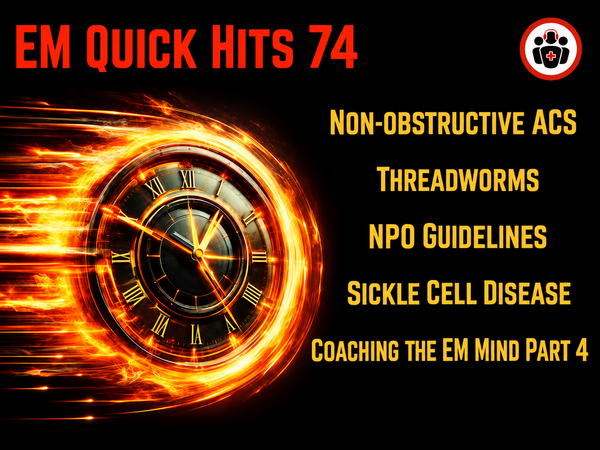
In this month’s EM Quick Hits Podcast, Amal Mattu discusses non-obstructive and non-thrombotic causes of ACS, Andrew Tagg reviews how to diagnose and treat threadworms (pinworms), and Justin Morgenstern implores us to let our ED patients eat and drink. Plus, Hans Rosenberg shares practical pearls for managing vaso-occlusive episodes and complications of sickle cell disease in the ED, and Sara Gray and Katie Lin return for Part 4 of “Coaching the EM Mind,” with strategies for addressing imposter syndrome and shame. Please consider a donation to EM Cases here: https://emergencymedicinecases.com/donation/
Dan Prosser and David Twohig introduce Full Bore, a brand new podcast that celebrates the past, present and future of great engineering. In episode one, Dan and David reveal how car factories have evolved over the past century, from the introduction of the moving assembly line at Ford's River Rouge complex in the 1910s to the ultra-sophisticated plants of today. But why has nobody been able to fully automate car production? Season one of Full Bore is sponsored by car tuning specialist Litchfield. Find out more here – https://www.litchfieldmotors.com Find Full Bore on Instagram here – https://www.instagram.com/fullborepod Email us – [email protected] Hosted on Acast. See acast.com/privacy (https://acast.com/privacy) for more information.
One of the ways that the US Constitution baked the institution of slavery into the very core of the new United States was through the fugitive slave clause. The clause required that people who escaped slavery be returned to their enslavers. In parts of the US that didn't want slavery, the clause sometimes went unenforced. Today we'll learn about how Congress passed the Fugitive Slave Law of 1793 to enforce that clause, how enslavers throughout the country used that rule, and the long-term effects of this law. SOURCES: Somerset v. Stewart, 98 E.R. 499 (K.B. 1772) Karen Arnold-Burger, Fugitive Justice: Slavery and the Law in Pre-Civil War America, 46 Ct. Rev. 116 (2009). Louise Weinberg, Methodological Interventions and the Slavery Cases; or, Night-Thoughts of a Legal Realist Symposium: The Silver Anniversary of the Second Conflicts Restatement, 56 Md. L. Rev. 1316–1370 (1997). H. Robert Baker, The Fugitive Slave Clause and the Antebellum Constitution, 30 Law & Hist. Rev. 1133–1174 (2012