What would happen if a global war began tomorrow? Imagine a world suddenly facing rising military tensions, cyberattacks, disrupted trade, and difficult decisions by world leaders. How would modern technology reshape warfare, and what would everyday life look like for ordinary people? Explore a hypothetical scenario of World War III, from the first hours of international crisis to the challenges of a conflict involving powerful nations and interconnected economies. Discover the role of alliances, advanced weapons, diplomacy, and the unpredictable consequences of decisions made under pressure. Settle in for a thoughtful journey through a possible future, exploring how fragile global stability can be and why preventing a worldwide conflict matters. Boring History for Sleep — Soft stories about world-changing events, difficult choices, and the forces that shape humanity.
Fall asleep to this quiet science story. A Boring Science For Sleep episode about Why Time Dilation Makes Clocks Tick at Different Rates. Why Time Dilation Makes Clocks Tick at Different Rates Settle in for a quiet exploration of Why Time Dilation Makes Clocks Tick at Different Rates. This episode follows The Tower and Its Clocks; Atoms, Particles and Patient People; Mirrors, Light and Height; Wandering Readings and Careful Fixes; Clocks That Measure Mountains. Listen closely or let the details drift past. If you enjoy this quiet science bedtime pace, you might also like Psalms for Sleep (https://open.spotify.com/show/7zd2RN8SMTCheFA2ifYK0m) on Spotify — same quiet rhythm, different night.
Ditching fossil fuels is the most important thing we can do to combat climate change, but it can feel like wandering through a labyrinth to try to do so. In this episode of Crash Course Climate and Energy, we'll explore why it's so hard for us to break up with fossil fuels and the ways governments and fuel companies affect our relationship with them. Chapters: Introduction: Ditching Fossil Fuels 00:00 Why Fossil Fuels Are Everywhere 1:00 Fossil Fuel Subsidies 2:20 Fossil Fuels & The Economy 5:40 Cuba's Special Period 6:54 Fossil Fuels' Global Impacts 8:29 Fuel Companies & Misinformation 9:18 Review & Credits 12:20 Sources: *** Crash Course is on Patreon! Thanks to the following patrons for their generous monthly contributions that help keep Crash Course free for everyone forever: Katie, Tori Thomas, DL Singfield, Ken Davidian, Stephen Akuffo, Toni Miles, Steve Segreto, Kyle & Katherine Callahan, Laurel Stevens, Burt Humburg, Allyson Martin, Aziz Y, Perry Joyce, Scott Harrison, Mark & S
View full lesson: http://ed.ted.com/lessons/the-wars-that-inspired-game-of-thrones-alex-gendler Uploaded 11-05-15 Beginning around 1377, medieval England was shaken by a power struggle between two noble families, which spanned generations and involved a massive cast of characters, complex motives and shifting loyalties. Sound familiar? Alex Gendler illustrates how the historical conflict known as the Wars of the Roses served as the basis for much of the drama in Game of Thrones. Lesson by Alex Gendler, animation by Brett Underhill.
To order Suicidal Empathy: https://lnk.to/SuicidalEmpathy _______________________________________ If you appreciate my work and would like to support it: _______________________________________ This clip was posted on November 11, 2026 on my YouTube channel as THE SAAD TRUTH_2126: https://youtu.be/NYpjtiln30o _______________________________________ I count on my fans to support my efforts. You can donate via Patreon, PayPal, and/or SubscribeStar. _______________________________________ Dr. In addition to his scientific work, Dr. _______________________________________
Does your child have a meltdown when you take their phone away? I know there’s a huge amount of confusion around screen time, smartphones, social media, gaming, and how this impacts our children's mental health. So in this episode, I cut through the headlines and focus on two things: what the research actually tells us, and what parents can realistically do about it. I will explain how smartphones, social media and gaming platforms are designed to capture attention, why children's developing brains are particularly vulnerable to the pull of dopamine‑driven technology, and the five signs that screen use may have gone from enjoyable to problematic. Most importantly, I share practical strategies for different scenarios, so whether you’re just starting to think about smart phones, or your teenager is already glued to their screens, I will give you something you can use right away. Highlights from this episode: 01:55 - The anxious generation 07:45 - The five signs every parent needs to know
I'm sure you've heard of Pavlov's Bell, but what was Ivan Pavlov up to, exactly? And how are our brains trained? And what is a "Skinner Box"? All those questions and more are answered in today's Crash Course Psychology, in which Hank talks about some of the aspects of learning. Want more videos about psychology? Check out our sister channel SciShow Psych at https://www.youtube.com/scishowpsych! -- Chapters: Introduction: Ivan Pavlov 00:00 Associative Learning 1:33 Classical Conditioning 2:47 Behaviorist Theory 4:22 Watson's Experiments 4:46 Operant Conditioning 5:42 Positive & Negative Reinforcement 7:18 Primary Reinforcers & Conditioned Reinforcers 8:54 Reinforcement Scheduling 9:32 Review & Credits 11:00 -- Crash Course is on Patreon! Want to find Crash Course elsewhere on the internet? Facebook - http://www.facebook.com/YouTubeCrashCourse Twitter - http://www.twitter.com/TheCrashCourse Instagram - https://www.instagram.com/thecrashcourse/ CC Kids: http://www.youtube.com/crashcoursek
Is it better to own something amazing, or to actually experience it? Michael has built a collected a whole shelf of things he refuses to look at, smell or open, and he's about to defend every one of them. Professor Hannah Fry and Michael Stevens (Vsauce) are back with Field Notes, a show-and-tell where the star attractions stay firmly sealed. Is a puzzle still a puzzle if the answer is staring you in the face? What does the tail of a comet smell like, and why will Michael never find out? And what is hiding inside a mystery can that's been sitting on his shelf for years? Then it's over to your questions. Can you wake up from surgery knowing something you never learned? What is the oldest everyday object we still use, and where does Lizzo come into it? ------------------ A company limited by guarantee. Registered address: 2 Redman Place, London, E20 1JQ. ------------------- ------------------- Video Producer: Adam Thornton + Oli Oakley + Jack Meek Animator: Sam Benson Video & Social: Bex
Listen ad-free (https://www.patreon.com/c/conspirituality) Brazil has a Steve Bannon of the Left. Today we study up how Congressman Andre Janones turned Lula’s Worker’s Party defeat in round one of the PE on October the 4 to win on October 26 with about 10 million votes shifting sides. We’ll do it by looking at the 12 points of the Mini-Manual of Informational Warfare. We’ll go through each. First, we explore the context, followed by Derek closing with a look back at the roots of this eclectic and liberatory political explosion in the 1960's Tropicalia movement. Show Notes Yes, Protest Still Works—Serbia Just Proved It (https://www.journalofdemocracy.org/online-exclusive/yes-protest-still-works-serbia-just-proved-it/) Tropical Truth: A Story Of Music And Revolution In Brazil (https://www.dacapopress.com/titles/caetano-veloso/tropical-truth/9780306812811/) Brutality Garden: Tropicália and the Emergence of a Brazilian Counterculture (https://uncpress.org/9780807849767/brutality-garden/)
Modern medicine is in danger of losing a powerful, old-fashioned tool: human touch. Physician and writer Abraham Verghese describes our strange new world where patients are merely data points, and calls for a return to the traditional one-on-one physical exam. Uploaded 16-08-13 Talk by Abraham Verghese.
While traveling for work, a man spent three months staying at a hotel in New Jersey. He had a familiar evening routine and usually went to bed early, knowing he'd have a long drive and a full day of work ahead of him. One night, after settling into bed, he was lying awake listening to music and thinking about the next day when he suddenly felt something get into bed beside him. He was completely alone in the room, and there had been no indication that anyone else was there. Frightened, he pulled the covers over his head and somehow managed to fall asleep. By morning, he was questioning what had happened. Nothing like it occurred again during his stay. But years later, he still remembers that unmistakable sensation—and wonders what might happen if he returned to the same hotel. #RealGhostStoriesOnline #TrueGhostStories #HauntedHotel #HotelGhostStories #UnseenPresence #ParanormalEncounters #GhostlyTouch #UnexplainedExperiences #HauntedHotelRoom #GhostStories Love real ghost stories? Want
In this episode, we're discovering how a love of birding can change lives and bring people together. We join birdwatcher and community builder Lira Valencia on her local patch in London, where she shares how discovering the birds on her doorstep opened up a whole new world. Lira also challenges perceptions of who belongs in the great outdoors, exploring why representation matters and making the case for a more diverse and inclusive birding community. Plus, we meet Shell, founder of The Birds and the Bells, an all-women birdwatching and photography group in Yorkshire. After a life-changing illness left her facing disability and an uncertain future, a trip to see puffins at Bempton Cliffs helped Shell rediscover joy and purpose. One Facebook post asking if other women wanted to go birdwatching has since grown into a thriving community, on a mission to redress the historic gender inequality in birdwatching and create safe, supportive spaces for everyone. We also meet author and wildlife d
This is a Grave Talks CLASSIC EPISODE! PART TWO As a child, Christie Williams was drawn to the unknown, fueled by late-night television and the quiet thrill of unanswered questions. Shows like Unsolved Mysteries, hosted by Robert Stack, didn’t just entertain her — they planted the idea that some mysteries refuse to stay buried. That fascination followed her into adulthood, evolving into hands-on paranormal investigation, the ownership of a haunted home, and eventually a museum filled with objects said to carry their own histories and energies. Over time, Christie noticed patterns that raised an unsettling question: when haunted objects are placed inside an already active space, does the activity intensify? Her experiences suggest the answer isn’t simple. Objects tied to trauma, memory, or unresolved emotion don’t always remain passive. Within a space already charged with paranormal activity, they can seem to interact, amplify, or even provoke responses that feel intentional. Christie’s
What's the science behind falling in love? How does a clear light bulb go cloudy? And how do planes not fall out of the sky? Dr Karl answers these questions and more on triple j Mornings with Lucy Smith.
Read the full transcript here. (https://podcast.clearerthinking.org/episode/328/) If someone causes harm they never intended, should we treat that as morally different from harm they meant to cause, or does impact simply override intent? When self-responsibility says you are not in charge of how others receive you, but intent versus impact says their reaction is what counts, where is the line supposed to sit? Does the predictability of the harm matter more than either slogan, so that shouting insults is on you while an innocuous compliment that happens to trigger a hidden history is not? If we are told never to assume what someone has been through, does that force us onto eggshells, treating every unknown past as our responsibility? Who actually gets to assign the meaning of a remark when one person hears gaslighting and the other remembers the moment completely differently, with no adjudicator in the room? Can we even talk about a single right meaning once we separate what you intende
Now that we know how complex and interwoven climate change is with society globally, we can begin to see it everywhere. But that heightened awareness also means we can begin to see solutions everywhere. In this episode of Crash Course Climate & Energy, we break down what needs to happen in our governments, corporations, and communities to slow the increase of Earth's average temperature. Chapters: Introduction: Slowing Down Climate Change 00:00 Limiting Global Warming 1:02 A Carbon-Neutral Future 3:31 Governments & Corporations 6:16 Young People Leading the Climate Movement 8:04 Climate Change is Everywhere 9:48 People Power Works 11:38 Review & Credits 12:08 Sources: *** Crash Course is on Patreon! Thanks to the following patrons for their generous monthly contributions that help keep Crash Course free for everyone forever: Katie, Tori Thomas, DL Singfield, Ken Davidian, Stephen Akuffo, Toni Miles, Steve Segreto, Kyle & Katherine Callahan, Laurel Stevens, Burt Humburg, Allyson Martin,
So political campaigns are a pretty big deal in the United States. For instance the 2012 presidential election clocked in at the most expensive ever - at around $6 billion dollars! Needless to say, money plays a very big role in American elections. So today, Craig is going to take a look at why we have campaigns in the first place, why the campaign seasons run for so long, and of course why campaigns cost so much. Produced in collaboration with PBS Digital Studios: http://youtube.com/pbsdigitalstudios Support is provided by Voqal: http://www.voqal.org (http://www.voqal.org/) All attributed images are licensed under Creative Commons by Attribution 4.0 Want to find Crash Course elsewhere on the internet? Facebook - http://www.facebook.com/YouTubeCrashCourse Twitter - http://www.twitter.com/TheCrashCourse Tumblr - http://thecrashcourse.tumblr.com (http://thecrashcourse.tumblr.com/) Support Crash Course on Patreon: http://patreon.com/crashcourse CC Kids: http://www.youtube.com/crashcoursek
In which John Green teaches you about Chinua Achebe's 1958 novel, Things Fall Apart. You'll learn about Igboland, a region in modern-day Nigeria, prior to the arrival of the British Empire. Achebe tells the story of Okonkwo, an Igbo villager who has worked his way up from life as a sharecropped and become a respected leader in his community. Okonkwo has a tragic fall and is exiled. And then the trouble starts. British missionaries arrive and change everything. Things Fall Apart has a lot to say about colonization and even something to say about decolonization. Consider supporting local bookstores by purchasing your books through our Bookshop affiliate link https://bookshop.org/shop/complexly or at your local bookseller. Crash Course is on Patreon! Want to find Crash Course elsewhere on the internet? Facebook - http://www.facebook.com/YouTubeCrashCourse Twitter - http://www.twitter.com/TheCrashCourse Instagram - https://www.instagram.com/thecrashcourse/ CC Kids: http://www.youtube.com/c
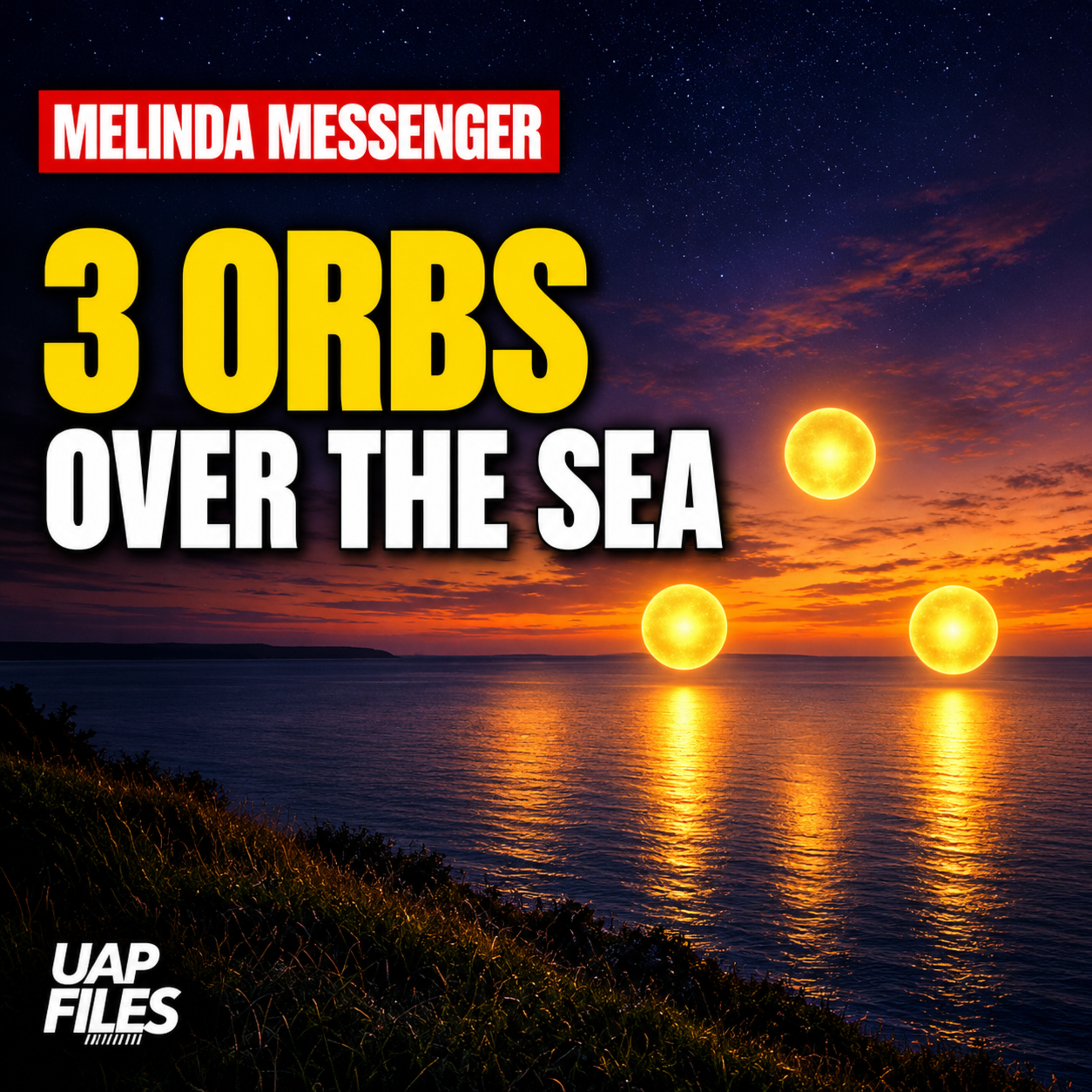
TV presenter turned psychotherapist Melinda Messenger felt so strongly that she had to go to Wales, alone with her two dogs and somewhere with a sea view, that she booked it there and then and left. On her second night, three large, sun-sized golden spheres appeared on the horizon above the sea. So she asked them to come back so she could film them, and she says they did, again and again through the night. In this clip: • The pull to go to three specific places in Wales she had never been to • Three golden, sun-sized orbs over the sea at dusk, and asking them to come back so she could film them • About 10 appearances through the night, in triangle formations, merging and splitting • Orbs splitting into a formation of about 10, with three becoming stars and then crosses, while her camera showed something different • Her dogs reacting with no sound, a pulsing feeling in her chest, and a “scanning” light in the clouds right above her • Waking at 3am, and one last orb at 6am Watch the full
View full lesson: http://ed.ted.com/lessons/the-silk-road-history-s-first-world-wide-web-shannon-harris-castelo Uploaded 03-06-14 With modern technology, a global exchange of goods and ideas can happen at the click of a button. But what about 2,000 years ago? Shannon Harris Castelo unfolds the history of the 5,000-mile Silk Road, a network of multiple routes that used the common language of commerce to connect the world's major settlements, thread by thread. Lesson by Shannon Harris Castelo, animation by Steff Lee.
Welcome to Crash Course Botany! Over the next 15 episodes, Alexis Nikole Nelson will spill plants’ secrets—how they evolved, how they function, and just how vital they are to human societies and all of life on Earth. Episode 1 premieres on May 18. *** Crash Course is on Patreon! Thanks to the following patrons for their generous monthly contributions that help keep Crash Course free for everyone forever: Tawny Whaley, Sean Saunders, Katie, Tori Thomas, DL Singfield, Ken Davidian, Stephen Akuffo, Toni Miles, Steve Segreto, Kyle & Katherine Callahan, Laurel Stevens, Burt Humburg, Aziz Y, Perry Joyce, Scott Harrison, Mark & Susan Billian, Alan Bridgeman, Rachel Creager, Breanna Bosso, Matt Curls, Jennifer Killen, Jon Allen, Sarah & Nathan Catchings, team dorsey, Trevin Beattie, Eric Koslow, Jennifer Dineen, Indija-ka Siriwardena, Jason Rostoker, Ken Penttinen, Nathan Taylor, Les Aker, William McGraw, ClareG, Rizwan Kassim, Constance Urist, Alex Hackman, Pineapples of Solidarity, Katie Dea
Did Charles Darwin settle the question of biological design once and for all? That's certainly the impression given by some of his modern defenders, including Richard Dawkins. But the actual history of Darwin's theory tells a different story about the dominant theory of biological origins and why it fails to explain the complexity and specificity and purpose of life. On this ID The Future, host Andrew McDiarmid continues his conversation with author and scholar Neil Thomas. In his books Taking Leave of Darwin and False Messiah, Thomas examines the intellectual influences behind Darwin's theory, the objections raised by his contemporaries, and the larger philosophical assumptions that have shaped modern evolutionary thinking. Source (https://idthefuture.com/2289/)
Hexagons appear all over the natural world from honeycomb to bubbles, and they even appear in organic chemistry! In this episode of Crash Course Organic Chemistry, we're learning all about cyclohexanes, including how rings pucker to relieve strain, the boat and chair conformations, and how ring flips can switch substituents from axial to equatorial. We'll practice a lot of chair flips, but don't flip an actual chair just yet! Lots of practice is key to understanding organic chemistry's favorite manifestation of the hexagon. Episode Sources: Philip Ball, Why Nature Prefers Hexagons: The geometric rules behind fly eyes, honeycombs and soap bubbles. Nautilus, 2016., Last accessed 1/26/2020. nautil.us/issue/35/boundaries/why-nature-prefers-hexagons References within: Kashyap Vyas, Why is the hexagon everywhere? All about this seemingly common shape. https://interestingengineering.com/why-is-the-hexagon-everywhere-all-about-this-seemingly-common-shape. Last access 1/26/2020. Series Sources:
Now that we’ve finished our tour of the planets, we’re headed back to the asteroid belt. Asteroids are chunks of rock, metal, or both that were once part of smallish planets but were destroyed after collisions. Most orbit the Sun between Mars and Jupiter, but some get near the Earth. The biggest, Ceres, is far smaller than the Moon but still big enough to be round and has undergone differentiation. CORRECTION: In the episode, we say that 2010 TK7 is 800 km away. However, 2010 TK7 stays on average 150 million kilometers from Earth, but that can vary wildly. Sorry about that! Check out the Crash Course Astronomy solar system poster here: http://store.dftba.com/products/crashcourse-astronomy-poster -- Chapters: Introduction: Asteroids 00:00 What are Asteroids? 1:37 Structure of the Main Belt 2:18 Ceres's Structure 3:43 Vesta and other Main Belt Asteroids 4:38 Rubble Piles 5:16 Why did the Asteroid Belt form? 6:20 Mars-crossing, Apollo, and Aten Asteroids 7:16 Trojan Asteroids & Lagrange P