Explore the technique known as the Socratic Method, which uses questions to examine a person’s values, principles, and beliefs. Uploaded 12-04-21 -- Socrates, one of the founding fathers of Western philosophical thought, was on trial. Many believed he was an enemy of the state, accusing the philosopher of corrupting the youth and refusing to recognize their gods. But Socrates wasn’t feared for claiming to have all the answers, but rather, for asking too many questions. Erick Wilberding digs into the technique known as the Socratic Method. Lesson by Erick Wilberding, directed by Draško Ivezić. Support Our Non-Profit Mission ---------------------------------------------- Support us on Patreon: http://bit.ly/TEDEdPatreon Check out our merch: http://bit.ly/TEDEDShop ---------------------------------------------- Connect With Us ---------------------------------------------- Sign up for our newsletter: http://bit.ly/TEDEdNewsletter Find us on Twitter: http://bit.ly/TEDEdTwitter Peep us on I
Chemistry raised to the power of AWESOME! That's what Hank is talking about today with Electrochemistry. Contained within, Hank discusses electrochemical reactions, half-reactions, how batteries work, galvanic cells, voltage, standard reduction potential, cell potential, electrolysis, electroplating, and the things that go into making it possible for you to watch this episode of Crash Course Chemistry! Pssst... we made flashcards to help you review the content in this episode! Find them on the free Crash Course App! Download it here for Apple Devices: https://apple.co/3d4eyZo Download it here for Android Devices: https://bit.ly/2SrDulJ -- Table of Contents Electro-Chemical Reactions 0:13 Half Reactions 1:42 How Batteries Work 1:47 Galvanic Cells 3:18 Calculating Voltage 4:12 Standard Reduction Potential 4:42 Standard Cell Potential 6:03 Electrolysis 7:24 Electroplating 7:02 -- Crash Course is on Patreon! Want to find Crash Course elsewhere on the internet? Facebook - http://www.faceboo
Bernie Krause has been recording wild soundscapes -- the wind in the trees, the chirping of birds, the subtle sounds of insect larvae -- for 45 years. In that time, he has seen many environments radically altered by humans, sometimes even by practices thought to be environmentally safe. A surprising look at what we can learn through nature's symphonies, from the grunting of a sea anemone to the sad calls of a beaver in mourning. Uploaded 16-08-13 Talk by Bernie Krause.
This is a Grave Talks CLASSIC EPISODE! PART TWO For Joni Mayhan, the paranormal didn’t begin with ghost stories or investigations. It began in childhood. From her earliest memories, strange shadows moved across her bedroom walls, disembodied voices echoed through quiet rooms, and an unexplained ringing filled the silence around her. Adults dismissed it as imagination, and over time, Joni tried to ignore the experiences and push them aside. But the paranormal had no intention of letting her go. In her late teens, the activity returned stronger than ever after moving into a home haunted by what seemed to be the hostile spirit of an old man. The presence made it painfully clear that the living were not welcome, forcing Joni to confront the terrifying reality that something unseen had followed her for years. That experience launched a lifelong search to understand spirits, hauntings, and why certain entities seemed drawn to her. #TheGraveTalks #Spirits #Apparition #GhostStories #Paranormal
This is a Grave Talks CLASSIC EPISODE! Built as a modest homestead in the 1840s, the May-Stringer House has endured more than a century of transformation — and tragedy. Over time, it evolved from a family home into a boarding house and later a repository of local history. Along the way came untimely deaths, unmarked graves, and a growing sense that something never truly moved on. Today, the May-Stringer House is considered one of Florida’s most paranormally active locations. Visitors and investigators alike report disembodied voices, shadow figures, and unexplained movement throughout the home. Some believe the spirits are former residents, bound to the place by unfinished lives. Others suspect the countless artifacts housed within its walls may act as anchors, holding onto energy from the past. Paranormal investigator Christian Paul has spent time exploring the house’s darker layers, documenting experiences that challenge simple explanations. His encounters raise unsettling questions
Featuring perspectives from Dr Charles E Geyer Jr, Dr Maryam Lustberg, Dr Rita Nanda and Dr Seth Wander, including the following topics: Breast Cancer Introduction: ESMO 2026; Recent FDA Approvals (0:00) ER-Positive Breast Cancer (5:01) HER2-Positive Breast Cancer (1:19:08) Triple-Negative Breast Cancer (1:48:54) CME information and select publications (https://researchtopractice.com/activity/integrating-new-advances-into-community-oncology-practice-8/)
Get to know the Stippled Studfish and Fundulid family that includes native fishes like studfish, killifish, topminnows and mummichogs. Our guests are Will Mutsch and Gabe Oleinik from the Fundulid Working Group. Learn about the habits and range of this species, Fundulid tips for fish keepers/aquarists, and how to get involved with these gorgeous native fish.
View full lesson: http://ed.ted.com/lessons/a-digital-reimagining-of-gettysburg-anne-knowles Uploaded 26-05-14 Geographer Anne Knowles uses digital technologies to reimagine the past. In this fascinating talk, Knowles transports us to the Battle of Gettysburg, the turning point of the Civil War. Using Geographic Information Systems (GIS) and historical maps, she traces the footsteps of Robert E. Lee as he orders Pickett's Charge -- and makes an educated guess why he made this crucial mistake. Talk by Anne Knowles.
Alex Kantrowitz is the host of Big Technology Podcast. Today he joins for a solo episode digging into the news that Nvidia CEO Jensen Huang, the head of the world’s second largest company and the backbone of the AI buildout, has admitted to an affair with a woman that U.S. intelligence believes is a Chinese spy. His board is unsure whether Nvidia‘s or U.S. state secrets were compromised, and has opened an investigation. So today, we dig into what happened and what's next.
Our first deep dive with an AI data company. In roughly a year, Handshake built an AI training business doing nearly $1 billion in gross annualized revenue. What are frontier labs buying? Garrett Lord joins us with the people building reinforcement lea... Full show notes and links (https://lspace.beehiiv.com/podcast/s/latent_space_the_ai_engineer_podcast/what_frontier_labs_buy_a_data_deep_dive_with_handshake_ai_garrett_lord_team)
View full lesson: http://ed.ted.com/lessons/how-to-unboil-an-egg-eleanor-nelsen Uploaded 23-04-15 It’s so obvious that it’s practically proverbial: you can’t unboil an egg. But actually, it turns out that you can -- sort of. Eleanor Nelsen explains the process by which mechanical energy can undo what thermal energy has done. Lesson by Eleanor Nelsen, animation by Provincia Studio.
This week, Stan teaches you about patents. It turns out, they're patently complicated! So, patents have some similarities to copyright, in that they grant a limited monopoly to people who invent things. The key difference between patents and copyright is that patents are for THINGS. Copyright is for an idea. So, if you've come up with a great new invention, like for example, a condiment gun, you should get a patent. We'll also talk about some of the limitations and problems of patents, including patent trolls Thanks to the following Patrons for their generous monthly contributions that help keep Crash Course free for everyone forever: Mark Brouwer, Jan Schmid, Steve Marshall, Anna-Ester Volozh, Sandra Aft, Brad Wardell, Christian Ludvigsen, Robert Kunz, Jason, A Saslow, Jacob Ash, Jeffrey Thompson, Jessica Simmons, James Craver, Simun Niclasen, SR Foxley, Roger C. Rocha, Nevin, Spoljaric, Eric Knight, Elliot Beter, Jessica Wode, Pigmy Wurm, Sverre Rabbelier, Liubko Qwert, Denis Anton,
Download a free audiobook version of "The Three-Body Problem" and support TED-Ed's nonprofit mission: https://www.audible.com/ted-ed Uploaded 03-08-20 -- In 2009, researchers ran a simple experiment. They took everything we know about our solar system and calculated where every planet would be up to 5 billion years in the future. They ran over 2,000 simulations, and the astonishing variety in results revealed that our solar system may be much less stable than it seems. Fabio Pacucci explores the n-body problem and the motion of gravitating objects. Lesson by Fabio Pacucci, directed by Hype CG. Animator's website: https://www.hype.cg/ and https://www.luisacopetti.com/ Sign up for our newsletter: http://bit.ly/TEDEdNewsletter Support us on Patreon: http://bit.ly/TEDEdPatreon Find us on Twitter: http://bit.ly/TEDEdTwitter Peep us on Instagram: http://bit.ly/TEDEdInstagram View full lesson: https://ed.ted.com/lessons/newton-s-three-body-problem-explained-fabio-pacucci Thank you so much to
Scott Gearen is a former U.S. Air Force Pararescueman (PJ) who served with the 24th Special Tactics Squadron and has almost 2,000 hours of flight time in and under helicopters. In this clip from UAP Files Podcast S3E8, Scott tells me about two encounters he still can’t explain. In this clip: • 2004, Wisconsin: sitting around a campfire with four family members when he suddenly feels paralysed, like sleep paralysis while awake • Coming out of it to find a beam of light shining straight down on the group, like a giant flashlight • Why it couldn’t be a helicopter: “there’s no wind, there’s no sound” • The other four men sitting motionless, then the light switching off and a dark object blocking out the stars as it moved away • Wondering, years later, whether it was some kind of evaluation, and why his companions say they felt and saw nothing • 2019, Panama City Beach: from the 22nd floor of his hotel he spots a bright, hovering object and photographs it for about an hour on his phone and
Puzzle through the ethical dilemma of lying to a friend, and decide: is lying always wrong or can it be justifiable? -- Your plan to set up your friend Carey with your acquaintance Emerson is finally coming together. You’ve made them a dinner reservation, but suddenly realize that there's a problem: Carey is always late. You really want this relationship to work— what if you told Carey dinner was at 6 instead of 6:30, so they arrived on time? Is it okay to lie? Sarah Stroud explores this classic ethical dilemma. Lesson by Sarah Stroud, directed by Avi Ofer. This video was produced in collaboration with the Parr Center for Ethics, housed within the renowned Philosophy Department at the University of North Carolina at Chapel Hill. The Parr Center is committed to integrating abstract work in ethical theory with the informed discussion of practical ethical issues, and prides itself on the development of innovative and inclusive approaches to moral and civic education. Support Our Non-Profi
Have you ever downplayed some aspect of your identity? Maybe you don’t hide it, but you don’t bring it up with certain people, either. It turns out that these subtle disguises can have powerful effects on how we view ourselves. This week, we bring you a favorite conversation with legal scholar Kenji Yoshino (https://its.law.nyu.edu/facultyprofiles/index.cfm?fuseaction=profile.overview&personid=22547). He introduces us to the concept of "covering," and talks about what happens when we soften or edit our true selves. Then, we revisit our "Your Questions Answered" segment in which Kenji answers listener questions and comments about his work. Another way that we hide who we are is by expressing views that we don't actually believe. In our latest YouTube video (https://www.youtube.com/watch?t=1s&v=iI3sfdYhGqY), we look at this phenomenon — known as preference falsification — and how it can affect our relationships. Check it out, and make sure to subscribe so you don't miss any of our future
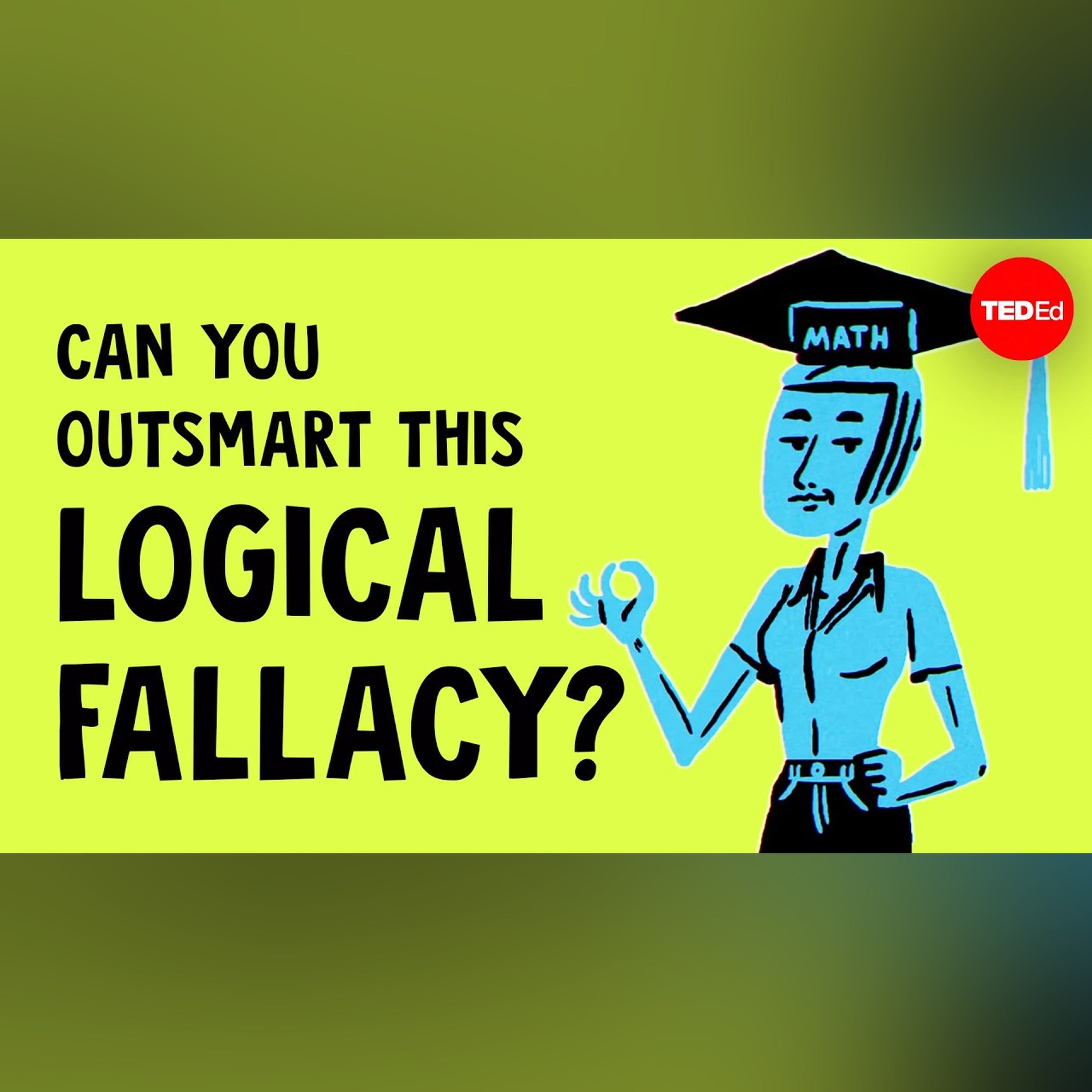
Explore the psychology of the cognitive bias known as the conjunction fallacy, where we assume specific conditions are more probable than general ones. Uploaded 25-11-19 -- Meet Lucy. She was a math major in college, and aced all her courses in probability and statistics. Which do you think is more likely: that Lucy is a portrait artist, or that Lucy is a portrait artist who also plays poker? How do we know which statement is more likely to be true? Alex Gendler explores our tendency to look for shortcuts and the phenomenon known as the conjunction fallacy. Lesson by Alex Gendler, directed by Artrake Studio. Animator's website: https://www.artrake.com (https://www.artrake.com/) Sign up for our newsletter: http://bit.ly/TEDEdNewsletter Support us on Patreon: http://bit.ly/TEDEdPatreon Find us on Twitter: http://bit.ly/TEDEdTwitter Peep us on Instagram: http://bit.ly/TEDEdInstagram View full lesson: https://ed.ted.com/lessons/can-you-outsmart-this-logical-fallacy-alex-gendler Thank you s
In this episode Prof Clare Collins talks with Dr Caroline Tuck from Swinburne University of Technology about the science related to histamine intolerance and how it relates to food. They discuss what it is, potential causes, symptoms, and management strategies for this condition. They cover how diet, the microbiome, and specific cells called mast cells all contribute to histamine intolerance, as well as discussing practical nutrition strategies to help those affected to manage this condition. Key topics What is histamine and histidine Foods containing preformed histamine Symptoms of histamine intolerance The microbiome's role in histamine production Mast cells and their impact on histamine levels Strategies for managing histamine intolerance The importance of personalized dietary approaches Potential medications and supplements for stabilization The prevalence of histamine intolerance in the population Caroline's Salmon Poke Bowl: https://nomoneynotime.com.au/healthy-easy-recipes/carol
I’ve been hearing from so many women in their 40s and 50s who feel like they’ve hit a wall. They’re overwhelmed, not sleeping well, reacting differently to their families, and wondering why things that used to feel manageable suddenly don’t. In this episode of Live Like a Girl, I’m sitting down with Dr. Dan Siegel, psychiatrist and author, to talk about what happens when your nervous system gets stuck in stress and how you start working with it. We talk about menopause, burnout, sleep, and the beliefs we carry from earlier in life. Dan also walks us through his Wheel of Awareness and a simple journaling practice called SIFT, which helps you pay attention to what you’re feeling in your body and mind. _ IN THIS EPISODE: How to tell if your nervous system is overwhelmed or shut down Why stress can feel different during perimenopause and menopause What your need for independence, connection, or certainty says about you How old experiences and beliefs can affect the way you feel today The W
Dr. Anna Lembke, MD, is chief of the Addiction Medicine Dual Diagnosis Clinic at Stanford and a leading expert in how to overcome addictions of all kinds. We discuss dopamine dynamics in the brain and how they impact risk-taking, mental obsession, and compulsive behaviors. We also discuss the most common addiction of all—people’s addiction to control—and how prayer and spiritual practices can open up new neural pathways and help end unhealthy thought patterns and behaviors, including codependence. Read the full episode show notes at hubermanlab.com (https://www.hubermanlab.com/episode/overcome-addictions-and-obsessions-of-all-kinds-anna-lembke). Thank you to our sponsors AG1: https://drinkag1.com/huberman Function: https://functionhealth.com/huberman Helix Sleep: https://helixsleep.com/huberman Lingo: https://hellolingo.com/huberman LMNT: https://drinklmnt.com/huberman Timestamps (00:00:00) Anna Lembke (00:02:14) Social Media, Digital Media Addiction, 4 Cs; Pollution Analogy (00:06:43)
In which John Green teaches you about World War II, a subject so big, it takes up two episodes. This week, John will teach you how the United States got into the war, and just how involved America was before Congress actually declared war. John will actually talk a little about the military tactics involved, and he'll get into some of the weaponry involved, specifically the huge amount of aerial bombing that characterized the war, and the atomic bombs that ended the war in the Pacific. Hey teachers and students - Check out CommonLit's free collection of reading passages and curriculum resources to learn more about the events of this episode. Americans entered World War II after the attack on Pearl Harbor: https://www.commonlit.org/texts/the-attack-on-pearl-harbor A call for soldiers led to an early civil rights victory, the Tuskegee Airmen: https://www.commonlit.org/texts/tuskegee-airmen America led the invasion of Normandy that would end the war, and American troops helped to liberate
Derek Condit joins us to share two reported Sasquatch encounters in Washington State, a family account from Northern California, and an unusual overnight sighting while working as a correctional officer in Monroe. His first encounter took place in the fall of 2012 on US Route 2 near Gold Bar and the Wayside Chapel. Derek describes a massive, dark brown figure crossing the two-lane highway in just three steps, passing roughly a hundred feet in front of him without looking toward the approaching vehicles. A couple of years later, near Mount Baker in the Mt. Baker–Snoqualmie National Forest, Derek says a strange hum, ringing ears, an abrupt quiet, and a powerful odor preceded another sighting. He recalls a light brown figure watching him from behind a cedar tree and then seeing what he believed was the same figure farther up the trail. A bracelet he found afterward led him to wonder whether the encounter included a deliberate gift. We also discuss the Sasquatch encounter his father descri
Yes, we have covered cervical cancer screening many, many times on this show. It is truly a testament to science and research just how far we have come from using slide-based cytology for cervical cancer screening. Primary high-risk HPV, as a screening modality, has been favored for many years and is now officially part of the age-based, ACOG cervical cancer screening guideline (July 2026). We will summarize that update in this episode. Plus, we will also review about what to do when the hrHPV expanded genotype panel returns positive for 56/59/66. Modern cervical screening reports frequently refer to HPV 56, 59, and 66, typically grouping them together into a single pooled result (often labeled as a trio "HPV 56/59/66"). This is due to the widespread adoption of extended HPV genotyping technology. WE, what do we do with that? Listen in for details. 1. ACOG Committee Statement No. 28: Screening for Cervical Cancer; July 2026 2. Massad LS, Clarke MA, Perkins RB, Garcia F, Chelmow D, Cheu
Dig into how the simple game of peek-a-boo contributes to babies developing their cognitive, motor, and social skills. -- In Italy, it’s called il gioco del cucù. Palestinians say ba' 'éno. And in Japan, it’s inaīnaibā! Peek-a-boo is a near universal source of laughter and connection for infants and adults— it’s the first game that almost everyone plays. So what is it about this goofy game that babies love so much? Dig into how this simple game promotes the development of our cognitive, motor, and social skills. Directed by Homework Studio. Support Our Non-Profit Mission ---------------------------------------------- Support us on Patreon: http://bit.ly/TEDEdPatreon Check out our merch: http://bit.ly/TEDEDShop ---------------------------------------------- Connect With Us ---------------------------------------------- Sign up for our newsletter: http://bit.ly/TEDEdNewsletter Find us on Twitter: http://bit.ly/TEDEdTwitter Peep us on Instagram: http://bit.ly/TEDEdInstagram --------------