Europe's system of alliances and centuries-old tensions erupted into war in August of 1914. This week on Crash Course Euro, we're talking about the military history of World War I, and taking a look at the broad strokes of how the war unfolded. We'll take you from the guns of August through gruesome battles like Verdun and the Somme, and follow the thread all the way through to the Armistice in 1918. It didn't turn out to be the War to End All Wars, sadly, but there is a lot to learn from it. Sources -Engelstein, Laura. Russia in Flames. War, Revolution, and Civil War 1914-1922. Oxford: Oxford University Press, 1918. -Hunt, Lynn et al. Making of the West: Peoples and Cultures, 6th ed. Boston: Bedford St. Martin’s 2019. -Sanborn, Joshua A. Imperial Apocalypse: The Great War and the Destruction of the Russian Empire. New York: Oxford University Press, 2014. -Suny, Ronald Grigor. “They Can Lie in the Desert but Nowhere Else”: A History of the Armenian Genocide. Princeton: Princeton Univer
A wide range of Americans contributed to the Civil Rights Movement in the 1950s and 1960s. Students and young people were prominent groups of activists within the movement. Today, we'll learn about the Little Rock Nine, the Greensboro Four, the Student Nonviolent Coordinating Committee, and the Freedom Riders. These groups undertook protests and worked to integrate schools and public accommodations by riding segregated buses, demanding service at lunch counters, and even by simply attending school. Clint's book, How the Word is Passed is available now! https://bookshop.org/a/3859/9780316492935 VIDEO SOURCES Jon N. Hale, The Freedom Schools: Student Activists in the Mississippi Civil Rights Movement (New York: Columbia University Press, 2016). Clayborne Carson, In Struggle: SNCC and the Black Awakening of the 1960s (Cambridge: Harvard University Press, 1981). Howard Zinn, SNCC: The New Abolitionists (Cambridge: South End Press, 2002). Barbara Ransby, Ella Baker and the Black Freedom Mov
Visit https://whyfileslovesgold.com (https://whyfileslovesgold.com/), text FILES to 638257, or call (888) 949-9172. -Download Cash App today. Click here to get started: https://click.cash.app/ui6m/4je4423a #CashAppPartner Bitcoin services by Block, Inc. See the Bitcoin disclosures at cash.app/legal/podcast (http://cash.app/legal/podcast). -Start your free online visit today at https://hims.com/thewhyfiles for personalized care—from hair to ED to weight loss and more. -Let Rocket Money help you find and cancel unwanted subscriptions, monitor your spending, and lower your bills—join at https://rocketmoney.com/thewhyfiles A brand-new Eastern Air Lines jet went down in the Florida Everglades in 1972, all because of a burned-out lightbulb. Soon after, crews on another plane started seeing familiar faces in first class and the galley. Two decades earlier, an Air Force fighter chased an unknown radar target over Lake Superior during a snowstorm. Controllers watched the two blips meet, and wha
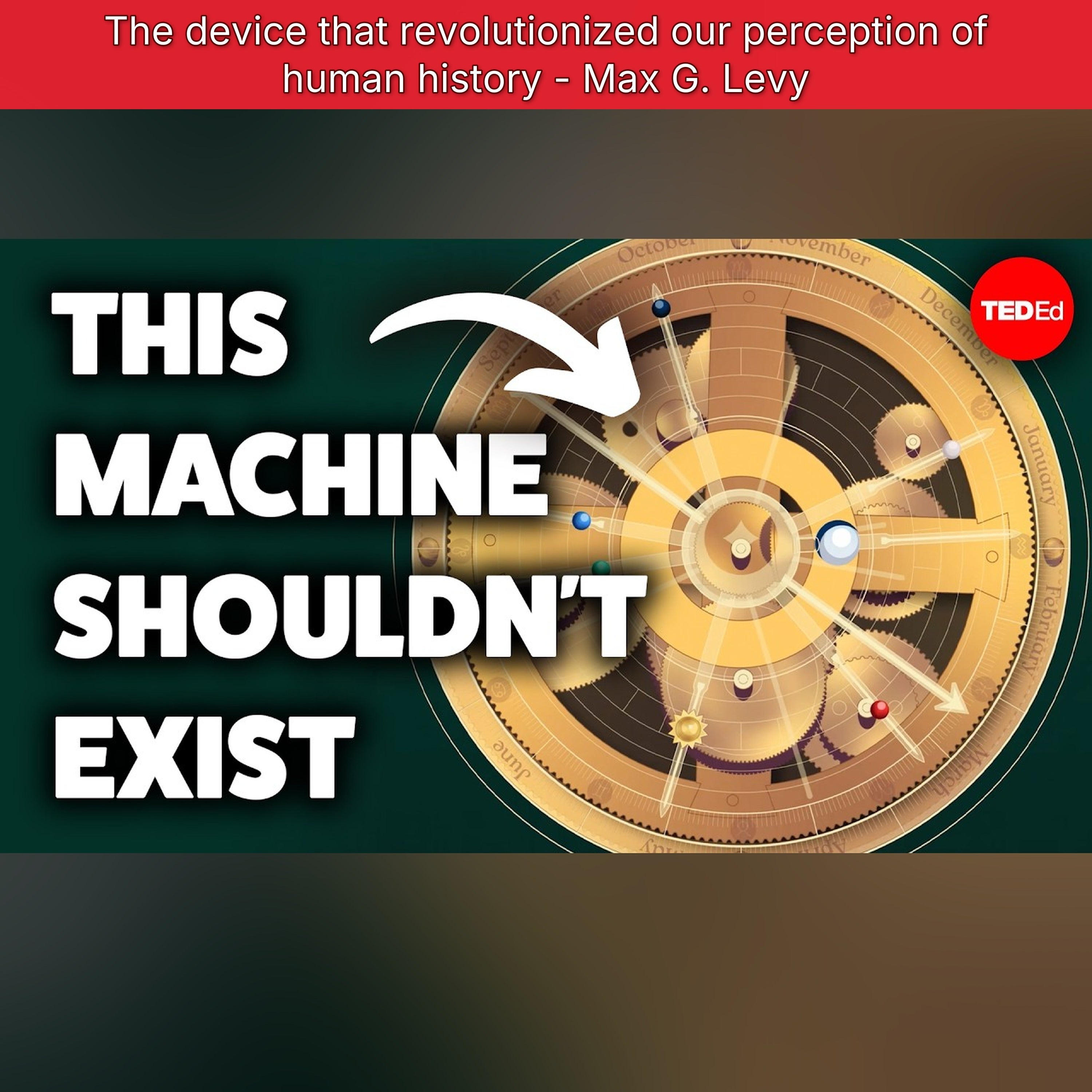
Learn more at https://brilliant.org/TedEd -- In 1900, Greek divers stumbled upon a 2,000-year-old shipwreck whose contents would shake our understanding of the ancient world. Among the remains were fragments of mangled wood and corroded metal, which archaeologists soon realized were parts of the oldest geared device ever discovered — and humankind’s first computer. So, how did it work? Max G. Levy explains the Antikythera mechanism. Lesson by Max G. Levy, directed by Vicente Numpaque, Hernando Bahamon, Globizco Studios. This video made possible in collaboration with Brilliant Learn more about how TED-Ed partnerships work: https://bit.ly/TEDEdPartner Support Our Non-Profit Mission ---------------------------------------------- Support us on Patreon: http://bit.ly/TEDEdPatreon Check out our merch: http://bit.ly/TEDEDShop ---------------------------------------------- Connect With Us ---------------------------------------------- Sign up for our newsletter: http://bit.ly/TEDEdNewsletter F
This is a Grave Talks CLASSIC EPISODE! PART TWO Are the shadows growing darker in today’s world? From senseless violence to moments of cruelty that seem almost impossible to comprehend, many believe humanity may be facing more than simple human evil. Some argue that demonic forces have always existed in the background—quietly influencing, manipulating, and feeding on fear throughout history. But what if those forces are becoming bolder? Demonologist James Annitto joins The Grave Talks to examine the unsettling possibility that demonic influence is becoming more visible in modern society. Together, we explore the ancient origins of demons, the warning signs that have appeared throughout history, and the disturbing patterns emerging in today’s increasingly divided world. From possession cases to cultural shifts and unexplained darkness hiding in plain sight, we confront one chilling question: if demons are real, what direction are they leading humanity next? #TheGraveTalks #Demons #Demon
This is a Grave Talks CLASSIC EPISODE! In Rock Island, Illinois, a former YMCA building now operating as the Rock Island Roadhouse carries more than a century of layered history. Once a center for recreation, education, and community life, the structure offered comfort and routine to generations who passed through its halls. Over time, unsettling reports began to surface. Staff and visitors describe shadow figures darting between rooms, unexplained footsteps echoing in the stairwell, and activity concentrated in former classrooms and storage areas. EVP sessions have captured disturbing sounds — including what some interpret as distant screams — adding to the building’s growing reputation as one of the region’s most active locations. Insights from Kandi Slater connect the documented past of the property with the experiences reported today. What once served as a gathering place for the living now carries signs that something may still linger within its walls. The Rock Island Roadhouse st
Listener feedback on the PROGRESS trial, the first Factor XI inhibitor improved, left bundle branch pacing, and statin discontinuation in older adults are the topics John Mandrola, MD, discusses in this week’s podcast. This podcast is intended for healthcare professionals only. To read a partial transcript or to comment, visit: I Listener Feedback PROGRESS Trial https://www.nejm.org/doi/abs/10.1056/NEJMoa2607326 II FDA Approves Asundexian in Stroke Will FDA-Approved Factor XIa Change Secondary Stroke Prevention? https://www.medscape.com/viewarticle/will-fda-approved-factor-xia-change-secondary-stroke-2026a100177u OCEANIC-STROKE Trial https://www.nejm.org/doi/10.1056/NEJMoa2513880 Bleeding With Asundexian vs Placebo in Patients With Ischemic Stroke or High-Risk TIA https://pubmed.ncbi.nlm.nih.gov/42866879/ OCEANIC-AF trial https://www.nejm.org/doi/full/10.1056/NEJMoa2407105 III Another Weak Pacing RCT – OptimPacing The Best Pacing Strategy for AV Block: A Head vs Heart Analysis of The O
So, during times of inflation or deflation, why doesn't the government just set prices? It sounds reasonable, but price ceilings or floors just don't work. Adriene and Jacob explain why. Subsidies, however, are a little different, and sometimes they even work. We'll also explain that. Today you'll learn about stuff like price controls, deadweight loss, subsidies, and efficiency. Crash Course is on Patreon! Thanks to the following Patrons for their generous monthly contributions that help keep Crash Course free for everyone forever: Mark, Eric Kitchen, Jessica Wode, Jeffrey Thompson, Steve Marshall, Moritz Schmidt, Robert Kunz, Tim Curwick, Jason A Saslow, SR Foxley, Elliot Beter, Jacob Ash, Christian, Jan Schmid, Jirat, Christy Huddleston, Daniel Baulig, Chris Peters, Anna-Ester Volozh, Ian Dundore, Caleb Weeks -- Want to find Crash Course elsewhere on the internet? Facebook - http://www.facebook.com/YouTubeCrashCourse Twitter - http://www.twitter.com/TheCrashCourse Tumblr - http://the
In which John Green teaches you about the Bronze Age civilization in what we today call the middle east, and how the vast, interconnected civilization that encompassed Egypt, The Levant, and Mesopotamia came to an end. What's that you say? There was no such civilization? Your word against ours. John will argue that through a complex network of trade and alliances, there was a loosely confederated and relatively continuous civilization in the region. Why it all fell apart was a mystery. Was it the invasion of the Sea People? An earthquake storm? Or just a general collapse, to which complex systems are prone? We'll look into a few of these possibilities. As usual with Crash Course, we may not come up with a definitive answer, but it sure is a lot of fun to think about. Crash Course is on Patreon! Want to find Crash Course elsewhere on the internet? Facebook - http://www.facebook.com/YouTubeCrashCourse Twitter - http://www.twitter.com/TheCrashCourse Instagram - https://www.instagram.com/t
What happens when a parent who has spent much of their own childhood in care finds themselves raising children while carrying unprocessed trauma, poverty, instability and loss? In this powerful episode of Messy Social Work, Rich and Tim are joined by Azariah Hope, lived experience consultant, trainer, advocate and mother of four, alongside Rebecca Carr-Hopkins, social worker, trainer and attachment specialist. Azariah shares her remarkable and deeply moving story: growing up in and out of care under Section 20 arrangements, experiencing abuse, multiple foster placements, becoming a mother at fifteen, losing two children to care proceedings and adoption, and eventually finding a path towards recovery and reunification through intensive therapeutic support. Together, the conversation explores: The reality of growing up in care and moving between twelve foster placements Trauma, survival strategies and the hidden impact of childhood adversity Teenage parenthood and the search for love, be
View full lesson: http://ed.ted.com/lessons/marcus-du-sautoy-symmetry-reality-s-riddle Uploaded 17-08-13 The world turns on symmetry -- from the spin of subatomic particles to the dizzying beauty of an arabesque. But there's more to it than meets the eye. Here, Oxford mathematician Marcus du Sautoy offers a glimpse of the invisible numbers that marry all symmetrical objects. Oxford's newest science ambassador Marcus du Sautoy is also author of The Times' Sexy Maths column. He'll take you footballing with prime numbers, whopping symmetry groups, higher dimensions and other brow-furrowers. Talk by Marcus du Sautoy.
Who shapes the UFO stories we hear, and who stands to benefit from them? On this episode of the Let’s Get Freaky Podcast, we sit down with Los Angeles-based animator and filmmaker Christopher Graybill to discuss his documentary Saucers, Spooks and Kooks. The film explores the overlap between UFOs, intelligence agencies and high strangeness. Christopher also recounts a UFO he saw while working on the documentary itself. Christopher brings a filmmaker’s perspective to the conversation. His credits include Birds of Prey, Dave Made a Maze and The Death of Superman Lives: What Happened?, along with animated projects such as Big Mouth, Beavis and Butt-Head Do the Universe and X-Men ’97. We explore the possibility of deliberate UFO deception. Could powerful interests use UFO stories to distract from other activities or profit from public fascination? How can we tell when prominent voices in the UFO community are following the evidence and when they might be advancing someone else’s agenda, kn
View full lesson: http://ed.ted.com/lessons/why-batteries-die-adam-jacobson Uploaded 21-05-15 Batteries are a triumph of science—they allow smartphones and other technologies to exist without anchoring us to an infernal tangle of power cables. Yet even the best batteries will diminish daily, slowly losing capacity until they finally die. Why does this happen, and how do our batteries even store so much charge in the first place? Adam Jacobson gives the basics on batteries. Lesson by Adam Jacobson, animation by FOX Animation Domination High-Def.
In today's Crash Course Astronomy, Phil takes a look at the explosive history of our cosmic backyard. We explore how we went from a giant ball of gas to the system of planets and other celestial objects we have today. This episode is sponsored by Squarespace: http://www.squarespace.com/crashcourse Check out the Crash Course Astronomy solar system poster here: http://store.dftba.com/products/crashcourse-astronomy-poster -- Chapters: Introduction 00:00 Geocentrism vs Heliocentrism 0:51 Makeup of the Solar System 2:38 Is Pluto a Planet? 3:14 Our Solar System 4:24 How Our Solar System Formed 5:36 Planet Formation Depends on Distance to Sun 7:14 Review 8:57 -- PBS Digital Studios: http://youtube.com/pbsdigitalstudios Follow Phil on Twitter: https://twitter.com/badastronomer Crash Course is on Patreon! Want to find Crash Course elsewhere on the internet? Facebook - http://www.facebook.com/YouTubeCrashCourse Twitter - http://www.twitter.com/TheCrashCourse Instagram - https://www.instagram.com
World War I was a total war for millions of people in Europe. Many men were enlisted in the fighting, but the war work had implications for the daily lives of a huge number of Europeans. Women entered the workforce in huge numbers, and for a lot of people, the battles raged through their towns, cities, and even their homes. In addition to learning about the homefronts of the war, we're going to look at how the war ended, and how the Paris Peace Conference and the treaties that resulted did little to heal the societal wounds of the war, and in many ways set the stage for the next big war. Sources -Akin, Yigit. “War, Women, and the State: The Politics of Sacrifice in the Ottoman Empire during the First World War,” Journal of Women’s History. Vol. 26, No. 3 (Fall 2014). -Gerwarth, Robert. The Vanquished: Why the First World War Failed to End. New York: Farrar, Straus, and Giroux, 2016. -Hunt, Lynn et al. Making of the West: Peoples and Cultures, 5th ed. Boston: Bedford St. Martin’s, 2016.
What would it take for hackers to shut down America—and how close have they come? This week on Ninjas Are Butterflies, we dig into power grid vulnerabilities and the unsettling possibility of a nationwide blackout. Then, before the world knew him as the Unabomber, Ted Kaczynski was a teenage Harvard student caught up in a controversial psychological experiment. Where does MKUltra enter the story? The questions only get darker. Plus, the strange case of Teddy Kyle Smith takes us deep into the Alaskan wilderness, where a violent encounter and chilling local folklore leave plenty to unravel. Cyberattacks, true crime, and unexplained mysteries, all on Episode 220. Thanks to Our Sponsors: Go to https://butcherbox.com/NINJAS to get $20 off across your first two boxes, plus new users get their choice of filet mignon, NY strip or Ribeye PLUS bacon in every box for the lifetime of their subscription — with free shipping always. #ad Download Cash App today and make your money work for you. Sheat
Enslaved people resisted their condition in a range of different ways. Oftentimes those ways were small and personal. There were also times when that resistance took on larger, more dramatic forms, like with slave uprisings and rebellions. Today, we'll learn about the Stono Rebellion, which was an uprising led by enslaved people in South Carolina in 1784. We'll also talk about ways that enslaved people resisted in general and methods like enforced illiteracy used by those who sought to keep people in bondage. Clint's book, How the Word is Passed is available now! https://bookshop.org/a/3859/9780316492935 Sources and References Ira Berlin, Many Thousands Gone: The First Two Centuries of Slavery in North America (Cambridge: The Belknap Press of Harvard University Press, 1998. Winthrop Jordan, White Over Black: American Attitudes Toward the Negro, 1550-1812 (Chapel Hill: University of North Carolina Press, 1968, reprinted in 2012) Peter Wood, Black Majority: Negroes in Colonial South Caro
Editor's Summary by Linda Brubaker, MD, and Preeti Malani, MD, MSJ, Deputy Editors of JAMA, and Gregory Curfman, MD, Executive Editor of JAMA, the Journal of the American Medical Association, for articles published from November 7-13, 2026. Related Content: Audio Highlights (https://jamanetwork.com/journals/jama/fullarticle/10.1001/jama.2025.16129)
View full lesson: http://ed.ted.com/lessons/james-balog-time-lapse-proof-of-extreme-ice-loss Uploaded 17-08-13 Photographer James Balog shares new image sequences from the Extreme Ice Survey, a network of time-lapse cameras recording glaciers receding at an alarming rate, some of the most vivid evidence yet of climate change. Talk by James Balog.
JAMA Medical News Director Jennifer Abbasi and Associate Managing Editor Kate Schweitzer discuss "In an Effort to Reduce Hypertension, Salt Substitutes Come to the Table." Related Content: In an Effort to Reduce Hypertension, Salt Substitutes Come to the Table (https://jamanetwork.com/journals/jama/fullarticle/10.1001/jama.2026.23873)
Datacentres, high fuel prices, and the cost of living crisis were some defining issues for the US electorate in the recent US midterm elections, but why didn’t politicians link these concerns to the environment and climate change? Associate Professor of Political Science at Ohio University, Dr. Nancy Manring Ph.D, joins Bertie to discuss framing of climate issues and environmental politics in the United States - the central theme of her latest book ‘A World of Wounds: Rebuilding a Bipartisan Environmental Movement and Cultivating Hope.’ Nancy applies her background in environmental conflict and environmental dispute resolution to first unpack why environmental politics is currently so divisive in the US, claiming “the partisan divide has been purposely constructed by conservatives and ultimately is an artificial construction.” Listen to Nancy explain why she believes American politicians are missing an opportunity to strengthen the salience of environmental politics: “I would argue tha
Unless it’s Christmas Eve, that chain of lights moving across the sky is probably not Santa’s sleigh but Starlink’s low earth orbit satellites (LEOs). To meet demand for ubiquitous, instantaneous, and uninterrupted communication, our internet infrastructure now extends into outer space. This talk explores who owns it, who has to clean up after it, and its impact on terrestrial politics. We’ll also take a look at how a new interplanetary internet might help shape the future of space exploration, to Mars and beyond. This lecture was recorded by Professor Victoria Baines on 25th of September 2026 at Barnard’s Inn Hall, London. Professor Victoria Baines FBCS is a leading authority in the field of online trust, safety and cybersecurity. She frequently contributes to major broadcast media outlets on digital ethics, cybercrime and the misuse of emerging technologies, including Extended Reality and Artificial Intelligence. Her areas of research include electronic surveillance, cybercrime futur
Professors Czerski and Lintott investigate how ocean Earth compares and differs from the other planets we’ve found, and how water worlds in many forms may be more common than expected. Using Lovelock’s framing of a biosphere, we consider life on these worlds, and explain what this thinking about the Universe can tell us about our own planet. This lecture was recorded by Professor Helen Czerski and Chris Lintotton 14th of October 2026 at Barnard’s Inn Hall, London. Helen Czerski is a physicist and oceanographer with a passion for science, sport, books, creativity, hot chocolate and investigating the interesting things in life. She is a Professor at the Department of Mechanical Engineering at University College London and her research focus is the physics of breaking waves and bubbles at the ocean surface. These bubbles change underwater sound and light, help transfer gases from ocean to atmosphere (helping the ocean breathe) and also eject ocean material into the air. She has spent mont
Following on from last year’s lecture at the Festival of Musical Ideas, Professors Lintott and Mermikides will present, demonstrate and critique the idea of ‘astro sonification’, using sound and music to represent the astronomical patterns seen in the sky. A particular focus will be on representations of the diverse exoplanet systems now found around other stars, and on musical representations (historical and contemporary) of the worlds of our Solar System. This lecture was recorded by Ronald Hutton and Chris Lintott on 25th Sept 2026 at Barnard's Inn Hall, London Milton Mermikides is a composer, guitarist, technologist, academic and educator in a wide range of musical styles and has collaborated with artists and scientists as diverse as Evelyn Glennie, Tim Minchin, Pat Martino, Peter Zinovieff, John Williams and Brian Eno. Son of a CERN nuclear physicist, he was raised with an enthusiasm for both the arts and sciences, an eclecticism which has been maintained throughout his teaching,