In which John Green teaches you about Imperialism, but not from the perspective of the colonizers. This week John looks at some Asian perspectives on Imperialism; specifically, writers from countries that were colonized by European powers. We'll look at the writings of Sayyid Jamal ad-Din al-Afghani from the Middle East, Liang Qichao from China, and Rabindranath Tagore from India. these voices from the countries that were colonized give us a sense of how conquered people saw their conquerors, and give an insight into what these nations learned from being dominated by Europe. It's pretty interesting, OK? A lot of this episode is drawn from a fascinating book by Pankaj Mishra called The Ruins of Empire: The Revolt Against the West and the Remaking of Asia. You should read it. Crash Course is on Patreon! Want to find Crash Course elsewhere on the internet? Facebook - http://www.facebook.com/YouTubeCrashCourse Twitter - http://www.twitter.com/TheCrashCourse Instagram - https://www.instagra
Professional musicians share what makes a great pop song, and how to grow your songwriting skills to make your music stand out. -- "Think Like A Musician" connects you with working musicians who want to help the music-curious and music-passionate hone and share the gift of music with the world. Part interview, part animated course, our second season "Think Like A Songwriter" features artists sharing their insight on the ins and outs of fine-tuning your songwriting and crafting timeless, memorable music. Each episode features free supplemental learning materials developed by Education Through Music (https://etmonline.org) (https://etmonline.org)/) — a nonprofit with over 30 years of experience developing classroom-adaptable curriculum for music educators. Directed by Serin İnan, Tolga Yıldız, Kozmonot Animation Studio. A special thanks to the musicians who provided their insights and expertise for this video. You can check out their pages here: Support Our Non-Profit Mission -----------
Imagine a world where the Mediterranean Sea was transformed into a vast, nearly dried-out basin, leaving behind enormous deposits of salt. Around 5.3 million years ago, Atlantic waters surged back into the region in a remarkable event known as the Zanclean flood, potentially reshaping one of Earth's most important geological landscapes. Scientists continue to investigate just how rapidly this extraordinary transformation unfolded. Travel back to a prehistoric world of shifting coastlines, towering cascades, and landscapes unlike anything we recognize today. Discover the Messinian Salinity Crisis, explore the geological clues hidden beneath the seafloor, and uncover the mystery of how the Mediterranean returned to a marine world. Settle in for a peaceful journey into one of Earth's most astonishing geological stories, where the power of the Atlantic may have changed an entire sea forever. Boring History for Sleep — Soft stories about ancient worlds, extraordinary events, and the mysteri
Fall asleep to this quiet science story. A Boring Science For Sleep episode about How DNA Replication Copies Your Genetic Code. How DNA Replication Copies Your Genetic Code Settle in for a quiet exploration of How DNA Replication Copies Your Genetic Code. This episode follows A Band Halfway Down; Chains, Extracts and Enzymes; Inside the Moving Fork; Short Pieces and Wrong Enzymes; Once Per Cycle, End to End. Listen closely or let the details drift past. If you enjoy this quiet science bedtime pace, you might also like Psalms for Sleep on Spotify — same quiet rhythm, different night. Search Spotify for Psalms for Sleep.
In which John Green teaches you about nonviolence and peace movements in the 20th century. What is nonviolence? What is a peace movement? Well. traditionally, humans often resort to violence when they come into conflict. In the 20th century, it became much more common for people to enact change by means of nonviolence, and there was a common thread of connection between many of the most notable advocates of peaceful change. Crash Course will take you from Gandhi to Gregg to Bayard Rustin to Martin Luther King, Jr, to the Cold War to Arab Spring along a path of nonviolent resistance and peaceful change. It's pretty great. Citation 1: King, Martin Luther, Jr., Farewell Statement for All India Radio, 9 March 1959. Crash Course is on Patreon! Want to find Crash Course elsewhere on the internet? Facebook - http://www.facebook.com/YouTubeCrashCourse Twitter - http://www.twitter.com/TheCrashCourse Instagram - https://www.instagram.com/thecrashcourse/ CC Kids: http://www.youtube.com/crashcours
View full lesson: http://ed.ted.com/lessons/how-i-responded-to-sexism-in-gaming-with-empathy-lilian-chen Uploaded 26-05-15 TED-Ed videos are used in a variety of different educational scenarios around the world. Due to limited moderation tools and resources, we have made this video discussable only on ed.ted.com. Lilian Chen grew up playing Super Smash Brothers Melee. But when her love of the game led her to compete in national tournaments, she noticed a big gender imbalance that brought with it a troubling social dynamic. In this TEDYouth talk, Lilian details her experiences with sexism in the Smash community and how she is now aiming to raise awareness for this topic in a way that doesn’t shame male gamers. TEDYouth Talk by Lilian Chen.
During a session at Sanders Theatre, Harvard Medical School, on “Memory, Consciousness, and Coma” on May 14, Emery N. Brown, MD, PhD, Warren M. Zapol Professor of Anesthesia at Harvard Medical School and at Massachusetts General Hospital, Edward Hood Taplin Professor of Medical Engineering and Professor of Computational Neuroscience at MIT; and Nicholas D. Schiff, MD, PhD, The Jerold B. Katz Professor of Neurology and Neurosciences, Weill Cornell Medical College,New York, seek Sadhguru’s inputs on various aspects of anesthesia, the brain and science. Sadhguru App (Download): https://onelink.to/sadhguru__app Inner Engineering Link: isha.co/ieo-podcast
Today, in our final episode of Crash Course AI, we're going to look towards the future. We've spent much of this series explaining how and why we don't have the Artificial General Intelligence (or AGI) that we see in the movies like Bladerunner, Her, or Ex Machina. Siri frequently doesn't understand us, we probably shouldn't sleep in our self-driving cars, and those recommended videos on YouTube and Netflix often aren't what we really want to watch next. So let's talk about what we do know, how we got here, and where we think it's all headed. Thanks so much everyone for watching! Don't forget to subscribe to Jabril’s channel here! And you can find some more free recourses to learn about AI below! https://www.kaggle.com/competitions?sortBy=grouped&group=general&page=1&pageSize=20&category=gettingStarted (https://www.kaggle.com/competitions?category=gettingStarted&group=general&page=1&pageSize=20&sortBy=grouped) Crash Course AI is produced in association with PBS Digital Studios: Crash C
These days, we don't have to worry too much about meeting an early demise from ulcers, breaks in the stomach lining that could be fatal back in the early 1900s. This is because we have medicines to treat them, like proton pump inhibitors! In this final episode of Crash Course Organic Chemistry, we'll look at medicinal chemistry by breaking down how penicillin fights bacteria, how proteins are made both in the body and in the lab, and we'll finally finish our synthesis of penicillin V and complete our Mold Medicine Map! Hopefully this series has shown you the many ways organic chemistry is all around us and how it can help us to better understand ourselves, and improve our world! Episode Sources: Patrick, G. L. (2013). An introduction to medicinal chemistry. Oxford university press. Vollmer, W., Blanot, D., & De Pedro, M. A. (2008). Peptidoglycan structure and architecture. FEMS microbiology reviews, 32(2), 149-167. Sauvage, E., Duez, C., Herman, R., Kerff, F., Petrella, S., Anderson, J
Ranjan Roy from Margins is back for our weekly discussion of the latest tech news. We cover: 1) Jensen Huang ousted as CEO of Nvidia 2) The real issue: Sending hundreds of thousands of restricted chips to China 3) Nvidia's mysterious Singapore numbers 4) The timing: Did this come out now because of AI's advancing capabilities? 5) Or was it the Republican midterm losses? Or something else? 6) How China programmed top AI models with Nvidia's top-line, restricted chips 7) Nvidia's competition is intensifying 8) Anthropic ramps on AMD chips in three days 9) Who succeeds Jensen? 10) Are leather jackets out of style now? Alex's New York Times opinion piece: https://www.nytimes.com/2026/11/13/opinion/jensen-huang-nvidia.html --- Enjoying Big Technology Podcast? Please rate us five stars ⭐⭐⭐⭐⭐ in your podcast app of choice. Want a discount for Big Technology on Substack + Discord?
When it comes to measles, the U.S. is going backwards. Our country, once a global leader in our ability to contain this virus, is now seeing measles surge back. Horizons moderator William Brangham explores how we got here, and where we go now with Dr. William Schaffner and Jessica Malaty Rivera. Hosted on Acast. See acast.com/privacy
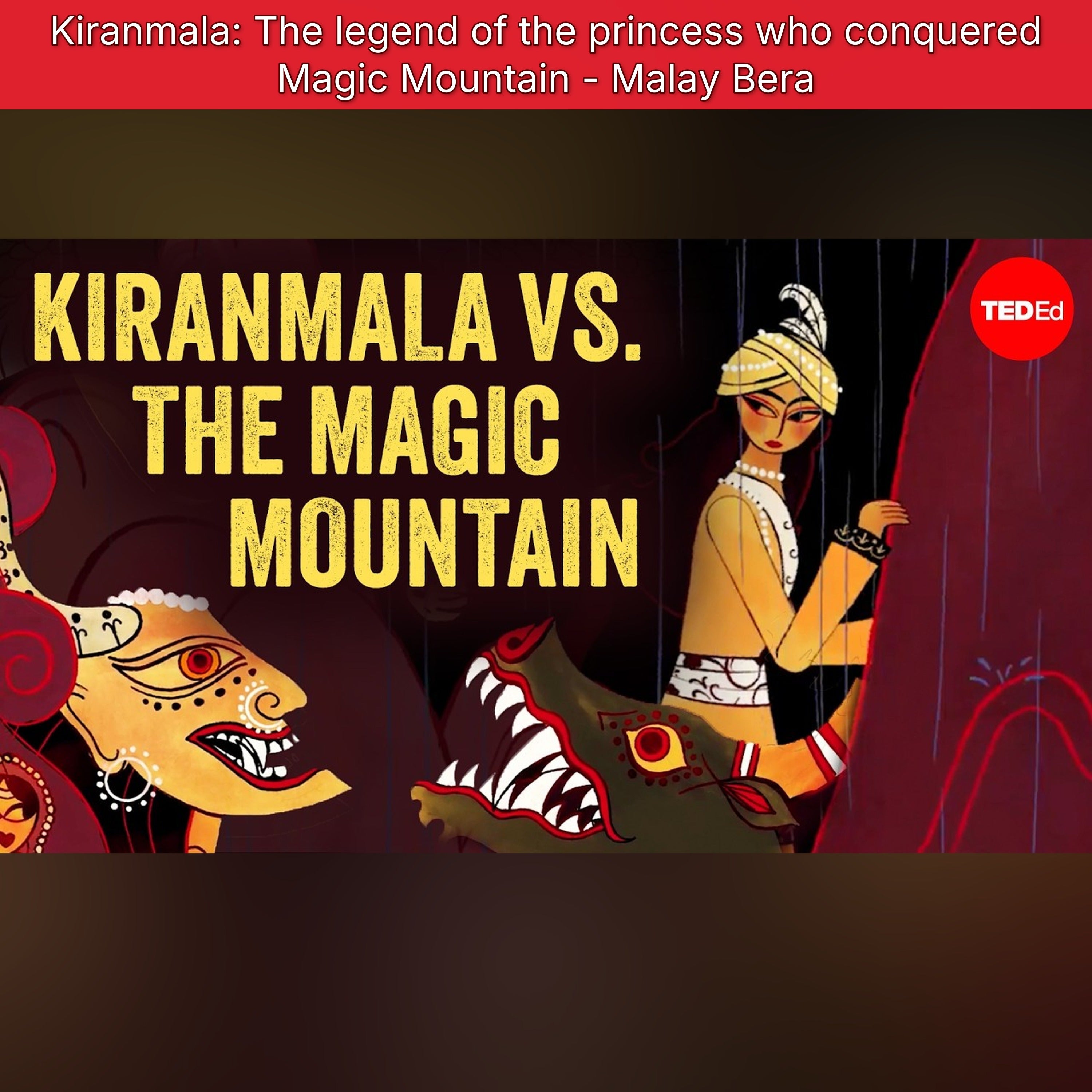
Dig into the Bengali tale of a trio of siblings who attempt to scale the fearsome Magic Mountain to gain treasures for their home. -- Inspired by a king’s visit, a trio of siblings began building a palace, traveling far and wide to collect rare jewels, seeds, and marble. A holy man stopped by and told them of a Magic Mountain, east of north and north of east, where they’d find their most meaningful treasures. But, he said, only a true hero could complete the journey. Malay Bera shares the Bengali tale of Kiranmala's quest. Lesson by Malay Bera, directed by Héloïse Dorsan-Rachet. Although this folktale exists in multiple oral variants across the Bengali-speaking world, this video is based on a variant akin to the better-known literary version, “Kironmala", from Thakurmar Jhuli (1907), an anthology of Bengali folktales collected by Dakshinaranjan Mitra Majumdar in the early 20th century. Support Our Non-Profit Mission ---------------------------------------------- Support us on Patreon:
Moving away to college was supposed to be the beginning of an exciting new chapter. But within weeks of settling into her dorm room, one student began experiencing an overwhelming sense of fear and anxiety whenever she was there. The feeling became so intense that she started avoiding her room whenever possible. Then, one night, she saw something standing in her open closet. It was a tall, strangely colored figure that seemed to be watching her. And it wasn't the last time she'd see it. As the encounters continued, she became increasingly frightened, eventually seeking refuge in another student's room. Attempts to cleanse the space seemed to help, but the relief didn't always last. Even after transferring to another university, she couldn't forget what she'd experienced—or stop worrying about the roommate she'd left behind. Was something still waiting in that dorm room? #RealGhostStoriesOnline #TrueGhostStories #HauntedDormRoom #CollegeGhostStories #ShadowFigures #ShadowPeople #Paranor
This is a Grave Talks CLASSIC EPISODE! PART TWO In Rock Island, Illinois, a former YMCA building now operating as the Rock Island Roadhouse carries more than a century of layered history. Once a center for recreation, education, and community life, the structure offered comfort and routine to generations who passed through its halls. Over time, unsettling reports began to surface. Staff and visitors describe shadow figures darting between rooms, unexplained footsteps echoing in the stairwell, and activity concentrated in former classrooms and storage areas. EVP sessions have captured disturbing sounds — including what some interpret as distant screams — adding to the building’s growing reputation as one of the region’s most active locations. Insights from Kandi Slater connect the documented past of the property with the experiences reported today. What once served as a gathering place for the living now carries signs that something may still linger within its walls. The Rock Island Roa
So, you know you'd like to get help with some problematic behavior (like fear of flying). What do you do? Who can you go to for help? Once you've gone, what can you expect? In this episode of Crash Course Psychology, Hank talks about what "Getting Help" can look like. If you are currently in need of help: http://www.mentalhealth.gov/get-help/ Want more videos about psychology? Check out our sister channel SciShow Psych at https://www.youtube.com/scishowpsych! -- Chapters: Introduction: Types of Psychotherapy 00:00 Psychodynamic Therapy 1:13 Existential-Humanist Therapy 03:46 Behavioral Therapy 6:00 Cognitive Therapy 8:02 Integrative Therapies 9:35 Group and Family Therapy 09:48 Review & Credits 10:31 -- Crash Course is on Patreon! Want to find Crash Course elsewhere on the internet? Facebook - http://www.facebook.com/YouTubeCrashCourse Twitter - http://www.twitter.com/TheCrashCourse Instagram - https://www.instagram.com/thecrashcourse/ CC Kids: http://www.youtube.com/crashcoursekids
Today we're (finally) going to talk about animal babies! But more than just puppies and piglets we're going to be looking at their genes. Sexual reproduction is part of the very definition of what it means to be an animal and as you'll see life has found a variety of methods to pass down genetic information. We'll also discuss the differences between sex and gender, take a closer look at sex determination systems, examine how same-sex behavior happens all across the animal kingdom, and live a day-in-the-life of the serially hermaphroditic clownfish! Learn more about Rae here! https://www.raewynngrant.com (https://www.raewynngrant.com/) *** Watch our videos and review your learning with the Crash Course App! Download here for Apple Devices: https://apple.co/3d4eyZo Download here for Android Devices: https://bit.ly/2SrDulJ Crash Course is on Patreon! Thanks to the following patrons for their generous monthly contributions that help keep Crash Course free for everyone forever: Vincent, Em
When we think of extraterrestrials, our minds generally go from the latex-suited bipedal aliens seen in Star Trek and Star Wars to more exotic critters in sci-fi movies. Scientists think in terms of carbon-based microbial life and other lower life forms. But some researchers, such as Mikhail Tikhonov from Washington University, suggest that life can take more unusual forms, ones we might not even recognize. He further suggests a new definition of life: something that takes in and transforms energy and replicates. His ideas radically expand our notions of alien life and how it might be recognized. Headlines: Space Shuttle Endeavour's New Launch Configuration Exhibit Debuts SpaceX Prepares for Starship Flight 15's First Attempted Double Landing Risks and Stakes for SpaceX's Reusable Starship Program Main Topic: Searching for Alien Life—Redefining the Approach Origins and motivations for thinking differently about our definition of life Traditional "follow the water" strategy versus seeki
One bag of apples, one apple, one slice of apple -- which of these is one unit? Explore the basic unit of math (explained by a trip to the grocery store!) and discover the many meanings of one. Lesson by Christopher Danielson, animation by TED-Ed. View the full lesson: http://ed.ted.com/lessons/one-is-one-or-is-it
You're already learning on YouTube — why not get college credit for it? https://link.gostudyhall.com/my1 Now that we're to the point of actually applying for college, things can get a little overwhelming. But, not to worry, Erica has some helpful ways to manage everything you need to keep track of, fill out, and even ways to save some money in fees. *** Now you can take top-tier college courses with Study Hall! Study Hall videos are available to watch at no cost, and first-year courses are $25 to sign-up and begin coursework. Sign up at https://link.gostudyhall.com/my1 Follow Study Hall on socials! Twitter: https://twitter.com/gostudyhall Instagram: https://Instagram.com/GoStudyHall (https://instagram.com/GoStudyHall) Facebook: https://www.facebook.com/GoStudyHall _______________________________________________ Chapters: 0:00 - Introduction 0:49 - List of schools 3:30 - Documents to assemble 4:12 - Writing samples 7:11 - Conclusion _______________________________________________ Watch
NASCAR legend Mark Martin never told this story outside his friends and family for more than 25 years. Flying his own private jet home after a race in late 1998 or early 1999, descending past Jacksonville at around 18,000 ft towards Daytona Beach, he saw a bright white light ahead. It kept getting closer, and closer, until he thought they were going to hit it. In this clip from UAP Files Podcast S3E3, Mark talks me through exactly what happened. In this clip: • Why he checked the story with his pilot Jason before telling it publicly, and Jason remembered it too • A dark night, high cloud and no stars: a light level with the jet, above the lights of Miami • No strobes and no red or green wingtip lights, so it didn’t look like any aircraft he knew • Kicking off the autopilot and getting ready to turn, which you don’t do unless it’s an emergency • Jason grabbing a camera from his flight bag (the photo only caught the flash on the windshield) • Jacksonville Center and Daytona Approach: “th
In which John Green talks about the methods of writing history by looking at some of the ways that history has been written about the rise of the West. But first, he has to tell you what the West is. And then he has to explain the Rise of the West. And then he gets down to talking about the different ways that historians and other academics have explained how the West became dominant in the world. He'll look at explanations from Acemoglu and Robinson's "Why Nations Fail," Francis Fukuyama's "The Origins of Political Order," and Ian Morris's "Why the West Rules, for Now." Crash Course is on Patreon! Want to find Crash Course elsewhere on the internet? Facebook - http://www.facebook.com/YouTubeCrashCourse Twitter - http://www.twitter.com/TheCrashCourse Instagram - https://www.instagram.com/thecrashcourse/ CC Kids: http://www.youtube.com/crashcoursekids
View full lesson: http://ed.ted.com/lessons/the-wacky-history-of-cell-theory Scientific discovery isn't as simple as one good experiment. The weird and wonderful history of cell theory illuminates the twists and turns that came together to build the foundations of biology. Lesson by Lauren Royal-Woods, animation by Augenblick Studios.
So today we're going to look at the rather thorny issue of the media and its role in politics. Wether you're talking about older forms of media like newspapers and radio or newer forms like television and the Internet, all media serves the same purpose - to provide information to the public. So we're going to discuss their strengths and weaknesses and examine how both content creators and consumers play a role in the information that is told. It could be argued that because the media only relays information it isn't actually important to the American political system, but when you look more closely at what and how this information affects voters as well as their elected officials, we can more clearly see its importance as a political institution. Produced in collaboration with PBS Digital Studios: http://youtube.com/pbsdigitalstudios Support is provided by Voqal: http://www.voqal.org (http://www.voqal.org/) All attributed images are licensed under Creative Commons by Attribution 4.0 Wa
In the late 19th and early 20th centuries, Black American Women were struggling with both racism and misogyny as they fought for their rights. Black Women formed clubs and organized to make sure civil and political rights were extended to ALL Black people, not just Black men. These clubs were grass-roots organizations of middle-class women who were often only one generation removed from slavery. Today we'll learn about the origins of these clubs and some of the notable women who drove this movement. Clint's book, How the Word is Passed is available now! https://bookshop.org/a/3859/9780316492935 SOURCES: https://www.nps.gov/people/josephine-st-pierre-ruffin.htm#_ftn4 (https://www.nps.gov/people/josephine-st-pierre-ruffin.htm) Paula Giddings, Where and When I Enter: The Impact of Black Women on Race and Sex in America (New York: Harper Collins Publishers, Inc., 1984). Deborah Gray White, Too Heavy a Load: Black Women in Defense of Themselves, 1894-1994 (New York: W. W. Norton & Company,