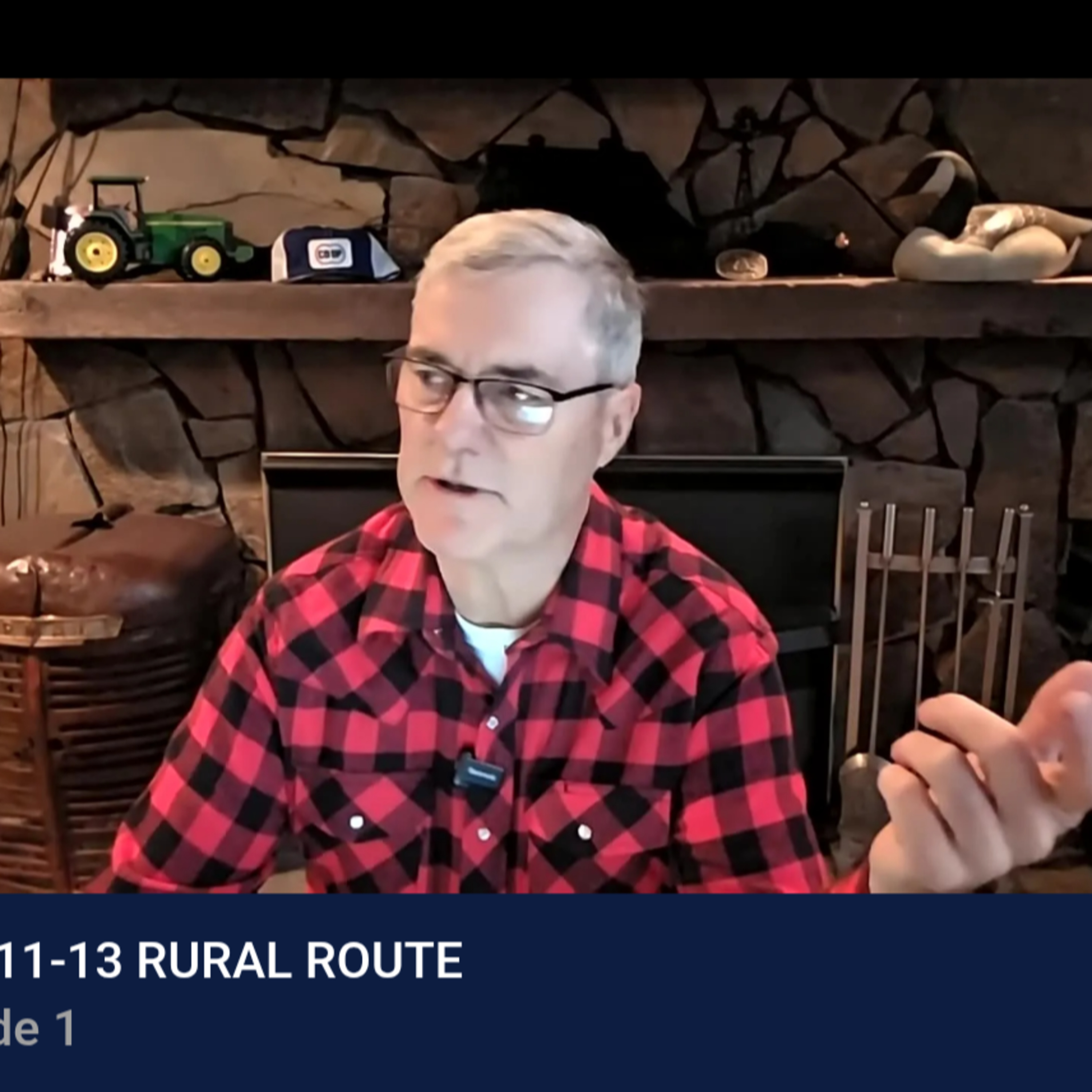
Kevin Kenney a Bio Fuels System engineer from Grand Island has done a deep dive into the IRS code that gives tax credits to dairies and feedyards with 7 times the value of the natural gas.
Getting ROSC is only the beginning. In Part 2 of our cardiac arrest series, we tackle what happens after pulses return, when real-world resuscitation may require thinking beyond the standard ACLS algorithm, and how to interpret ECGs in the evolving post-arrest period. Want to experience the greatest in board and CME studying? Check out our interactive question bank podcast- the FIRST of its kind here (http://emboardbombs.com/interactive-question-bank/) Cite this podcast as: Briggs, Blake; Wosiski-Kuhn, Marlena. 297. Cardiac Arrest Part 2: ROSC, ACLS deviations and post-arrest EKGs. November 16, 2026. Accessed [date]. Check out our Youtube channel! (https://www.youtube.com/@emboardbombs)
Hank gets down to the nitty-gritty about meiosis, the special type of cell division that is necessary for sexual reproduction in eukaryotic organisms. References: https://www.genome.gov/Glossary/index.cfm?p=viewimage&id=33 (https://www.genome.gov/Glossary/index.cfm?id=33&p=viewimage) Table of Contents 1) Homologous Chromosome Pairs 2:10 2) Primary Oocytes 3:30 3) Primary Spermatocytes 3:30 4) Meiosis 2:59 5) Interphase I 4:04 6) Prophase I 4:37 a) Crossover 5:05 b) Recombination 5:05 7) Metaphase I 7:53 8) Anaphase I 8:05 9) Telophase I 8:19 10) Prophase II 8:57 11) Metaphase II 9:23 12) Anaphase II 9:28 13) Telophase II 9:32 Crash Course is on Patreon! Want to find Crash Course elsewhere on the internet? Facebook - http://www.facebook.com/YouTubeCrashCourse Twitter - http://www.twitter.com/TheCrashCourse Instagram - https://www.instagram.com/thecrashcourse/ CC Kids: http://www.youtube.com/crashcoursekids
Dig into the Prohibition era in the United States, when the government banned the manufacture, sale, and transport of alcohol. Uploaded 09-07-20 -- On January 17, 1920, less than one hour after spirits had become illegal throughout the United States, armed men robbed a Chicago freight train and made off with thousands of dollars worth of whiskey. It was a first taste of the unintended consequences of Prohibition. So what exactly was Prohibition, and why did it happen? Rod Phillips investigates this chapter of American history. Lesson by Rod Phillips, directed by Gibbons Studio. Animator's website: http://www.gibbonsstudio.net/ Sign up for our newsletter: http://bit.ly/TEDEdNewsletter Support us on Patreon: http://bit.ly/TEDEdPatreon Find us on Twitter: http://bit.ly/TEDEdTwitter Peep us on Instagram: http://bit.ly/TEDEdInstagram View full lesson: https://ed.ted.com/lessons/what-happened-when-the-united-states-tried-to-ban-alcohol-rod-phillips Thank you so much to our patrons for your s
In this episode of The Acres U.S.A. Podcast host Taylor Henry sits down with renowned plant pathologist and former Purdue University professor Dr. Don Huber for an in-depth conversation about glyphosate, soil health, plant nutrition, and the future of American agriculture. Drawing on more than 60 years of research and experience, Dr. Huber shares his concerns about the long-term impacts of glyphosate on soil biology, nutrient availability, crop diseases, and human health. He discusses the role of essential minerals in plant health, the potential for biological approaches to address glyphosate residues, and why he believes conventional agriculture has overlooked important connections between soil fertility and disease. The conversation also explores Dr. Huber's remarkable career, including his work in military intelligence, agricultural biological defense, and plant pathology. He reflects on the challenges and opposition he has faced throughout his research career and the importance of
Dr. Don and Professor Ben talk about the risks from using found mischief night toilet paper for it's intended purpose. Dr. Don - not risky Professor Ben - not risky Mischief Night - Wikipedia (https://en.wikipedia.org/wiki/Mischief_Night) Mischief Night, Goosey Night, Cabbage Night history in NJ (https://www.northjersey.com/story/news/new-jersey/2026/10/30/mischief-night-goosey-night-cabbage-night-history-nj/92511651007/?gca-cat=p&gca-ds=sophi&gca-epti=z113801p002650l002550c002650e1194xxv113801d--68--b--68--&gca-ft=157&gca-uir=true&gnt-cfr=1) Wiping the Habit An interdisciplinary research on the alteration of the environmentally harmful human activities revolving around the use of toilet papert (https://studenttheses.uu.nl/server/api/core/bitstreams/bfc1dd48-7f4d-4f92-b1f0-ad7e7514bb5b/content) Journal of Clinical Gastroenterology and Hepatology Research (https://www.pubtexto.com/journals/journal-of-clinical-gastroenterology-and-hepatology-research/fulltext/the-butt-to-wipe-or-not-to-w
In 1878, a quiet household in Amherst, Nova Scotia, became the center of one of the nineteenth century's most extraordinary alleged hauntings. It began with strange scratching sounds and unexplained knocking. But soon, furniture was reportedly moving on its own, objects were flying through rooms, and a threatening message appeared on a wall. At the center of it all was eighteen-year-old Esther Cox. As the disturbances grew increasingly violent, witnesses came forward, a physician became involved, and an investigator arrived determined to uncover the truth. But the most troubling detail was that the activity seemed to follow Esther wherever she went. Was she the victim of a terrifying poltergeist, the center of an elaborate deception, or someone experiencing something that couldn't be explained? And why, after months of increasingly dangerous incidents, did it all suddenly stop? #RealGhostStoriesOnline #TheGreatAmherstMystery #EstherCox #AmherstPoltergeist #TrueHauntings #HistoricalHaun
Could a new gene therapy slow the progression of Huntington’s disease? Early results suggested an astonishing 80% reduction in disease progression. But there’s a catch: the evidence comes from just a handful of treated patients, compared with patients from an entirely different study. How can we know whether we're comparing like with like? We dig into the science behind the treatment, the statistical challenges of finding a fair comparison group, and the heated controversy between the drug company and the FDA. Along the way, we take a statistical detour into propensity score matching—and wrestle with a difficult question: How much evidence should we demand when patients are running out of time? Statistical topics External control groups Randomized controlled trials Sham surgery controls Propensity scores Restricted full propensity score matching Inverse probability of treatment weighting (IPTW) Confounding Selection bias Methodologic Morals “Seventeen patients is still 17 patients, no
Hosted by: Fraser Cain (@frasercain (https://www.youtube.com/@frasercain)) and Dr. Pamela L. Gay (@CosmoQuest (https://www.youtube.com/@CosmoQuest)) Fraser & Pamela interview Dr. Ethan Siegel in a Gyoza restaurant in Tokyo. We basically discuss everything in the current state of cosmology! Every bit helps! Thank you! ------------------------------------ Thank you! (Haven't donated? It's not too late! Just click (http://cosmoquest.org/Donate)!) ------------------------------------
An update on the H5N1 Avian Influenza, including a discovery that it's been growing rapidly on a mink farm in Utah, where officials chose to do nothing about it. A potential spillover event, should one occur, is expected to initiate in an environment such as this. Bird Flu Is Raging on a Mink Farm. It Could Spark a Human Pandemic, Experts Say, but Officials Won’t Act. — ProPublica (https://www.propublica.org/article/bird-flu-mink-farm-utah-human-risk) OR Bird flu: Avian influenza detected in Oregon dairy cattle for first time, officials say (https://www.koin.com/news/oregon/bird-flu-detected-in-oregon-dairy-cattle-for-first-time-officials-say/) Farm Workers Sound Alarm on Underreported Bird Flu Numbers - Newsweek (https://www.newsweek.com/farm-workers-sound-alarm-on-underreported-bird-flu-numbers-12698834) Bird flu has caused catastrophic die-offs – could a wave of extinctions follow? | Bird flu | The Guardian (https://www.theguardian.com/environment/2026/nov/11/wildlife-bird-flu-kille
This is a Grave Talks CLASSIC EPISODE! PART TWO Built in 1722 by Robert Field, White Hill Mansion has stood for more than three centuries in Fieldsboro. During the American Revolution, Mary Peel Field welcomed both Colonial and Hessian troops, a strategic decision that spared the mansion from destruction while conflict raged around it. In the years that followed, the estate sheltered more than soldiers. Its long history includes rumored ties to smugglers and gangsters, along with generations of residents whose lives left their imprint on the structure. Today, it is regarded as one of New Jersey’s most haunted locations. Visitors and investigators report shadow figures moving through hallways, sudden cold spots, disembodied voices, and an atmosphere that feels persistently occupied. Accounts shared by Dawn Reichard connect documented history with ongoing activity, suggesting the mansion never truly emptied. At White Hill Mansion, the past doesn’t sit quietly — it lingers. #TheGraveTalks
The history of science is always fascinating, and the history of medicine surely has some of the best stories. In this episode we talk to writer Lindsey Fitzharris about two of them. First, the story of Scottish surgeon Joseph Bell, who was both a pioneer of forensic pathology and the inspiration for Sherlock Holmes (whose author, Arthur Conan Doyle, took classes with Bell as a medical student). Second, the story of Harold Gillies, the World War II doctor who pioneered reconstructive surgery. Bell is the subject of Fitzharris's new book Sleuth-Hound (https://drlindseyfitzharris.com/sleuth-hound/), while Gillies is the subject of her previous book The Facemaker (https://drlindseyfitzharris.com/facemaker/). Blog post with transcript: https://preposterousuniverse.com/podcast/2026/11/16/374-lindsey-fitzharris-on-forensic-pathology-reconstructive-surgery-and-sherlock-holmes/ Stop piecing your software together. Go to https://odoo.com/mindscape to learn more. #ad Upgrade your everyday with Q
Forget Quantum-Thermodynamic Computing-Extropic + Robots is the way of the future! Episode release date: 9 Aug 2024 Core Ideas: Metamodernism: Narratives and emergence view of reality - Reduce suffering - Increase prosperity - Increase understanding mantra: Seek knowledge. DISCLAIMER: This is a community-driven show. ---- Keywords: ai innovation, david shapiro, superintelligence, chatbots, machine autonomy
Hank describes how cells regulate their contents and communicate with one another via mechanisms within the cell membrane. "Concert" music used with permission from Chameleon Circuit. This video uses sounds from Freesound.org Table of Contents time codes: 1) Passive Transport - 1:17 2) Diffusion - 1:25 3) Osmosis - 2:12 4) Channel Proteins- 4:37 5) Active Transport - 4:58 6) ATP - 5:37 7) Transport Proteins - 6:19 8) Biolography - 6:37 9) Vesicular Transport - 9:02 10) Exocytosis - 9:21 11) Endocytosis - 9:50 12) Phagocytosis - 9:57 13) Pinocytosis - 10:29 14) Receptor-Mediated Endocytosis - 10:48 Crash Course is on Patreon! Want to find Crash Course elsewhere on the internet? Facebook - http://www.facebook.com/YouTubeCrashCourse Twitter - http://www.twitter.com/TheCrashCourse Instagram - https://www.instagram.com/thecrashcourse/ CC Kids: http://www.youtube.com/crashcoursekids
View full lesson here: http://ed.ted.com/lessons/mark-salata-how-taking-a-bath-led-to-archimedes-principle Stories of discovery and invention often begin with a problem that needs solving. Summoned by the king to investigate a suspicious goldsmith, the early Greek mathematician Archimedes stumbles upon the principle that would make him famous. Lesson by Amdon Consulting's Mark Salata, animation by TED-Ed.
AI capabilities are improving fast. But will the economy move just as quickly? a16z General Partner Erik Torenberg sits down with Google DeepMind economist Alex Imas and economist Tyler Cowen to examine how advances in AI translate into growth, jobs, wages, and productivity. They debate what it would take to reach double-digit economic growth, why bottlenecks and falling AI costs could slow the impact, and whether frontier lab valuations require much larger productivity gains. They also explore the “economics of intelligence,” including why the bigger shift may come not from smarter individual agents, but from AI agents learning to coordinate at scale. Resources: Follow Alex Imas on X:https://x.com/alexolegimas Follow Tyler Cowen on X:https://x.com/tylercowen Follow Erik Torenberg on X:https://x.com/eriktorenberg Stay Updated: Find a16z on YouTube: YouTube (https://www.youtube.com/@a16z) Find a16z on X (https://x.com/a16z) Find a16z onLinkedIn (https://www.linkedin.com/company/a16z) Fo
Could a 16th-century Frenchman who spent two decades in a tower library be the first blogger? And could Tyler Cowen achieve immortality not through his books, but because AI has digested everything he’s ever said? Economist Tyler Cowen joins EconTalk’s Russ Roberts to explore the essays of Michel de Montaigne. They discuss what Montaigne got right about education (hire a tutor with a well-formed, not a well-filled, brain) and what he may have gotten wrong about material progress and growth. Along the way: Larry David, Torah study, kidney stones, Cowen’s odds of living to 120, why you should befriend people ten years younger, and Montaigne’s deceptively simple wisdom: when I dance, I dance.
Today we are introducing a new area of philosophy – philosophy of religion. We are starting this unit off with Anselm’s argument for God’s existence, while also considering objections to that argument. -- “That’s a Neigh” David Goehring https://www.flickr.com/photos/carbonnyc/8757020626 All other images via Wikimedia Commons, licensed under Creative Commons by 4.0: https://creativecommons.org/licenses/by/4.0/ -- Produced in collaboration with PBS Digital Studios: http://youtube.com/pbsdigitalstudios Crash Course Philosophy is sponsored by Squarespace. -- Want to find Crash Course elsewhere on the internet? Facebook - http://www.facebook.com/YouTubeCrashC... Twitter - http://www.twitter.com/TheCrashCourse Tumblr - http://thecrashcourse.tumblr.com (http://thecrashcourse.tumblr.com/) Support CrashCourse on Patreon: http://www.patreon.com/crashcourse CC Kids: http://www.youtube.com/crashcoursekids
China wants to equip its nukes with AI??? Maybe... But let's unpack this Episode release date: 12 Sep 2024 Core Ideas: Metamodernism: Narratives and emergence view of reality - Reduce suffering - Increase prosperity - Increase understanding mantra: Seek knowledge. DISCLAIMER: This is a community-driven show. ------ Keywords: machine learning, tech singularity, ai masterclass
We’re all gonna die someday. But can statistics help us know when? In this episode of Crash Course Scientific Thinking, we’ll learn how to interpret the statistics we see in our daily lives. And we’ll explore why we need stats to make informed judgments, be more precise about what we don’t know, and get closer to what we can know. Introduction: When Will I Die? 00:00 Basic Statistics 0:44 Confidence Intervals 4:14 Relative & Absolute Risk 5:32 Correlation vs. Causation 7:22 Review & Credits 9:45 Sources: https://docs.google.com/document/d/1Kv2_mFsDxQURuFDxpflD45dy-pCxlqnM9iPSNYxigmQ/edit?tab=t.0#heading=h.vk5i2fgqyumq (https://docs.google.com/document/d/1Kv2_mFsDxQURuFDxpflD45dy-pCxlqnM9iPSNYxigmQ/edit?tab=t.0) *** Support us for $5/month on Patreon to keep Crash Course free for everyone forever! https://www.patreon.com/crashcourse Or support us directly: https://complexly.com/support Join our Crash Course email list to get the latest news and highlights: https://mailchi.mp/crashcourse
View full lesson: http://ed.ted.com/lessons/how-bees-help-plants-have-sex-fernanda-s-valdovinos Uploaded 17-06-14 Plants have a hard time finding mates -- their inability to get up and move around tends to inhibit them. Luckily for plants, bees and other pollinator species (including butterflies, moths and birds) help matchmake these lonely plants in exchange for food. Fernanda S. Valdovinos explains how these intricate pollination networks work and how it can all change from one season to the next. Lesson by Fernanda S. Valdovinos, animation by The Moving Company Animation Studio.
Deep beneath the French-Swiss border, the Large Hadron Collider accelerates trillions of protons to nearly the speed of light to probe the most infinitesimal components of reality. In this episode, we explore the deeply ambiguous question: What is the smallest particle in the universe? We trace the historic journey from J.J. Thomson’s 1897 discovery of the electron in cathode-ray tubes—proving that atoms are not indivisible—to James Chadwick’s 1932 identification of the elusive neutron. We examine the Standard Model's architecture of fermions and bosons, confronting the counterintuitive reality that fundamental particles have no physical volume, operating instead as zero-dimensional geometric points or excitations in pervasive fields. We trace how mass serves as the ultimate measure of smallness, culminating in the monumental July 4, 2012 discovery of the Higgs boson at CERN. Finally, we investigate the featherweights of the cosmos—from massless photons and gluons to neutrinos, whose u
Fortean Fifty: Indiana Indiana might be known for its cornfields and small towns, but hidden throughout the Hoosier State are some truly bizarre stories. From the terrifying Beast of Boonville and the mysterious Grey Lady haunting Willard Library to an enormous, one-eyed creature floating through the skies above Crawfordsville, Indiana has no shortage of unexplained encounters. This week, Holosky continues its Fortean Fifty journey with tales of giant turtles, strange tentacled creatures discovered in wells and industrial sludge pits, and the disturbing legends of the Ohio River's mysterious Mud Mermaids. Are these encounters forgotten pieces of American folklore, elaborate hoaxes, or evidence of something genuinely unexplained? Stay Safe • Stay Weird. Facebook and Twitter @holoskypodcast Instagram @ theholoskypodcast The number is going to be 1 (618) 556-0837 If you want to send us weird shit then please do! Holosky Podcast P.O. Box 145 Fieldon, IL 62031 https://discord.gg/GFsbY92NgU