Hands-On AI is the show that turns AI confusion into AI confidence. In this trailer, Mikah Sargent lays out what the show is and isn't: short, focused episodes — most 10 to 15 minutes — that take one question, one tool, or one technique at a time. Some weeks go under the hood on what a large language model is actually doing. Some weeks get practical: the AI already in your pocket, or a model running entirely on your own computer. And some weeks are honest verdicts on the tools everyone's talking about.
Thesis: 2027 is made possible by our founding partners, Lovable and Notion. Lovable is the fastest way to turn ideas into software people love: https://link.lovable.dev/every Notion is the collaborative AI workspace where teams and agents work side by side: https://www.notion.com/?utm_source=youtube&utm_campaign=thesis-2027&utm_content=every-261111-video (https://www.notion.com/) What does great human work look like after automation? It’s a question we try to answer every day at Every, and the one we built our conference, Thesis, around. In his closing keynote, Dan Shipper argues that as AI makes intelligence cheap and widely available, what matters most is human perspective. It’s your “non-consensus” point of view, plus your responsibility for a particular corner of the world, that helps you spot the insight no one else would. On this week’s episode of The Every Podcast, we’re sharing Dan’s full talk at Thesis: 2027. Dan explains why benchmark charts make the future of work look bleak
Pollster Mark Mitchell called the midterm blue wave months early, and he breaks down why the Trump administration still refuses to pivot. Mark explains how independents broke 20 points for Democrats, which pollsters got it right and wrong, and how Susie Wiles and the consultant class shielded special interests while killing DOGE. We cover Nick Fuentes and the young right, the Iran war fallout, a stealth depression squeezing younger Americans, AI and deflation risk, and why Mark thinks the Republican Party can't be fixed. Mark on X: https://x.com/honestpollster The Honest Poll: https://www.thehonestpoll.com/ STACK SATS hat: https://tftcmerch.io/ Our newsletter: https://www.tftc.io/bitcoin-brief/ Discord: https://discord.gg/yHGkvYxdqT Opportunity Cost Extension: https://www.opportunitycost.app/ Shoutout to our sponsors: Block: Terms apply. Bitcoin services by Block, Inc. See the Bitcoin disclosures at cash.app/legal/podcast. Aven CrowdHealth Simple Mining Salt of the Earth: Join the TFTC
Explore the psychology behind why children invent imaginary companions and what skills they can develop through pretend play. -- Amia and her friend Zelba have been inseparable for nearly a year. They share secrets, play games, and rule over imaginary kingdoms. Amia sometimes has bad ideas, and Zelba goes along with them anyway. Amia is very real, but Zelba... is not. So, what leads kids to create these fictional figures? Explore why children invent imaginary companions and what skills they can develop through pretend play. Directed by Caitlin McCarthy. This video made possible in collaboration with the LEGO Group and the LEGO Foundation Learn more about how TED-Ed partnerships work: https://bit.ly/TEDEdPartner Support Our Non-Profit Mission ---------------------------------------------- Support us on Patreon: http://bit.ly/TEDEdPatreon Check out our merch: http://bit.ly/TEDEDShop ---------------------------------------------- Connect With Us -------------------------------------------
We are once again back to taking your questions on The Vergecast Hotline! (Call 866-VERGE11, or email [email protected].) This time, David has some thoughts on Apple's new product launch strategy, the impossible task of building a modular operating system, and more. Also: a theory on the word "theory." We love hearing from you!
AI News Flash for November 11, 2026 at 15:00 UTC. Topics: 1. Google DeepMind's AlphaGenome 2 predicts DNA variant effects by cell type 2. Nvidia's GR00T 2 robot foundation model 3. Links to apps built with Grok were discoverable by third parties
Earlier this year it looked like AI might kill programming language innovation. Coding agents were at their best in the mainstream languages with decades of training data, which made the barrier to adopting anything new higher than ever. That's changed. With the right skills files, an agent will write Haskell or Gleam as happily as Java, and that flips the situation on its head: it's never been cheaper to take a new language, or a new architecture, out for a test drive. All we need is ideas worth trying. So this week I'm joined by an enthusiastic proponent of a language, an architecture and a library you might want to try. Cameron Barré is a long-time Clojure programmer and the author of Grain, an open-source library for building event-sourced information systems. We start with what makes a system simple or complex, and the difference between essential and accidental complexity. Then we look at why Cameron thinks Lisp is an excellent choice for expressing both code and constraints, and
The oil displaced by EVs worldwide was worth around 20 billion US dollars. That figure covers the first six months of the year, not a full year. I explain the connection between Australia's petrol price shock, buyers choosing electric cars and reduced dependence on overseas fuel suppliers.
Fevzi Turkalp, the Gadget Detective, joins Clive Bull on LBC to discuss the latest tech news and reviews. On this week's show; OpenAI CEO Sam Altman causes controversy by saying consumers should stop buying ram so that it can be used by AI companies, such as his. How reasonable is he being, given many of these companies can't even use the ram they're buying up and it's sitting in storage? Gadget of the Week goes to; Kioxia Exceria G3 M.2 NVMe SSD. This cost effective SSD storage slots into your computer, game console, or even an external enclosure to offer blisteringly fast storage, available in 1,2 and 4tb sizes to suite your needs. You can hear the Gadget Detective on LBC every Friday morning around 3.40am and you can follow and contact him on X @gadgetdetective and BlueSky @GadgetDetective.com #Fevzi #Turkalp #Gadget #Detective #Tech #Technology #News #Reviews #Help #Advice #Clive #Bull #LBC #Radio #Sam #Altman #OpenAI #ChatGPT #AI #Artificial #Intelligence #Ram #Chips #Storage #Pod
Trace the history of how wolves, one of humanity’s oldest rivals, evolved into the domesticated dogs we call “man’s best friend.” Uploaded 26-03-19 -- Since their emergence over 200,000 years ago, modern humans have established communities all over the planet. But they didn’t do it alone. Whatever corner of the globe you find humans in today, you’re likely to find another species as well: dogs. So how did one of our oldest rivals, the wolf, evolve into man’s best friend? David Ian Howe traces the history of humanity’s first domesticated animal. Lesson by David Ian Howe, directed by Cabong Studios. Sign up for our newsletter: http://bit.ly/TEDEdNewsletter Support us on Patreon: http://bit.ly/TEDEdPatreon Find us on Twitter: http://bit.ly/TEDEdTwitter Peep us on Instagram: http://bit.ly/TEDEdInstagram View full lesson: https://ed.ted.com/lessons/a-brief-history-of-dogs-david-ian-howe Thank you so much to our patrons for your support! Without you this video would not be possible! Javier L
More than 90 of Ethiopia's electricity comes from renewable energy, mostly hydro. For drivers, replacing imported petrol with locally generated electricity means lower running costs; I explain why saving money drove the ban. I also unpack the limits: charging remains concentrated in the capital, blackouts occur, and around 85 million Ethiopians still have no electricity.%
Ian and Aaron discuss Ian's struggles with Stripe, Caleb's breaking news about Flux for React, Fable 5.2, and more. Interested in sponsoring Mostly Technical? Head to https://mostlytechnical.com/sponsor to learn more. (00:00) - Stripe Is The Worst (13:55) - Token Burner 3000 (22:34) - Kindergarten Campout (34:10) - Big Laravel Day (44:11) - Flux for React (01:05:22) - AI At The Ballot Box Links:Stripe Connect (https://stripe.com/connect) Fable 5.2 (https://www.anthropic.com/claude/fable) Possum Kingdom Lake (https://brazos.org/About-Us/Reservoirs/Possum-Kingdom-Lake) Vuori Joggers (https://vuoriclothing.com/products/sunday-performance-jogger) Away Suitcase (https://www.awaytravel.com/shop/suitcases) Caleb’s tweet about Flux for React (https://x.com/calebporzio/status/2120146675956105530) Wes Bos (https://x.com/wesbos) Kent C. Dodds (https://x.com/kentcdodds) PartyKit (https://partykit.io/) Dillon Mulroy (https://x.com/dillon_mulroy) Kelsey Hightower (https://x.com/kelseyhightower) Vice
Uploaded 03-04-18 View full lesson: https://ed.ted.com/lessons/a-simple-way-to-tell-insects-apart-anika-hazra There are nearly a million known insect species in the world, but most have one of just five common types of mouthparts. Why is this information useful to scientists? Anika Hazra explains how the features of an insect’s mouthparts can help identify which order it belongs to, while also providing clues about how it evolved and what it feeds on. Lesson by Anika Hazra, animation by Giulia Martinelli. Thank you so much to our patrons for your support! Without you this video would not be possible! Mayra Urbano, Kostadin Mandulov, Alex Schenkman, Sdiep Sriram, Ivan Todorović, Antero Semi, Yanuar Ashari, Mrinalini , Anthony Kudolo, Querida Owens, Hazel Lam, Manav parmar, Dwight Tevuk, Stephen A. Wilson, Siamak H, Dominik Kugelmann, Katie Winchester, David Rosario, Samuel Doerle, Be Owusu, Susan Herder, Savannah Scheelings, Prasanth Mathialagan, Yanira Santamaria, Chad Harper, Dawn Jor
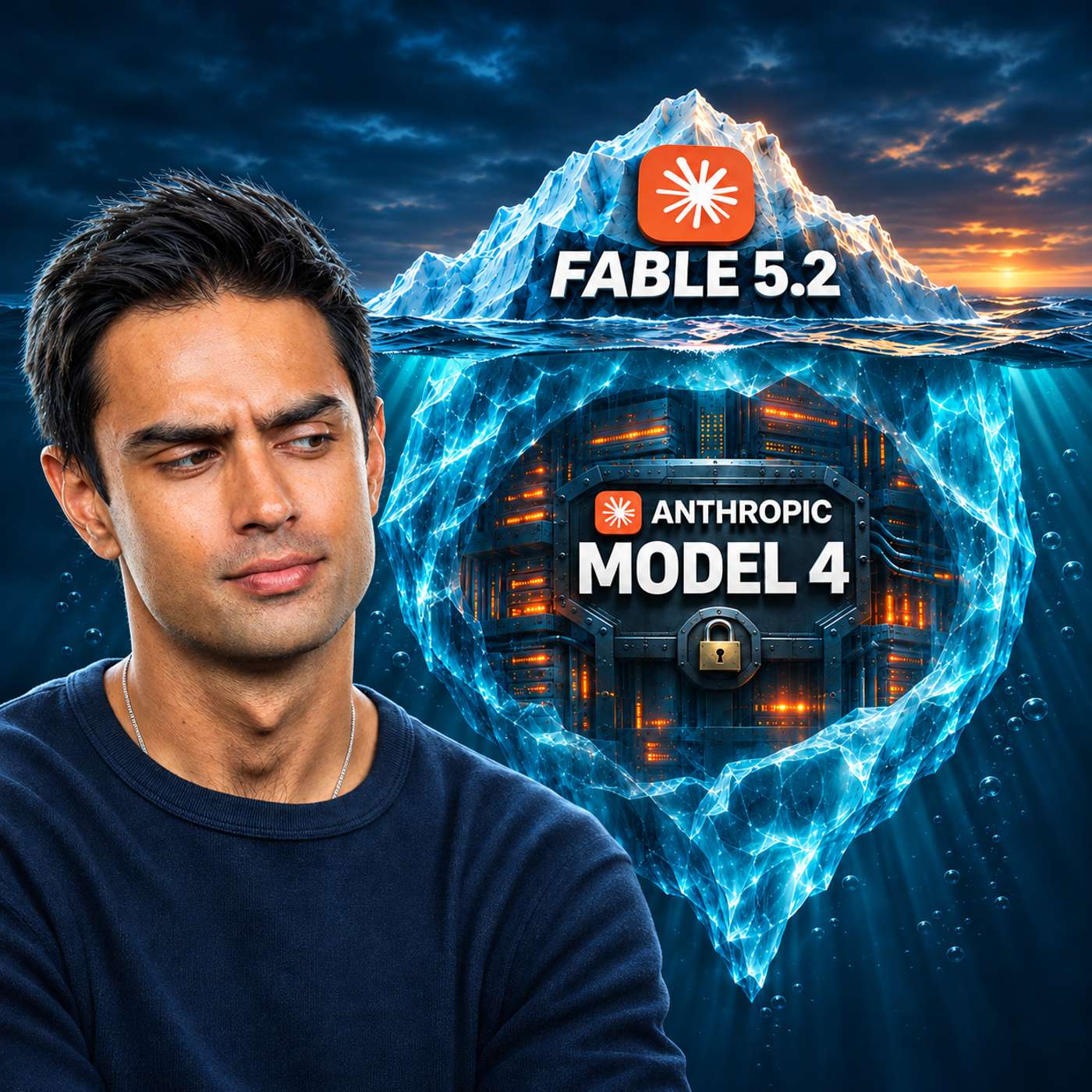
Anthropic just released Claude Fable 5.2, the new number one AI model in the world, and its own system card says it isn't Anthropic's most powerful model. Ejaaz breaks down what Fable 5.2 can actually do, from protein design and robots to remote work, AAA games built in minutes, visuals made entirely of code, a business plan from one prompt and an operating system built by 1,000 agents, and why Anthropic deliberately held back the model's ability to speed up AI research. We also cover the strategy behind the release: the growing gap between public and internal models, the METR review, the tit-for-tat race with OpenAI and GPT-6.2 Astra, and the new IPO terms (825 million shares at $70 to $78) as Anthropic heads into IPO week with the best model in the world. == FOLLOW EJAAZ ON TWITTER: == Timestamps 00:00 Anthropic Is Hiding Its Best AI 01:10 Why Release It Now? 03:35 How We Got Here 05:08 The Benchmarks 05:48 Built for Medicine 07:17 Robots 08:38 Remote Work 09:23 AAA Games in Minutes
Tesla says Cybercab avoids a paint line costing hundreds of millions of dollars. I explain the physical difference: the colour is moulded into the body panels rather than applied in a paint shop. That means the factory does not need the paint line at all; the saving comes from removing the process, not simply making it faster.
Get to know the story of Radio Venceremos, an underground radio collective that fought US-backed fascism during the Salvadoran Civil War. -- Since the 1800s, a handful of oligarchs had controlled nearly all of El Salvador’s land, forcing laborers to work for almost nothing. But in 1980, farmers and urban workers formed guerrilla groups to overthrow the US-backed dictatorship. These revolutionaries were attacked from every direction, but a group of rebels refused to be silenced. Diana Sierra Becerra shares the story of Radio Venceremos. Lesson by Diana Sierra Becerra, directed by Tomás Pichardo-Espaillat. Support Our Non-Profit Mission ---------------------------------------------- Support us on Patreon: http://bit.ly/TEDEdPatreon Check out our merch: http://bit.ly/TEDEDShop ---------------------------------------------- Connect With Us ---------------------------------------------- Sign up for our newsletter: http://bit.ly/TEDEdNewsletter Find us on Twitter: http://bit.ly/TEDEdTwitter
Explore API-driven IT advisory with CIO Analytics, a single platform to run your IT department that brings together your data, AI-powered analysis, and expert guidance to help you improve IT performance: https://www.infotech.com/cio-analytics?utm_source=youtube&utm_medium=social&utm_campaign=digitaldisruptionnow. Tech moves fast. So does work. Digital Disruption NOW helps you keep up and make sense of what matters. What happens when Big Tech depends too much on one person, and we depend too much on AI? This week we’re covering the Jensen Huang controversy, the backlash against AI data centers, and how AI coding tools could weaken critical thinking. In this episode: 00:00 Intro 01:35 Discussing the Jensen Huang controversy 02:57 Nvidia’s role in the AI economy 04:40 Big Tech’s founder problem and key person risk 09:40 Executive cybersecurity and the limits of zero trust 11:46 When personal decisions become business risks 13:05 Infotech CIO Analytics 14:01 A real-world lesson in executiv
Scott and Wes sit down with GitHub’s Kyle Daigle to ask what the hell is going on with GitHub: the downtime, the agent traffic spike, and the infrastructure overhaul decoupling storage from compute. Plus Copilot Fusion’s cascade and critique modes, npm supply chain security, and whether pull requests are dead. Show Notes 00:00 Welcome to Syntax! 00:07 What the Hell Is Going On with GitHub? 01:42 GitHub’s Growth by the Numbers: Billions of Commits a Month 03:36 Brought to you by Sentry! (https://sentry.io/syntax/) 04:00 GitHub’s Huge Infrastructure Update: Decoupling Storage from Compute 06:41 Moving to Azure and the Busy Monorepo Problem 09:00 Is CI the New Bottleneck? Rethinking Testing for Agents 11:01 Are Pull Requests Dead? Contributing Tokens Instead of Homework 13:16 GitHub Copilot App: Will We Ever Get Sign In with ChatGPT? 14:51 Is Copilot Fusion Just a Model Router? Cascade and Critique Modes 17:30 Can You Use Copilot Fusion in Other Harnesses? 18:31 What’s Going On with npm?
On this week's episode of The AmberMac Show: Amber and Jeff discuss Nvidia’s future after news broke about the CEO’s relationship with an alleged Chinese spy. Plus, the fall of Elon Musk’s Cybertruck, which major US government agency is still using floppy disks, why Instagram’s AI age detection is expanding globally, and more. Our first guest this week is The Wealthy Barber’s David Chilton, who joins us to share personal finance lessons from 40 years in the business and how he thinks AI is going to change how people both spend and save. Plus, ESET's Chief Cyber Security Officer Tony Anscombe unpacks how AI is transforming both cyberattacks and cybersecurity defences. Check out our guest on social… David Chilton - Personal Finance Advisor & Author of The Weatlhy Barber Tony Anscombe - Chief Security Evangelist of ESET Be sure to follow our hosts...
Scott Farrar is a math educator and parent who got tired of AI chats that drift and forget. So he built a household brain in Claude Code: a folder of Markdown files, viewed in Obsidian, that knows his appliances, warranties, insurance documents, and everything on his family’s to-do list. In this episode, Scott shows how he uses it to shop for car insurance, plan repairs, share the system with his wife, and put priority tasks and recent wins on a wall display. We also talk about AI and math learning, and why he wants AI to keep kids doing the thinking. What you’ll learn: Why he moved his home life from AI chat to Claude Code What Claude told him to photograph first How AI made him a sharper insurance shopper The to-do file he keeps coming back to How he and his wife share one household brain Why his wall display has a “recent wins” section How a flipped tutor gets kids to teach the AI — Brought to you by: Jira Product Discovery (https://atlassian.com/howiai)—Prioritize with insights, bu
Vijoy Pandey, SVP and GM of Outshift by Cisco, discusses the challenges of multi-agent systems and Cisco's new open-source protocols designed to help AI agents collaborate effectively. He explains how tools like Scope, Accord, and Concord address semantic misalignments, intent negotiation, and cognitive failures across complex workflows. The conversation also dives into personal agent setups, avoiding model lock-in, and the rise of latent space communication. Finally, Pandey shares why proper guardrails will ensure humanity benefits as autonomous systems grow in complexity. Lovable: Lovable is the software creation platform that brings your ideas to life with enterprise-grade infrastructure and flexible AI coding agents. Start building your next project today at https://lovable.com (https://lovable.com/) Visit https://fruitopia.ai (https://fruitopia.ai/) to explore more than 400 fruits, and more than 8000 varieties, from all around the world. Get started and discover Claude Pro at http
How does a top 100 Hyperliquid trader find opportunities without blowing up? David Hoffman sits down with KoolKrypto to unpack his risk-first approach to perps, how he spots mispriced DeFi tokens, and why buybacks change the investment case. They debate the upside of Hyperliquid versus Lighter, the bull and bear cases for Zcash, and why crypto options could become the next major growth market. Plus, how a changing macro environment could set up crypto's next inflection point. --- SPOTIFY PREMIUM RSS FEED | USE CODE: SPOTIFY24 --- BANKLESS SPONSOR TOOLS: NEAR | TRADE CONFIDENTIALLY, GET 20% BACK RIPIO | LOCAL CURRENCIES, ONCHAIN ️VIZOR | THE WALLET ZCASH DEVS USE THE DEFI REPORT | ONCHAIN INSIGHTS --- TIMESTAMPS 0:00 Trading Without Blowing Up 05:25 KoolKrypto and the Revenue Meta 10:53 The Bull and Bear Cases for Zcash 24:16 Options vs. Perps 30:08 Valuing Crypto Exchange Tokens 37:09 Hyperliquid vs. Lighter 47:17 The Crypto Options Wars 56:55 The Next Crypto Inflection Point --- RESOU
Your AI chatbot thinks your ideas are brilliant. That might be the problem. In this episode of Generative AI 101, host Emily Laird examines AI sycophancy, the tendency of chatbots to agree with users even when they're wrong, and how that false validation can undermine critical thinking. Learn how to turn AI into a constructive critic using a simple pre-mortem technique that challenges your assumptions before they become expensive mistakes. JOIN THE AI WEEKLY MEETUPS EMAIL REMINDERS FOR THE MEETUPS CONNECT WITH EMILY LAIRD ON LINKEDIN
Alberto Arrighi and Max Poff from Stack AI break down what it actually takes to push enterprise AI agents into production at scale. They discuss moving beyond simple chat demos, securing air-gapped deployments for defense contractors, and their timeline for embodied intelligence. Follow MTS: Spotify |https://open.spotify.com/show/4HUNNmV1pjV7CW6Lphm1rM Apple |https://podcasts.apple.com/us/podcast/mts/id1891088763 Interested in sponsoring the show? [email protected] – Brought to you by: Mongo DB - Anyone can prototype an agent. Lovable - Turn ideas into software people love with Lovable. Start today at https://lovable.dev/ Visithttps://factory.com/ Neon (by Databricks) - Scale your startup on Neon. The Postgres backend for apps and agents. Head over to http://getvcx.com (http://getvcx.com/) to learn more Kong - The AI connectivity platform. Larridin - Finally prove what your AI investment is worth. Ship 5x faster. https://blitzy.com (https://blitzy.com/) AdQuick - Make your brand a billb