1124 - 5 Natural Ways to Talk About Something Difficult
10 min
Listen through the publisher, then discuss the episode here or arrange an in-person Roundtable. Your city determines where to meet.
Roundtables are designed for groups of four, with a shared subject and room for everyone to speak. Come for discussion, with no dating expectation.
I’m having trouble with this. I mean I’m really struggling with it. Like, I'm trying, but I can’t seem to figure it out. When something is difficult, there are a lot of natural ways to talk about what you’re experiencing. Some expressions focus on the problem, some focus on your effort, and one of them shows that things are finally starting to improve. So today, we’re going to look at five natural ways to talk about something difficult in everyday English. The Happy English Podcast Helping people speak English better since 2014 Over 1,000 episodes • 8 million downloads Learn more about my English lessons and courses https://www.myhappyenglish.com (https://www.myhappyenglish.com/)
Episode information is provided by the publisher. Listening takes place on the publisher’s service.
There's no how-to for this human experience and certainly none for being a woman. But there are patterns, seasons, and chapters, each with its own gift and its own invitation. In this heartfelt reflection, Sage Robbins shares what the decades have taught her: the innocence of her younger years, the humbling health awakening of her 40s, and the gradual coming home to herself that she calls the most authentic chapter of her life. Uploaded 07-10-26 Watch more videos like this How Sage and Tony Robbins Finally Became Parents After 20 Years of Trying: https://youtu.be/oUx3Uj9rUTc 5 Simple Ways to Feel More Peaceful Every Day: https://youtu.be/NaYILgJK15g You're Not Broken, You're Just Living the Wrong Identity: https://youtu.be/pqMOp4ROz1E How to Free Yourself from Difficult Emotions: https://youtu.be/hwsHxLR259M Join my weekly newsletter 'The Mirror' to receive these exclusive videos each week: https://www.sagerobbins.com (https://www.sagerobbins.com/) Follow Sage Robbins: Instagram: https
Thanks to Brilliant for supporting PBS. Learn more at: https://brilliant.org/spacetime Uploaded 17-12-19 PBS Member Stations rely on viewers like you. To support your local station, go to: http://to.pbs.org/DonateSPACE What if every single black hole that formed in our universe sparked the big bang of a new universe? Cosmological natural selection proposes exactly this - but even better, it claims to be able to test the hypothesis. Sign Up on Patreon to get access to the Space Time Discord! Check out the Space Time Merch Store Physicists have been struggling for some time to figure out why our universe is so comfy. Why, for example, are the fundamental constants - like the mass of the electron or the strength of the forces - just right for the emergence of life? Tweak them too much and life, stars, galaxies, the universe as we know it wouldn’t exist. In recent episodes we explored one possible explanation for this - the anthropic principle and the idea of the multiverse. If there are c
In this Jim Rohn Motivation video, we unpack the real meaning of resilience—not as something you're born with, but something you build. It’s not about pretending life is easy. It’s about developing the mindset, discipline, and strength to keep going when everything in you says stop. Key Topics From This Motivational Video: Resilience as a skill, not a trait Taking full ownership of your life and mindset Reframing adversity into growth opportunities Emotional regulation and grounded self-talk Endurance, grit, and the decision to grow daily This Jim Rohn Motivational video reminds us that resilience doesn’t come from waiting for life to calm down—it comes from training your mind to rise in the middle of the chaos. It’s a mindset built on consistent ownership, reframed challenges, and the ability to lead yourself under pressure. Strength isn’t given. It’s earned—through the unseen decisions you make when no one is watching. This Jim Rohn Motivational Video Is Perfect For: Anyone feeling o
Happy Pot Luck Saturday! We talk Cary Grant, David Niven, Loretta Young, an angel with questionable intentions, and a Christmas movie that takes four nights to finish. We cover the 1947 classic The Bishop’s Wife and try to figure out how a film with five Oscar nominations earns only one and a half candy canes. We talk Cary Grant’s charm, David Niven’s stiff bishop, a wealthy widow who just wants to build a cathedral, and an angel who seems more interested in the bishop’s wife than saving Christmas. We talk Hollywood casting mistakes, Billy Wilder’s rewrites, and on-set tensions. We talk endless ice skating, glowing cathedrals, magically refilling bottles, self-decorating Christmas trees, and familiar faces from It’s a Wonderful Life. We talk Siskel and Ebert, critics who loved the wrong movies, and Kev rewriting the entire story into something we might actually want to watch. Plus, Whitney Houston and Denzel Washington in The Preacher’s Wife, Alastair Sim versus George C. Scott as Scro
What if success isn't something you chase, but something you attract through the person you become? Real success begins with personal growth, self discipline, and the value you bring to the world. Instead of constantly searching for shortcuts or waiting for opportunities, focus on developing the skills, mindset, and character that make meaningful achievements possible. This powerful motivational speech explores timeless principles of success, wealth creation, personal development, and the importance of becoming more valuable to others. Discover why your personal growth influences your results, how daily discipline shapes your future, and why helping others achieve their goals can become one of the most powerful foundations for your own success. In this motivational journey, you'll explore: • The Attraction Principle: Why success is connected to the person you become rather than simply what you pursue. • The Marketplace Rule: How developing valuable skills and contributing to others can
Join NCI University today to master human behavior and influence: Uploaded 20-10-22 What if we were made to believe something so strange that it would change the fabric of society? These two lies are the two most powerful forces that marketing and medicine....and even politics seem to sell us. 1️⃣ LIE ONE: Focus on symptoms and not causes. 2️⃣ LIE TWO: Pleasure is the same as happiness. In this video, I'll explore with you, the causes of some of these deceptions, and I hope you'll come to see that our culture is almost rooted in these two deceptions. From marketing and sales to medicine and politics, these LIES seem to be interwoven in the fabric of our culture as a whole. Knowing them and being aware of them will make you start seeing these EVERYWHERE you look. DOWNLOAD THE APP: https://team.chasehughes.com/share/Sxaxa8CW58Q_4sKk?utm_source=manual (https://team.chasehughes.com/share/Sxaxa8CW58Q_4sKk) THE FATE MODEL: https://www.youtube.com/watch?v=PbEJ_y7tscY&feature=share&utm_source=
It’s worth seeing. It’s worth the money. It’s not worth worrying about. Is it worth going? It’s worth it. Worth is a very useful word in everyday English, but the grammar after it can be surprising. We don’t say, “It’s worth to see.” We say, “It’s worth seeing.” So why do we use -ing after worth? And how can you use expressions like worth the money and worth it naturally? That’s what we’re going to look at today. The Happy English Podcast Helping people speak English better since 2014 Over 1,000 episodes • 8 million downloads Learn more about my English lessons and courses https://www.myhappyenglish.com (https://www.myhappyenglish.com/)
I had my hair cut. I had my car fixed. I got my phone repaired. I had Jenny fix my computer. Wait a minute. Why do we say I had my hair cut instead of something like I cut my hair, if another person actually did the work? And why can we also say I had Jenny fix my computer? These are two very useful patterns for talking about services and situations where another person does something for us. So today, we’re going to look at how you can use them naturally in everyday English. The Happy English Podcast Helping people speak English better since 2014 Over 1,000 episodes • 8 million downloads Learn more about my English lessons and courses https://www.myhappyenglish.com (https://www.myhappyenglish.com/)
Making decisions is part of everyday life, and depending on where you are in the decision-making process, there are different natural phrases you can use. So today, we’re going to look at five useful ways to talk about decisions in everyday English. These are: I haven’t decided yet. I’m still thinking about it. I’m leaning toward the blue one. I’ve made up my mind. It’s up to you. The Happy English Podcast Helping people speak English better since 2014 Over 1,000 episodes • 8 million downloads Learn more about my English lessons and courses https://www.myhappyenglish.com (https://www.myhappyenglish.com/)
Research announcements should give uncertainty as much attention as promising findings.
Share your view, then see how readers voted. No sign-in required. This poll is shared across stories.
Do you agree or disagree?
Common Quandary
A Common Quandary to discuss
Another conversation to explore, separate from this news story.
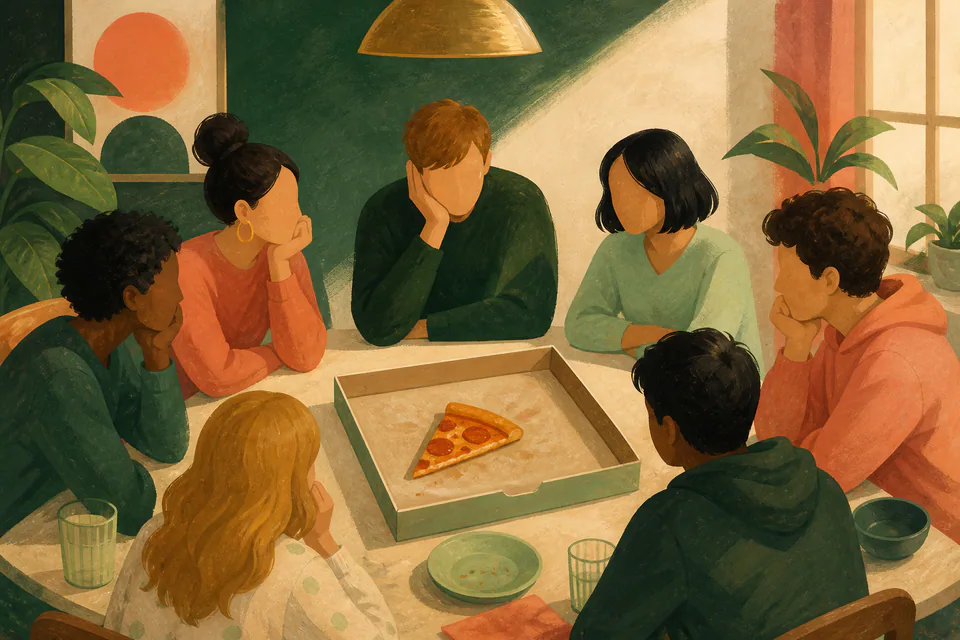
One slice of pizza remains and everyone is pretending not to want it. Can you take it?
Six friends have been circling the last slice of pizza for twenty minutes. Nobody claims it when you ask, yet two people keep glancing at the box. You are still hungry and paid the same share as everyone else.
Does politeness require leaving something that nobody will openly claim?