English-language podcasts

PBS Space Time

Do Black Holes Create New Universes?
24 min

Listen through the publisher, then discuss the episode here or arrange an in-person Roundtable. Your city determines where to meet.

Roundtables are designed for groups of four, with a shared subject and room for everyone to speak. Come for discussion, with no dating expectation.

Thanks to Brilliant for supporting PBS. Learn more at: https://brilliant.org/spacetime Uploaded 17-12-19 PBS Member Stations rely on viewers like you. To support your local station, go to: http://to.pbs.org/DonateSPACE What if every single black hole that formed in our universe sparked the big bang of a new universe? Cosmological natural selection proposes exactly this - but even better, it claims to be able to test the hypothesis. Sign Up on Patreon to get access to the Space Time Discord! Sign up for the mailing list to get episode notifications and hear special announcements! Check out the Space Time Merch Store Physicists have been struggling for some time to figure out why our universe is so comfy. Why, for example, are the fundamental constants - like the mass of the electron or the strength of the forces - just right for the emergence of life? Tweak them too much and life, stars, galaxies, the universe as we know it wouldn’t exist. In recent episodes we explored one possible explanation for this - the anthropic principle and the idea of the multiverse. If there are countless universes with different fundamental constants, then it’s not surprising that a few exist with the right numbers for life - and certainly not surprising that we find ourselves in one of those good ones. But if you don’t like the anthropic principle - and many scientists don’t - then rest assured, there’s an alternative. You only need to accept two things: that our universe formed inside a black hole, and that universes can evolve. Hosted by Matt O'Dowd Written by Matt O'Dowd Graphics by Leonardo Scholzer and Adriano Leal Directed by: Andrew Kornhaber Executive Producers: Eric Brown and Andrew Kornhaber End Credits Music by J.R.S. Schattenberg: https://www.youtube.com/channel/UCRl6-nb4iOnsij-vnpAjp0Q Special Thanks to our Patreon Sponsors: Big Bang Andrew and Brenna Alexander Tamas Craig Stonaha David Barnholdt David Nicklas Fabrice Eap John S Juan Benet Morgan Hough Quasar Mark Heising Vinnie Falco Hypernova Chuck Zegar Danton Spivey Donal Botkin Edmund Fokschaner Hank S John Hofmann John Pollock John R. Slavik Jordan Young Joseph Salomone Julian Tyacke Justin Ash Mathew Matthew O'Connor Syed Ansar Timothy McCulloch Gamma Ray Burst A G Adrian Hatch Adrien Molyneux AlecZero Andreas Nautsch Angela Prigge Bradley Jenkins Brandon labonte Dan Warren Daniel Lyons David Bethala DFaulk Eric Kiebler Frederic Simon Geoffrey Short Graydon Goss Greg Smith James Flowers Jamie Frederick John Funai John Griffith John Robinson Jonathan Nesfeder Joseph Dillman Josh Thomas Kevin Lee Kevin Warne Kyle Hofer Malte Ubl Michael Conroy Nick Virtue Nick Wright Patrick Sutton Paul Rose Robert Ilardi Scott Gossett Sean Warniaha Sipke Schoorstra Steve Bradshaw Tatiana Vorovchenko Tim Stephani Tonyface Yurii Konovaliuk

Episode information is provided by the publisher. Listening takes place on the publisher’s service.

Listen at the source ↗

Featured places to meet in Palo Alto, CA

Explore these places and arrange a conversation through ThinkMatch.

City guide for Palo Alto, CA

More from PBS Space Time

PBS Space Time

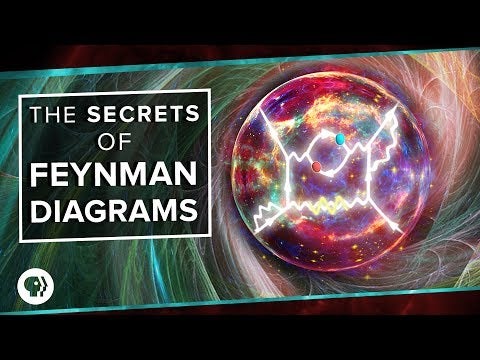
The Secrets of Feynman Diagrams

19 min

Viewers like you help make PBS (Thank you ) . Support your local PBS Member Station here: https://to.pbs.org/DonateSPACE Uploaded 26-07-17 Unlock the secrets of Feynman Diagrams. Part 5 in our Quantum Field Theory series. And if you're submitting an answer to our challenge question email your answer by August 2nd to pbsspacetime [AT] gmail.com with the subject line "Feynman Diagram Challenge." You can further support us on Patreon at https://www.patreon.com/pbsspacetime Get your own Space Time t­shirt at http://bit.ly/1QlzoBi Tweet at us! @pbsspacetime Facebook: facebook.com/pbsspacetime Email us! pbsspacetime [at] gmail [dot] com Comment on Reddit: http://www.reddit.com/r/pbsspacetime Help translate our videos! https://www.youtube.com/timedtext_cs_... Previous Episode: The Real Star Wars Feynman’s path integral shows us that, to properly calculate the probability of a particle traveling from point A to point B, we need to add up the contributions from all conceivable paths between tho

Discuss this episode

PBS Space Time

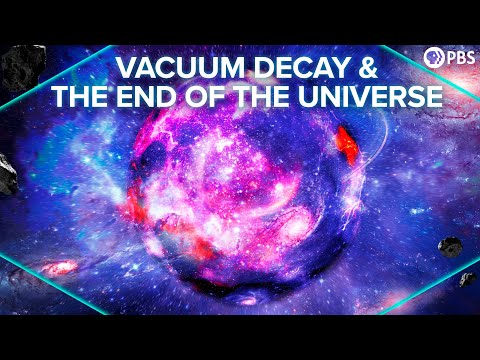
How Vacuum Decay Would Destroy The Universe

17 min

Sign Up on Patreon to get access to the Space Time Discord! Uploaded 18-08-21 The universe is going to end. But of all the possible ends of the universe vacuum decay would have to be the most thorough - because it could totally rewrite the laws of physics. Today I hope to help you understand exactly how terrified you should be. Check out the Space Time Merch Store Sign up for the mailing list to get episode notifications and hear special announcements! Hosted by Matt O'Dowd Written by Matt O'Dowd Graphics by Leonardo Scholzer, Yago Ballarini, Pedro Osinski, Adriano Leal and Stephanie Faria GFX Visualizations: Ajay Manuel Directed by Andrew Kornhaber Assistant Producer: Setare Gholipour Executive Producers: Eric Brown and Andrew Kornhaber End Credits Music by J.R.S. Schattenberg: https://www.youtube.com/user/MultiDroideka Special thanks to Our Patreon Sponsors Big Bang Supporters Ari Paul Kyle Bulloch Charlie Mrs. Tiffany Poindexter Leo Koguan Sandy Wu Matthew Miller Scott Gray Ahmad Jo

Discuss this episode

PBS Space Time

The Real Science of the EHT Black Hole

16 min

You can learn more about CuriosityStream at https://curiositystream.com/spacetime Uploaded 01-05-19 PBS Member Stations rely on viewers like you. To support your local station, go to: http://to.pbs.org/DonateSPACE How do you take a picture of a black hole and what can we learn from it? Our first ever actual bona fide photo of a black hole, made by the Event Horizon Telescope and revealed to the world in a press conference on April 10th. Since then it’s got plenty of coverage, because … I mean look at it. It’s a freaking black hole. It’s black, it’s holey, it’s everything we hoped it would be. Now that the giddiness has subsided and I personally have stopped spending hours on end staring at a black spot, we can take a breath and actually look at the real science here and discuss exactly how a picture like this could be taken and what we can learn from it. Check out the new Space Time Merch Store! Support Space Time on Patreon Need a Black Hole Refresher #Blackhole #astrophysics #spaceti

Discuss this episode

Community Poll

A striking scientific discovery should face stronger scrutiny before changing established practice.

Share your view, then see how readers voted. No sign-in required. This poll is shared across stories.

Do you agree or disagree?

Choose one answer

Common Quandary

A Common Quandary to discuss

Another conversation to explore, separate from this news story.

A pricey AI tutor can turn B students into A students. Should schools let them use it?

An effective AI tutor adapts to each student and dramatically improves performance, but its subscription is expensive. A public school cannot provide it to everyone and worries that allowing its use will deepen existing inequality.

Should access be limited when a beneficial tool cannot yet be shared fairly?

Explore this quandary