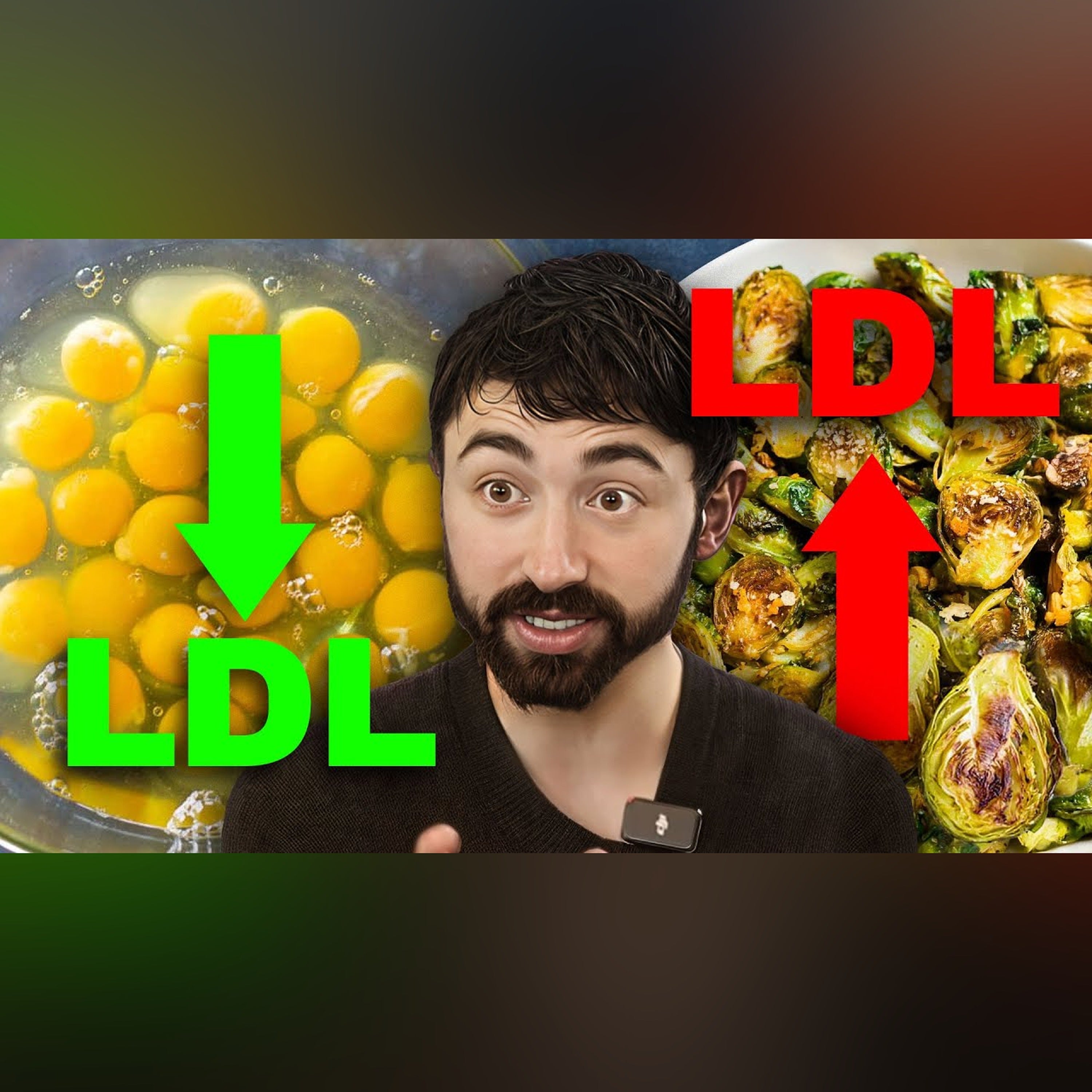
I went on a Vegan diet and my cholesterol increased. Really! But there’s more to the story. I performed a crossover experiment from an animal-based ketogenic diet to a vegan ketogenic diet and – despite reducing my saturated fat intake over 4-fold and increasing my fiber and PUFA intake – my LDL cholesterol went up. I explain the results and why they make sense. And I’ll explain why you should care. Chapters 0:00 – A Vegan Diet Increased my Cholesterol 0:54 – Animal-Based versus Vegan Keto Diets 2:50 – The Surprising Results 4:56 – Surprising Clinical Case 5:39 – Lipid Energy Model. Explaining the Results 7:14 – Dave’s Vegan Keto! N = 2 7:52 – Check Your Emotions. Stay Curious 8:16 – Why You Should Care SiPhox Affiliate Link: https://siphoxhealth.com/nick Discount Code: NICK15 House of Macadamia Affiliate Link: http://partner.houseofmacadamias.com/nick-norwitz Discount Code: NICK10 Dave’s Vegan Keto Experiment: COMING SOON! N = 1 Playlist: https://youtube.com/playlist?list=PL5VdyNo7qtL
In this video I discuss Magnesium Deficiency. Magnesium is essential to living a healthy life and not enough people understand the symptoms of Magnesium Deficiency. The best way to avoid Magnesium Deficiency is by soaking in Epsom Salt Baths. Epsom Salt is basically Magnesium, and by soaking in these Float Spas a.k.a. Epsom Salt Baths you are able to replenish your Magnesium Levels and avoid Magnesium Deficiency. Read more about this topic on my blog: https://bozmd.com/low-magnesium-symptoms/ This is an excerpt from Keto Consults with Dr. Boz: https://bit.ly/2GzctYm Thanks for checking out the Dr Boz Channel. Tune in Sunday nights, 6PM Central Time to watch me Live! We are KETONES FOR LIFE. Improving your health - One ketone at a time. Dr Boz’s First ONLINE Course Consistently Keto: https://bozmd.com/shop WAYS TO SUPPORT THIS CHANNEL: Buy Dr Boz Products. Dr Boz K2+D3: https://amzn.to/31lIlqL (affiliate link) Dr Boz Ketones-In-A-Can: Raspberry Lemon: https://amzn.to/2GXLlSw Dutch Choco
Dig into the animal kingdom’s capacity for generosity, and find out how cooperation between animals may contribute to their survival. -- Charles Darwin introduced the notion of “survival of the fittest,” where the fittest animals are those who can survive long enough to produce healthy offspring. The fittest animal can also be the most stealthy, resourceful, or even the most cooperative. So what exactly does cooperation look like in the wild? Ashley Ward digs into the animal kingdom's capacity for generosity. Lesson by Ashley Ward, directed by Sharon Colman. Support Our Non-Profit Mission ---------------------------------------------- Support us on Patreon: http://bit.ly/TEDEdPatreon Check out our merch: http://bit.ly/TEDEDShop ---------------------------------------------- Connect With Us ---------------------------------------------- Sign up for our newsletter: http://bit.ly/TEDEdNewsletter Find us on Twitter: http://bit.ly/TEDEdTwitter Peep us on Instagram: http://bit.ly/TEDEdInstag
Growing food doesn’t look like I thought… Learn more about Dropbox for teams: https://www.dropbox.com/cleo Thanks Dropbox for sponsoring this video! Right now, we’re living through one of the most pivotal moments in food history… and most people have no idea it’s happening. Experts are calling the “Fourth Agricultural Revolution” and it’s here because we’re facing a big problem: The world’s population is rising, so experts say we’ll need to increase food output to catch up with our current population and feed those new people. But we’ve got to do it in ways that actually protect the Earth long term. Right now, farmers are in a fight to feed the world. So let me show you some of the coolest machines they’re using to do it… Chapters: 0:00 What’s the fourth agricultural revolution? 01:15 Why do we need more food? 1:54 Where does farming tech get tested? 3:00 What were the first 3 agricultural revolutions? 3:58 How do we feed billions more people… better? 4:31 How do farmers grow more food
Introducing the “Facts From the Frontlines” episode of #TheTonyRobbinsPodcast – where Tony uncovers the truth about coronavirus with a 7-person panel of highly qualified researchers, an experienced epidemiologist, a Nobel Laureate, and M.D.s testing and treating patients on the frontlines. Together, they reveal the evidence-based research that has come to light in the last two months. Uploaded 23-05-20 This is one of the most important interviews Tony has ever conducted. It reminds us to stand guard at the door of our mind, practice discernment when determining trustworthy sources, and think critically in order to stay flexible and maintain the ability to pivot in light of new information – especially when lives depend on it. To hear the full interview, go here: https://www.tonyrobbins.com/podcasts/covid-19-facts-from-the-frontline/ *COVID-19 Playlist* https://www.youtube.com/watch?v=YgP_Au5RZVw&list=PLYTXvUDQT5pUaoPTzi71UIqilqgBOKkQe (https://www.youtube.com/watch?list=PLYTXvUDQT5pUao
Get the 200+ Page Optimal Living Daily Workbook (PDF) - Free. Want to turn today's episode into an actionable plan? Episode 3615: Becca Shern explains why the common nutrition advice of everything in moderation may not be serving people well. She looks at how heavy marketing and social norms around sugar and alcohol make it easy to overconsume while still feeling moderate, and what the actual recommended limits are. The takeaway is that taking a critical look at what moderation really means, and setting a higher standard, can build healthier habits for ourselves and the people around us. Read along with the original article(s) here: http://minimalwellness.com/reconsideringmoderation/ Quotes to ponder: "Moderation is a squishy term." "Our consumption patterns are dramatically influenced by marketing, but they're also molded by social norms." "Setting a higher standard for ourselves helps others do the same."
IBS Symptom Relief Without Lifelong Food Restriction The low FODMAP diet can be an effective tool for managing IBS symptoms, but what happens when a temporary dietary intervention turns into years of food avoidance? In this episode, I'm joined by Samina Qureshi a dietitian specializing in digestive disorders and disordered eating. In This Episode, You'll Learn: What to ask when patients say "everything I eat bothers my stomach" Who is a good candidate for a low FODMAP diet, and when a history of disordered eating, malnutrition, or significant food restriction should make you reconsider. What are FODMAPs and how the three phases of a low FODMAP diet work The warning signs that symptom management has become food fear Why adding more fiber can sometimes worsen IBS symptoms What to know about probiotics, digestive enzymes, peppermint oil, and IgG food sensitivity testing Resources Mentioned Monash University: FODMAPs and IBS (https://www.monashfodmap.com/about-fodmap-and-ibs/) Monash Unive
Infant Feeding: Gagging, Choking, and First Foods Starting solids can feel surprisingly complicated for parents, especially when the advice they receive from healthcare providers, social media, and well-meaning family members doesn't always agree. Purées or baby-led weaning? Four months or six? And is food before one really just for fun? In this episode, I'm joined by Kinzie Matzeller, a registered dietitian and PhD candidate at Colorado State University who researches infant feeding, nutrition, and growth. What We Talk About: What developmental signs to look for when determining whether a baby is ready for solids, and why age alone doesn't tell the whole story Whether baby-led weaning actually offers advantages over purées How to explain the difference between gagging and choking Why “food before one is just for fun” overlooks important nutritional needs Kinzie's approach to introducing common food allergens and how to help parents navigate conflicting recommendations How much food ba
Environmental marketing claims should require independent verification.
Share your view, then see how readers voted. No sign-in required. This poll is shared across stories.
Do you agree or disagree?
Common Quandary
A Common Quandary to discuss
Another conversation to explore, separate from this news story.
You paid extra for the aisle seat. Must you trade with a parent?
You reserved and paid extra for an aisle seat on a long flight. A parent asks you to trade for a middle seat so they can sit beside their young child after the airline separated them.
When does another person's predicament become your responsibility?