Listen through the publisher, then discuss the episode here or arrange an in-person Roundtable. Your city determines where to meet.
Roundtables are designed for groups of four, with a shared subject and room for everyone to speak. Come for discussion, with no dating expectation.
Master the skills that change lives — enroll in your free human behavior course today: https://nci.university/learn Uploaded 16-01-26 Please note that the content provided in this broadcast is for informational and educational purposes only and should not be construed as legal, medical, financial, or professional advice. No material in this communication establishes any form of professional relationship that is privileged or confidential. The insights and opinions expressed herein solely reflect the personal views of the speaker based on his extensive expertise and academic background in his field of study. These are purely personal opinions and should not be taken as direct statements of fact about any individuals, whether stated explicitly or implied. Any opinion shared in this broadcast is drawn from referenced material specific to this publication only. Remember, what's discussed here are perspectives—not claims of fact. Copyright and all rights reserved.
Episode information is provided by the publisher. Listening takes place on the publisher’s service.
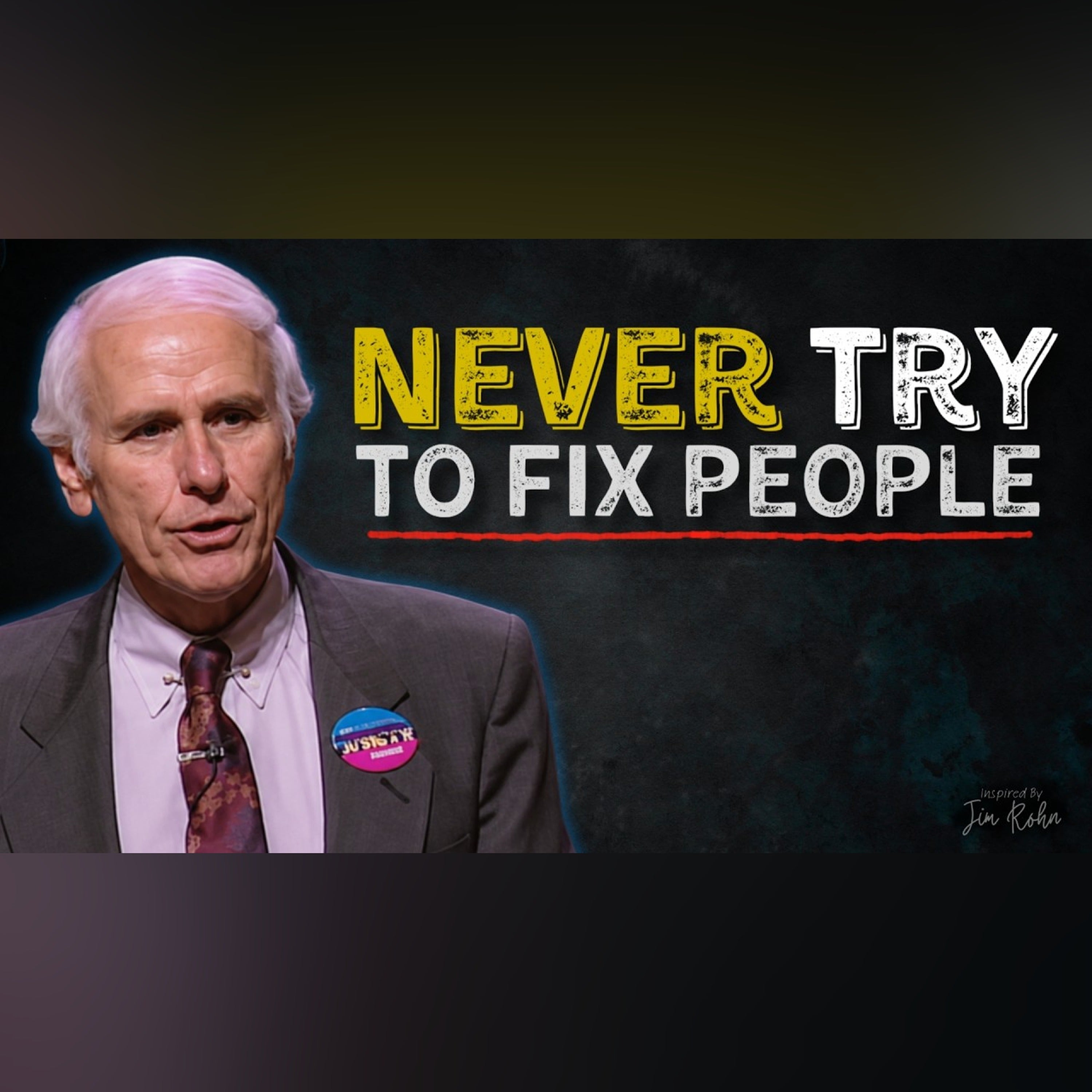
Some people walk through life believing that if they could just change one or two people around them, their whole life would finally work. Uploaded 27-05-26 Their spouse would stop doing that thing. Their parents would finally understand. Their kid would just listen for once. So they spend year after year trying to change the people in their life. And year after year, nothing changes. The people in their life are exactly who they were 10 years ago. Meanwhile, the person doing all the fixing has gotten older, more tired, more bitter, and not noticeably closer to the life they actually wanted. The whole project was never going to work — and there's a specific mechanism underneath it that does damage the longer you stay in it. This seminar lays out why fixing other people is the most sophisticated form of procrastination there is, what it's quietly costing every relationship in your life, and the only move that actually changes anything. CHAPTERS: 0:00 The Years You've Spent Trying to Fix
Thank you to Brilliant for Supporting PBS. To learn more go to https://brilliant.org/SpaceTime/ PBS Member Stations rely on viewers like you. To support your local station, go to:http://to.pbs.org/DonateSPACE Sign Up on Patreon to get access to the Space Time Discord! The weird rules of quantum mechanics lead to all sorts of bizarre phenomena on tiny scales— particles teleporting through walls or being in multiple places at once or simultaneously existing and not. Shame all this magical behavior doesn’t happen on scales large enough for us to see. Except that there is a way for us to see large-scale quantum weirdness, and that’s Bose-Einstein Condensates & Superfluids. Check out the Space Time Merch Store Sign up for the mailing list to get episode notifications and hear special announcements! Search the Entire Space Time Library Here: https://search.pbsspacetime.com/ Hosted by Matt O'Dowd Written by Fernando Franco Felix & Matt O'Dowd Post Production by Leonardo Scholzer, Yago Ballari
What NVIDIA is trying to build next… You're probably hearing a lot about AI, DeepSeek, NVIDIA and more right now. If you want the big picture (and to start from the beginning), watch this Huge Conversation with NVIDIA CEO Jensen Huang. In the last few years, NVIDIA has skyrocketed to become one of the world's most valuable companies. That's because, beginning in the 90s, they led a fundamental shift in how computers work, now unleashing the current explosion of what’s possible with technology. A huge amount of the most futuristic tech you’re hearing about - in AI, robotics, gaming, self-driving cars, breakthrough medical research - relies on new chips and software designed by him and his company. During the dozens of background interviews I did to prepare for this, what struck me most was how much Jensen Huang has already influenced all our lives over the last 30 years, and how many are saying it’s just the beginning of something even bigger… We all need to know what he’s building and
What if everything you've been chasing was already inside you? It took me 40 years to understand that happiness isn't somewhere in the future, it's here, in this moment. As a younger woman, I avoided pain, resisted it, distracted myself from it. What I know now is that pain doesn't break us. It rearranges us. And on the other side of it is something I wouldn't trade for anything, lived wisdom, inner comfort, and a clarity that simply cannot be rushed. Uploaded 04-03-26 In this conversation with @lewishowes, I share what I wish I had known decades sooner: about fulfillment, presence, the gift hidden inside our most difficult moments, and why it might just be the simplest things that wake us up the most. Watch more videos like this How To End Self Sabotage with 1 Simple Choice: https://youtu.be/-0Ln4-h4LQQ Do This When You Feel Triggered and Your Life Will Transform: https://youtu.be/h7YylJ3nuok Creating Moments of Stillness in the Chaos: https://youtu.be/eR6e50AmeRY Turning Towards Fear
Before House Democrats voted on Hakeem Jeffries for Speaker, nobody was running against him, but a group of new progressive members, known as "The Bloc," wouldn't commit to backing him without guarantees. Asked about the holdouts, Jeffries told reporters: "You'll have to ask, you know, those individuals." In the Senate, Chris Van Hollen was challenging Chuck Schumer for leader, and Schumer was bristling. Meanwhile, John Fetterman was hinting he could leave the party if Van Hollen won. Don was joined by Mehdi Hasan, founder and editor-in-chief of Zeteo, to talk about who should lead the Democrats and whether the party was already blowing its big win. GUEST: Mehdi Hasan, founder and editor-in-chief of Zeteo FIND THE DON LEMON SHOW: Youtube: https://www.youtube.com/@TheDonLemonShow Substack: https://substack.com/@donlemon Facebook: facebook.com/donlemon Instagram: instagram.com/donlemonofficial Tik Tok: tiktok.com/@donlemonofficial LEMON NATION: Website: donlemon.com Buy Merch: https://do
Until a little under two weeks ago, Silicon Valley Bank was the sixteenth largest bank in the United States, the favoured choice of tech startups due to the tailored services it provided. But by 10th March 2023, American authorities were taking control of SVB following its collapse. It had assets of over $200bn, making for the second biggest bank failure in US history. There were a number of factors behind the collapse, and it’s causing concern as it’s common for one bank collapse to be followed by another, due to what’s called financial contagion. Indeed, just a few days later it was the turn of New York-based Signature Bank to collapse. And over in Europe, Switzerland’s second largest bank Crédit Suisse had to take out a $54bn to stay afloat, before then being bought out by the country’s largest bank UBS, in a bid to halt the crisis. Why did Silicon Valley Bank collapse? How do stock market crashes happen? In under 3 minutes, we answer your questions! To listen to the last episodes,
DISCOVER NCI - 1: https://nci.university/nci-1v2 Uploaded 09-05-26 ⬆️ Please note that the content provided in this broadcast is for informational and educational purposes only and should not be construed as legal, medical, financial, or professional advice. No material in this communication establishes any form of professional relationship that is privileged or confidential. The insights and opinions expressed herein solely reflect the personal views of the speaker based on his extensive expertise and academic background in his field of study. These are purely personal opinions and should not be taken as direct statements of fact about any individuals, whether stated explicitly or implied. Any opinion shared in this broadcast is drawn from referenced material specific to this publication only. Remember, what's discussed here are perspectives—not claims of fact. Copyright and all rights reserved.
Master the skills that change lives — enroll in your free human behavior course today: https://nci.university/learn Uploaded 09-01-26 You were never reacting to chaos — you were responding to structure. Outcomes don’t appear suddenly; they’re assembled long before you notice them. Understanding how pressure is built changes how the world feels immediately. All influence follows patterns once you know where to look. Reality doesn’t break — it gets reshaped in layers. Every system depends on predictable human responses. Given the right conditions, behavior becomes almost automatic. Once you see the architecture, panic loses its leverage. Detection beats reaction — every time. Please note that the content provided in this broadcast is for informational and educational purposes only and should not be construed as legal, medical, financial, or professional advice. No material in this communication establishes any form of professional relationship that is privileged or confidential. The insi
Instant Access to your FREE training course: https://nci.university (https://nci.university/) Uploaded 27-07-25 This is the simulation you already live inside of—and you’ve been breathing it like oxygen since the day you were born. In this video, we expose the invisible machinery beneath modern life—how symbols have replaced truth, how marketing has replaced meaning, and how our desires are manufactured by the very system that feeds on them. Drawing from the work of Jean Baudrillard and the hidden mechanisms of simulacra, we walk you through 10 real-life “glitches” that reveal the truth: • Why your food is rendered, not real • How social media replaced memory • Why you take photos of things you never actually see • And why even your “rebellion” is likely pre-approved This isn’t a conspiracy. It’s a mirror. And once you see it, you can’t unsee it. simulation theory, simulated reality, Baudrillard simulation, are we in a simulation, hyperreality explained, social media illusion, digital
Neighboring communities should share responsibility for problems crossing their boundaries.
Share your view, then see how readers voted. No sign-in required. This poll is shared across stories.
Do you agree or disagree?
Common Quandary
A Common Quandary to discuss
Another conversation to explore, separate from this news story.
An old friend refuses to use someone's new name. Do you correct them at the reunion?
At a reunion, an old friend repeatedly uses the name a former classmate had years ago. They say shared history gives the old name affectionate meaning; the classmate has clearly introduced themselves with a different name.
When does preserving your shared past deny who someone is now?