Listen through the publisher, then discuss the episode here or arrange an in-person Roundtable. Your city determines where to meet.
Roundtables are designed for groups of four, with a shared subject and room for everyone to speak. Come for discussion, with no dating expectation.
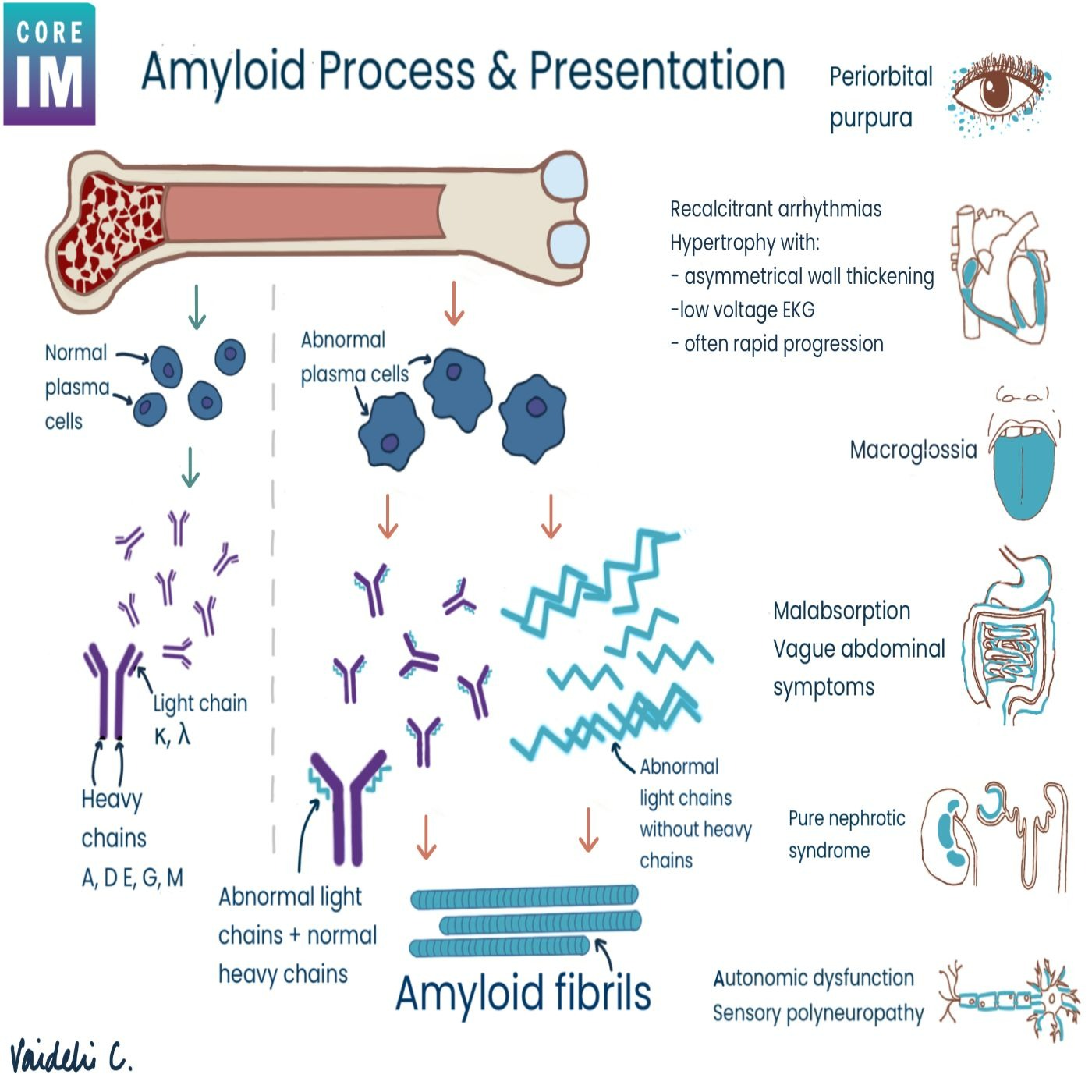
“Could amyloidosis be the reason behind a patient’s unexplained symptoms?” This episode explores the clinical clues that should prompt clinicians to consider AL amyloidosis and recognize patterns of organ involvement that may otherwise be easy to overlook. Learn how to connect the findings, spot important red flags, and bring amyloidosis into your differential diagnosis. Transcript and Show Notes (https://www.coreimpodcast.com/2026/11/11/amyloidosis-presentation-gray-matters-segment/) 00:55 Aliquot 1 04:38 Deep Dive 1: When to suspect Amyloid - Warning Signs 10:31 Aliquot 2 12:28 Deep Dive 2: Organ System Involvement 24:38 Aliquot 3 Tags: IMCore, Internal Medicine, Medical Education, Nephrotic Syndrome, Restrictive Cardiomyopathy, Periorbital Purpura, Unexplained Proteinuria, Hematology Find the best disability insurance for you: https://www.patternlife.com/disability-insurance?campid=497840 Our Sponsors: * Check out Eko: https://ekohealth.com * Check out ElevenReader and use my code PODCAST for a great deal: https://elevenreader.io * Check out FIGS and use my code FIGSRX for a great deal: https://wearfigs.com Privacy & Opt-Out: https://redcircle.com/privacy
Episode information is provided by the publisher. Listening takes place on the publisher’s service.
Master the skills that change lives — enroll in your free human behavior course today: https://nci.university/learn Uploaded 10-04-26 The Cheat Code for Controlling Conflict Every argument, meltdown, or power struggle follows a pattern. Most people miss it—and that’s why they lose control in the moment. This video breaks down the exact psychological system behind conflict escalation, including why people suddenly become defensive, aggressive, manipulative, or unpredictable. Once you see it, you’ll recognize the moment before things spiral—and you’ll know how to respond without escalating, backing down, or losing your frame. This isn’t about winning arguments. It’s about understanding what actually triggers human behavior under pressure. Inside this breakdown: • Why people suddenly “flip” in conversations • The hidden triggers behind anger, defensiveness, and power plays • How ego threat drives conflict escalation • Why logic fails when emotions take over • How to read the exact moment
Read the “Refuse The Easy Life” Action Guide here: [https://jimrohnfans.com/refuse-the-easy-life/](https://jimrohnfans.com/refuse-the-easy-life/) Uploaded 22-02-26 This Action Guide turns the ideas from this video into a simple, repeatable system you can use daily—so you don’t just feel motivated, you actually change what you do. What you’ll get from the Action Guide A clear way to spot the “small deals” comfort keeps offering you A standards check that helps you stop negotiating with yourself A daily structure for choosing what’s necessary over what’s convenient A practical method to separate planned rest (recovery) from comfort (escape) How to use it with this video Watch the video once for the message Rewatch and pause when a line hits you—then write the exact “small compromise” it exposes Use the guide to set a rule for that area (a standard you enforce, not a goal you hope for) Track the next 7 days of choices so effort becomes your default instead of convenience In this video, yo
How can you make your voice heard in a noisy world? The key is public speaking and presentation literacy, and we can help: http://bit.ly/TMCPSApp Uploaded 14-01-21 -- Storytelling is an ancient art; as humans developed language and culture, we learned to share our stories, thoughts, and dreams. And that storytelling evolved into public speaking, and our audience— thanks to the internet— is the whole world, not just a campfire. So how can we make our voices heard in such a busy space? Chris Anderson digs into why presentation literacy is the skill of the future. Lesson by Chris Anderson, directed by Avi Ofer. Support Our Non-Profit Mission ---------------------------------------------- Support us on Patreon: http://bit.ly/TEDEdPatreon Check out our merch: http://bit.ly/TEDEDShop ---------------------------------------------- Connect With Us ---------------------------------------------- Sign up for our newsletter: http://bit.ly/TEDEdNewsletter Find us on Twitter: http://bit.ly/TEDEdTwit
A kiss can be wonderful. It can create an instant connection, spark romance, or make you feel closer to someone. But a kiss can also have the opposite effect — and sometimes ruin everything. So what makes kissing so powerful, and why can one kiss make such a difference? There's some fascinating science behind it. https://www.scientificamerican.com/article/why-we-kiss/ We spend an enormous amount of time worrying about what's going to change. What's next? What's coming? How do we prepare? But what if we're paying attention to the wrong things? Some of the most important forces shaping our lives never change, and understanding them may be far more valuable than trying to predict the future — something humans are notoriously bad at. Morgan Housel, partner at The Collaborative Fund and author of Same as Ever: A Guide to What Never Changes (https://amzn.to/3SwWn6u) (https://amzn.to/3SwWn6u)), joins me to explain why the things that stay the same may be the most important things to understan
Get the 200+ Page Optimal Living Daily Workbook (PDF) - Free. Want to turn today's episode into an actionable plan? Episode 4232: Chris Guillebeau shares a candid, funny account of his lack of qualifications, from a short-lived dishwashing job to failing his way through statistics and shrink-wrapping pallets. He argues that formal credentials matter far less than people think, and that anyone who builds a good life without them should treat that work with gratitude and diligence. It is an encouraging take on personal development for anyone who has ever felt like an imposter. Read along with the original article(s) here: https://chrisguillebeau.com/qualifications/ Quotes to ponder: "First, forget about what you're actually qualified to do. It's irrelevant and no one cares." "Fourth, when you do find something that works for you, you should be very grateful, every day." "Regardless of your actual qualifications, there's one thing that no one can give you and no one can take away: the wil
Today, Mel is doing something she's never done before on The Mel Robbins Podcast. She's bringing members of her team into the studio for live coaching with world-renowned communications expert Vinh Giang. Vinh is known for teaching millions of people online how to stop sounding insecure, speak more clearly, and get people to listen when you talk. And when you hear him coaching today, it will be like he’s coaching you. One person freezes when they're put on the spot. Another can't stop interrupting people. Someone else has great ideas but stays quiet because they're afraid of being judged. Does any of that sound familiar? And Vinh isn't just giving advice. He's coaching real people through practical exercises, right there in the studio, so you can hear the difference and start making those same changes in your own life. As Mel says, put yourself in their shoes. As Vinh works with each person, you'll recognize things you struggle with, too. You'll learn: -What to do when your mind goes b
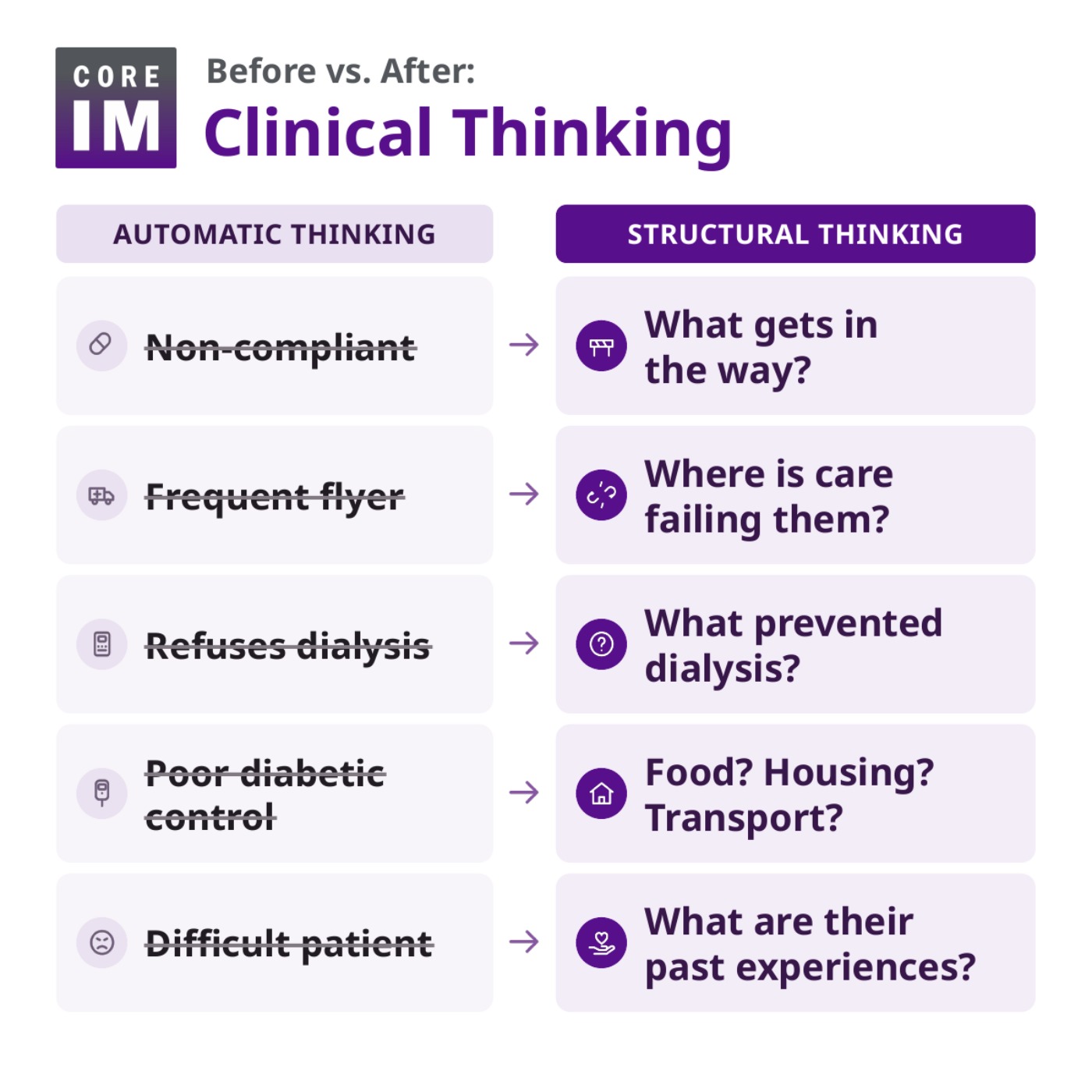
“Frequent flyer.” “Noncompliant.” “Refusing care.” We’ve all heard these terms thrown around on rounds. How do they change what we ask when we walk into the room? One patient missed dialysis because her building’s elevator broke. Another kept coming back to the ED with uncontrolled asthma despite multiple inhalers. In this Core IM episode on the social determinants of health, we talk through what to ask at the bedside, who to call when housing or transportation gets in the way, and how to start a conversation when a patient tells you they felt mistreated. One question to take back to rounds comes from Dr. Richard Greene, who learned it from a resident. “What else do I need to know about you to take care of you?” Transcript and Show Notes (https://www.coreimpodcast.com/2026/11/18/frequent-flyer-cases-what-are-we-missing/) 00:00 A dialysis conversation that started with listening 03:36 Uncontrolled asthma and environmental exposures 05:54 Redlining, housing, and health 12:17 What clinici
Long-term environmental commitments should require public review before a new government abandons them.
Share your view, then see how readers voted. No sign-in required. This poll is shared across stories.
Do you agree or disagree?
Common Quandary
A Common Quandary to discuss
Another conversation to explore, separate from this news story.
You find a rare library book your father kept for forty years. Do you return it anonymously?
While clearing your father's attic, you find a rare book stamped by the local library and due in 1986. The library would be thrilled to recover it, but returning it openly would expose a secret he apparently kept for decades—and might produce a spectacular overdue fine.
Does making an old wrong right require admitting who did it?