English-language podcasts

Supreme Court Oral Arguments

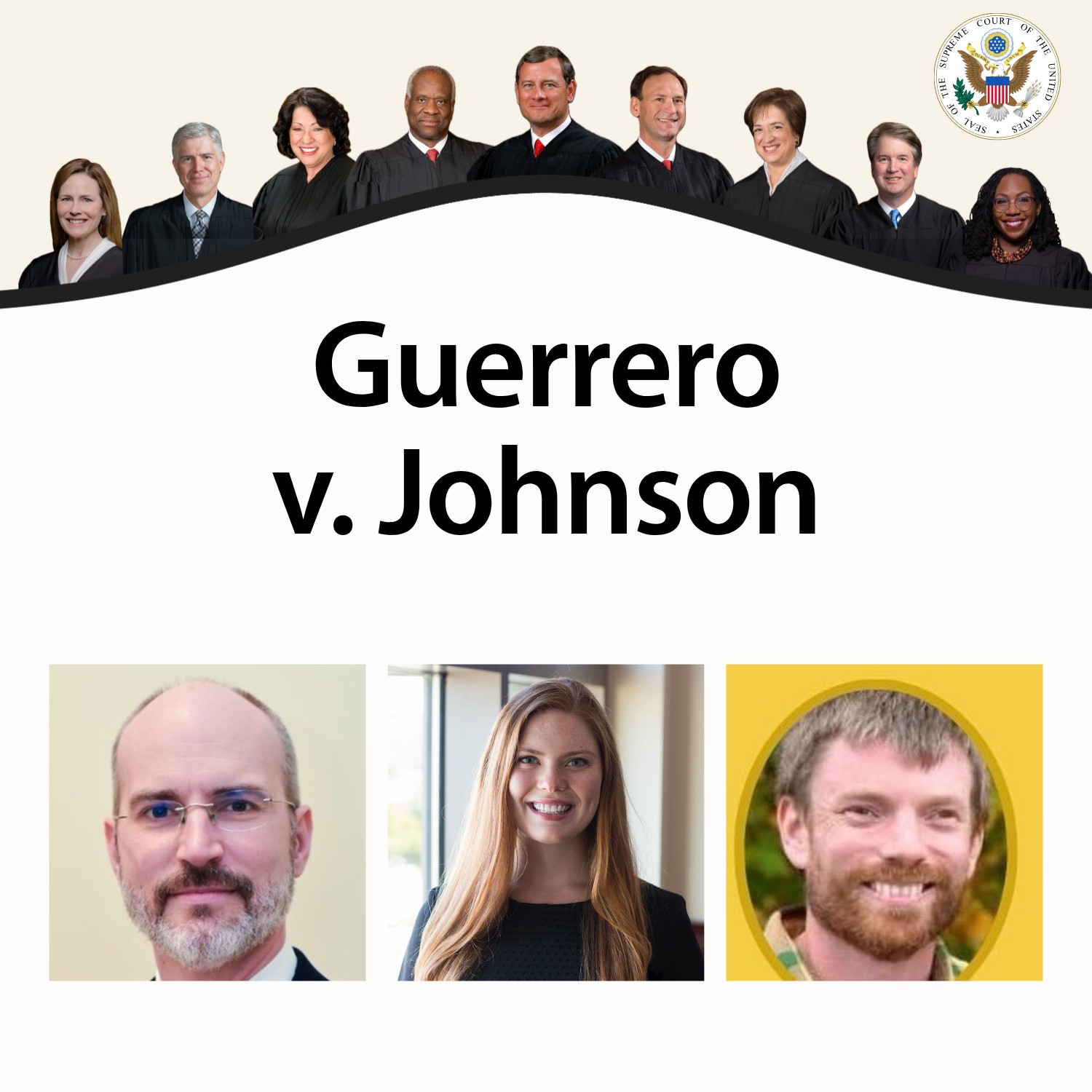
[25-1003] Guerrero v. Johnson
59 min

Listen through the publisher, then discuss the episode here or arrange an in-person Roundtable. Your city determines where to meet.

Roundtables are designed for groups of four, with a shared subject and room for everyone to speak. Come for discussion, with no dating expectation.

Guerrero v. Johnson Justia · Docket (https://www.supremecourt.gov/docket/docketfiles/html/public/25-1003.html) · oyez.org (https://www.oyez.org/cases/2026/25-1003) · YouTube (https://www.youtube.com/watch?v=QzOSlEEjjvQ) Argued on Nov 4, 2026. Petitioner: Eric Guerrero. Respondent: Dexter Johnson. Advocates: William R. Peterson (for the Petitioner) Emily M. Ferguson (for the United States, as amicus curiae, supporting the Petitioner) Jeremy Schepers (for the Respondent) Facts of the case (from oyez.org) Dexter Johnson kidnapped, raped, and murdered Maria Aparece in June 2006, years after the Supreme Court decided Atkins v. Virginia, 536 U.S. 304 (2002), which held the Eighth Amendment prohibits executing intellectually disabled people. At trial, Johnson’s own defense expert tested his IQ between 74 and 88, concluded he showed no obvious adaptive deficits, and opined that he was not intellectually disabled. Johnson was convicted of capital murder and sentenced to death in June 2007. Johnson did not raise an Atkins claim in his initial state habeas application or his initial federal habeas petition filed in 2011. Instead, he argued that the Atkins principles should extend to the mentally ill. In May 2013, the American Psychiatric Association published the DSM-5, which substantially revised intellectual disability diagnosis by de-emphasizing IQ score cutoffs and recognizing that individuals with scores above 70 could still qualify. Johnson's federal habeas petition was denied in August 2013—just months after the DSM-5’s publication. Johnson’s counsel, aware of the DSM-5, chose not to develop an Atkins claim, citing concerns about unfavorable Texas state court standards and his strategic focus on other claims. With an execution date set for 2019, Johnson obtained new expert evaluations under the DSM-5 standards; those experts diagnosed him as intellectually disabled. Johnson then sought authorization to file a successive federal habeas petition, arguing that the DSM-5 had made his Atkins claim newly viable and therefore “previously unavailable” during his earlier habeas proceedings. After the U.S. Court of Appeals for the Fifth Circuit authorized the successive petition in 2019, the district court denied the State's motion to dismiss and found Johnson’s Atkins claim was previously unavailable under the Fifth Circuit’s “futility exception” from In re Cathey. The district court certified that ruling for interlocutory appeal, the Fifth Circuit accepted, and a panel affirmed in July 2025, reaffirming Cathey’s holding that a claim is not “previously available” unless it had “some possibility of merit” at the time of the earlier petition. The Fifth Circuit denied rehearing en banc by a 9-7 vote in January 2026. Question Does a claim rely on a “previously unavailable” new rule of constitutional law, permitting a successive habeas petition, when the prisoner could have raised a claim based on that rule in an earlier petition?

Episode information is provided by the publisher. Listening takes place on the publisher’s service.

Listen at the source ↗

Featured places to meet in Palo Alto, CA

Explore these places and arrange a conversation through ThinkMatch.

City guide for Palo Alto, CA

More from Supreme Court Oral Arguments

Supreme Court Oral Arguments

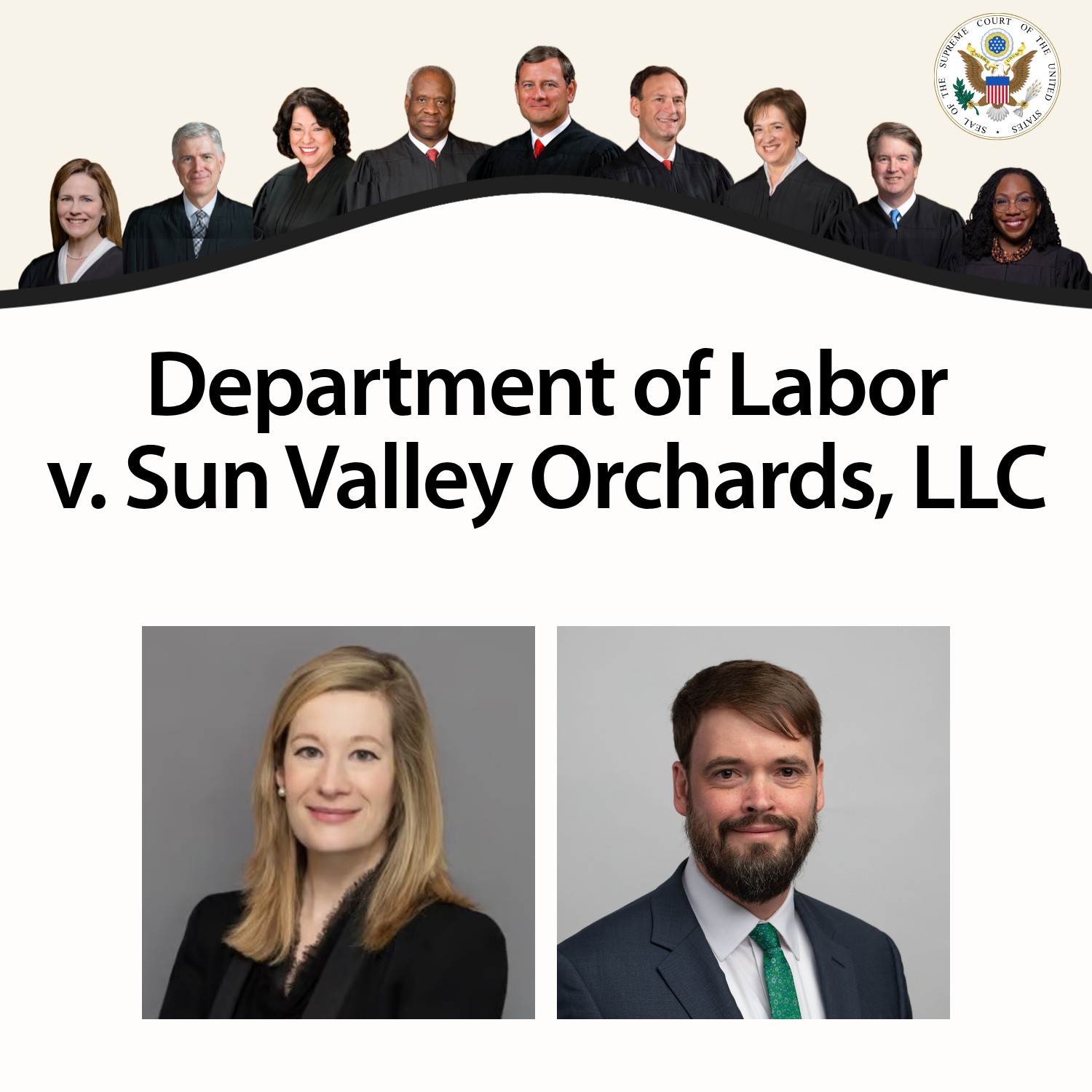
[25-966] Department of Labor v. Sun Valley Orchards, LLC

103 min

Department of Labor v. Sun Valley Orchards, LLC Justia (https://supreme.justia.com/cases/federal/us/2026/25-966/) · Docket (https://www.supremecourt.gov/docket/docketfiles/html/public/25-966.html) · oyez.org (https://www.oyez.org/cases/2026/25-966) · YouTube (https://www.youtube.com/watch?v=K2nVsb_BRfU) Argued on Nov 10, 2026. Petitioner: Department of Labor,. Respondent: Sun Valley Orchards, LLC. Advocates: Sarah M. Harris (for the Petitioners) Robert E. Johnson (for the Respondent) Facts of the case (from oyez.org) Sun Valley Orchards, a New Jersey farm, hires seasonal workers through the H-2A visa program. Under this program, the farm must provide certain benefits, such as safe housing and transportation, which it outlines in a “job order” that serves as a work contract. After an investigation into the 2015 growing season, the Department of Labor alleged that Sun Valley breached this contract by providing infested housing, failing to provide required kitchen access, and firing worke

Discuss this episode

Supreme Court Oral Arguments

[25-159] Hoffmann v. WBI Energy Transmission, Inc.

60 min

Hoffmann v. WBI Energy Transmission, Inc. Justia · Docket (https://www.supremecourt.gov/docket/docketfiles/html/public/25-159.html) · oyez.org (https://www.oyez.org/cases/2026/25-159) · YouTube (https://www.youtube.com/watch?v=JFZQ8OSmpCI) Argued on Nov 9, 2026. Petitioner: Leonard W. Hoffmann. Respondent: WBI Energy Transmission, Inc. Advocates: Robert J. McNamara (for the Respondents) Paul W. Hughes (for the Respondent) Zoe A. Jacoby (for the United States, as amicus curiae, supporting the Respondent) Facts of the case (from oyez.org) WBI Energy Transmission, Inc. is a private natural gas company that holds a federal certificate authorizing it to use eminent domain to build and operate a natural gas pipeline. WBI used that authority to condemn an easement across ranchland in McKenzie County, North Dakota, owned by Leonard Hoffmann, Margaret Hoffmann, Denae Hoffmann, Rocky & Jonilla Farms, LLP, and Randall Stevenson. After roughly three years of litigation over the value of the taken

Discuss this episode

Supreme Court Oral Arguments

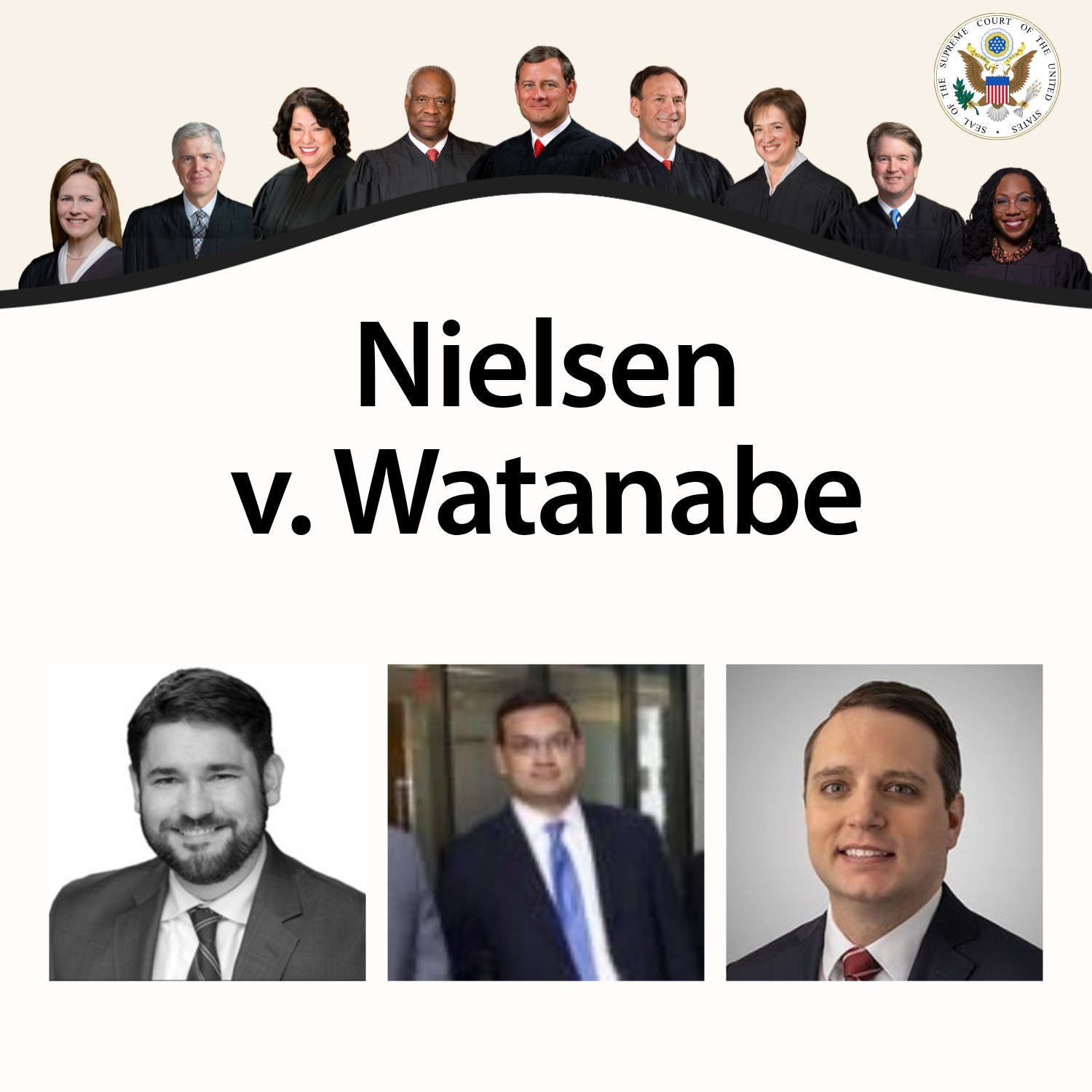
[25-417] Nielsen v. Watanabe

83 min

Nielsen v. Watanabe Justia · Docket (https://www.supremecourt.gov/docket/docketfiles/html/public/25-417.html) · oyez.org (https://www.oyez.org/cases/2026/25-417) · YouTube (https://www.youtube.com/watch?v=hi29t0a4Qm8) Argued on Nov 9, 2026. Petitioner: Francis Nielsen. Respondent: Kekai Watanabe . Advocates: Lucas M. Walker (for the Petitioner) Vivek Suri (for the United States, as amicus curiae, supporting the Petitioner) Joshua M. Wesneski (for the Respondent) Facts of the case (from oyez.org) Kekai Watanabe was a federal detainee at the Federal Detention Center in Honolulu when, in July 2021, rival gang members attacked him during a prison riot. After staff restored order, prison officials documented his visible injuries and placed him on sick call. Later that day, Watanabe told correctional officers he had headaches and pain and asked to see medical staff. He eventually described his condition to Francis Nielsen, a staff nurse at the facility, who denied his request to go to the ho

Discuss this episode

Community Poll

Correcting clear officiating errors is worth some interruption to a game's flow.

Share your view, then see how readers voted. No sign-in required. This poll is shared across stories.

Do you agree or disagree?

Choose one answer

Common Quandary

A Common Quandary to discuss

Another conversation to explore, separate from this news story.

You find a family secret after a relative dies. Does the truth come out?

Sorting through a deceased relative's papers, you discover evidence of a serious betrayal that would change how the family remembers them. Revealing it could answer old questions—and cause fresh pain.

Can the dead retain a claim to privacy?

Explore this quandary