The railway learns lessons after disaster. But how does it keep those lessons alive when the people who learned them move on? To close Clapham month, this Rail Safety Review explores corporate memory: the knowledge an industry carries forward, and the understanding behind the rules, checks and working practices it inherits. We begin at South Wingfield in October 2022, where two trains came to a stand just seventy-five metres apart after a signalling error allowed a passenger train into an occupied section. From there, we follow investigations into unsecured points at Cardiff East Junction, a collision at London Waterloo and a derailment at Dalwhinnie. Each incident had its own causes, but together they raise questions which reach directly back to Clapham. How are changes to signalling equipment controlled? What does each check actually prove? And how can an organisation establish that the safeguards written into its procedures are protecting the railway in practice? Through these inves
• Black Friday! Must end Tue Dec 15! Setting out the stories that will shape the week ahead… Burnham’s new EU deal gets the Continuity Brexiters foaming at the mouth. Are we ready for 2016 all over again? Plus why COP’s collapse might not be the disaster it seems, Europe digests the Trump/Xi/Putin tyrantfest, Spain teeters on the edge of admitting the far-right into Government… and don’t miss the supermoon. Ros Taylor and Andrew Harrison have the stories of the next seven days. • Don’t miss our mini-series The Conspiracy Files with Alex von Tunzelmann, starting on the Bunker feed on Tue 24 Nov. • Back The Bunker on Patreon (https://www.patreon.com/bunkercast/membership?vanity=bunkercast) to keep the podcast in rude health – and get early, ad-free episodes, merch and more. Written and presented by Group Editor Andrew Harrison with Ros Taylor. Produced by James Liddell. Audio production by Simon Williams. Music by Kenny Dickinson. Artwork by James Parrett. Managing Editor: Jacob Jarvis.
Imagine if every big change in our lives came with a whole community stepping up beside us… In this episode, I sit down with Dr Arne Rubinstein, former GP and emergency doctor, founder of the Rites of Passage Institute, and a man who's spent more than 30 years walking young people across the threshold into adulthood. Arne's work began around a fire at his very first men's gathering, listening to a hundred men wrestle with the same handful of wounds. Then in the Emergency Dpt, he kept meeting teenagers who'd pushed it one step too far... kids trying to become adults with nobody there to hold them. He came to believe every young person will go through a rite of passage either way. The question is whether we leave them to create their own, or gather around and help. We talk about why our culture is so good at turning away from the big moments - from first periods to menopause to death - and what opens up when we turn towards them. We explore: Separation, transformation and integration, an
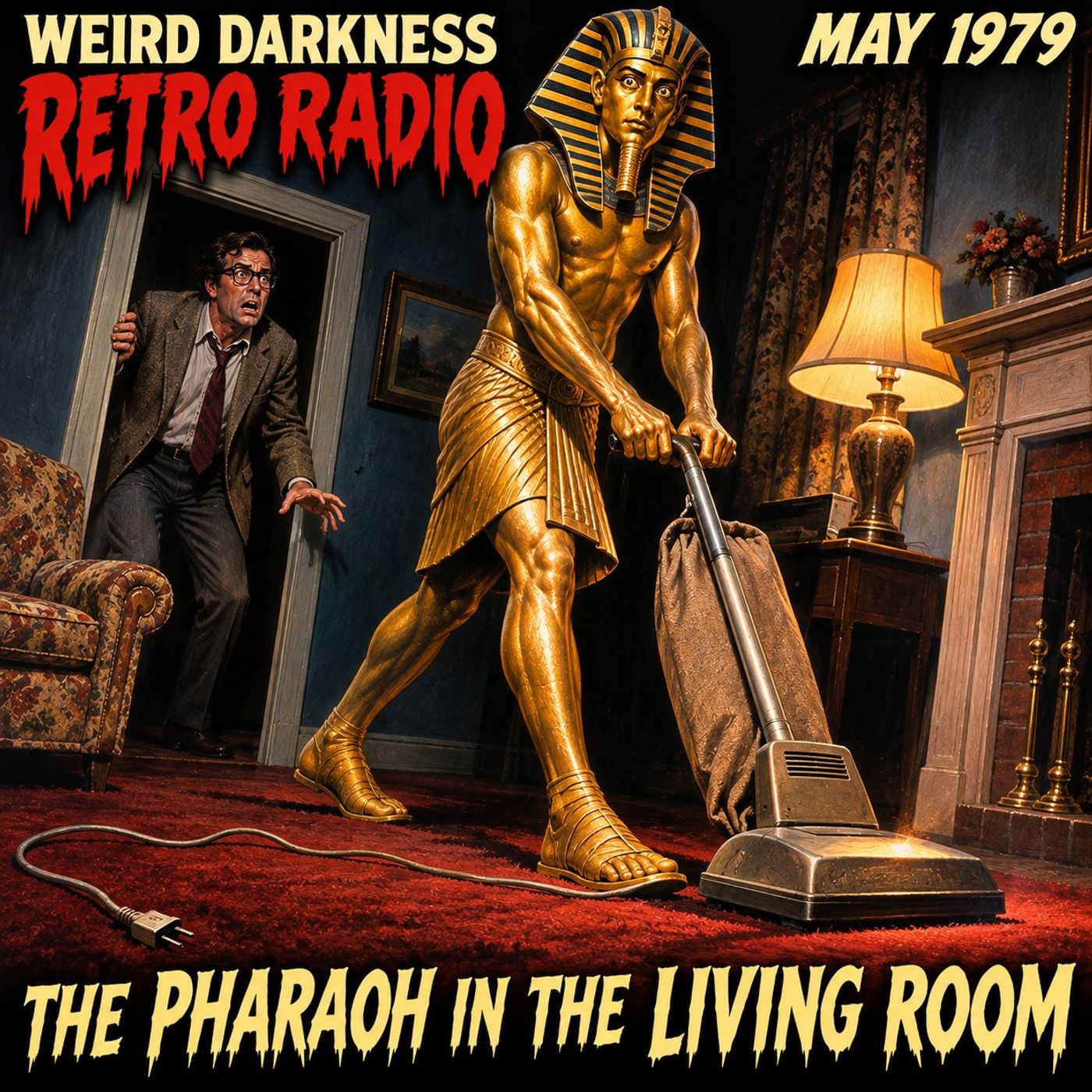
For his wife's birthday, Egyptology professor Ramsey West brings home a life-size, gold-painted reproduction of the pharaoh Seti I that a junk dealer practically gave away, and within minutes its bent right arm is hanging straight at its side. Then, with his wife out of town, he walks in to find the statue running the vacuum cleaner and telling him, "I am making this house ready for the long journey." CHAPTERS & TIME STAMPS (All Times Approximate)… 00:00:00.000 = Show Open 00:01:30.028 = CBS Radio Mystery Theater, “Messenger From Yesterday” (May 16, 1979) ***WD 00:46:06.916 = Night Beat, “Somebody Stop Ann” (August 07, 1952) ***WD 01:16:02.404 = Author’s Playhouse, “The Inexperienced Ghost” (December 04, 1944) ***WD 01:44:46.723 = Box 13, “Sealed Instructions” (April 17, 1949) 02:12:36.277 = Casey, “King of Apes” (May 01, 1947) ***WD 02:43:31.234 = Chet Chetter, “Interface To Terror” (1992) ***WD 03:11:10.971 = “The Lobomoter” by Static Wax (SONG), based on “Interface To Terror” 03:17:
Today, Mel is taking 58 years of hard-earned life lessons and is packing them into under an hour, to save you some of the time, frustration, and worry it took her to learn them the hard way. In this episode, Mel is fielding real questions from listeners around the world. From making friends and bouncing back from rejection to feeling stuck in life and wondering if it's all going to work out, Mel is sharing the advice she wishes she'd known sooner. And she's not holding back. You'll hear Mel get personal about her own setbacks, and what she's learned about starting over, going after what you want, and trusting yourself when life doesn't go according to plan. You'll learn: -How to stop worrying about the future when nothing feels certain -How to make big life decisions, including whether or not to have kids -How to make new friends as an adult -What to do when you get rejected from your dream job -What to do when a friend ghosts you -How to stop procrastinating and finally follow through
Fin Taylor is an English comedian, writer and podcaster. Horatio Gould is also an English comedian, writer, and podcaster. Expect to learn why there is such a range of historical beauty standards, what historians think about Clavicular, why the Manosphere has gone back to the Stone Age way of thinking, which historical world leaders had the best rizz, the most overrated dictators of history, how much of a genius Napoloean really was, the most corrupt sporting event in history, and much more… Get a free bottle of D3K2, an AG1 Welcome Kit, and more when you first subscribe at https://ag1.info/modernwisdom Timestamps: (00:00) Is There a Secret War Between Historians? (01:01) Maxxing vs Mogging: How Beauty Standards Have Changed (09:19) How Incels Are Reshaping Modern Beauty Standards (15:13) Why Henry VIII Was Such a Ruthless King (24:35) Is David Starkey a Controversial Historian? (29:24) Why Fin & Horatio Can't Stop Talking About Hitler (31:02) Where Would Dictators Go on the Political
Stephen Dubner recently served on a criminal jury. Twelve strangers — selected randomly and barely paid — took the job seriously. Afterward, he wondered: why can’t our politics work that way? A growing movement, inspired by Athenian democracy, says it can. SOURCES:Terry Bouricius (https://terrybouricius.com/about/), author and former Vermont state representative. Dj Hairston (https://www.linkedin.com/in/darryl-hairston-6647561a/), public-defense lawyer. Kathy Hochul (https://www.governor.ny.gov/about-governor-hochul), governor of New York. Hélène Landemore (https://politicalscience.yale.edu/people/h-l-ne-landemore), professor of political science at Yale University. RESOURCES:Democracy Without Politicians: Government by the People (https://link.amazon/B0emzIhh5), by Terry Bouricius (2026). Politics Without Politicians: The Case for Citizen Rule (https://link.amazon/B01Q6d4J2), by Hélène Landemore (2026). The Principles of Representative Government (https://link.amazon/B064Upe8v), by Be
SNL writer and Weekend Update anchor Michael Che joins Trevor and Eugene in this episode preview. Watch What Now? with Trevor Noah on Youtube or tune-in anywhere you listen to podcasts. Hosted by Simplecast, an AdsWizz company.
Customers should receive compensation for prolonged failure of essential paid online services.
Share your view, then see how readers voted. No sign-in required. This poll is shared across stories.
Do you agree or disagree?
Common Quandary
A Common Quandary to discuss
Another conversation to explore, separate from this news story.
The restaurant gives free birthday cake. Is moving your birthday by a week close enough?
A restaurant offers a spectacular free dessert on birthdays. Your birthday was last week, but nobody took you out then. When the server asks whether anyone is celebrating, your friends point at you and wait for your answer.
How much flexibility can a harmless celebration tolerate before it becomes a lie?