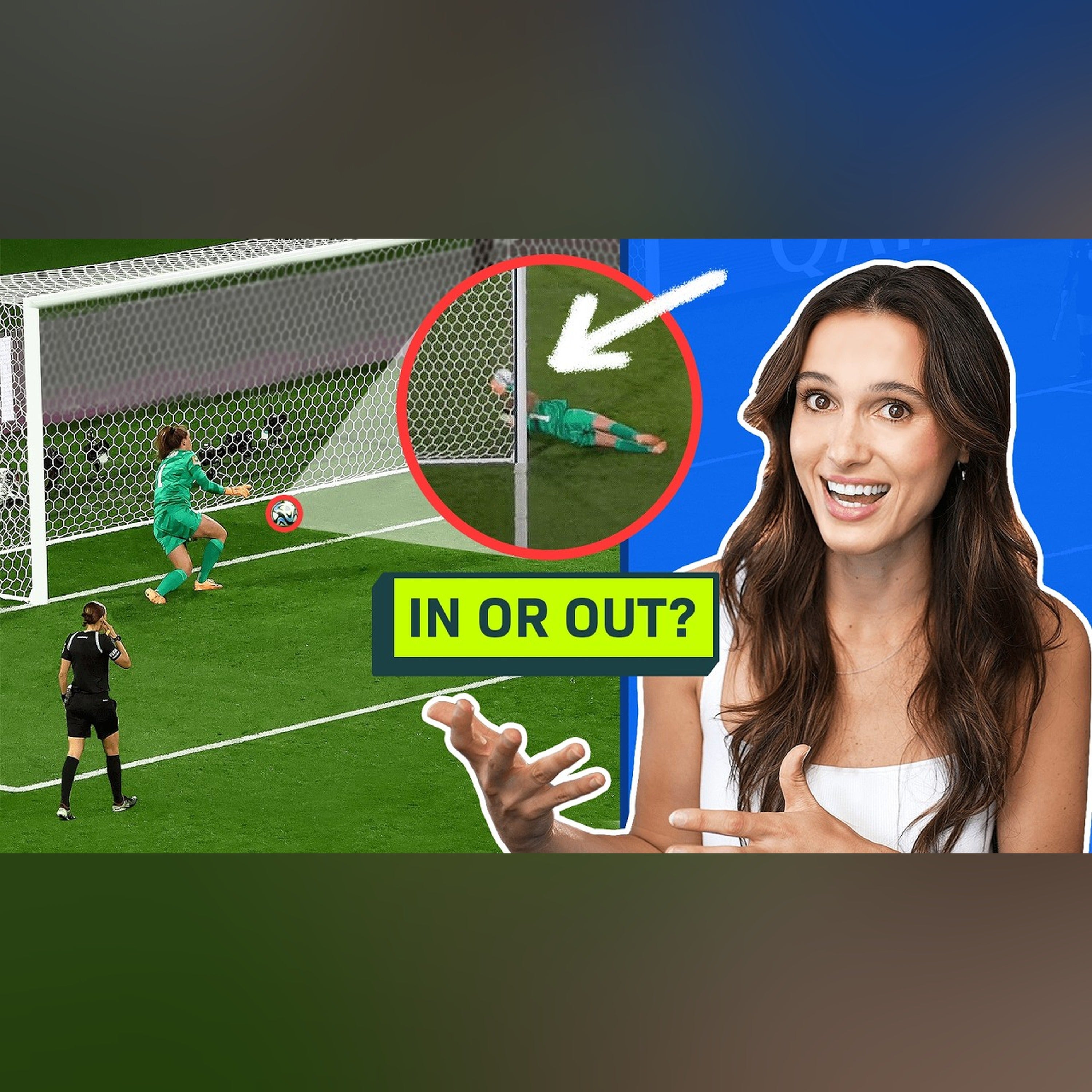
Are AI referees ruining sports? Or making them better? If you’re watching the 2023 US Open, you’re seeing automated referee calls. After years of controversy about human accuracy, tennis has used a system called Hawkeye to not only check human calls… but now to replace human referees. And this robot ref revolution isn’t just happening in tennis. It’s taking over the sports world. Soccer, basketball, baseball, they are all using machines to improve the calls being made on the field. The World Cup in particular has invested in these tools, from VAR (video assistant referee) to semi-automated offside and goal-line technology. The stakes are high. The difference between a right or wrong call can be a championship, or millions of dollars in prizes, endorsements, ticket sales. For the most part, fans like tech that makes calls more objective. HOWEVER… there is a big chunk of sports fans who would strongly disagree, who think that robot refs are ruining the game. Thing is, this tech isn’t goi
A kiss can be wonderful. It can create an instant connection, spark romance, or make you feel closer to someone. But a kiss can also have the opposite effect — and sometimes ruin everything. So what makes kissing so powerful, and why can one kiss make such a difference? There's some fascinating science behind it. https://www.scientificamerican.com/article/why-we-kiss/ We spend an enormous amount of time worrying about what's going to change. What's next? What's coming? How do we prepare? But what if we're paying attention to the wrong things? Some of the most important forces shaping our lives never change, and understanding them may be far more valuable than trying to predict the future — something humans are notoriously bad at. Morgan Housel, partner at The Collaborative Fund and author of Same as Ever: A Guide to What Never Changes (https://amzn.to/3SwWn6u) (https://amzn.to/3SwWn6u)), joins me to explain why the things that stay the same may be the most important things to understan
In this video, Disability Attorney Walter Hnot of the Disability Resolution Law Firm goes over why the wealthy are sour about social security benefits, and whether they have a good reason to end the program in general. Americas Most Viewed Disability Attorney Like the content? Review us here: https://g.page/r/CcwyektC7nCPEAg/review . If the link does not work, Google: Disability Resolution, P.A. Welcome to the largest Social Security Disability Tutorial Video Library On Earth. PRIVATE ONE HOUR SESSION PHONE CALL THIS IS HOW YOU CAN GIVE BACK TO HELP GROW THE CAUSE: Option 1: Leave 5 |==================5 STAR REVIEWS==================| Google (Search Disability Resolution Orlando, FL)- https://www.google.com/search?authuse... (https://www.google.com/search?authuse...=) AVVO (Search Walter Hnot) - https://www.avvo.com/attorneys/32817-... BBB (Search Disability Resolution Orlando, FL)- https://www.bbb.org/us/fl/orlando/pro... MARTINDALE (Search Walter Hnot Orlando, FL) - https://www.marti
DISCOVER GRAD SCHOOL: https://nci.university/home-v2?utm_source=chase_youtube&utm_medium=social_video&utm_campaign=nci4_promo (https://nci.university/home-v2) Uploaded 02-05-26 LEARN ABOUT NCI LEVEL 2: https://nci.university/nci-2?utm_source=chase_youtube&utm_medium=social_video&utm_campaign=nci2_promo (https://nci.university/nci-2) There’s a moment in every conversation where everything gets decided. It happens before logic. Before persuasion. Before anyone thinks they’re “in control.” And most people miss it completely. That’s why conversations feel unpredictable… Why people react in ways that don’t make sense… Why you can say the right thing — and still lose the room. Because the outcome was already set. This video breaks down the hidden structure behind human interaction: * how conversations organize themselves before words matter * how frames control behavior without force * how categories decide what’s allowed (and what isn’t) * how identity and metaphor quietly shape every respo
How to stop giving a F*CK what people think (for good) Episodes created by entrepreneur and masculinity ace Jack Hopkins for his youtube channel, this podcast is dedicated to helping men rediscover their inner strength and confidence in a society that often promotes feminine values over masculine ones.Follow the podcast for valuable insights, inspiring stories, and practical advice on how to embrace your masculinity, build your confidence, and achieve your goals. Whether you're looking to improve your relationships, advance your entrepreneurial career, or simply feel more confident and capable, Jack has valuable insights that can help you achieve your goals.So, if you're ready to reclaim your masculinity and awaken the beast that lives inside you, follow the podcast & turn on notis Follow Jack Hopkins:Insta: @jackhopfitnessYT: @JackhopkinsCEODisclaimer: All content rights belong to @JackhopkinsCEO on YouTube. This is a fan page.-------------------------- -----------------How to stop gi
Sign Up on Patreon to get access to the Space Time Discord! Uploaded 15-09-21 We’ve traveled to lots of weird places on this show - from the interiors of black holes to the time before the big bang. But today I want to take you on a journey to what has got to be the weirdest place in the modern universe - a place where matter exists in states I bet you’ve never heard of. Today we take a journey to the center of the neutron star. Check out the Space Time Merch Store Sign up for the mailing list to get episode notifications and hear special announcements! Hosted by Matt O'Dowd Written by Matt O'Dowd Graphics by Leonardo Scholzer, Yago Ballarini, Pedro Osinski, Adriano Leal and Stephanie Faria GFX Visualizations: Ajay Manuel Directed by Andrew Kornhaber Assistant Producer: Setare Gholipour Executive Producers: Eric Brown and Andrew Kornhaber End Credits Music by J.R.S. Schattenberg: https://www.youtube.com/user/MultiDroideka Special thanks to Our Patreon Sponsors Big Bang Sponsors David N
The theoretical capability of AI tools seems to be expanding rapidly. At the same time, however, their practical impact in the office has been uneven. Why? In this episode, Cal journeys through the history of the idea of “efficiency,” from the 1750s through today, exploring why this concept explains AI’s workplace struggles and what approach might solve them. Get your questions answered by Cal! Here’s the link: https://bit.ly/3U3sTvo Video from today’s episode: youtube.com/calnewportmedia (0:00) Beware of “efficiency” theater (48:18) The phenomenon of “AI Boomeranging” (52:03) Job numbers from the Bureau of Labor Statistics (55:24) Do school phone bans make a difference? (1:01:01) Early data on social media bans for kids (1:07:18) What Cal is up to Links: Thanks to our Sponsors: https://www.rayneo.com (https://www.rayneo.com/) https://www.mybodytutor.com (https://www.mybodytutor.com/) Thanks to Jesse Miller for production and mastering, Nate Mechler for research and newsletter, and Ben
Last week, Google announced that, in response to pressure from parents and educators, it would allow schools to turn off AI tools in their widely used education apps. Cal Newport analyzes this announcement and provides a logical explanation on how to react to this recent news. Chapters: 00:00 Intro: Google's ultimatum to schools 01:59 What's actually going on? 05:23 Can Google really not separate Search from AI? 07:25 The real reasons Google is doing this 08:43 How should we react? Option 1: Sue Google 10:54 Option 2: Switch search engines 13:37 Option 3: Legislation 16:12 Final thoughts: Get out of our classrooms
It’s becoming increasingly clear that the negative impact of phones on our lives is larger than we’d like to admit. Maybe it’s time to move beyond tips and hacks to explore more serious interventions. But what would these look like? In this episode, Cal dispatches correspondent Dale Davidson on a world-spanning investigation of some of the more extreme solutions people have deployed to reclaim their lives from their devices. Get your questions answered by Cal! Here’s the link: https://bit.ly/3U3sTvo Video from today’s episode: youtube.com/calnewportmedia (0:00) Can we escape our internet hell? (4:36) Act 1 (27:37) Act 2 (41:40) Act 3 (1:06:46) Closing comments Links: https://www.wsj.com/lifestyle/phone-screen-time-prison-pg-sittenfeld-8c3b186b?st=JjqsTg&reflink=desktopwebshare_permalink (https://www.wsj.com/lifestyle/phone-screen-time-prison-pg-sittenfeld-8c3b186b?reflink=desktopwebshare_permalink&st=JjqsTg) https://hangingup.substack.com/?utm_campaign=profile_chips (https://hangingup.
Businesses should explain substantial price increases to their customers.
Share your view, then see how readers voted. No sign-in required. This poll is shared across stories.
Do you agree or disagree?
Common Quandary
A Common Quandary to discuss
Another conversation to explore, separate from this news story.
You lecture everyone about climate change—then get invited on a dream flight. Do you go?
A close friend living overseas invites you to an important celebration. Flying is affordable but carbon-intensive. Your individual decision will not determine whether the flight operates, yet it conflicts with commitments you publicly encourage others to make.
When is a small personal contribution to a large harm morally significant?