A seminar can change your mind — but how do you actually change your life? Motivational videos can inspire you in the moment. They can give you energy, clarity, and hope. But inspiration without direction fades. In this episode, Jim Rohn explains the structure of motivation — why some forms of motivation push you temporarily, while others can carry you for a lifetime. You’ll learn the three levels of motivation, how each one works, and why most people get stuck relying on the weakest fuel. This isn’t about feeling fired up. It’s about understanding what’s driving you — and choosing a better source of momentum. To help you apply these ideas, we include Action Guides that turn philosophy into practical steps. Action Guide for this lesson: You can find this action guide, along with other free resources, at: If you keep waiting, you’ll just keep waiting. Start changing your life now. **Follow, Start listening and let Jim Rohn’s legacy inspire your path forward.** ---
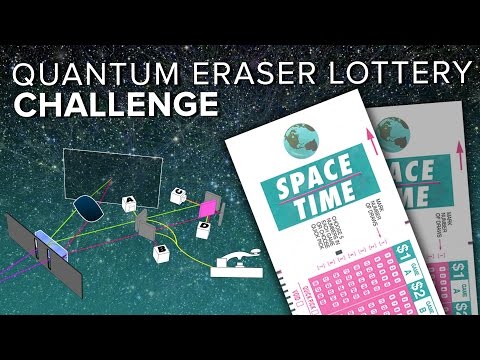
Matt challenges you to use quantum physics to win the lottery. Are you up to the task? Uploaded 17-08-16 Previous Episode on Quantum Eraser https://www.youtube.com/watch?v=8ORLN_KwAgs Get your own Space Time tshirt at http://bit.ly/1QlzoBi Tweet at us! @pbsspacetime Facebook: facebook.com/pbsspacetime Email us! pbsspacetime [at] gmail [dot] com Comment on Reddit: http://www.reddit.com/r/pbsspacetime Support us on Patreon! http://www.patreon.com/pbsspacetime Help translate our videos! http://www.youtube.com/timedtext_cs_panel?tab=2&c=UC7_gcs09iThXybpVgjHZ_7g (http://www.youtube.com/timedtext_cs_panel?c=UC7_gcs09iThXybpVgjHZ_7g&tab=2) The Quantum Eraser experiment seems to show that information can travel backwards in time. On today’s episode of Space Time, we are going to create a time-traveling communication device and use it to cheat on the lottery! Here's Your Challenge question: Why am I going to be sadly disappointed after turning on my invention? I do get a signal – nice work fut
Where is the economy is today – is it growing? Flat? Declining? Uploaded 15-10-19 What about YOUR economy – your personal investments, your nest egg? How safe is it, and how likely it is to grow at the rate you want it to? When you think about your current investments, how do you feel? Secure, or are you half-panicked? For many, the recession of 2008 still lingers. Those who suffered are waiting, white-knuckled, holding on to their portfolios and still wondering what to do next. We have, after all, been in one of the longest bull markets in history and bull markets always come to an end at some point. So how do you protect yourself from the possibility of another 2008? And how can you start to take a more proactive, confident approach to your portfolio? When Tony wrote Money Master the Game, he had the unique privilege of sitting down with some of the most successful, masterful investors and financial gurus of all time – including the legendary Ray Dalio. Ray founded the investment man
The Fair Work Tribunals edition of Wednesday 25 November 2026 (39 decisions, two with headnotes), with the Fair Work Tribunals edition of Tuesday 24 November 2026 (228 decisions, three with headnotes) alongside it. A Full Bench on why the Black Coal award's redundancy relief clause runs through the dispute procedure and not compulsory arbitration; another on appealing a refusal to reinstate and counting the anticipated period; and three rulings where generative AI did some of the drafting: costs and fictitious authorities, an AI-drafted agreement that made a worker an employee, and an AI-prepared witness statement. Fair Work Desk: relief from retrenchment pay goes through the dispute procedure (opening story). R2S Medical & Emergency Response Pty Ltd v Peter Quirk and Others [2026] FWCFB 291 (https://jade.io/article/1307378) - Gibian VP, Dobson and Slevin DP, 5 November 2026. Signal Doctrine and Practice & Procedure. Black Coal Mining Industry Award 2020 cll 32, 34.4, 34.6; Fair Work A
What if your child already loves learning... and you’re just looking for it in the wrong place? This week, I’m exploring one of the questions I get asked more than almost any other: “My child used to be so curious. What happened?” In today’s episode, I challenge one of the biggest myths in modern parenting: that a love of learning looks like a child happily reading, sitting at a desk, completing homework without complaint, and engaging enthusiastically with educational activities. I explain what the research actually tells us and walk you through the psychology of curiosity, the science of intrinsic motivation, why children become obsessed with Minecraft, dinosaurs, trains, or random facts, and why those interests may be far more important than they appear. I also unpack why children seem to have a built‑in radar for anything that feels educational, why homework battles happen so often, and what the evidence really says about homework in the primary years. If you've ever worried that y
Dig into the slippery slope fallacy, which assumes that one step will lead to a series of events that lead to an extreme— often bad— scenario. Uploaded 19-08-21 -- It’s 1954. Vietnamese nationalists are on the verge of securing an independent Vietnam under communist leader Ho Chi Minh. U.S. President Eisenhower claims that by virtue of the "falling domino principle," communist control of Vietnam would lead to the global spread of authoritarian communist regimes. Can you spot the problem with this argument? Elizabeth Cox explores the slippery slope fallacy. Lesson by Elizabeth Cox, directed by TOGETHER. Support Our Non-Profit Mission ---------------------------------------------- Support us on Patreon: http://bit.ly/TEDEdPatreon Check out our merch: http://bit.ly/TEDEDShop ---------------------------------------------- Connect With Us ---------------------------------------------- Sign up for our newsletter: http://bit.ly/TEDEdNewsletter Find us on Twitter: http://bit.ly/TEDEdTwitter Pe
View full lesson: http://ed.ted.com/lessons/how-do-we-measure-distances-in-space-yuan-sen-ting Uploaded 09-10-14 When we look at the sky, we have a flat, two-dimensional view. So how do astronomers figure the distances of stars and galaxies from Earth? Yuan-Sen Ting shows us how trigonometric parallaxes, standard candles and more help us determine the distance of objects several billion light years away from Earth. Lesson by Yuan-Sen Ting, animation by TED-Ed.
As machines take on more jobs, many find themselves out of work or with raises indefinitely postponed. Is this the end of growth? No, says Erik Brynjolfsson -- it's simply the growing pains of a radically reorganized economy. A riveting case for why big innovations are ahead of us ... if we think of computers as our teammates. Be sure to watch the opposing viewpoint from Robert Gordon. Uploaded 30-08-13 Talk by Erik Brynjolfsson.
Organizations should collect less personal information rather than simply promise stronger security.
Share your view, then see how readers voted. No sign-in required. This poll is shared across stories.
Do you agree or disagree?
Common Quandary
A Common Quandary to discuss
Another conversation to explore, separate from this news story.
Five friends join the person ahead of you after a forty-minute wait. Do you object?
You wait forty minutes for a popular event. Just before the doors open, five friends join the person directly ahead of you, who says they have been holding everyone's place from the beginning.
What unwritten agreement does joining a line create?