A Strange Triple-Star System Just 28 Light-Years Away Is Challenging Stellar Evolution
20 min
Listen through the publisher, then discuss the episode here or arrange an in-person Roundtable. Your city determines where to meet.
Roundtables are designed for groups of four, with a shared subject and room for everyone to speak. Come for discussion, with no dating expectation.
Just 28 light-years from Earth, astronomers have discovered Welopōʻai, an unusual triple-star system that challenges our understanding of stellar evolution. Its complex arrangement of white dwarfs and a red dwarf raises intriguing questions about how stars interact, survive catastrophic transformations, and evolve over time. What makes this nearby system so difficult to explain? This episode includes AI-generated content.
Episode information is provided by the publisher. Listening takes place on the publisher’s service.
In this calm and sleepy facts episode, we look up and explore the enormous, slowly turning galaxy that contains everything humanity has ever known. We begin with what the Milky Way actually is, a barred spiral galaxy roughly 100,000 light years across, home to somewhere between 100 and 400 billion stars, one of which is our own Sun, quietly orbiting about two thirds of the way out from the center. We trace the galaxy's structure from the dense central bulge and its bar of stars outward through the great spiral arms, past stellar nurseries where new stars are still being born in vast clouds of gas and dust, and into the faint stellar halo where ancient globular clusters orbit high above and below the galactic plane. At the very heart of it all sits Sagittarius A star, a supermassive black hole roughly four million times the mass of the Sun, hidden behind thick lanes of dust that block visible light but reveal themselves in infrared and radio waves. We explore the stellar population of t
Thank you to Morning Brew for supporting PBS. To learn more and sign up go to https://cen.yt/mbpbsspace Uploaded 08-03-22 Take the Space Time Fan Survey Here: https://forms.gle/wS4bj9o3rvyhfKzUA PBS Member Stations rely on viewers like you. To support your local station, go to:http://to.pbs.org/DonateSPACE At just four light years away, Proxima Centauri is our closest solar neighbor. The recent discovery of the new exoplanet Proxima D, has reopened the discussion of whether the proxima system is our best chance at reaching another Earth. How did we discover Proxima D? How do we know what the conditions are on planets so far away? Watch the episode to learn more. Sign Up on Patreon to get access to the Space Time Discord! Check out the Space Time Merch Store Sign up for the mailing list to get episode notifications and hear special announcements! Hosted by Matt O'Dowd Written by Matt O'Dowd Post Production by Leonardo Scholzer, Yago Ballarini, Pedro Osinski, Adriano Leal and Stephanie F
View full lesson: http://ed.ted.com/lessons/how-do-we-measure-distances-in-space-yuan-sen-ting Uploaded 09-10-14 When we look at the sky, we have a flat, two-dimensional view. So how do astronomers figure the distances of stars and galaxies from Earth? Yuan-Sen Ting shows us how trigonometric parallaxes, standard candles and more help us determine the distance of objects several billion light years away from Earth. Lesson by Yuan-Sen Ting, animation by TED-Ed.
This is a Grave Talks CLASSIC EPISODE! What if hearing the voices of the dead wasn’t strange—but simply your everyday reality? For Kelly McCarville, growing up meant living in a world where spirits were never far away. As a child, she didn’t question it. She assumed everyone else could hear them too. Whispers in quiet rooms, shadows that seemed to linger with intent, feelings of presence that were more real than imagined—all of this was as natural as breathing to her. In her home, among her family, it was simply part of life. But as she grew older, it became clear that not everyone had these same abilities. What Kelly thought was “normal” wasn’t the experience of most children. And instead of fading with time, her connection to the other side only deepened. The voices became clearer. The sensations stronger. The glimpses of spirits undeniable. Kelly’s gift was not meant to be silenced—it was meant to be used. Over the years, she embraced her abilities and learned how to harness them in
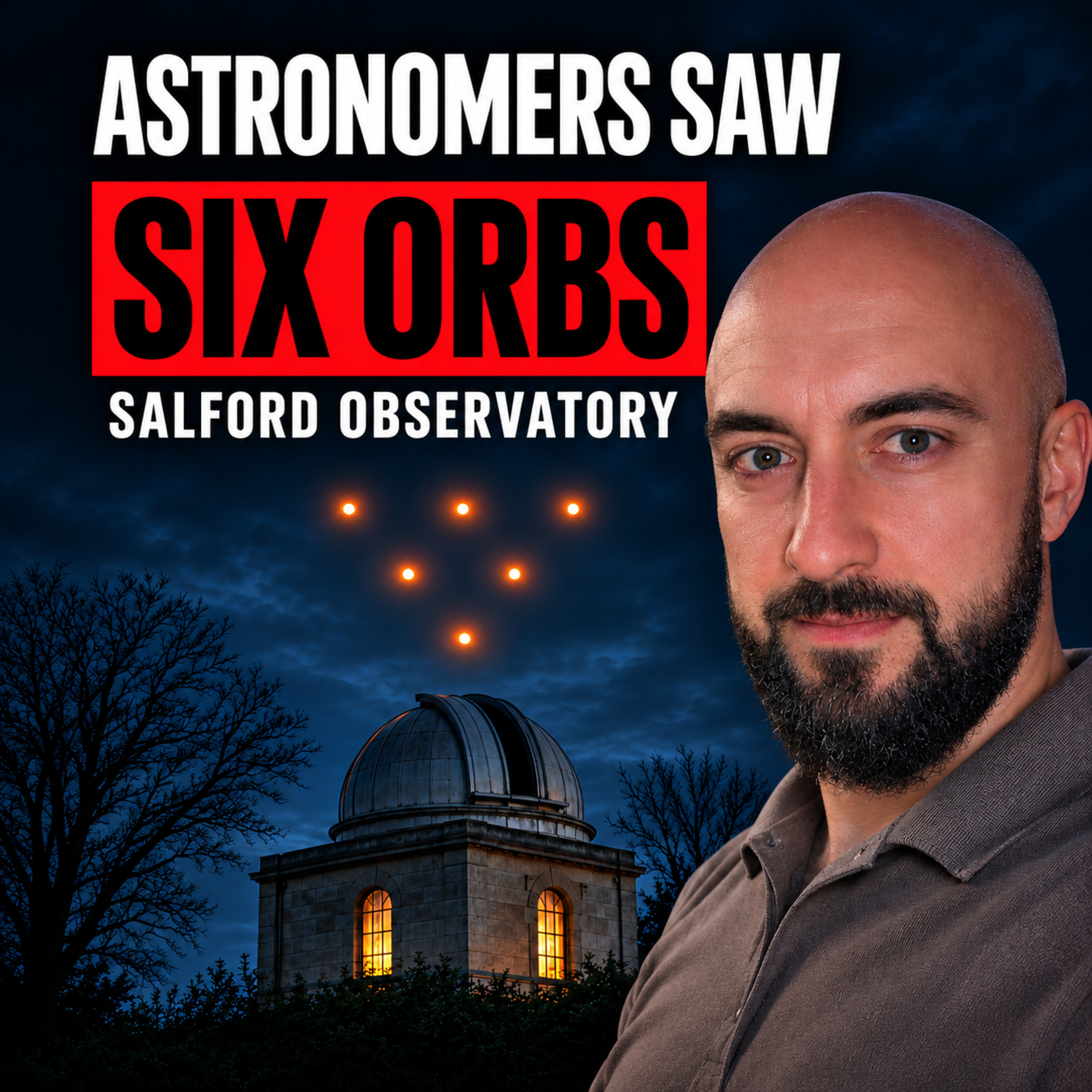
Six orange orbs shot across the sky in formation. About 20 minutes later, three white lights appeared in a triangle. This time, someone got their phone out. UAP Files Podcast S4|E44 On 7 October 2026, amateur astronomer and astrophotographer Adam George was outside Salford Observatory with other observers when they saw two sets of unusual lights. Adam describes the first six lights as fast, silent and arranged in a 3–2–1 formation. While the group was still discussing what they’d seen, someone spotted three white lights moving across the sky. One of the group filmed that second sighting before the lights appeared to switch off. Adam joins me on UAP Files to talk through both sightings, what the group checked that night and why he still hasn’t settled on an explanation. We also get into how difficult it is to judge the speed, size and distance of a light in the night sky. What do you make of the second sighting? If you’ve seen something similar, let us know where and when in the comment
In 1956, a teenage girl in Battersea, London, received a mysterious package containing a small silver key. Nobody knew who had sent it or what it was supposed to unlock. But shortly afterward, strange things began happening in her family's home. At first, there were unexplained knocks and scratching sounds. Then objects reportedly began moving, furniture shifted, and the disturbances became increasingly difficult to ignore. As the activity continued, journalists and paranormal investigators took an interest in the family, and what they encountered raised even more questions. Eventually, the family began receiving what appeared to be messages from an unseen presence that claimed to have a name, a personality, and a particular interest in their teenage daughter. The experiences reportedly continued for twelve years. Was the family dealing with an unusually persistent poltergeist—or was there another explanation for one of Britain's most extensively investigated hauntings? #RealGhostStori
Astronomers may have found a new way to hunt for primordial black holes, mysterious ancient objects that could help explain dark matter. New theoretical models suggest that their encounters with rapidly spinning stars could produce extraordinary cosmic events, potentially leaving behind distinctive signals detectable by existing telescopes. Could these stellar explosions finally reveal what has remained hidden since the early universe? This episode includes AI-generated content.
Astronomers have confirmed an extraordinary stellar merger in the Andromeda galaxy, involving a massive supergiant and a smaller, Sun-like star. By combining observations from multiple telescopes with advanced simulations, researchers reconstructed the dramatic process, offering new insights into how stars interact, evolve, and eventually merge. This episode includes AI-generated content.
Observations from the James Webb Space Telescope reveal how powerful gas outflows shape the evolution of massive galaxies. Driven by supermassive black holes, these cosmic winds can regulate or even shut down star formation, influencing the conditions needed for future planetary systems. The findings offer new insight into how galaxies evolve across cosmic history. This episode includes AI-generated content.
A study's methods should be available before its findings influence public policy.
Share your view, then see how readers voted. No sign-in required. This poll is shared across stories.
Do you agree or disagree?
Common Quandary
A Common Quandary to discuss
Another conversation to explore, separate from this news story.
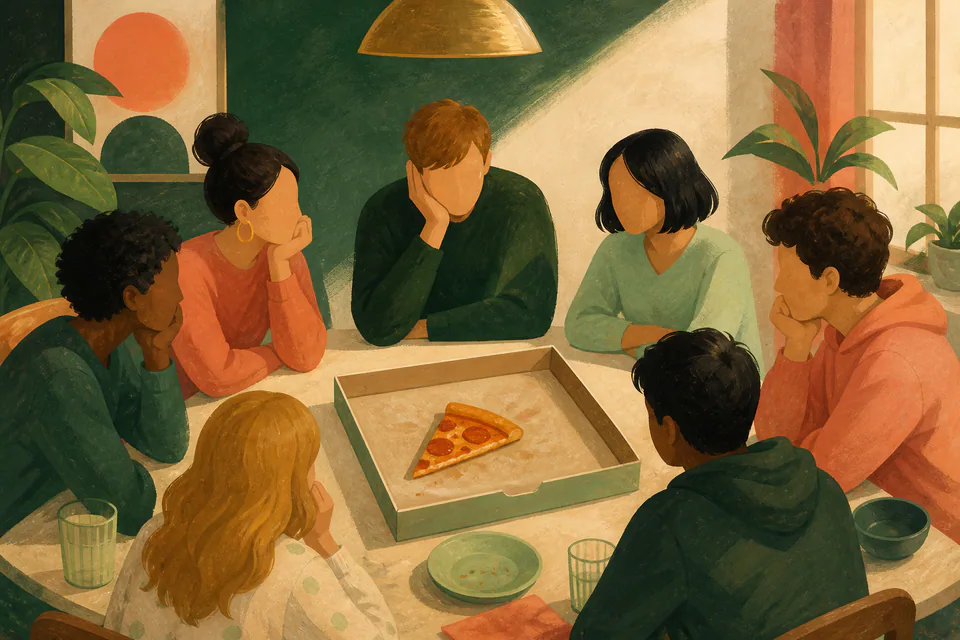
One slice of pizza remains and everyone is pretending not to want it. Can you take it?
Six friends have been circling the last slice of pizza for twenty minutes. Nobody claims it when you ask, yet two people keep glancing at the box. You are still hungry and paid the same share as everyone else.
Does politeness require leaving something that nobody will openly claim?