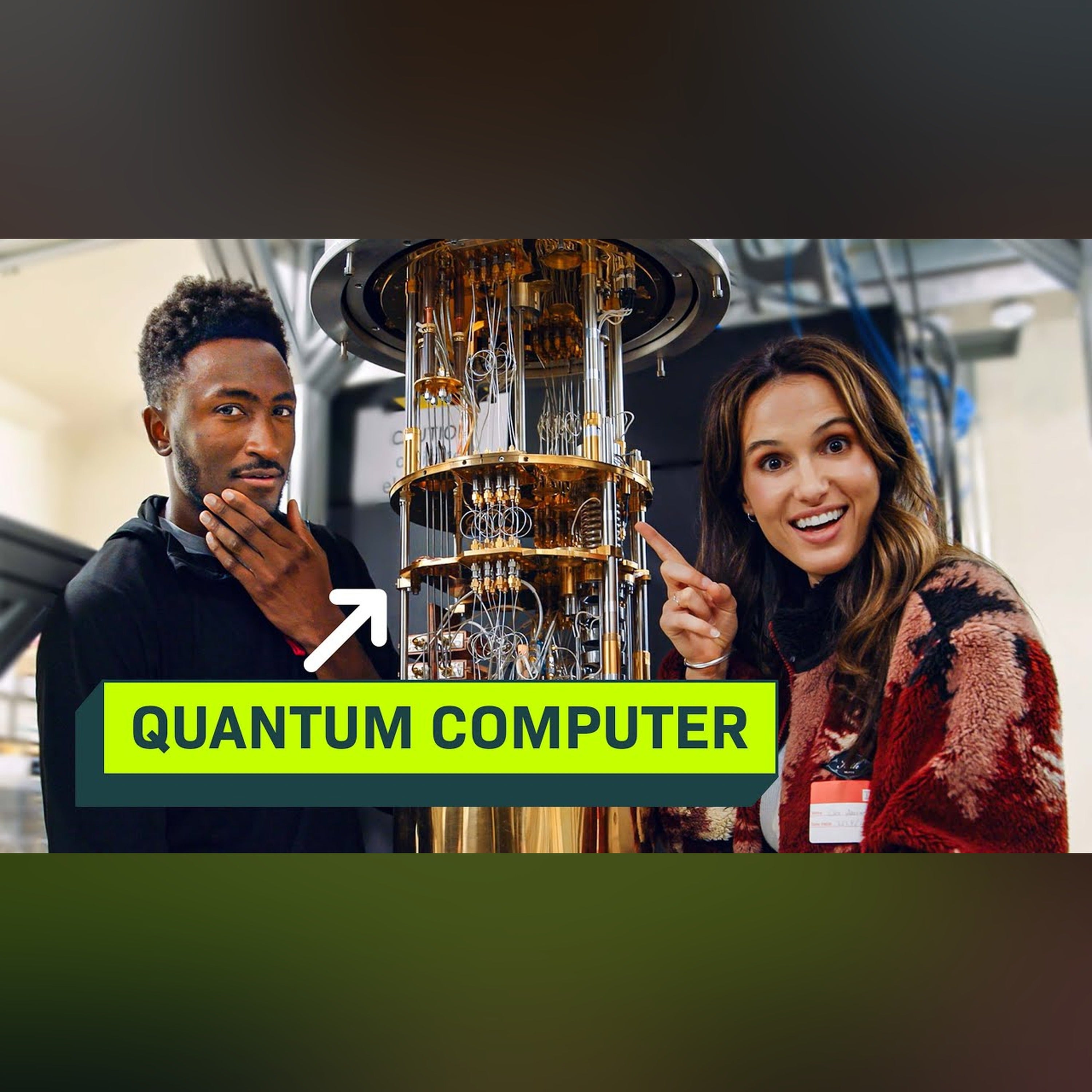
Quantum computers aren’t what you've been told... You’ve heard about quantum computers. Maybe you’ve seen the “race for quantum supremacy” between governments and companies, or read that quantum computers will break all encryption, or heard terms like “qubits” or “superposition” or “quantum mechanics” in a confusing tv segment. But you might be wondering… what does a quantum computer actually DO? And how could it actually affect my life? @mkbhd and I had the same questions. Marques and I both realized quantum computing was this big important technology… that we didn’t really understand. So we decided to go on an adventure to learn the truth about quantum computers. And we're taking you with us, to show you what we learn as we learn it. But more importantly, to show you how these crazy computers might actually impact YOUR life... sooner than you think. Chapters: 00:00 What is a quantum computer? 02:00 Why is quantum computing important? 04:00 The Quantum Video Game analogy 07:40 What do
Europe's intake of Chinese-built vehicles passed 1.1 million in the first eight months of this year, exceeding all of last year's total. I explain why America's carmakers cite that competition alongside concerns about connected cars collecting data. I take the data concern seriously, but I don't think it justifies permanently denying buyers the choice. With Trump open to Chinese manufacturers building locally, I examine the clash between that offer and the industry's demand for a ban.
Horizon3.ai co-founder and CTO Anthony Pillitiere discusses how AI-enabled agentic threat actors are industrializing cyberattacks using existing vulnerabilities rather than novel exploits. Drawing on 21 years in the Air Force and his role as deputy CTO for JSOC, he explains why organizations must shift to autonomous offensive security and how the collapse between emerging threats and exploitation is forcing leaders to address long-standing cyber debt. Brought to you by: Mongo DB - Anyone can prototype an agent. Lovable - Turn ideas into software people love with Lovable. Start today at https://lovable.dev/ Factory - A 24/7 system turning signals into production software. Visithttps://factory.com/ Neon (by Databricks) - Scale your startup on Neon. The Postgres backend for apps and agents. Built by Databricks.https://neon.com/mtshttps://neon.com/mts (https://neon.com/mts%E2%81%A0) Head over to http://getvcx.com (http://getvcx.com/) to learn more Kong - The AI connectivity platform. Larri
Zvi does the reading on OpenAI’s system card for GPT-6.2 Astra and Sol: the first externally deployed model to meet OpenAI’s High threshold for AI self-improvement, already at Critical for cybersecurity. He works through the preparedness results, the safeguards against misuse, distillation and model escape, and the alignment and monitorability findings, including rising evaluation awareness, reasoning that happens without visible chain of thought, and UK AISI’s tour of misaligned behaviours, asking what the numbers do and don’t show. This has been an Askwho Casts audio conversion. Thanks for listening. * 00:00 - Introduction * 01:10 - Table of Contents * 02:45 - Safety Overview (1) * 05:19 - Internal Deployment (1.2) * 05:32 - Preparedness Assessment (2) * 06:40 - Biological Threats (2.1.1) * 09:55 - Cyber Threats (2.1.2) * 11:36 - AI Self-Improvement Threats (2.1.3) * 14:32 - OpenAI Epoch Capabilities Index (OECI) * 16:10 - Safeguards (2.2) * 17:34 - AI Self-Improvement Threat Modelin
Project Synapse: Markets in Freefall, Fragile Infrastructure, and AI's Perfect Storm The hosts banter through the show's intro before focusing on a sense that "things are out of control," citing a WallStreetBets suicide-hotline post amid a market crash and discussing cascading system failures involving Microsoft, the FAA, and a reported NSA internal communications outage. They argue politicians and leadership lack technical competence and clear messaging, increasing panic, while emphasizing that many problems stem from aging, underfunded infrastructure and complex, brittle software (PHP, NGINX, Java), not proven AI attacks—more a "perfect storm" of crises. They debate whether AI should help fix complexity, stressing critical thinking, accountability, and using multiple AIs to verify each other. In a lightning round they cover Anthropic's IPO performance, mixed reactions and token limits with ChatGPT 6.2 (favoring "Sol" over "Astra"), Google's cheaper Neon model and confusing UX, Loblaw
Palo Alto Networks has agreed to acquire the artificial intelligence startup Applied Compute in an all-stock transaction valued at $4.5 billion. Founded by former OpenAI researchers, Applied Compute specializes in helping businesses train and deploy customized open-weight AI models using their own proprietary data. This strategic purchase enables the cybersecurity giant to expand beyond traditional security offerings and embed protection directly into corporate AI infrastructure. Alongside the acquisition announcement, Palo Alto reported strong quarterly financial results that pushed its shares up significantly and led the company to raise its annual revenue forecast. Ultimately, the deal highlights a broader industry trend where major tech firms are rapidly absorbing specialized artificial intelligence capabilities to meet growing enterprise demand.
AI is changing the cyber security landscape, creating new capabilities for attackers and defenders. In the first episode of the new No Ordinary Tech Podcast series, Ron van Kemenade is joined by Snehal Antani, CEO and Co-Founder of Horizon3.ai, and Manija Poulatova from Lloyds Banking Group to ask: can we use AI to keep us safe from AI? They explore how AI is changing the speed and scale of cyber threats, why good security fundamentals still matter, and how defenders are moving towards 'machine-speed' defence. They also discuss the role of people and engineering, the importance of cutting through AI hype, and why security, transparency and trust matter as AI plays a growing role in the services we use. Brought to you by Lloyds Banking Group. Visit https://www.lloydsbankinggroup.com/who-we-are/group-overview/tech-and-transformation.html (https://eur02.safelinks.protection.outlook.com/?data=05%7C02%7CNitesh.Patel1%40lloydsbanking.com%7C67b3b3d40f904ecc78a208dec6075c84%7C3ded2960214a46ff8
Demonstration organizers should take reasonable steps to discourage violence by participants.
Share your view, then see how readers voted. No sign-in required. This poll is shared across stories.
Do you agree or disagree?
Common Quandary
A Common Quandary to discuss
Another conversation to explore, separate from this news story.
A coworker tells you their salary in confidence—and proves everyone else is underpaid. Do you share it?
A coworker privately tells you their salary and asks you not to repeat it. You later realize the figure is strong evidence that several equally experienced colleagues are being underpaid.
When does fairness outweigh a promise of confidentiality?