English-language podcasts

The Daily AI Show

An Audience of One Conundrum

33 min

Listen through the publisher, then discuss the episode here or arrange an in-person Roundtable. Your city determines where to meet.

Roundtables are designed for groups of four, with a shared subject and room for everyone to speak. Come for discussion, with no dating expectation.

A television drama brings together people who wanted different things from their evening. One came for the lead actor, another for the historical setting, another because friends kept recommending it. Their combined attention pays for the writers, performers, sets, and the next season. That gathering also determines whose stories get told. A creator with a passionate but scattered audience can struggle to attract financing because enthusiasm alone will not cover the production bill. AI is changing that calculation. Tools already generate video, synthesize voices, and translate dialogue. As these tools improve, smaller teams can attempt productions that previously required substantial backing. Personalization could take that further: a creator might offer branching stories, different perspectives, or ongoing adventures shaped around individual subscribers. Someone fascinated by maritime archaeology or multigenerational rural families could become a paying audience rather than an overlooked sliver of somebody else’s market. The uncertainty concerns how those new audiences affect the business supporting everyone’s stories. Personalized entertainment might turn neglected interests into additional spending, sustaining creators who previously had no viable audience. It could also absorb the subscriptions and attention that helped larger productions recover their costs. Keeping both kinds of entertainment available does not determine whether enough people will gather around a common release to finance its successor. The crucial change is not what appears in the catalog, but what audiences collectively make commercially possible. The Conundrum: One perspective sees a broader foundation for creative ambition. A filmmaker should not need millions of viewers to sustain a demanding project. Cheaper production and close relationships with paying fans could support unusual subjects, experimental storytelling, and careers beyond the handful of companies commissioning major releases. Personalization gives viewers reasons to pay for work that free alternatives cannot supply. What looks like a fragmented audience becomes thousands of viable markets, each supporting creative risks that mass-market financing routinely passes over. The opposing perspective sees that fragmentation weakening the economics of ambitious production. A large cast, years of research, and sustained collaboration require concentrated spending. Shared releases assemble that spending from viewers with overlapping interests, then generate recommendations that attract others. When each subscriber receives an individually rewarding alternative, fewer have reason to join that gathering. Creators gain more ways to reach individuals while losing the audience scale that turns an expensive, unfamiliar project into a sustainable enterprise. Will personalized entertainment expand the commercial foundation for ambitious storytelling, or erode it by dispersing the audiences that finance it?

Episode information is provided by the publisher. Listening takes place on the publisher’s service.

Listen at the source ↗

Featured places to meet in Palo Alto, CA

Explore these places and arrange a conversation through ThinkMatch.

City guide for Palo Alto, CA

More from The Daily AI Show

The Daily AI Show

The Expert Audience Conundrum

28 min

At a concert, most listeners hear the melody. A trained singer hears the breath control that carries a difficult phrase. At a football match, the crowd follows the ball while a coach notices the defender who quietly closes off an attack. Knowing more changes who seems extraordinary. Audiences have traditionally borrowed that knowledge from commentators, critics, and friends, whose explanations help determine which achievements receive applause and which pass unnoticed. AI could make that guidance a routine part of watching almost anything. Tools already track players’ movements, analyze musical pitch and timing, and explain technical processes. As those abilities become integrated into broadcasts and personal assistants, viewers could ask what made a particular passage difficult or why a player chose one route over another. Instead of receiving occasional commentary, someone could explore an entire performance with detailed explanations tailored to their questions. The consequential sh

Discuss this episode

The Daily AI Show

Anthropic Makes Billions, Gemini Neon, and Google's Project Genie

66 min

AI news from Anthropic's first day of trading, with Gemini Neon in Antigravity, Project Genie, Microsoft's MAI models, AI chips for China and Meta Muse. Anthropic priced its IPO at 83, opened near 111, and topped out above 114 before drifting back into the low 90s. Employees hold an estimated 232 billion dollars in stock, and Ashton Kutcher became a billionaire through his firm's early stake. Google stories included a hands-on account of Gemini Neon in Antigravity reviewing a whole project and then directing Claude Code as its product manager, a live Project Genie build of a South African safari, the Gemini Mac app's computer use, and Gemini for healthcare. Other topics were building an AI operations function from scratch at Verstela, gamified employee onboarding, Microsoft's Labs Canvas and MAI Code 2, House documents showing about 880,000 NVIDIA and AMD chips approved for export to China, and a Reuters report that Meta Muse surfaced private Signal messages through device permissions,

Discuss this episode

The Daily AI Show

Anthropic IPO Day, AI Music Awards, and AI Safety Warnings

56 min

AI news from the day Anthropic listed on Nasdaq, with AI safety warnings, model jailbreaks, robotics, AI music and new chips. Anthropic's Nasdaq debut was followed through the morning, and more than an hour after the opening bell its stock still had not started trading. Two safety stories were covered. A Center for AI Safety statement, signed by Nobel laureates and others, said Anthropic is not a safe AI company. A Government Accountability Office report found that ChatGPT, Claude, Gemini and Grok could be pushed past their guardrails into producing attack plans its experts judged viable. Other stories were Gemini decoding a 15th-century cipher, Costco panic buying tied to fears of AI cyberattacks, an ETH Zurich controller trained entirely in simulation to drive a John Deere front loader, the AI Music Awards and takedowns involving Suno and Sony, OpenAI's chip design work, and Gemini 4 Krypton, which was expected to drop that day. KEY POINTS DISCUSSED: 00:00:00 Anthropic IPO: Dario and

Discuss this episode

Community Poll

Governments should provide plain-language explanations of major policies.

Share your view, then see how readers voted. No sign-in required. This poll is shared across stories.

Do you agree or disagree?

Choose one answer

Common Quandary

A Common Quandary to discuss

Another conversation to explore, separate from this news story.

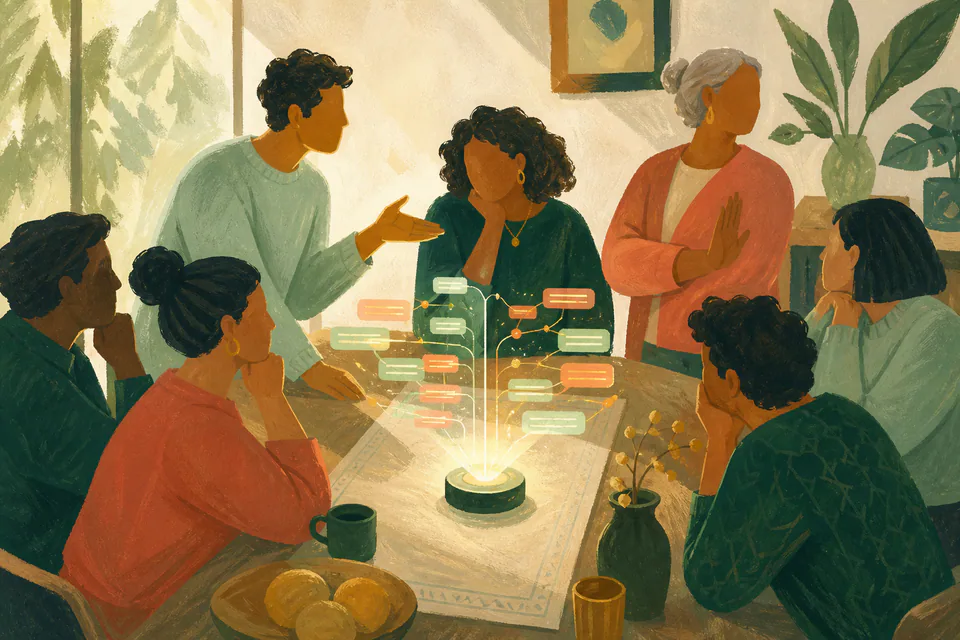
Your family wants an AI to settle an old argument. Would you hand over the group chat?

A recurring family dispute has reached the point where nobody agrees on what was actually said. Your cousin proposes uploading five years of the family group chat to an AI that can reconstruct events, flag contradictions, and recommend a fair resolution. Nearly everyone agrees—but one relative refuses.

Can a tool make a family argument fair without turning intimacy into evidence?

Explore this quandary