Arata v. Standard Lithium Ltd. — 2d Cir. (Nov 10, 2026)
35 min
Listen through the publisher, then discuss the episode here or arrange an in-person Roundtable. Your city determines where to meet.
Roundtables are designed for groups of four, with a shared subject and room for everyone to speak. Come for discussion, with no dating expectation.
The Second Circuit considers investor Arata's securities-fraud lawsuit against Standard Lithium. The company was testing a process to extract lithium from salty water at an Arkansas demonstration plant. Arata says its statements about high recovery rates and large production volumes overstated what the plant could actually do. Reports challenging the company's claims were followed by sharp drops in its stock price. The company disputes the reports' calculations and says it warned investors that the project was still being tested. A federal judge dismissed the case, finding the alleged misleading statements and fraudulent intent insufficiently pleaded. Arata will argue that warnings about future risks did not excuse withholding disappointing results already known to management. Standard Lithium will argue that its statements described laboratory results and potential capacity, not proven commercial production. Arata v. Standard Lithium Ltd. (No. 25-2821) — U.S. Court of Appeals for the Second Circuit, argued November 10, 2026. Sources: Official Second Circuit oral argument — November 10, 2026. Source note: the argument and submission are complete; a faint final administrative sound is indistinct and is retained as supplied by the court.: Prior district-court memorandum and order — Doc. 46, September 28, 2025:
Episode information is provided by the publisher. Listening takes place on the publisher’s service.
Six decisions in the Federal Courts edition for Wednesday 18 November 2026: one from the Full Court of the Federal Court and five from the Federal Court of Australia. The opening story: a contract claim founded on the same agreement as Fair Work Act claims is part of the same matter, and the Federal Court has no general discretion to decline it. Then the Full Court on particulars, directors' declarations and audit opinions in a securities class action, a company that wanted to run its case without a lawyer, a lease and the consumer law, and the registry. The Full Court ruling also features in today's Courts of Appeal brief. Practice and Procedure Desk (opening story). Liebovitz v Golden Steel International Pty Ltd t/a Ariston Wire [2026] FCA 1739 (Goodman J, 18 November 2026) - Signal: Practice and Procedure. A breach of contract claim for restraint payments joined with Fair Work Act 2009 (Cth) claims (alleged sham contracting and employee entitlements, accepted as bona fide for the ap
Training Wednesday is back, and Aaron, Trent, and Peaches spend the live answering Air Force Special Warfare candidate questions — but first, there is an update from the current SWAS class. According to the numbers discussed on the live, 78 candidates failed the initial IFT and 52 still failed the refire. The guys try to understand how that happens after months of development and preparation, discuss reports that some candidates struggled with the swim and high-volume masks, and once again return to the same message they keep giving candidates: you need to arrive ready. From there, the live turns into a full candidate-training clinic. The guys talk about periodizing strength and endurance work, building Zone 2 capacity, gradually increasing mileage, why running with a weighted vest is probably not solving the problem you think it is, preparing for A&S, training with the equipment you will actually use, and why the goal is not simply to pass a minimum standard. They also answer question
How does a status-sensitive China approach international order—the hierarchical institutional and/or normative orders that can either elevate or demote its positions? Conventional wisdom often accredits rising powers’ strategies to their treatment by established powers, whose (mis)recognition can swing these status-seekers between cooperation or revisionism. However, this simple dynamic between destabilizing rising powers and their superior status-quo-defenders risks truncating a status hierarchy—the vertical ordering of super- and subordination. This project thus theorizes the dynamic of multiple-audience status-seeking to comprehensively capture the diverse sources and consequences of China’s status (dis)satisfaction. Navigating recognitiongranting great powers and deference-paying smaller powers, China chooses its international order strategy according to four status scenarios with distinct socio-psychological and social forces: (1) cooperation vis-à-vis status satisfaction (high re
**BREAKING MEDICARE 2027 NEWS: THE OFFICIAL NUMBERS ARE OUT! HOW MUCH MORE WILL YOU PAY?** The Centers for Medicare & Medicaid Services (CMS) has just announced the new **2027 Medicare premiums, deductibles, and hospital costs**. But what do these changes mean for YOUR Medicare coverage, your monthly expenses, and the Social Security check you actually receive? Need help with your Medicare plan? Contact our friends at Chapter Medicare: 352-841-0632 In today's video, **Dr. Ed Weir, former Social Security Administration District Manager**, breaks down the newly announced Medicare 2027 costs and explains what you need to know before the new year. Some costs are increasing. Others depend on your income, coverage choices, and the type of Medicare plan you have. And with the **December 7, 2026 Medicare Open Enrollment deadline approaching**, now is an important time to review your options. **IN THIS VIDEO, YOU'LL LEARN:** What's changing with Medicare Part B premiums in 2027. How the new Med
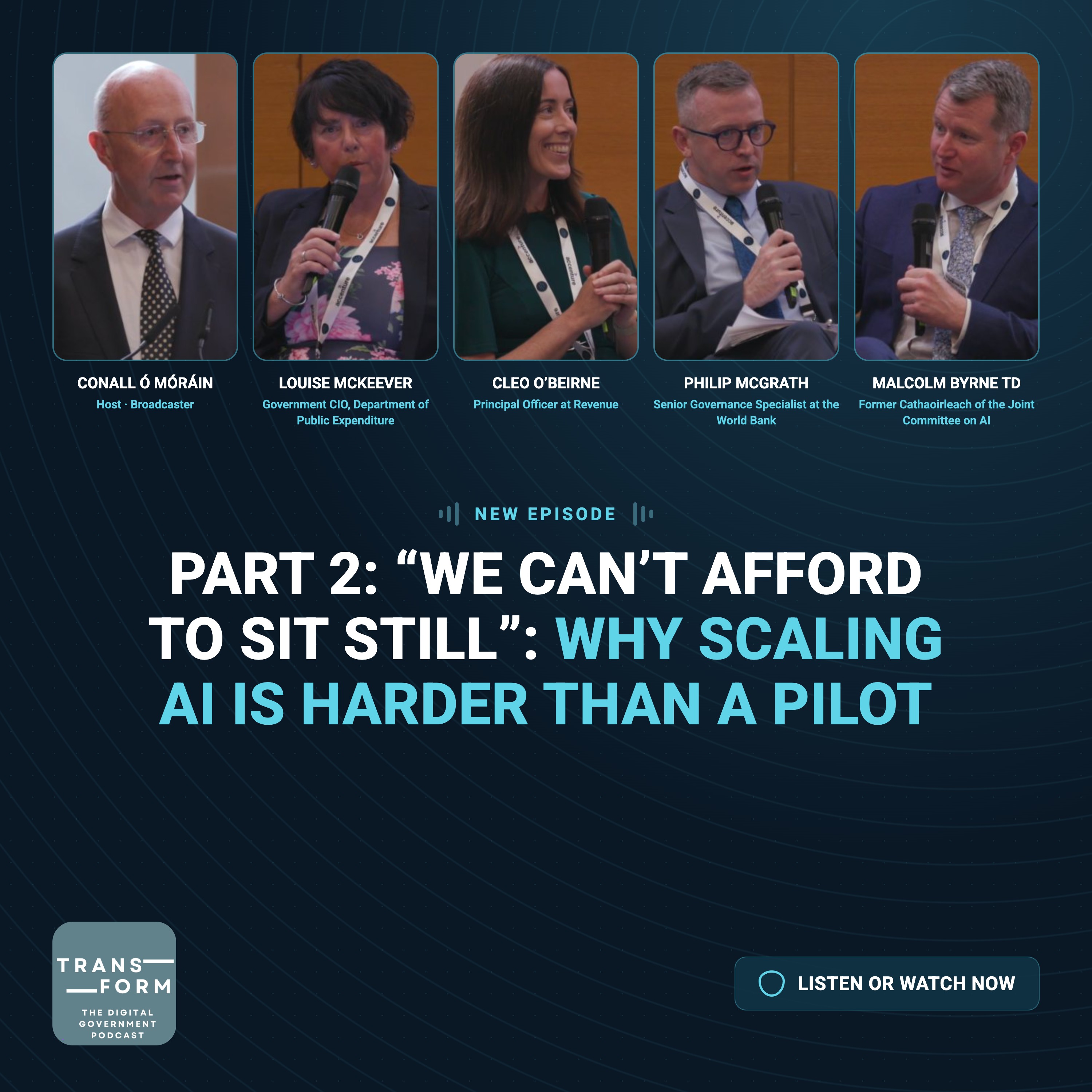
The pilot worked. Now what? In Part 2 of this panel discussion, four leaders explain how they're taking AI from pilot to scale, and what it takes to get data and governance right. This panel discussion took place at the Ireland eGovernment Awards and Leadership Summit 2026 on 24 September 2026 at UCD's O'Reilly Hall. We bring together Louise McKeever, Government CIO; Cleo O'Beirne, Principal Officer at Revenue; Philip McGrath, Senior Governance Specialist at the World Bank; and Malcolm Byrne TD, former Cathaoirleach of the Joint Committee on AI. The panel is chaired by Conall Ó Móráin. If you're taking AI beyond the pilot, here's what to do: Start small, prove it, then scale. Revenue tested agentic AI on a small application first, stage by stage. Redesign the whole process, not one stage. Individual productivity gains only go so far. Plan for lost knowledge, and recovered knowledge. As AI scales, people may know less, but AI can also capture knowledge that has already been lost. Reuse
In this video, Disability Attorney Walter Hnot shows off the Whisper Room, and his first attempt at a recorded singer setup. Things don't go to plan, but thankfully the singer was super cool while wiring issues were fixed. Like the content? Review us here: https://g.page/r/CcwyektC7nCPEAg/review . If the link does not work, Google: Disability Resolution, P.A. WANT A CLASS ACTION COLA FRAUD LAWSUIT? Sign the petition here: https://chng.it/bvLmbpWrrY Welcome to the largest Social Security Disability Tutorial Video Library On Earth. PRIVATE ONE HOUR PHONE CALL THIS IS HOW YOU CAN GIVE BACK TO HELP GROW THE CAUSE: Option 1: Leave 5 |==================5 STAR REVIEWS==================| Google (Search Disability Resolution Orlando, FL)- https://www.google.com/search?authuse... (https://www.google.com/search?authuse...=) AVVO (Search Walter Hnot) - https://www.avvo.com/attorneys/32817-... BBB (Search Disability Resolution Orlando, FL)- https://www.bbb.org/us/fl/orlando/pro... MARTINDALE (Searc
The Ninth Circuit considers a shareholder's challenge to disclosures used to sell UserTesting. During negotiations, Thoma Bravo reduced a proposed ten-dollar-a-share offer to seven dollars and fifty cents. The board initially rejected that lower price, but later recommended a deal at that price to shareholders. The shareholder alleges that the merger's proxy statement wrongly made the company's revenue performance look worse than it was. The disputed sentence grouped revenue with calculated billings and said both had fallen short of expectations. Her theory is that this depressed picture helped persuade shareholders to accept too little for their stock. That is an allegation, not a finding that the deal was unfair. The district court dismissed the revised complaint. Although it had treated the disputed sentence as false or misleading, it said the allegations still sounded in fraud and failed the stricter requirements for pleading the executive's responsibility. The shareholder will arg
The Second Circuit considers a plan to help homebuyers who need mortgages compete with cash offers. Canandaigua National Corporation, a New York financial holding company, wanted to guarantee purchases arranged through its mortgage subsidiary. If a preapproved customer failed to obtain final mortgage approval, the company would buy the home itself and later resell it. The proposal capped the value of homes held at any one time at five million dollars and promised resale within two years. Canandaigua says those safeguards make the risk small. The Federal Reserve Board rejected the plan on safety-and-soundness grounds, looking beyond the risk to this particular company. It did not finally decide the remaining statutory factors. Canandaigua will argue that the Board ignored the limits in its actual application. The Board will defend considering what could happen if financial holding companies generally began buying property under such guarantees. This is a dispute over permission for a pr
The Ninth Circuit hears a dispute over a proposed waste-processing project in California. Nortech already operated the Western Placer Waste Management Authority's facility. It worked with EcoHub on a proposal for the facility's future, first seeking a contract extension and then preparing for competitive bidding. The collaboration broke down. Nortech ended discussions after EcoHub failed to produce a requested financing commitment. EcoHub says the financing demand was a pretext, and that Recology pushed Nortech to abandon their joint effort. EcoHub and Nortech eventually submitted separate bids. Neither won. EcoHub nevertheless says their work together had already created a legal partnership, with duties Nortech could not simply walk away from. The district court ruled against EcoHub before trial, finding insufficient evidence of shared control. It also found EcoHub's interference claims against Recology were brought too late. EcoHub will argue that the companies' conduct and board dis
Essential services should offer a workable alternative to smartphone-only access.
Share your view, then see how readers voted. No sign-in required. This poll is shared across stories.
Do you agree or disagree?
Common Quandary
A Common Quandary to discuss
Another conversation to explore, separate from this news story.
You can clone the best dog you ever had. Would you?
After a beloved dog dies, its owner can afford to have it cloned. The procedure is legal and improving, but it uses animals as surrogates and will not recreate the original dog's memories or personality.
What do our obligations to animals permit us to create for our own comfort?