Astronomers Discover an Unusual Radio Signal From a Hidden Stellar System
23 min
Listen through the publisher, then discuss the episode here or arrange an in-person Roundtable. Your city determines where to meet.
Roundtables are designed for groups of four, with a shared subject and room for everyone to speak. Come for discussion, with no dating expectation.
A mysterious radio signal is drawing astronomers attention with its remarkably regular flashes every eight minutes. Its source challenges expectations about which stellar remnants can produce such signals, while offering a promising new way to uncover hidden objects across our galaxy. This episode includes AI-generated content.
Episode information is provided by the publisher. Listening takes place on the publisher’s service.
Eleven billion years ago two quasars blazed side by side, and this week astronomers weighed the invisible gas around them by the shadow it casts on the cosmic microwave background. There is 3.6 times more heat in it than gravity can explain. Plus a triple star 28 light-years away that 'should not exist', a pulsar found in ten hours with an algorithm borrowed from cryptography, The Week That Was, and the weekend sky from both hemispheres. In this episode Lead: Hot bubble around the dual quasar J1549+1245 at z = 2.37, measured with ALMA via the thermal Sunyaev–Zel'dovich effect (Hall, Zakamska et al., Nature Astronomy, 18 Nov 2026). Fresh item: Welopōʻai, the closest known triple with two white dwarfs, 28 light-years away (Artigau et al., A&A, 19 Nov 2026). Week That Was: Starship Flight 15 ship catch, CSIRO GenDIReCT and M87, SN 2026ahvu, failed supernovae in gravitational waves (E230); Voyager 1 one light-day, Beta Pictoris ices, heavy-oxygen water, Roman alignment (E231); Terra ends,
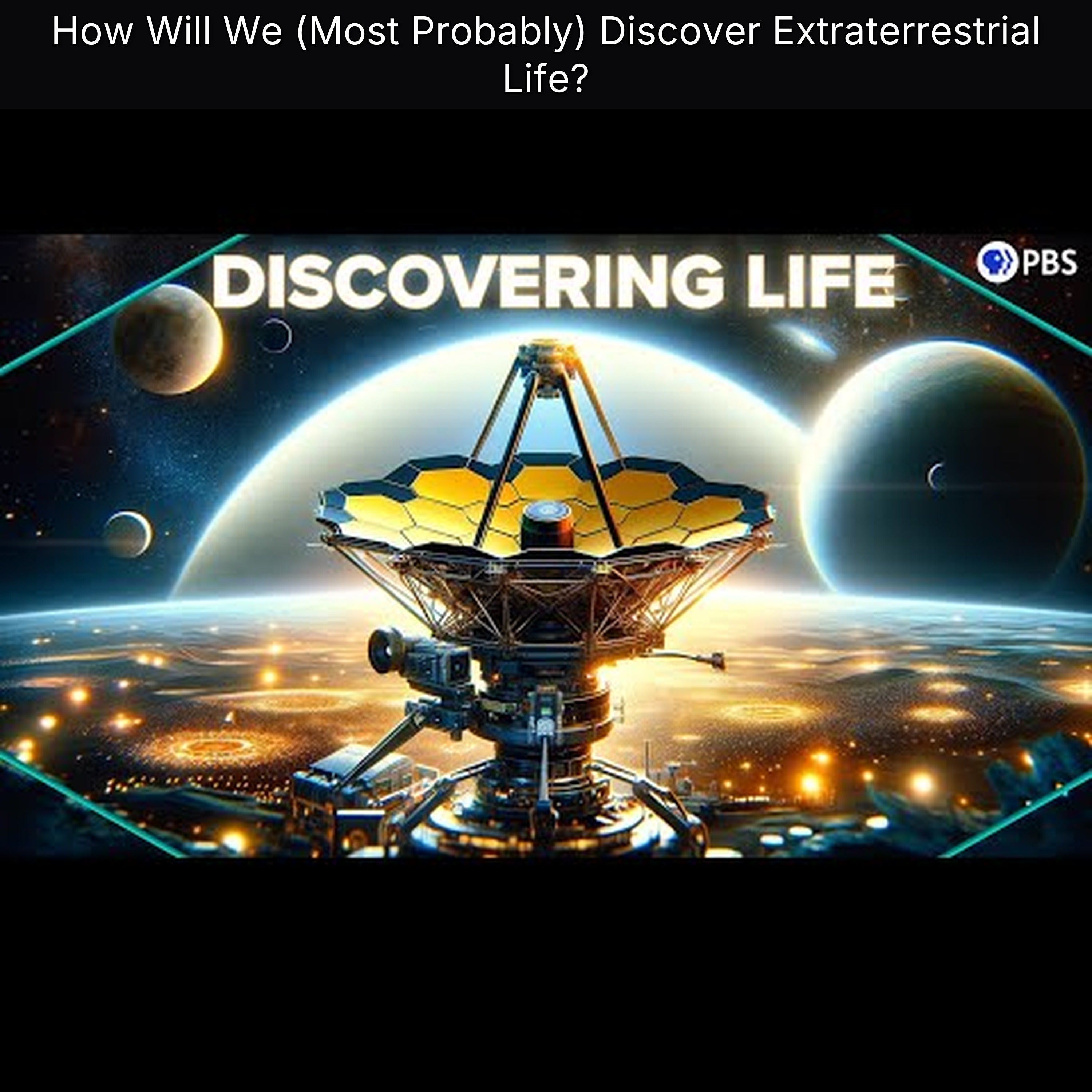
PBS Member Stations rely on viewers like you. To support your local station, go to:http://to.pbs.org/DonateSPACE Sign Up on Patreon to get access to the Space Time Discord! The first discovery of extraterrestrial life will almost certainly NOT be when it visits us, nor when we visit it. It won’t be when we see it’s stray TV signals. It’ll be in the excruciatingly faint changes in the color of alien sunsets glimpsed hundreds of light years away. Today we’re going to talk about the first such hint, why it's probably not aliens, and why there’s a tiny chance that it still might not not be aliens. Check out the Space Time Merch Store Search the Entire Space Time Library Here: https://search.pbsspacetime.com/ Hosted by Matt O'Dowd Written by Matt Caplan & Matt O'Dowd Post Production by Leonardo Scholzer, Yago Ballarini & Stephanie Faria Directed by Andrew Kornhaber Associate Producer: Bahar Gholipour Executive Producers: Eric Brown & Andrew Kornhaber Executive in Charge for PBS: Maribel Lop
Physicists have developed a new theoretical framework that challenges conventional understanding of radioactive decay. Their research explores an unusual quantum process involving the simultaneous emission of different particles, potentially resolving a decades-old mystery in nuclear physics. The findings could reveal new insights into the complex interplay of fundamental forces inside unstable atomic nuclei. This episode includes AI-generated content.
THE SEARCH FOR THE ULTIMATE RED LIGHT THERAPY IS OVER! After decades of exploring wellness technologies, Michael Jaco sits down with Rob Rene, founder of Exodus Strong, to explore the Red Light+ Total Body Reset system, the science behind red and near-infrared light, and why this technology has become such an important part of their wellness conversation. Rob's remarkable personal journey—including surviving five near-death experiences—inspired his mission to develop practical wellness tools that people can incorporate into their everyday lives. Discover the full-body Red Light+ Mat, designed for convenient 20-minute sessions, and the portable Red Light+ Wand, created for targeted use on areas such as the knees, shoulders, hands, and lower back. Michael and Rob discuss the technology, personal experiences, and how red light therapy may support a daily wellness routine. BLACK FRIDAY–CYBER MONDAY LISTENER EXCLUSIVE! This is your opportunity to explore Exodus Strong's special holiday offe
Alessandro “Boni” Bonifacio Rodrigues is an airline pilot who flies the Airbus A350 and has more than 9,000 hours in the air. Over the years he has started filming the things he sees out of the cockpit window that don’t behave like stars, satellites or planes. In this clip from UAP Files Podcast S2E29, Boni explains what he looks for and talks me through his footage, which is on screen as we talk. In this clip: • How a pilot tells Starlink, the ISS, shooting stars and twinkling stars apart • Three super-bright lights, filmed on his iPhone through the cockpit window, “easily 10,000 ft above me” • A friend’s footage over India of a fast object with a strange, magnetic-field-like shape • A hollow, doughnut-shaped object in the clouds filmed by a pilot friend who pulled over while driving in Brazil • Why sceptics who say pilots just misidentify things don’t convince him • How openly pilots now talk about it with each other • A “constellation” of seven or eight objects going through the clo
For a written breakdown, early access to content like this, and extra nuances, see the associated StayCurious Metabolism newsletter: https://staycuriousmetabolism.substack.com/p/why-you-need-to-track-your-heart?r=40ekz2 If you want to try the omega supplement I use, Accentrate Omega Max, here’s the link: https://www.fenixhealthscience.com/staycurious Heart rate variability (HRV) is more than just a number, it’s a real-time window into how well your brain, heart, and nervous system are working together. In this video, we break down what HRV actually measures, why it’s such a powerful predictor of mortality and heart attack risk, and how it reflects something deeper: your body’s ability to adapt, recover, and respond to stress. We walk through landmark studies showing that low HRV is associated with significantly higher risk of death and first cardiac events—even after controlling for traditional risk factors. But this isn’t just about risk. HRV is something you can measure today and act
The Euclid space telescope has uncovered a remarkable collection of cosmic gravitational lenses, offering new opportunities to investigate some of the universe’s greatest mysteries. These natural magnifying glasses reveal distant galaxies through the distortion of light, providing astronomers with valuable clues about dark matter, cosmic structure, and the hidden architecture of the universe. This episode includes AI-generated content.
A massive new simulation is offering an unprecedented look at the universe's earliest stages, exploring how the first structures emerged from cosmic darkness. The research provides fresh insights into the mysterious era that shaped the cosmos and how the universe evolved into the vast structure we see today. This episode includes AI-generated content.
Astronomers have caught a young Type Ia supernova, SN 2026ahvu, just 50 million light-years away, at an unusually early stage. Using powerful telescopes, researchers are tracking the explosion as it evolves, hoping to uncover new details about stellar destruction and improve one of astronomy's most important methods for measuring cosmic distances. This episode includes AI-generated content.
Employees should usually have a say in whether their work requires office attendance.
Share your view, then see how readers voted. No sign-in required. This poll is shared across stories.
Do you agree or disagree?
Common Quandary
A Common Quandary to discuss
Another conversation to explore, separate from this news story.
Someone holds a grocery line spot while their partner fills the cart. Is that cutting?
A shopper with one item stands ahead of you in a long checkout line. Just before reaching the register, their partner arrives with a cart packed to the top and joins them. They insist they were shopping together all along.
Can one person reserve a place in line for an unknown amount of work?