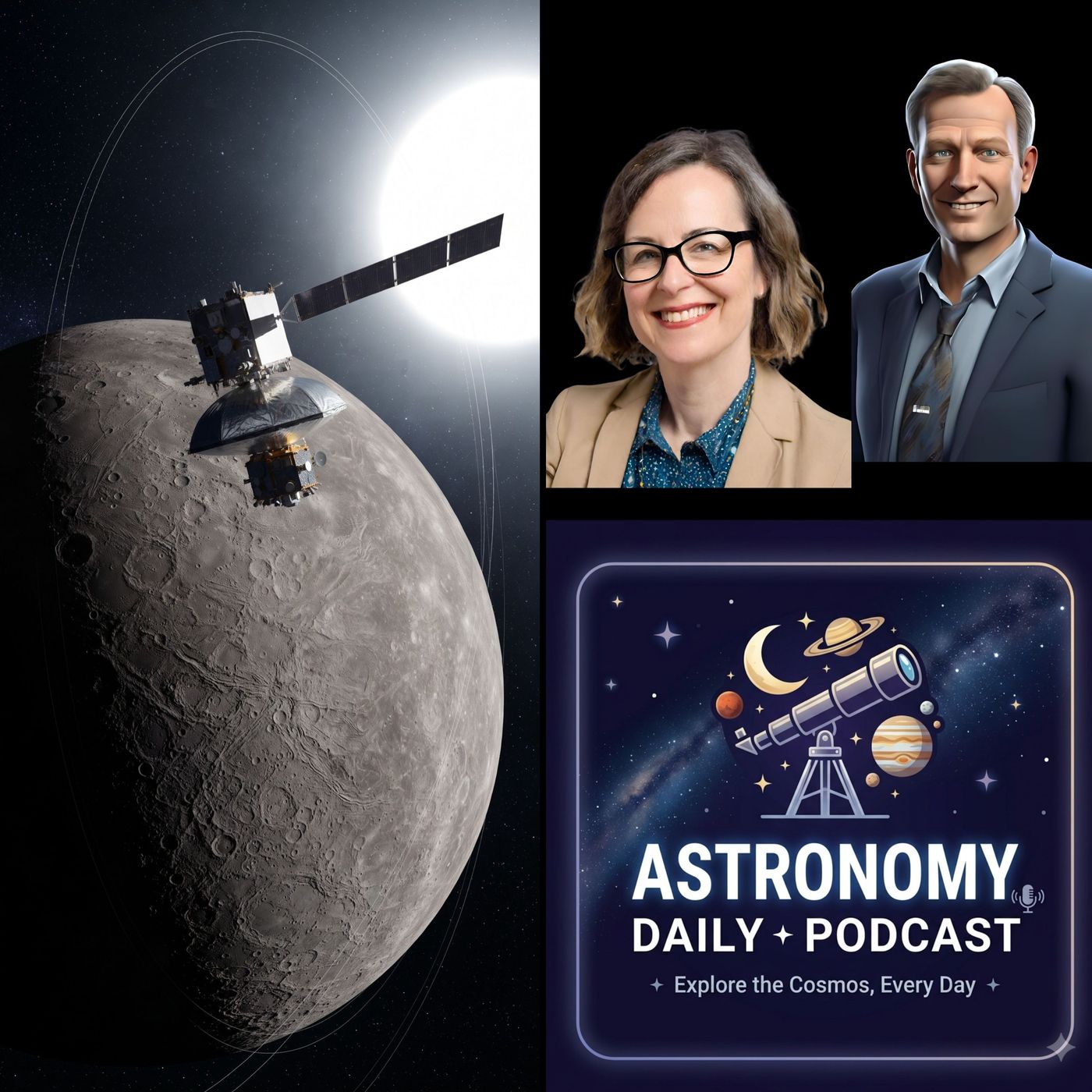
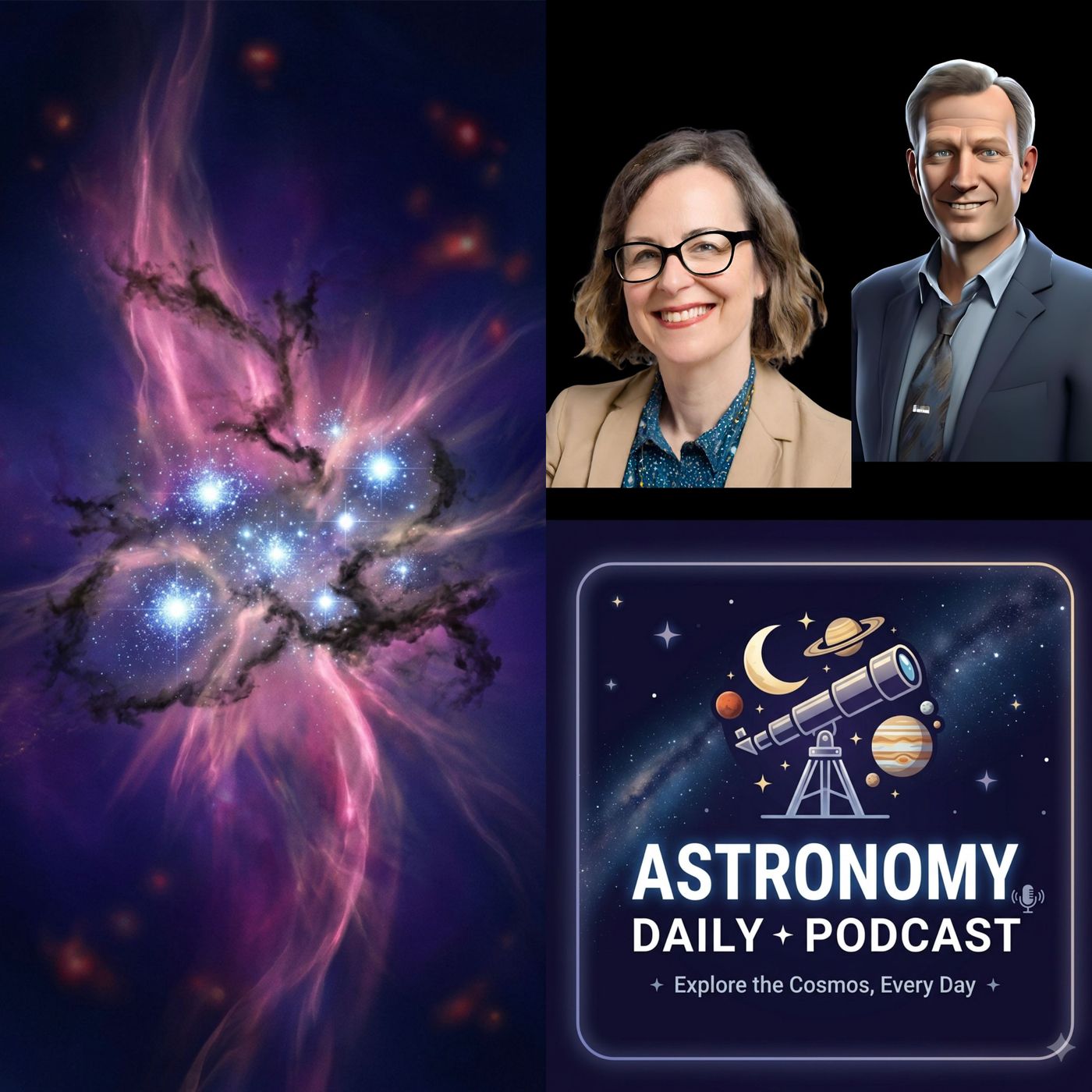
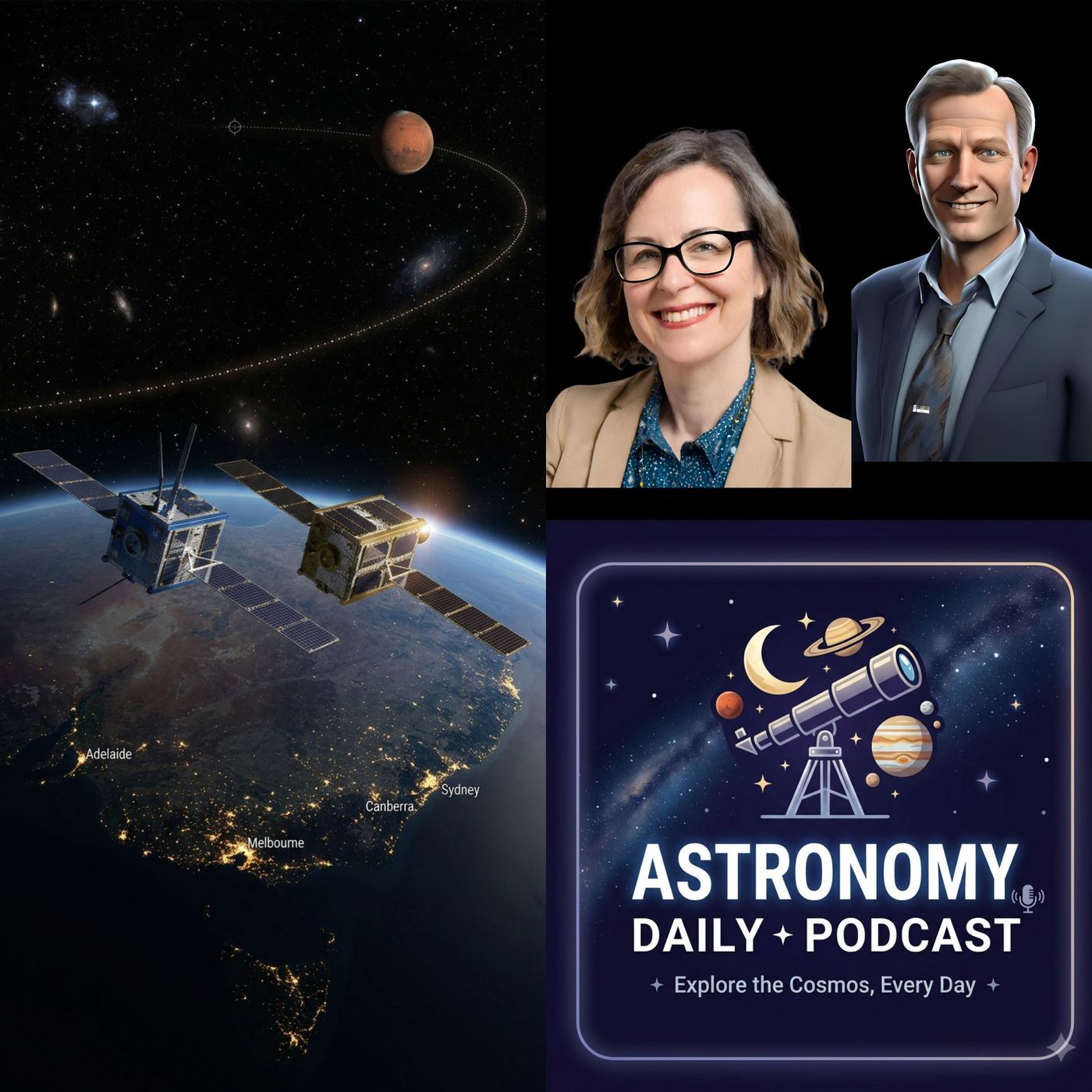
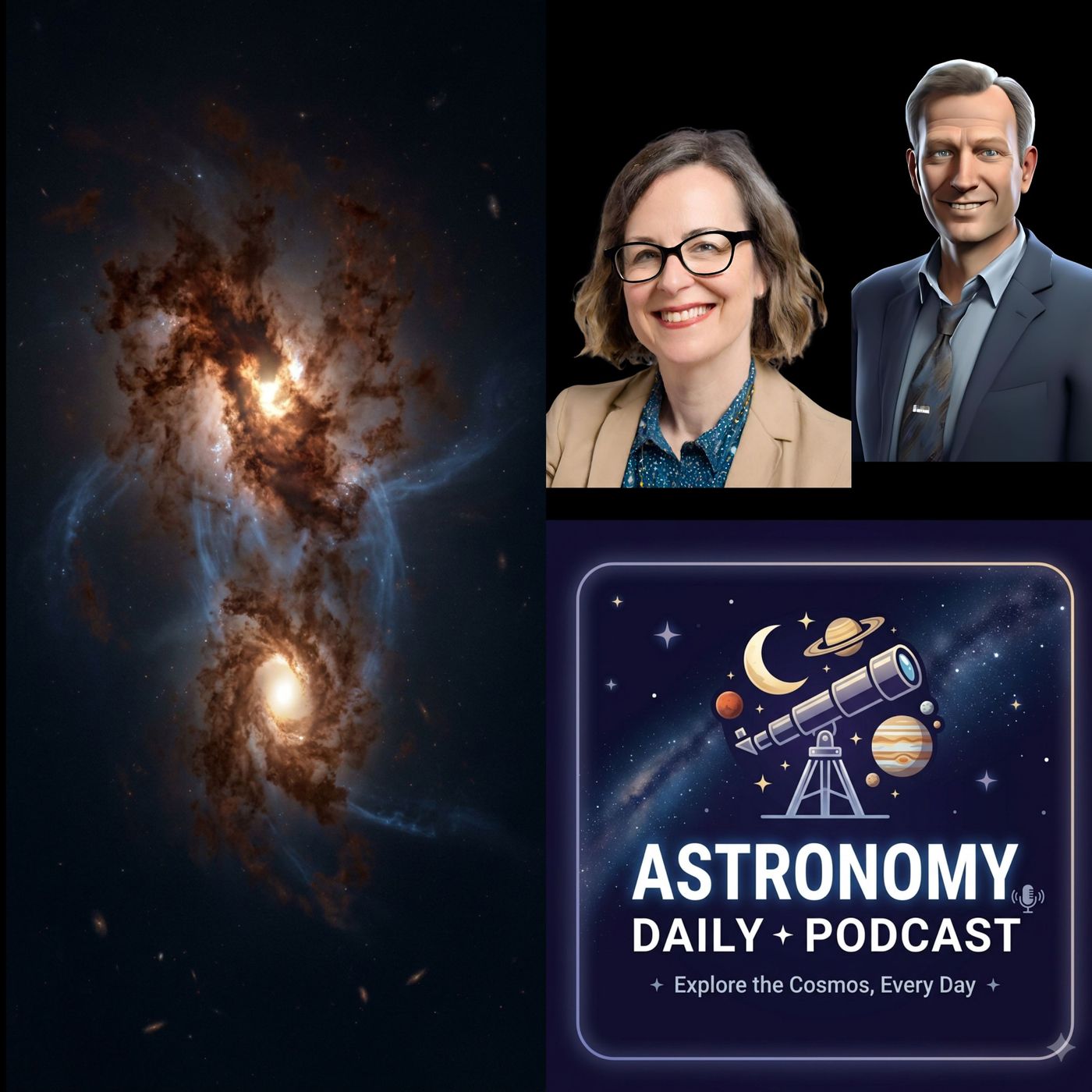
After more than eight years and nine planetary flybys, the ESA/JAXA BepiColombo mission is due to be captured into orbit around Mercury on Saturday 21 November 2026, the first mission to put two spacecraft in orbit there at once. Anna and Avery explain why the closest planet to the Sun is one of the hardest to reach, how the gentle 'weak stability boundary' capture works, and what happens between now and the start of science in April 2027. Also: Webb and a string of survey telescopes reconstruct a giant star swallowing its companion in the Andromeda galaxy; Voyager 1 reaches one light-day from Earth just as it stops sending data; and Fermi maps 450 sources in the under-explored 'MeV gap', including the globular cluster M2. Quick hits on Rocket Lab's 100th Electron, Shenzhou 24's Pakistani astronaut and the Cygnus 'S.S. Jim Lovell'. Skywatch: Mercury at greatest elongation on BepiColombo's arrival day, Andromeda, and M2 for both hemispheres. In this episode BepiColombo: the long way to
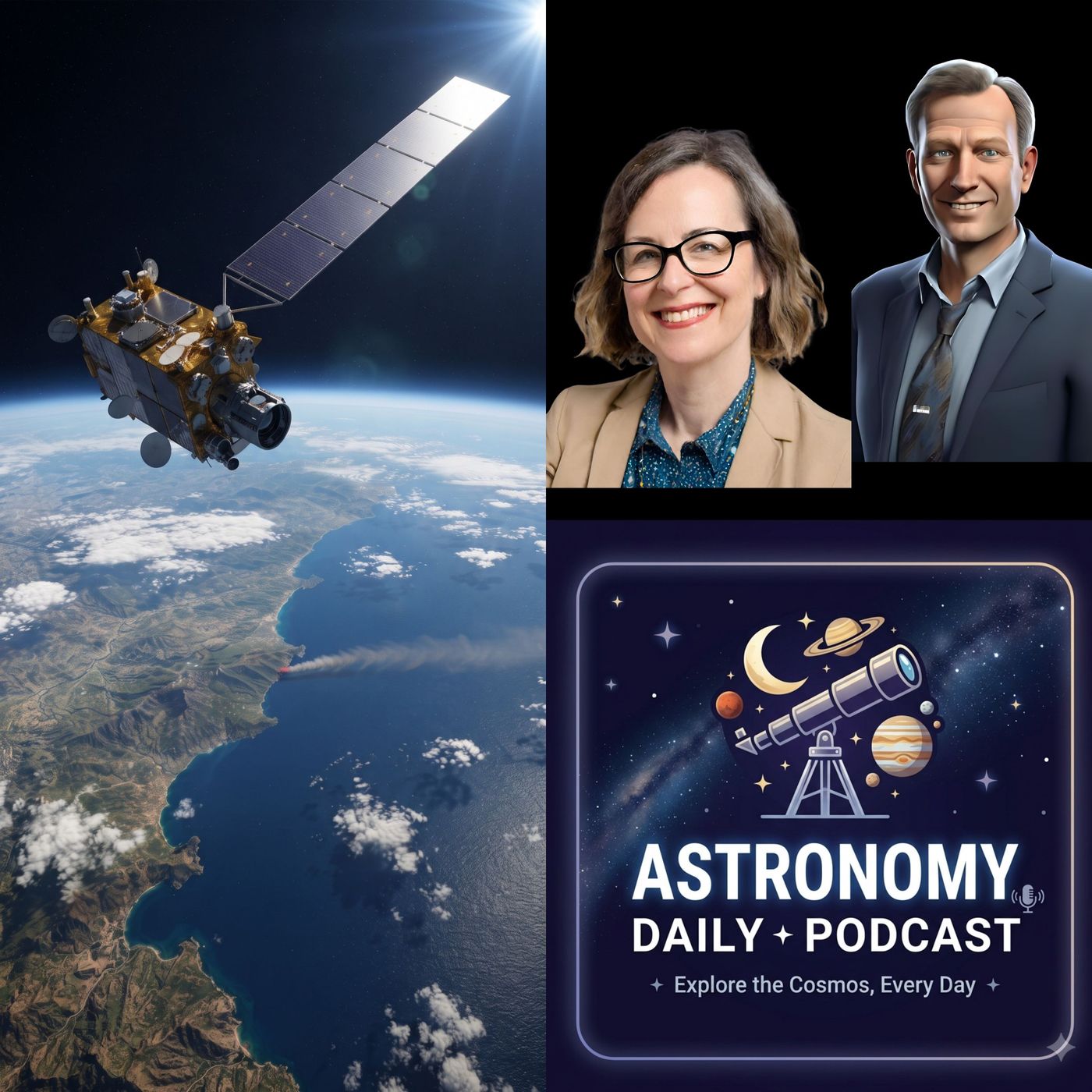
After 27 years, NASA's Terra satellite stops collecting science data on 1 December 2026. Anna and Avery look at what the first flagship of NASA's Earth Observing System measured, why its morning orbit mattered so much, what its MODIS fire hotspots meant for bushfire monitoring in Australia, and what replaces them. Also: ULA's Vulcan loses 40 Amazon Leo satellites in the company's first total mission failure; new mapping says Mars's biggest olivine deposit came from magma that cooled underground; and China formally puts a Callisto landing into its Tianwen-4 plans. Quick hits on the date for Roman's first images, BepiColombo's arrival at Mercury and Hera at Dimorphos, and a skywatch with the last of the Leonids, Mars and Jupiter at dawn, Mercury for the north and the Moon passing Saturn. In this episode · Terra signs off after 27 years · Vulcan's first loss: 40 Amazon Leo satellites · Mars's olivine came from below · China targets a Callisto landing · Quick hits: Roman's first images dat
We get asked all the time 'What is a Black Hole?' followed by, are we safe from them? So we figured we should put a short explainer video together in plain language...so meet the newest member of our team, Professor Holmes. Professor Holmes answers Sam’s big questions about black holes: what they are, how they form, and how astronomers find them. Discover the event horizon, the scorching discs of gas around some black holes, and the evidence from orbiting stars, X-rays, gravitational waves and the Event Horizon Telescope. We also visit Sagittarius A* at the heart of the Milky Way, dispel the myth that black holes are cosmic vacuum cleaners, and explain why Earth has nothing to fear from them. Plus: spaghettification, time slowing near a black hole, and Stephen Hawking’s prediction that black holes slowly evaporate.In this episode · What a black hole is—and what it isn’t· Event horizons, singularities and accretion discs· How massive stars can collapse into black holes· How astronomers
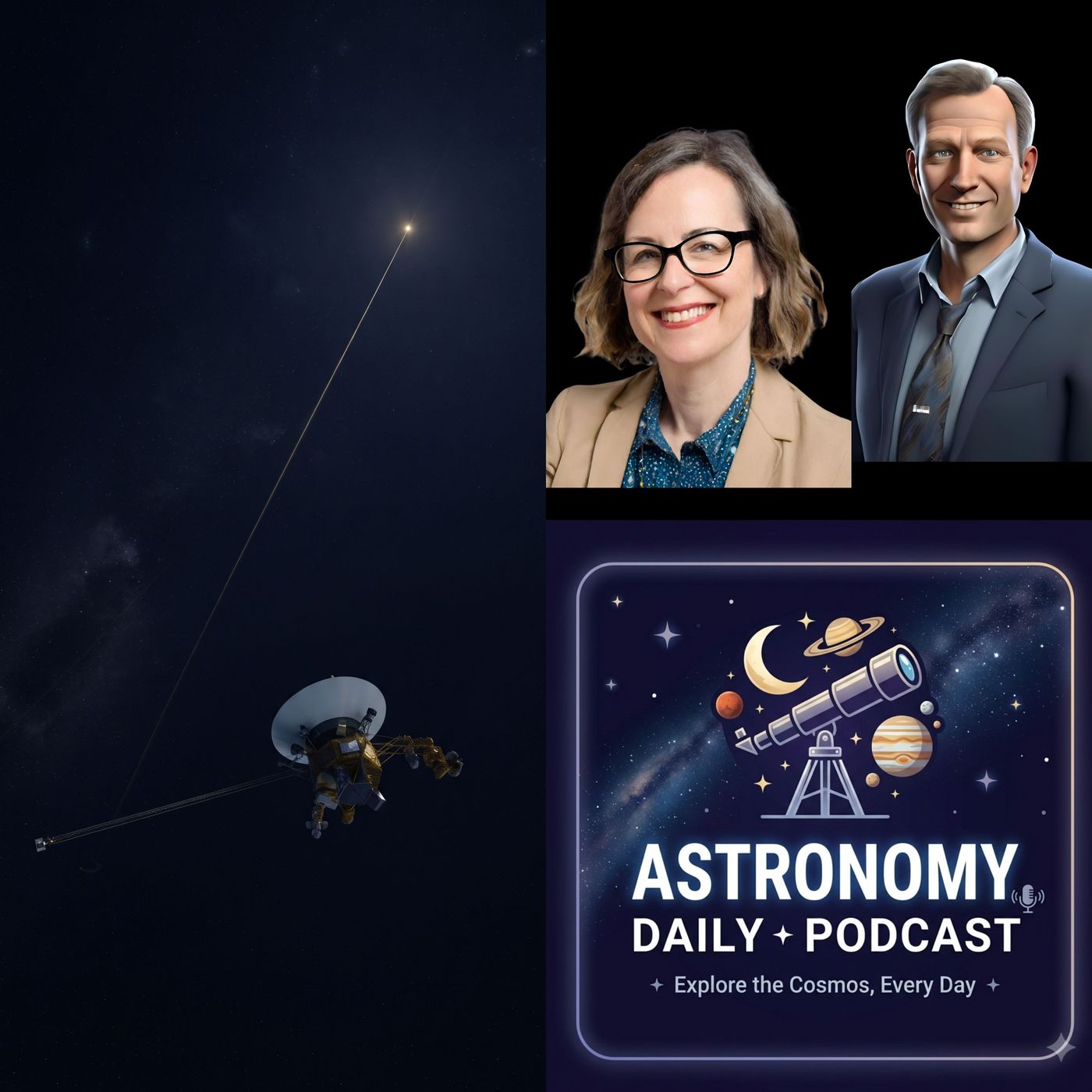
At 9:16 pm Sydney time on Wednesday 18 November 2026, Voyager 1 becomes the first human-made object to reach one light-day from Earth. Anna and Avery explain what that distance means, what it takes to fly a spacecraft when every conversation lasts 48 hours, and why there is no line in space to cross, and they correct a timing error from yesterday's episode. Also: the Webb telescope finds water and carbon dioxide ice around the southern star Beta Pictoris that may be older than the star itself; twelve grains of stratospheric dust point to a reservoir of heavy-oxygen water in the Kuiper Belt; the Roman Space Telescope finishes aligning its instruments; and quick hits on Starship V4, Shenzhou 24, BepiColombo and Hera. Skywatch shows where Voyager is in the sky, with a second chance at the Leonids. In this episode · Voyager 1 reaches one light-day · Beta Pictoris: ice older than its star · Kuiper Belt dust and heavy-oxygen water · Roman Space Telescope aligned · Quick hits: Starship V4, Sh
SpaceX has caught a Starship upper stage with its launch tower for the first time, after a 22-hour orbital flight, though the Super Heavy booster was lost and the cause is still under investigation. Anna and Avery tell the full story of Flight 15, then turn to a four-person CSIRO team in Perth that has independently confirmed the famous 2019 image of the M87 black hole. Also: a nearby Type Ia supernova still brightening in the southern galaxy NGC 1433, gravitational-wave hints of stars that collapsed without exploding, Hera's arrival at Didymos, Voyager 1 at one light-day, and a both-hemispheres guide to the Leonids. In this episode · Starship Flight 15: the ship comes home · CSIRO confirms the M87 black hole image · Supernova SN 2026ahvu in NGC 1433 · The stars that didn't explode · Quick hits: Hera, Voyager 1, BepiColombo · Skywatch: Leonids, Mars and Jupiter, the supernova Sources Story Source Starship Flight 15 Space.com launch, abort and live coverage, 13–15 Nov 2026; NASASpaceFli
Every 7.9 minutes a radio pulse arrives from Canis Major. This week astronomers at ICRAR-Curtin in Perth traced it to a white dwarf orbiting a star like our Sun, the first pairing of its kind, and found that the pulses carry the weather of the companion star with them. We unpack how the timing gives away which star is talking, and everything this result is not. Then: how the LISA gravitational-wave observatory could find planets around pairs of white dwarfs. In The Week That Was: NASA's nuclear Moon rover built from Curiosity's twin, the hot Jupiter that stopped transiting, Euclid's first big data release, and Starship Flight 15, in orbit with its catch attempt still to come at the time of recording. Plus Mars and Jupiter 1.2 degrees apart, and the Leonids, from both hemispheres. In this episode · Lead: GPM J071507−114153, a long-period radio transient made of a white dwarf and a Sun-like star (McSweeney, Hurley-Walker et al., Nature Astronomy, 12 Nov 2026). · Fresh item: LISA as a pla
SpaceX is targeting today for Starship Flight 15, and for the first time it will try to catch both the Super Heavy booster and the Starship upper stage back at the launch tower, the ship after more than 22 hours and about 14 orbits. We walk through the plan, the timings for both hemispheres, and the three caveats that matter. Also: ESA's Euclid telescope opens about 1,900 square degrees of sky to the world in its first major data release; Caltech's ASTRA robot assembles the first piece of structure ever built autonomously in orbit; Voyager 1 closes in on one light-day from Earth; and Mars and Jupiter draw to 1.2 degrees apart in the pre-dawn sky. In this episode · Starship Flight 15: targeted for Fri 13 Nov, 4:45 pm CT (22:45 UTC; 9:45 am AEDT Sat). First attempt to catch both booster and ship. · Euclid DR1-Foundation: about 1,900 square degrees and 1.8 petabytes, public from 12 November. Cosmology products follow in mid-2027. · ASTRA: a Caltech/DARPA robot assembles a truss bay in low
Show notes A hot Jupiter called TOI-2535 b has become the first planet around a single star seen to stop transiting, tipped out of line by an unseen neighbour. Plus: why Uranus and Neptune have scrambled magnetic fields, MeerKAT measuring how cosmic hydrogen clusters, Euclid's first big data release, ESCAPADE heading for Mars, Starship Flight 15's double-catch attempt, the 2026 ozone hole, and a both-hemispheres sky with Mars and Jupiter 1.2 degrees apart. The planet that stopped transiting. TOI-2535 b, an 8.24-day hot Jupiter ~1,000 light-years away, ran up to ~6 hours early or late and its transits shortened and faded over seven years of TESS data until they vanished in 2026. A hidden companion of at least Saturn mass, likely in resonance on a tilted orbit, is making both orbits precess. Transits should return in 30–50 years. Yee, Petigura et al., The Astrophysical Journal Letters, 9 Nov 2026. Ice giants' scrambled magnetic fields. Dynamo models with electrical conductivity rising wi
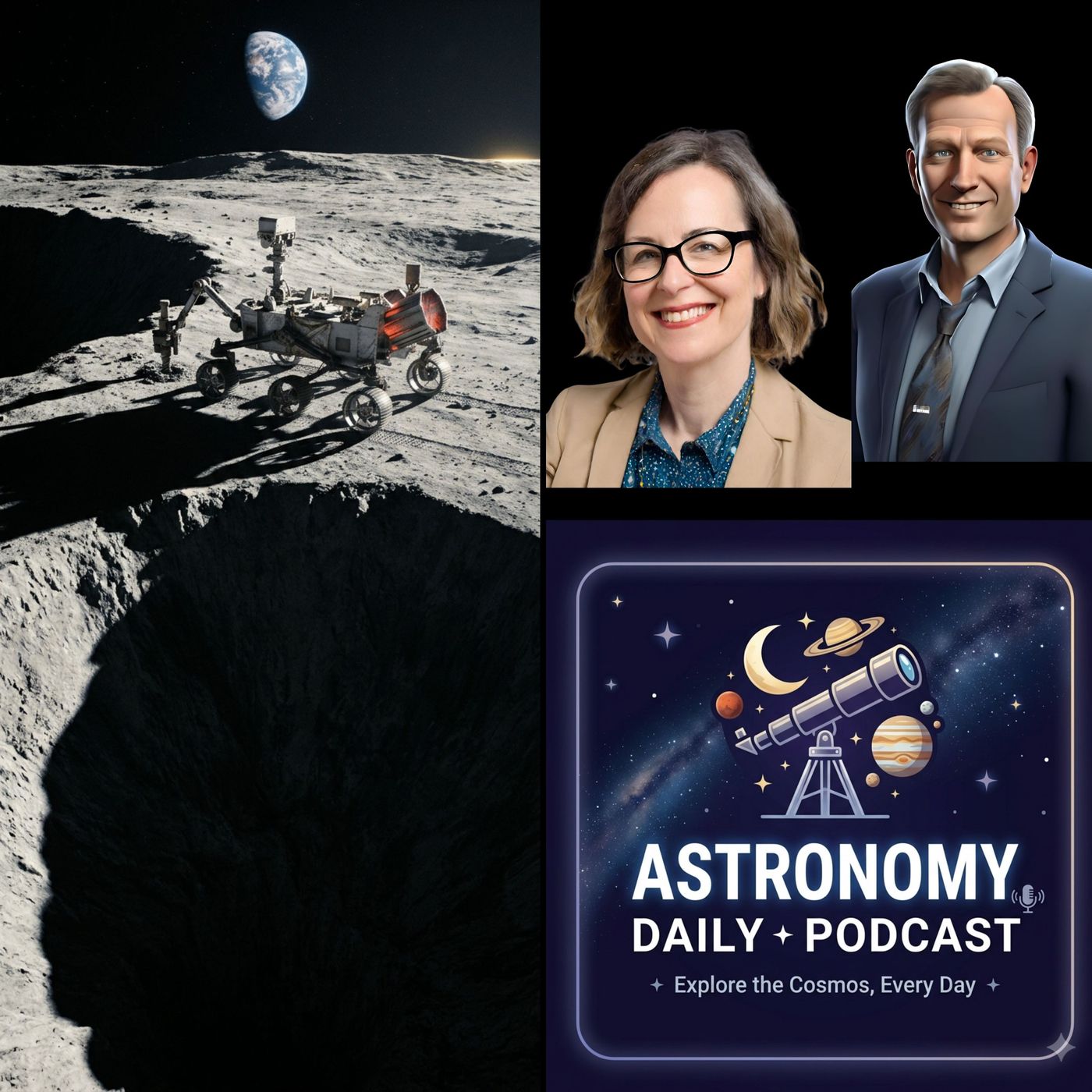
Show notes NASA turns Curiosity's spare test-bed rover into PROMISE, a nuclear-powered rover bound for the Moon's south pole, as part of a sweep of Moon Base awards. Plus: a theory of 'gravitational reconnection' hidden in Einstein's equations, a record 9.7-picokelvin quantum gas aboard China's Tiangong space station, ESCAPADE's twin burns over southern Australia, and a both-hemispheres skywatch. NASA's PROMISE rover and the Moon Base awards NASA Release 26-095 (7 Nov 2026) and PROMISE mission page. JPL is converting the duplicate Curiosity test-bed rover, powered by a flight-spare MMRTG, for a late-2028 launch and an 18-month mission at the lunar south pole. Blue Origin: $94M base + $140M option to deliver it on Mark 1. Also: eight CLPS 2 companies ($10B maximum, 10 years), CLPS 1 raised to $4.2B, six VADR task orders (~$1.3B), a 2028 Starship cislunar communications demo. https://www.nasa.gov/news-release/nasa-awards-moon-base-transportation-technology-science-projects/ https://www.n
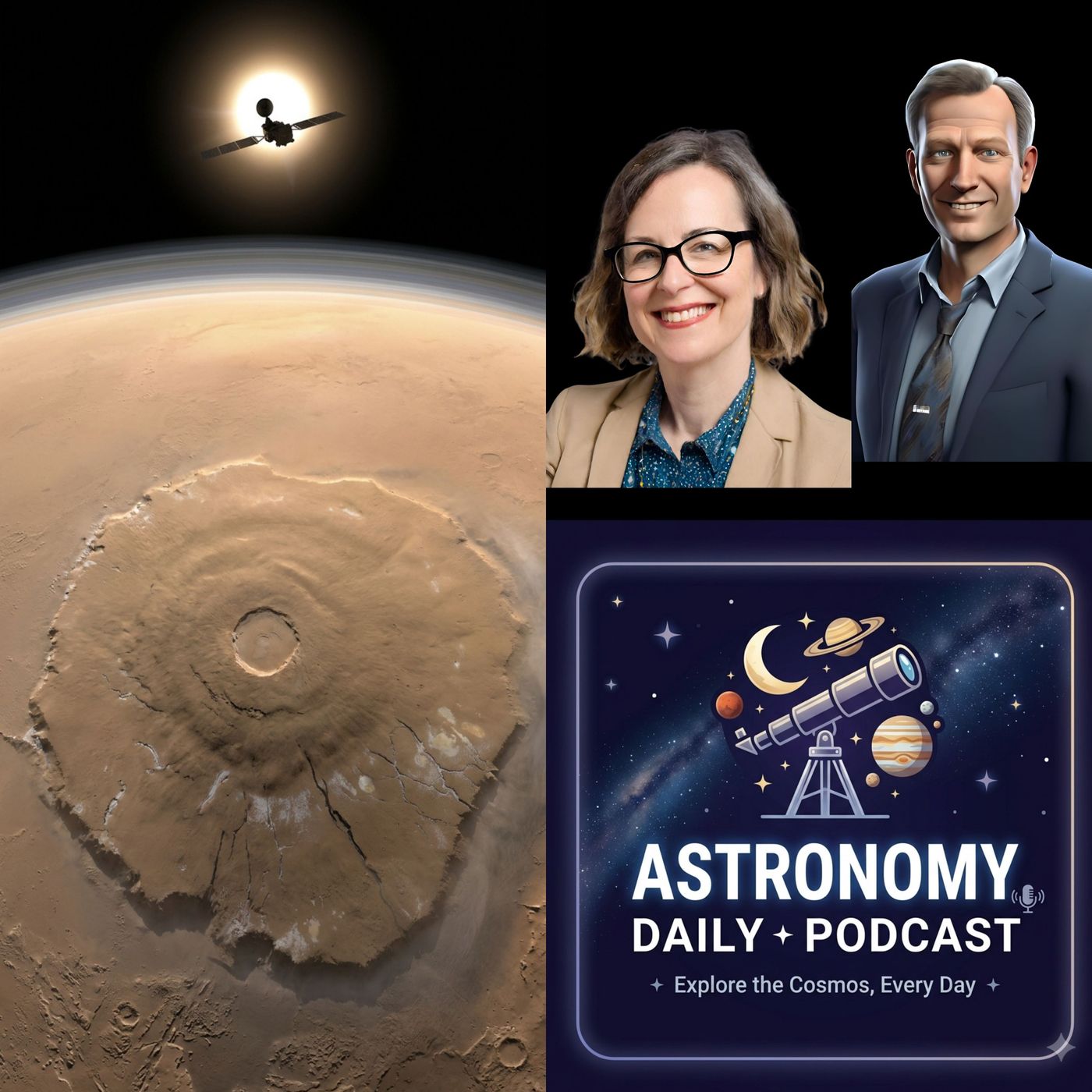
Is Mars still volcanically alive? Europe's ExoMars Trace Gas Orbiter keeps catching hydrogen chloride, a gas that comes out of volcanoes on Earth, above fresh cracks on the giant Alba Mons volcano, in the wrong season, in one place and low to the ground. We unpack the evidence, the proposed 'ice lid', and everything this result is not. Then it's The Week That Was: two black holes in one early galaxy, Swift's fiery end over Sumatra, ESCAPADE's powered slingshots over Australia, a planet rescued from Webb's glare, and the cosmic leaf blower. Plus the week's sky from both hemispheres. In this episode • Lead: Hydrogen chloride detections at Alba Mons as a potential sign of igneous activity on Mars (Trokhimovskiy, Mège et al., Science Advances, 4 Nov 2026). Detections first presented at 2025 conferences. • Week That Was: LID-1166 dual black holes (E220); Swift re-entry, 4 Nov (E221); ESCAPADE powered flybys (E222); FLIP digital-twin coronagraph and 51 Eridani b (E223); Lyman-alpha 'leaf blo
Show notes Light from newborn stars may have blown the fog out of the early universe. A new study by Shyam Menon (Flatiron Institute, ANU PhD) and Aaron Smith (UT Dallas) finds that Lyman-alpha radiation — ultraviolet light that bounces from hydrogen atom to hydrogen atom — can clear diffuse gas and dust out of young galaxies while leaving their dense star clusters free to keep forming stars, helping explain why JWST sees so many bright galaxies so early. Also: LOFAR's sharpest and deepest low-frequency radio image yet (almost 63,000 sources, 200 hours of observing); Blue Origin's new GS3 third stage and Northstar engine; and Sandia simulations showing that an asteroid's shape and orientation can change a nuclear stand-off deflection by up to five times. Quick hits: the space station's final roll-out solar array is installed, sunspot region AR4566 fires an M3 flare as October's sunspot number falls, and Earth picks up a tiny temporary mini-moon, 2026 QQ8. Skywatch for both hemispheres:
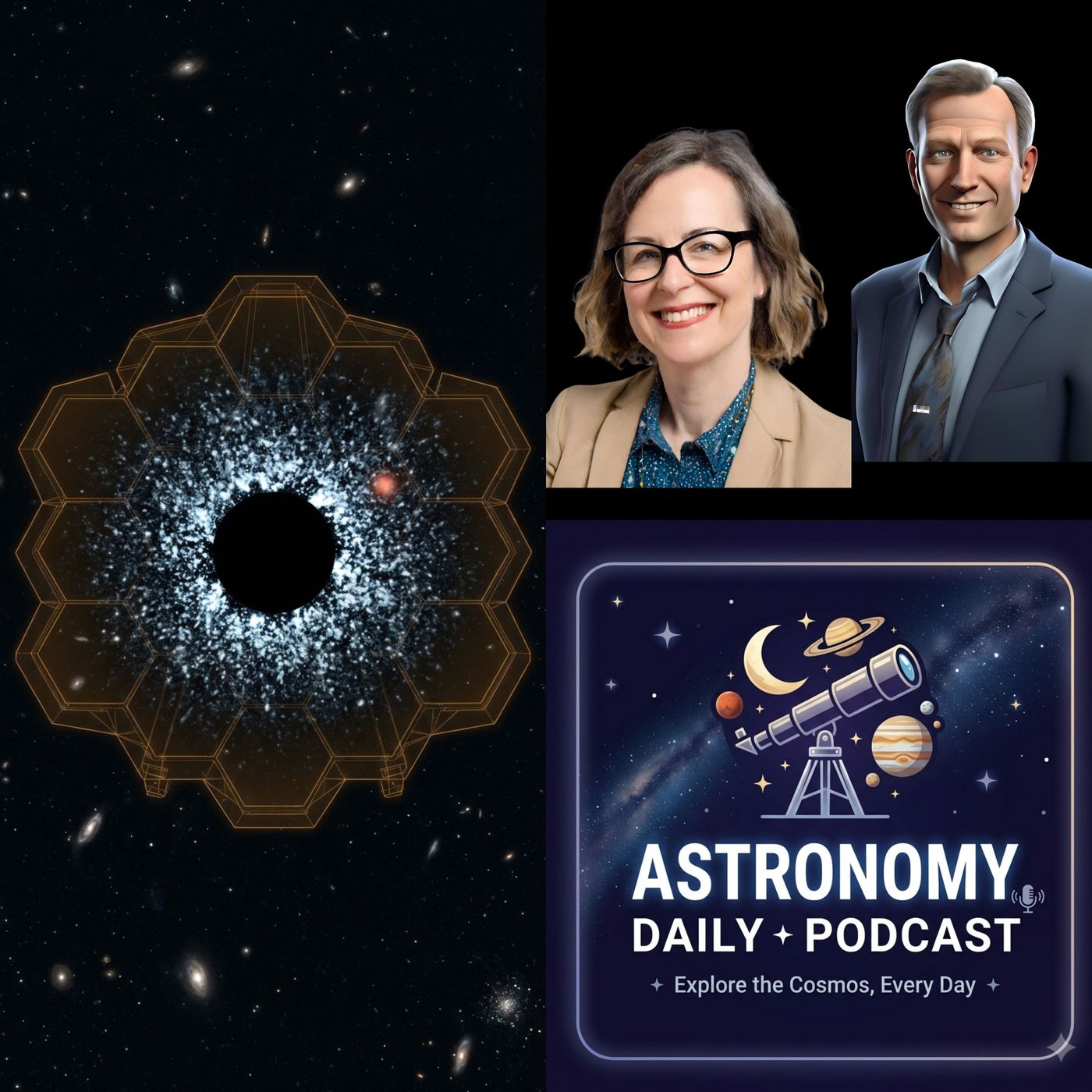
Show notes A Northwestern-led team builds a physics-based digital twin of the James Webb Space Telescope's coronagraph and recovers the giant planet 51 Eridani b in two-year-old data where standard processing could not see it. Plus VVV CL001, a dust-hidden cluster near the Milky Way's core dated at 13.4 billion years; China's most detailed account yet of its two-launch crewed Moon landing plan; and the flare alert system that tells sounding rockets exactly when to launch, as sunspot region AR4566 turns magnetically complex. The Planet in the Glare (lead) Ferrer-Chavez, Wang, Bouman, Freeman, Pueyo et al., Nature, 4 Nov 2026, DOI 10.1038/s41586-026-11213-z. FLIP (Physics-based Learning for Imaging Planets) models JWST/NIRCam coronagraph optics as a digital twin and subtracts simulated starlight. Tested on HIP 65426, 51 Eridani and TYC 5899: sensitivity improved 2–15×; 51 Eri b recovered at >5σ in F430M (CO₂ band) data where standard processing failed. Not a new planet; three-star demons
Show notes ESCAPADE's double slingshot over Australia NASA's twin ESCAPADE spacecraft, Blue and Gold, will each fly a powered Earth flyby on their way to Mars: the first around 5 a.m. EST on Saturday 7 November, the second around 6 a.m. EST on Monday 9 November. Each fires its engine for about nine minutes at closest approach, a manoeuvre NASA says no Mars-bound spacecraft has flown successfully before. The burns happen over southern Australia, starting 8:51 p.m. AEDT on the 7th and 9:51 p.m. AEDT on the 9th, and the spacecraft may be visible there through telescopes. Western US observers get their best chance between midnight and 2 a.m. PST. Arrival at Mars: 7 and 9 September 2027. Where did the oxygen go? Hubble's GLOW project (McQuinn et al., The Astrophysical Journal, published 2 November; preprint since August) measured oxygen in 37 nearby dwarf galaxies and found they keep only 4–25% (about 11% on average) of the oxygen their stars made, nearly all of it in gas. Simulations predi
Show notes Swift's Last Orbit: NASA's burst hunter falls home, a gamma-ray burst that is two explosions in one, and 3I/ATLAS's dusty ice. Swift's Last Orbit NASA's Neil Gehrels Swift Observatory is expected to re-enter Earth's atmosphere on Wednesday 4 November; the US Space Force prediction is about 03:30 EST (08:30 UTC, 19:30 AEDT), plus or minus 11 hours. Surviving fragments are confined between 20.6°N and 20.6°S, a band that includes northern Australia; NASA puts the risk of harm to anyone at about 1 in 2,100. We look back at 22 years of science from a two-year mission: more than 2,000 gamma-ray bursts, the first short-burst afterglow in 2005, the BOAT in 2022, and about 7,000 papers. Two Bursts, Two Births GRB 160425A, caught by Swift in April 2016, is a 1.7-second short spike, four minutes of silence, then a 51-second long burst from the same place. A Nature Astronomy paper (Li, Wang, Zhang, Cai et al., 23 October; preprint March) argues the first is merger-like and the second co
Show notes Two black holes caught feeding side by side just 1.3 billion years after the Big Bang. JWST and ALMA confirm LID-1166, the first close dual AGN found beyond the nearby universe. Plus: Swift's final days and NASA's call for ideas to save Hubble, Rubin finds Neptune's missing trailing Trojans as Lucy enters Jupiter's, TRACERS' first look at where the solar wind gets in, and a both-hemispheres skywatch built around the Mars-Jupiter meeting on 16 November. Two Hearts in One Galaxy (LID-1166) JWST/NIRSpec integral-field spectroscopy resolves two feeding black holes ~1.5 kpc (~4,900 ly) apart at z~4.5; ALMA [CII] finds matching cold gas around each. Both appear super-Eddington yet already sit on the local black hole-host mass relation. One system, projected separation; preprint posted July, published in Nature Astronomy this week. Living on Borrowed Altitude Swift ended operations on 20 October and is expected to re-enter in early November. NASA's 29 October Request for Informatio