English-language podcasts

Astronomy Daily: Latest Space News

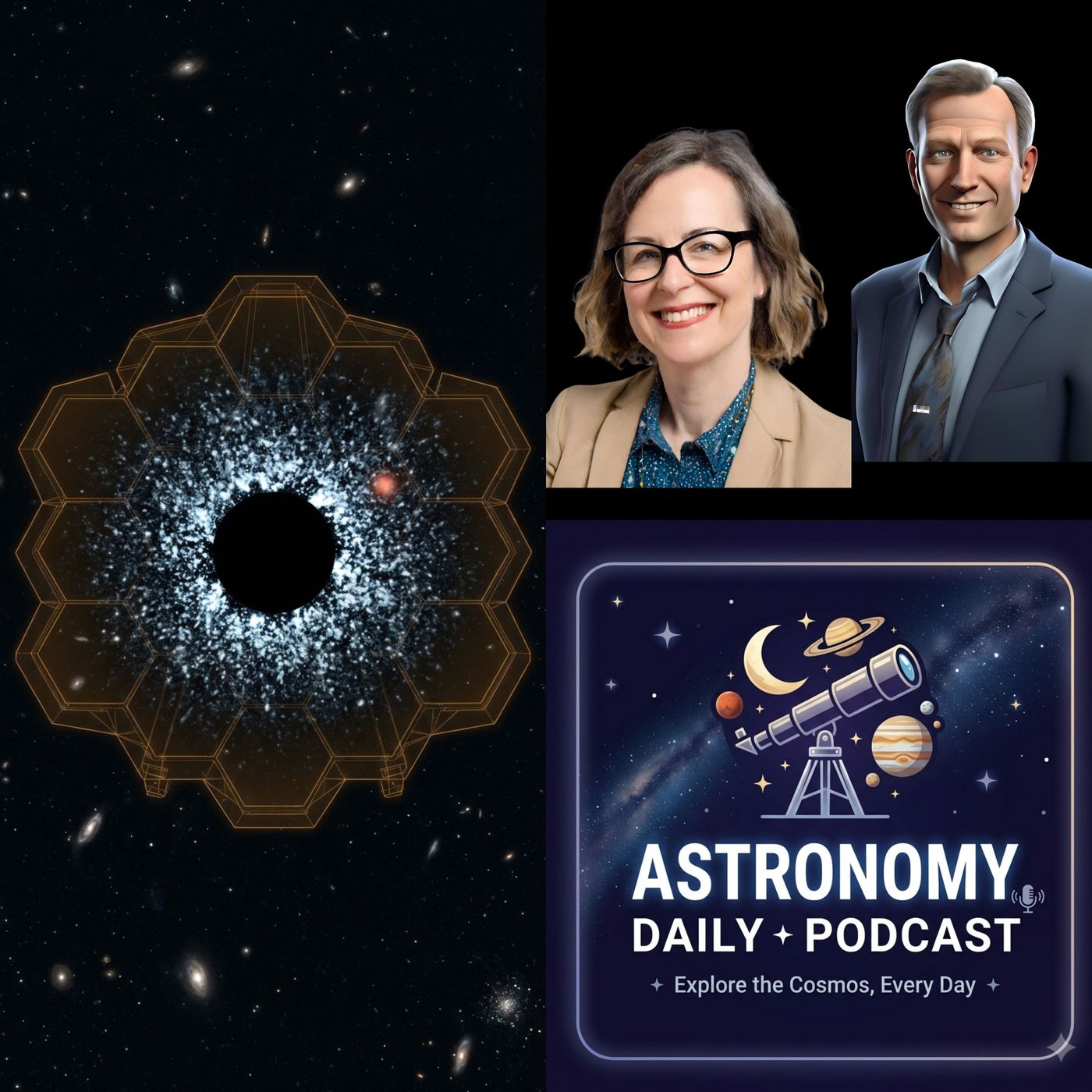
Webb’s Digital Twin: A Hidden Planet, Ancient Stars and China’s Moon Plan
22 min

Listen through the publisher, then discuss the episode here or arrange an in-person Roundtable. Your city determines where to meet.

Roundtables are designed for groups of four, with a shared subject and room for everyone to speak. Come for discussion, with no dating expectation.

Show notes A Northwestern-led team builds a physics-based digital twin of the James Webb Space Telescope's coronagraph and recovers the giant planet 51 Eridani b in two-year-old data where standard processing could not see it. Plus VVV CL001, a dust-hidden cluster near the Milky Way's core dated at 13.4 billion years; China's most detailed account yet of its two-launch crewed Moon landing plan; and the flare alert system that tells sounding rockets exactly when to launch, as sunspot region AR4566 turns magnetically complex. The Planet in the Glare (lead) Ferrer-Chavez, Wang, Bouman, Freeman, Pueyo et al., Nature, 4 Nov 2026, DOI 10.1038/s41586-026-11213-z. FLIP (Physics-based Learning for Imaging Planets) models JWST/NIRCam coronagraph optics as a digital twin and subtracts simulated starlight. Tested on HIP 65426, 51 Eridani and TYC 5899: sensitivity improved 2–15×; 51 Eri b recovered at >5σ in F430M (CO₂ band) data where standard processing failed. Not a new planet; three-star demonstration; picometre-stability relief for the Habitable Worlds Observatory is a prospect, not yet shown. VVV CL001: the oldest cluster in the Galaxy? Olivares Carvajal, Zoccali et al., accepted to A&A, arXiv 2610.27969 (posted 20 Oct 2026). Age 13.4 ± 0.4 Gyr from Magellan/FourStar and Hubble photometry; [Fe/H] ≈ −2.2; ~7.3 kpc in the bulge. ~1 Gyr additional systematic from distance; Ton 2 dated at 13.6 Gyr — a strong candidate, not a settled record. China's crewed Moon landing plan Wang Xiang, 7th Manned Space Symposium, Beijing, 31 Oct 2026. Two Long March 10 launches; Lanyue lander and Mengzhou crew ship rendezvous in lunar orbit; crew of three, two land, rover on first landing. No new dates; target remains before 2030. Catching a flare in the act Early flare alert system, The Astrophysical Journal, 4 Nov 2026, DOI 10.3847/1538-4357/ae95fd. Enabled FOXSI-4 and Hi-C Flare to launch into an M-class flare on 17 Apr 2024 and FOXSI-5 to catch three flares on 14 May 2026. AR4566 reached beta-gamma-delta classification on 4 Nov. Quick hits Swift re-entered 7:39 a.m. EST 4 Nov (12:39 UTC) over North Sumatra; NASA's SSPICY (Starfish Space Otter) declared unrecoverable; final ISS roll-out solar array spacewalk (Kutryk, Menon); Hera begins early characterisation at Didymos per ESA's timeline. Sponsor Details: Ensure your online privacy by using NordVPN. Get the best secure and private email on the planet. Do what we did and use ProtonMail. Commercial free episodes daily are only a click way... This episode includes AI-generated content.

Episode information is provided by the publisher. Listening takes place on the publisher’s service.

Listen at the source ↗

Featured places to meet in Palo Alto, CA

Explore these places and arrange a conversation through ThinkMatch.

City guide for Palo Alto, CA

More from Astronomy Daily: Latest Space News

Astronomy Daily: Latest Space News

BepiColombo’s Mercury Arrival, a Star Swallows Its Companion, Voyager 1 Goes Quiet...

21 min

After more than eight years and nine planetary flybys, the ESA/JAXA BepiColombo mission is due to be captured into orbit around Mercury on Saturday 21 November 2026, the first mission to put two spacecraft in orbit there at once. Anna and Avery explain why the closest planet to the Sun is one of the hardest to reach, how the gentle 'weak stability boundary' capture works, and what happens between now and the start of science in April 2027. Also: Webb and a string of survey telescopes reconstruct a giant star swallowing its companion in the Andromeda galaxy; Voyager 1 reaches one light-day from Earth just as it stops sending data; and Fermi maps 450 sources in the under-explored 'MeV gap', including the globular cluster M2. Quick hits on Rocket Lab's 100th Electron, Shenzhou 24's Pakistani astronaut and the Cygnus 'S.S. Jim Lovell'. Skywatch: Mercury at greatest elongation on BepiColombo's arrival day, Andromeda, and M2 for both hemispheres. In this episode BepiColombo: the long way to

Discuss this episode

Astronomy Daily: Latest Space News

Terra’s 27-Year Earth Record Ends, Vulcan Loses 40 Satellites, China Plans a Callisto Landing...

20 min

After 27 years, NASA's Terra satellite stops collecting science data on 1 December 2026. Anna and Avery look at what the first flagship of NASA's Earth Observing System measured, why its morning orbit mattered so much, what its MODIS fire hotspots meant for bushfire monitoring in Australia, and what replaces them. Also: ULA's Vulcan loses 40 Amazon Leo satellites in the company's first total mission failure; new mapping says Mars's biggest olivine deposit came from magma that cooled underground; and China formally puts a Callisto landing into its Tianwen-4 plans. Quick hits on the date for Roman's first images, BepiColombo's arrival at Mercury and Hera at Dimorphos, and a skywatch with the last of the Leonids, Mars and Jupiter at dawn, Mercury for the north and the Moon passing Saturn. In this episode · Terra signs off after 27 years · Vulcan's first loss: 40 Amazon Leo satellites · Mars's olivine came from below · China targets a Callisto landing · Quick hits: Roman's first images dat

Discuss this episode

Astronomy Daily: Latest Space News

Black Holes Explained, Sagittarius A* at the Heart of the Milky Way, and Why Earth Is Safe...

10 min

We get asked all the time 'What is a Black Hole?' followed by, are we safe from them? So we figured we should put a short explainer video together in plain language...so meet the newest member of our team, Professor Holmes. Professor Holmes answers Sam’s big questions about black holes: what they are, how they form, and how astronomers find them. Discover the event horizon, the scorching discs of gas around some black holes, and the evidence from orbiting stars, X-rays, gravitational waves and the Event Horizon Telescope. We also visit Sagittarius A* at the heart of the Milky Way, dispel the myth that black holes are cosmic vacuum cleaners, and explain why Earth has nothing to fear from them. Plus: spaghettification, time slowing near a black hole, and Stephen Hawking’s prediction that black holes slowly evaporate.In this episode · What a black hole is—and what it isn’t· Event horizons, singularities and accretion discs· How massive stars can collapse into black holes· How astronomers

Discuss this episode

Community Poll

Protecting natural places can justify limiting visitor numbers.

Share your view, then see how readers voted. No sign-in required. This poll is shared across stories.

Do you agree or disagree?

Choose one answer

Common Quandary

A Common Quandary to discuss

Another conversation to explore, separate from this news story.

You cannot stand your friend's partner. Do they still get a wedding invitation?

You are planning a small wedding and strongly dislike the person your longtime friend has been dating. Inviting them would make you uncomfortable, but excluding only that partner would embarrass your friend.

Whose comfort should govern a celebration centered on you?

Explore this quandary