English-language podcasts

Astronomy Daily: Latest Space News

Voyager’s Far-Reaching Milestone, Webb Discovers Frozen Water, Roman Telescope Finishes Alignment...
20 min

Listen through the publisher, then discuss the episode here or arrange an in-person Roundtable. Your city determines where to meet.

Roundtables are designed for groups of four, with a shared subject and room for everyone to speak. Come for discussion, with no dating expectation.

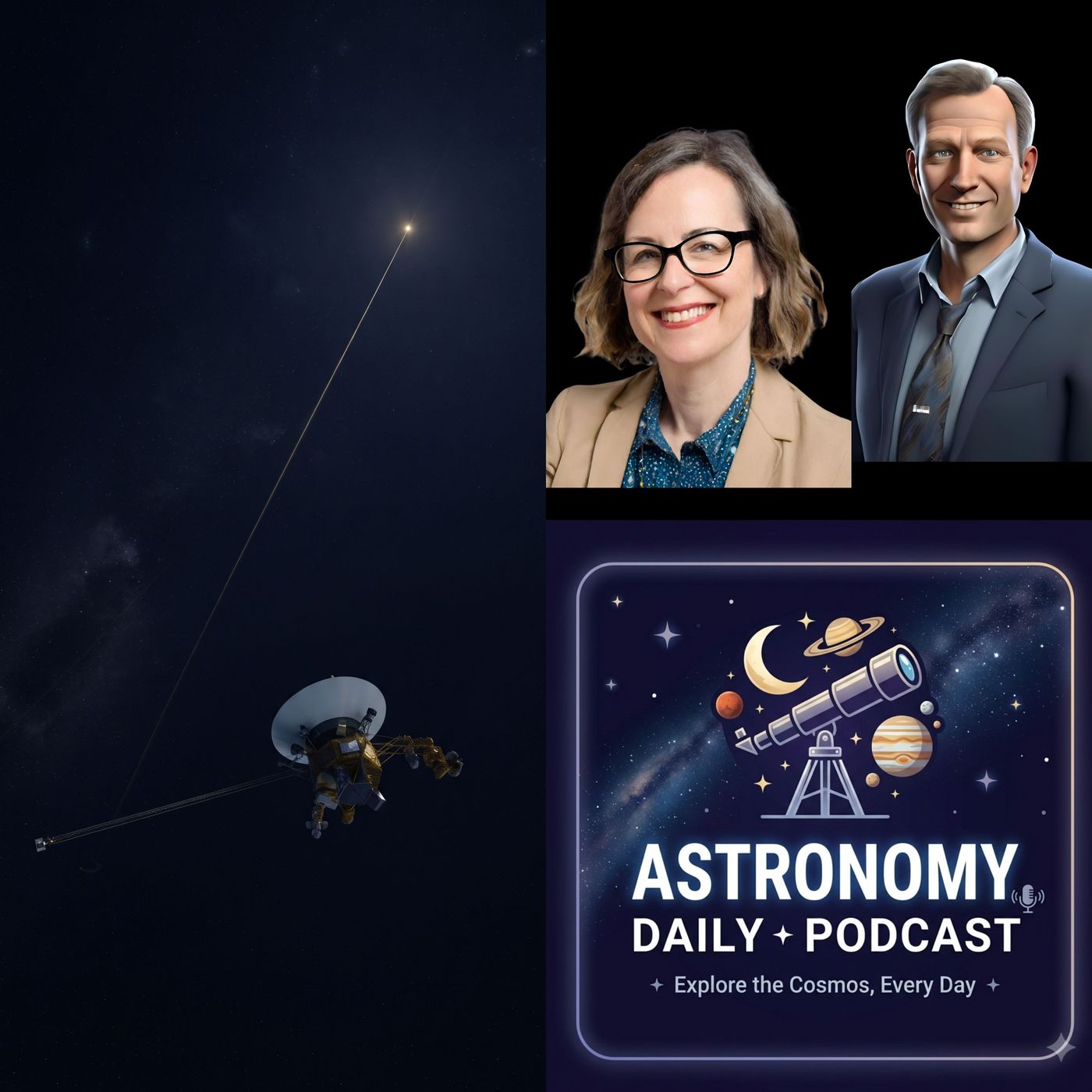
At 9:16 pm Sydney time on Wednesday 18 November 2026, Voyager 1 becomes the first human-made object to reach one light-day from Earth. Anna and Avery explain what that distance means, what it takes to fly a spacecraft when every conversation lasts 48 hours, and why there is no line in space to cross, and they correct a timing error from yesterday's episode. Also: the Webb telescope finds water and carbon dioxide ice around the southern star Beta Pictoris that may be older than the star itself; twelve grains of stratospheric dust point to a reservoir of heavy-oxygen water in the Kuiper Belt; the Roman Space Telescope finishes aligning its instruments; and quick hits on Starship V4, Shenzhou 24, BepiColombo and Hera. Skywatch shows where Voyager is in the sky, with a second chance at the Leonids. In this episode · Voyager 1 reaches one light-day · Beta Pictoris: ice older than its star · Kuiper Belt dust and heavy-oxygen water · Roman Space Telescope aligned · Quick hits: Starship V4, Shenzhou 24, BepiColombo, Hera · Skywatch: where Voyager is, Leonids, dawn planets Sources Story Source Voyager 1 NASA Science, 'Voyager 1: What Is a Light-Day' (5:16:07 a.m. EST, 18 Nov 2026); NASA/JPL advisory M26-086, 'NASA Invites Media, Public to Join Voyager 1 One-Light Day Activities', 10 Nov, updated 13 Nov; Universe Today, 6 Nov 2026 (status and 'Big Bang' fix); Scientific American, 16 Nov 2026 Beta Pictoris ices Betti, Chen et al., 'Carbon dioxide and amorphous water ices in the debris disk around β Pictoris', Science 394, 742–745, 12 Nov 2026, DOI 10.1126/science.adw7770 Kuiper Belt dust Keller, Snead, Liu & McKeegan, 'A primordial heavy water reservoir in the outer solar system', Science Advances 12(46), eaeg1602, 11 Nov 2026, DOI 10.1126/sciadv.aeg1602 Roman NASA Roman blog, 'Instruments on NASA's Roman Space Telescope Get in Sync for Science', 13 Nov 2026 Starship V4 Elon Musk post, 15 Nov 2026, as reported by Space.com, 16 Nov 2026 Shenzhou 24 China Manned Space Agency statement, 7 Nov 2026, as reported by Space.com BepiColombo ESA, 'Latest updates: BepiColombo's arrival at Mercury' (orbit insertion from 21 Nov 2026; 16 burns to March 2027) Skywatch Computed in-session with PyEphem for Sydney, Los Angeles, New York and London; full Moon and supermoon series per NASA 'What's Up', November 2026 Sponsor Details: Ensure your online privacy by using NordVPN. Get the best secure and private email on the planet. Do what we did and use ProtonMail. Commercial free episodes daily are only a click way... This episode includes AI-generated content.

Episode information is provided by the publisher. Listening takes place on the publisher’s service.

Listen at the source ↗

Featured places to meet in Palo Alto, CA

Explore these places and arrange a conversation through ThinkMatch.

City guide for Palo Alto, CA

More from Astronomy Daily: Latest Space News

Astronomy Daily: Latest Space News

Quasars Heat the Early Universe, a Triple Star That Shouldn’t Exist, The Weekend Wrap...

21 min

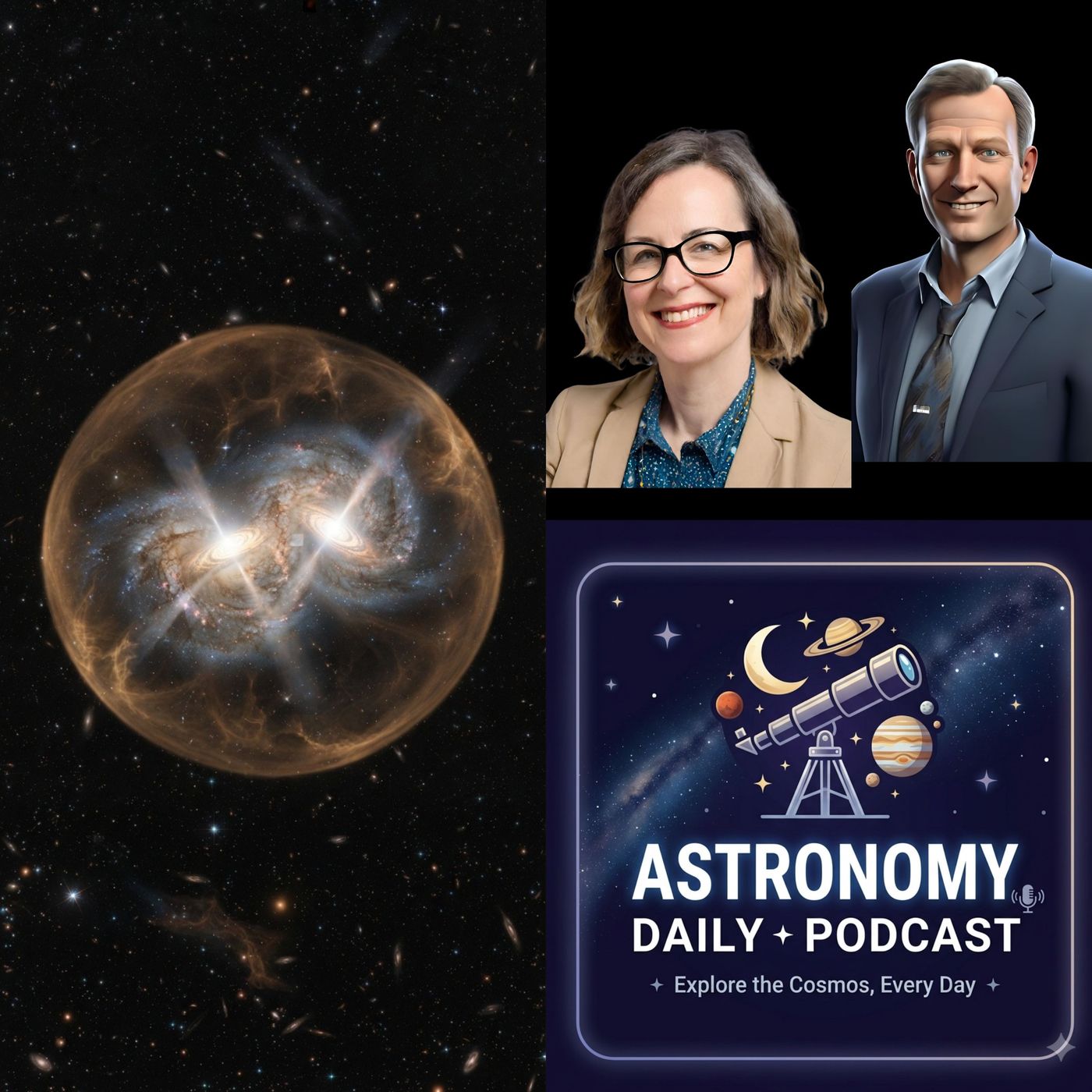
Eleven billion years ago two quasars blazed side by side, and this week astronomers weighed the invisible gas around them by the shadow it casts on the cosmic microwave background. There is 3.6 times more heat in it than gravity can explain. Plus a triple star 28 light-years away that 'should not exist', a pulsar found in ten hours with an algorithm borrowed from cryptography, The Week That Was, and the weekend sky from both hemispheres. In this episode Lead: Hot bubble around the dual quasar J1549+1245 at z = 2.37, measured with ALMA via the thermal Sunyaev–Zel'dovich effect (Hall, Zakamska et al., Nature Astronomy, 18 Nov 2026). Fresh item: Welopōʻai, the closest known triple with two white dwarfs, 28 light-years away (Artigau et al., A&A, 19 Nov 2026). Week That Was: Starship Flight 15 ship catch, CSIRO GenDIReCT and M87, SN 2026ahvu, failed supernovae in gravitational waves (E230); Voyager 1 one light-day, Beta Pictoris ices, heavy-oxygen water, Roman alignment (E231); Terra ends,

Discuss this episode

Astronomy Daily: Latest Space News

BepiColombo’s Mercury Arrival, a Star Swallows Its Companion, Voyager 1 Goes Quiet...

21 min

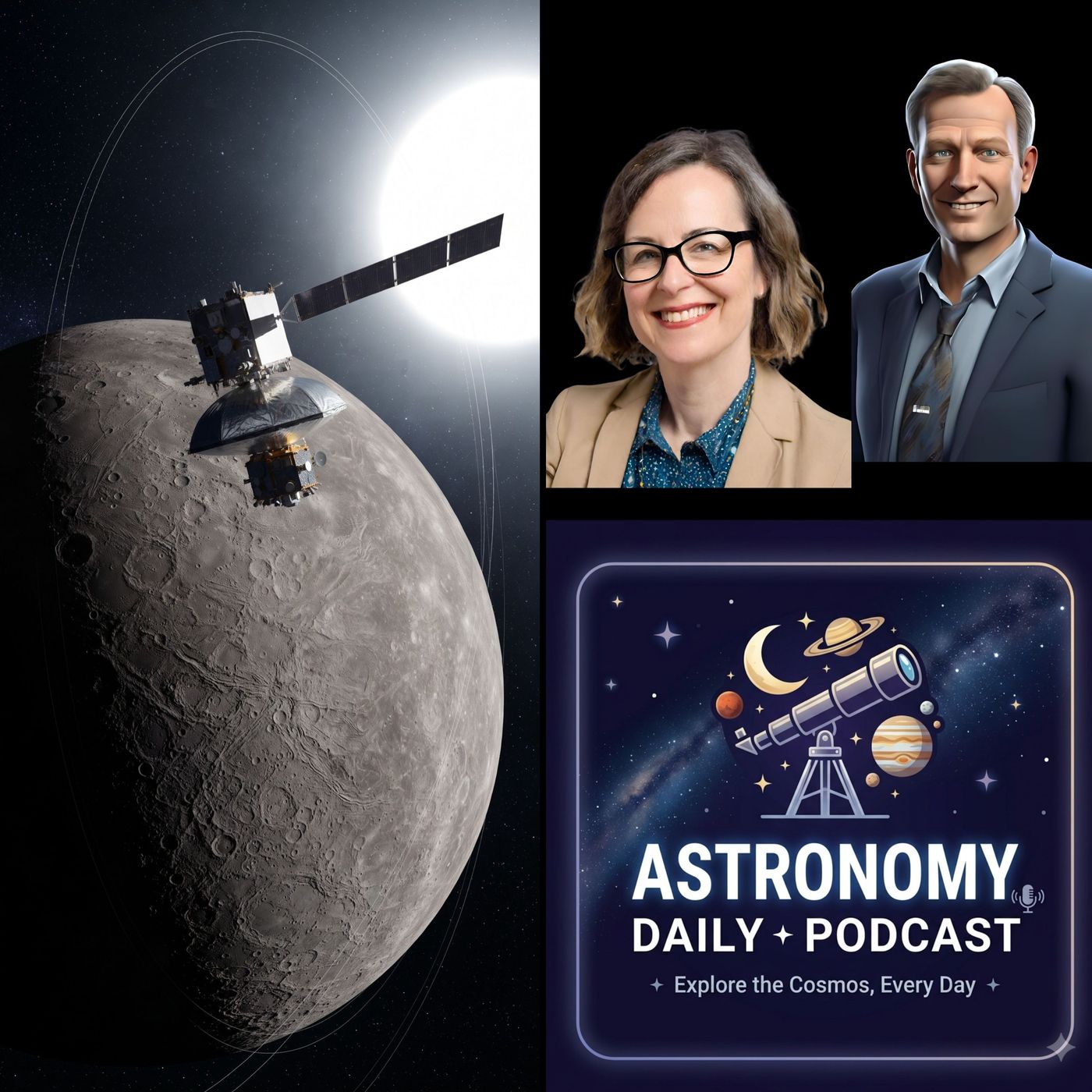
After more than eight years and nine planetary flybys, the ESA/JAXA BepiColombo mission is due to be captured into orbit around Mercury on Saturday 21 November 2026, the first mission to put two spacecraft in orbit there at once. Anna and Avery explain why the closest planet to the Sun is one of the hardest to reach, how the gentle 'weak stability boundary' capture works, and what happens between now and the start of science in April 2027. Also: Webb and a string of survey telescopes reconstruct a giant star swallowing its companion in the Andromeda galaxy; Voyager 1 reaches one light-day from Earth just as it stops sending data; and Fermi maps 450 sources in the under-explored 'MeV gap', including the globular cluster M2. Quick hits on Rocket Lab's 100th Electron, Shenzhou 24's Pakistani astronaut and the Cygnus 'S.S. Jim Lovell'. Skywatch: Mercury at greatest elongation on BepiColombo's arrival day, Andromeda, and M2 for both hemispheres. In this episode BepiColombo: the long way to

Discuss this episode

Astronomy Daily: Latest Space News

Terra’s 27-Year Earth Record Ends, Vulcan Loses 40 Satellites, China Plans a Callisto Landing...

20 min

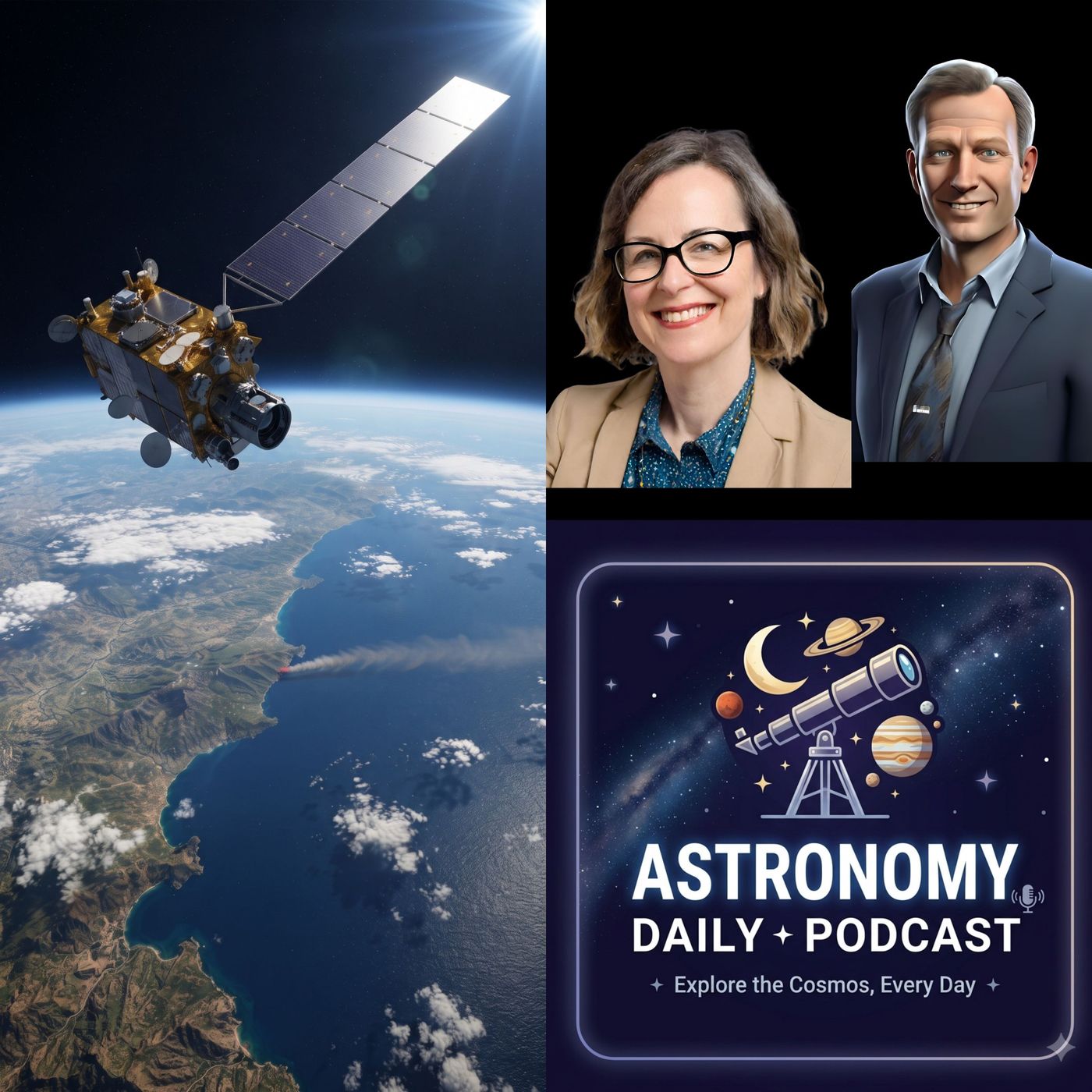
After 27 years, NASA's Terra satellite stops collecting science data on 1 December 2026. Anna and Avery look at what the first flagship of NASA's Earth Observing System measured, why its morning orbit mattered so much, what its MODIS fire hotspots meant for bushfire monitoring in Australia, and what replaces them. Also: ULA's Vulcan loses 40 Amazon Leo satellites in the company's first total mission failure; new mapping says Mars's biggest olivine deposit came from magma that cooled underground; and China formally puts a Callisto landing into its Tianwen-4 plans. Quick hits on the date for Roman's first images, BepiColombo's arrival at Mercury and Hera at Dimorphos, and a skywatch with the last of the Leonids, Mars and Jupiter at dawn, Mercury for the north and the Moon passing Saturn. In this episode · Terra signs off after 27 years · Vulcan's first loss: 40 Amazon Leo satellites · Mars's olivine came from below · China targets a Callisto landing · Quick hits: Roman's first images dat

Discuss this episode

Community Poll

Patients should be able to compare expected treatment costs before choosing care.

Share your view, then see how readers voted. No sign-in required. This poll is shared across stories.

Do you agree or disagree?

Choose one answer

Common Quandary

A Common Quandary to discuss

Another conversation to explore, separate from this news story.

One sibling did years of caregiving. Should they get more of the inheritance?

One sibling lives near an aging parent and handles appointments, errands, and emergencies. The others live far away, call regularly, and assume the nearby sibling will receive the same inheritance despite years of unpaid work.

When does family care become labor that should be repaid?

Explore this quandary