English-language podcasts

Astronomy Daily: Latest Space News

A Planet Vanishes from View: Uranus’ Shifting Fields, Meerkat’s Hydrogen Map...
23 min

Listen through the publisher, then discuss the episode here or arrange an in-person Roundtable. Your city determines where to meet.

Roundtables are designed for groups of four, with a shared subject and room for everyone to speak. Come for discussion, with no dating expectation.

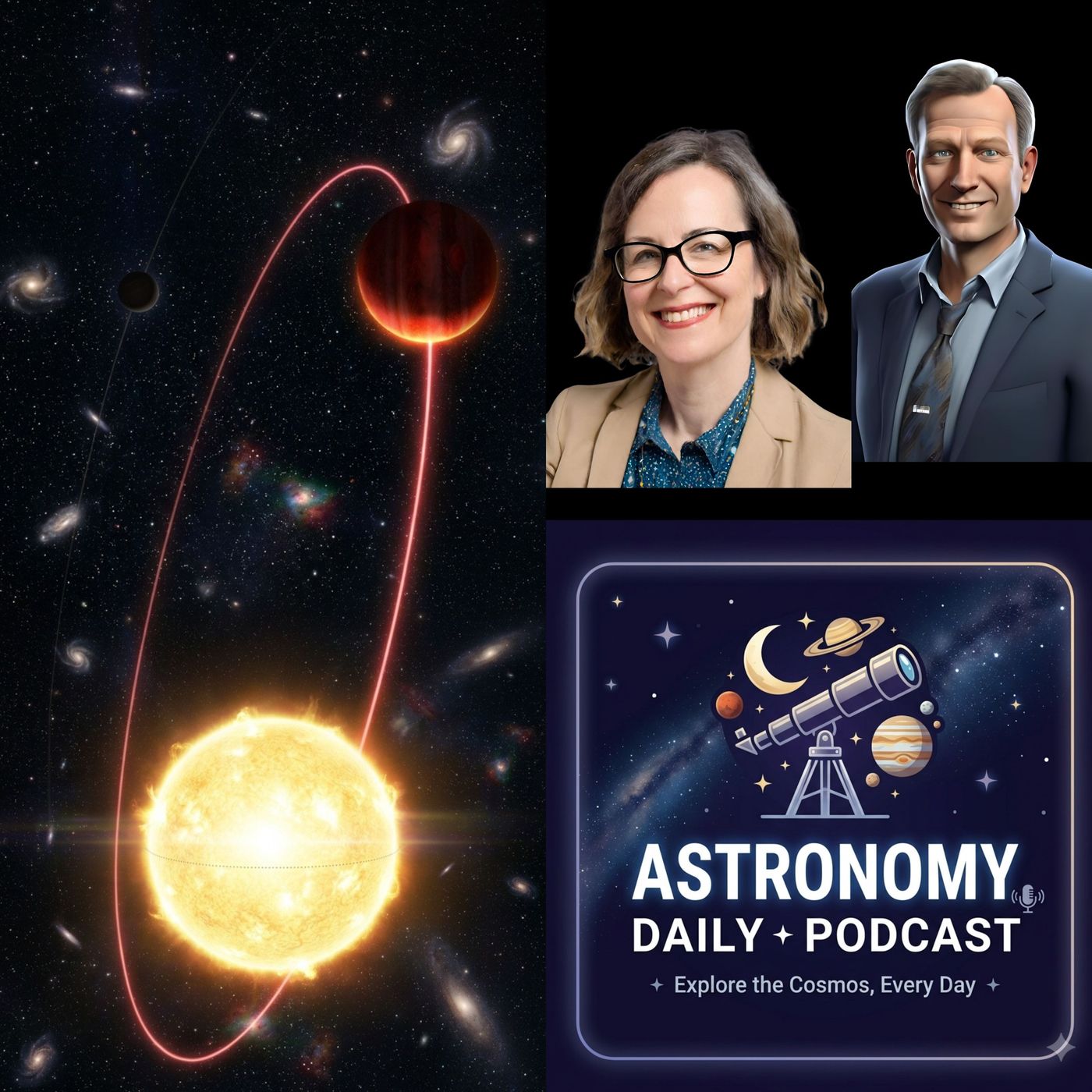
Show notes A hot Jupiter called TOI-2535 b has become the first planet around a single star seen to stop transiting, tipped out of line by an unseen neighbour. Plus: why Uranus and Neptune have scrambled magnetic fields, MeerKAT measuring how cosmic hydrogen clusters, Euclid's first big data release, ESCAPADE heading for Mars, Starship Flight 15's double-catch attempt, the 2026 ozone hole, and a both-hemispheres sky with Mars and Jupiter 1.2 degrees apart. The planet that stopped transiting. TOI-2535 b, an 8.24-day hot Jupiter ~1,000 light-years away, ran up to ~6 hours early or late and its transits shortened and faded over seven years of TESS data until they vanished in 2026. A hidden companion of at least Saturn mass, likely in resonance on a tilted orbit, is making both orbits precess. Transits should return in 30–50 years. Yee, Petigura et al., The Astrophysical Journal Letters, 9 Nov 2026. Ice giants' scrambled magnetic fields. Dynamo models with electrical conductivity rising with depth reproduce Uranus- and Neptune-like fields, and suggest their tilt could shift by tens of degrees within decades. Aurora observations could test for change since Voyager 2. Yan et al., Communications Physics. MeerKLASS hears the cosmic web. Running MeerKAT's 64 dishes as independent telescopes, the MeerKLASS collaboration detected the 21-cm hydrogen power spectrum on cosmological scales at z = 0.42 over ~236 square degrees, signal-to-noise 6.2. MNRAS. Euclid DR1-Foundation. ~1,900 square degrees (about 1,400 in the southern sky), ~1.8 PB of images, catalogues and spectra. Weak-lensing and clustering products follow in mid-2027. Quick hits. ESCAPADE Blue and Gold complete powered Earth flybys, Mars arrival Sept 2027; Starship Flight 15 targeted NET 13 Nov 22:45 UTC; 2026 Antarctic ozone hole seventh largest in 48 years, recovery on track. Skywatch. Mars–Jupiter 1.19° on 16 Nov (pre-dawn, north-favoured); Venus 1.2° from Spica, a 10%-lit crescent; Saturn high in southern evenings; Leonids peak 17–18 Nov; first quarter 17 Nov, full Moon 24 Nov. Sources · UCLA Newsroom — First known 'disappearing planet' — https://newsroom.ucla.edu/releases/first-known-disappearing-planet-neighbor-wobble-like-top · Yee et al., ApJL 1011 L60 — https://iopscience.iop.org/article/10.3847/2041-8213/aeb4a4 · arXiv 2611.13343 — https://arxiv.org/abs/2611.13343 · Yan et al., Communications Physics — https://www.nature.com/articles/s42005-026-02841-y · UT Austin Jackson School release — https://www.jsg.utexas.edu/news/2026/11/wacky-magnetic-fields-of-ice-giants-explained/ · University of Portsmouth — MeerKLASS — https://www.port.ac.uk/news-events-and-blogs/news/breakthrough-cosmic-hydrogen-measurement-could-transform-our-view-of-the-universe · MNRAS stag1911 (DOI) — https://doi.org/10.1093/mnras/stag1911 · Caltech/IPAC — Euclid DR1 — https://euclid.caltech.edu/page/euclid-dr1 · ESA — DR1 timeline — https://www.cosmos.esa.int/web/euclid/dr1-timeline · Berkeley News — ESCAPADE — http://news.berkeley.edu/2026/11/09/berkeleys-escapade-spacecraft-say-goodbye-to-earth-next-stop-mars/ · NextSpaceflight — Starship Flight 15 — https://nextspaceflight.com/launches/details/8403/ Sponsor Details: Ensure your online privacy by using NordVPN. Get the best secure and private email on the planet. Do what we did and use ProtonMail. Commercial free episodes daily are only a click way... This episode includes AI-generated content.

Episode information is provided by the publisher. Listening takes place on the publisher’s service.

Listen at the source ↗

Featured places to meet in Palo Alto, CA

Explore these places and arrange a conversation through ThinkMatch.

City guide for Palo Alto, CA

More from Astronomy Daily: Latest Space News

Astronomy Daily: Latest Space News

BepiColombo’s Mercury Arrival, a Star Swallows Its Companion, Voyager 1 Goes Quiet...

21 min

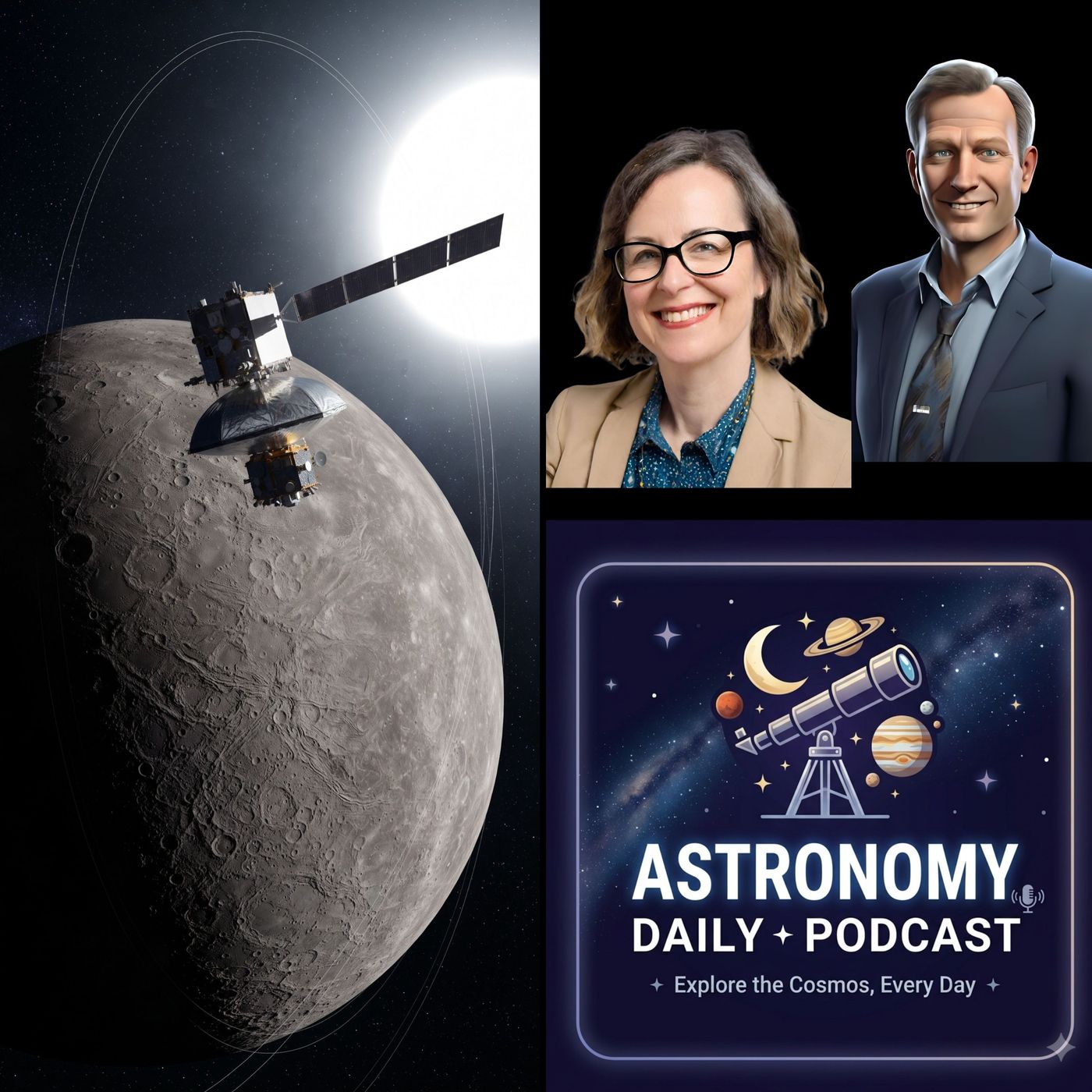
After more than eight years and nine planetary flybys, the ESA/JAXA BepiColombo mission is due to be captured into orbit around Mercury on Saturday 21 November 2026, the first mission to put two spacecraft in orbit there at once. Anna and Avery explain why the closest planet to the Sun is one of the hardest to reach, how the gentle 'weak stability boundary' capture works, and what happens between now and the start of science in April 2027. Also: Webb and a string of survey telescopes reconstruct a giant star swallowing its companion in the Andromeda galaxy; Voyager 1 reaches one light-day from Earth just as it stops sending data; and Fermi maps 450 sources in the under-explored 'MeV gap', including the globular cluster M2. Quick hits on Rocket Lab's 100th Electron, Shenzhou 24's Pakistani astronaut and the Cygnus 'S.S. Jim Lovell'. Skywatch: Mercury at greatest elongation on BepiColombo's arrival day, Andromeda, and M2 for both hemispheres. In this episode BepiColombo: the long way to

Discuss this episode

Astronomy Daily: Latest Space News

Terra’s 27-Year Earth Record Ends, Vulcan Loses 40 Satellites, China Plans a Callisto Landing...

20 min

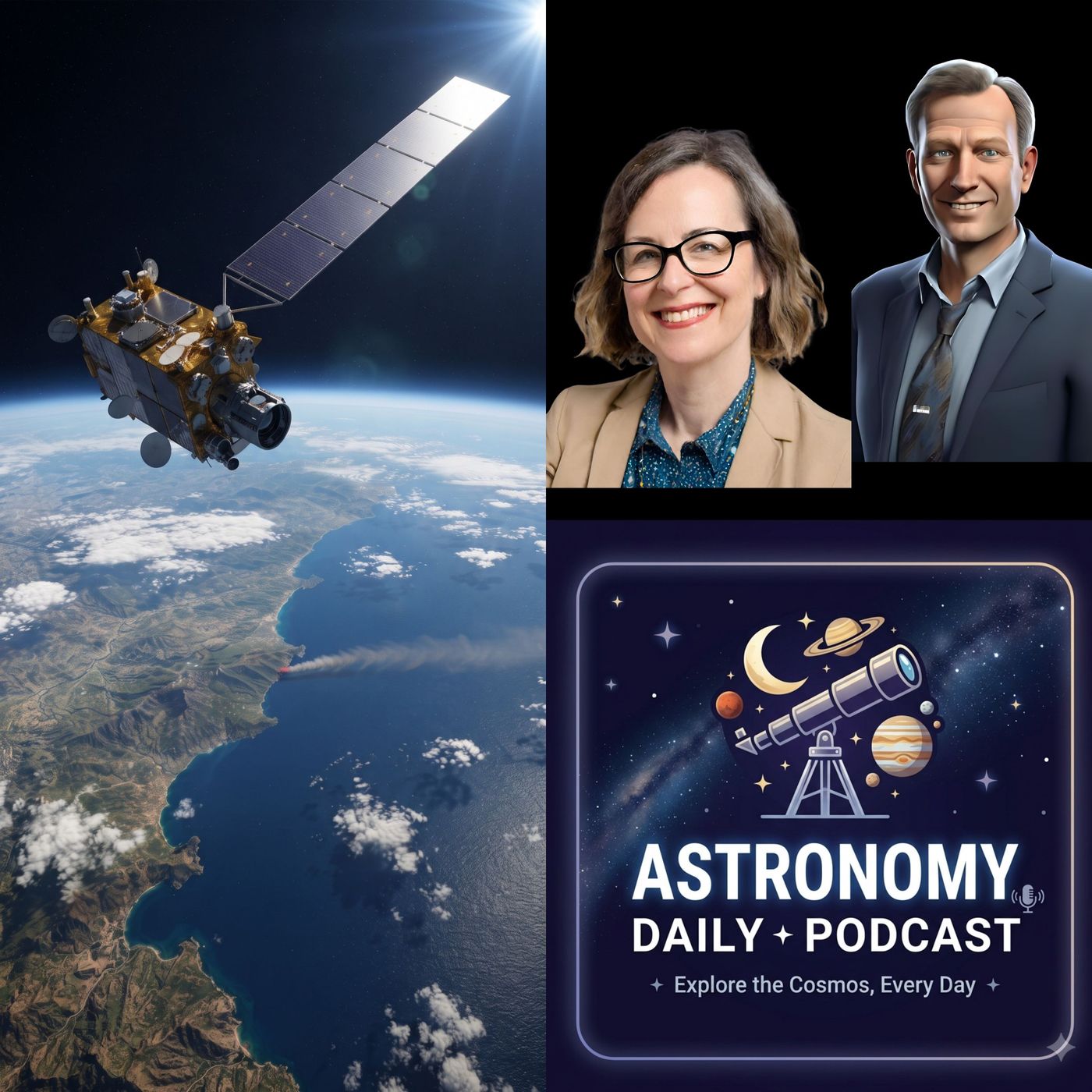
After 27 years, NASA's Terra satellite stops collecting science data on 1 December 2026. Anna and Avery look at what the first flagship of NASA's Earth Observing System measured, why its morning orbit mattered so much, what its MODIS fire hotspots meant for bushfire monitoring in Australia, and what replaces them. Also: ULA's Vulcan loses 40 Amazon Leo satellites in the company's first total mission failure; new mapping says Mars's biggest olivine deposit came from magma that cooled underground; and China formally puts a Callisto landing into its Tianwen-4 plans. Quick hits on the date for Roman's first images, BepiColombo's arrival at Mercury and Hera at Dimorphos, and a skywatch with the last of the Leonids, Mars and Jupiter at dawn, Mercury for the north and the Moon passing Saturn. In this episode · Terra signs off after 27 years · Vulcan's first loss: 40 Amazon Leo satellites · Mars's olivine came from below · China targets a Callisto landing · Quick hits: Roman's first images dat

Discuss this episode

Astronomy Daily: Latest Space News

Black Holes Explained, Sagittarius A* at the Heart of the Milky Way, and Why Earth Is Safe...

10 min

We get asked all the time 'What is a Black Hole?' followed by, are we safe from them? So we figured we should put a short explainer video together in plain language...so meet the newest member of our team, Professor Holmes. Professor Holmes answers Sam’s big questions about black holes: what they are, how they form, and how astronomers find them. Discover the event horizon, the scorching discs of gas around some black holes, and the evidence from orbiting stars, X-rays, gravitational waves and the Event Horizon Telescope. We also visit Sagittarius A* at the heart of the Milky Way, dispel the myth that black holes are cosmic vacuum cleaners, and explain why Earth has nothing to fear from them. Plus: spaghettification, time slowing near a black hole, and Stephen Hawking’s prediction that black holes slowly evaporate.In this episode · What a black hole is—and what it isn’t· Event horizons, singularities and accretion discs· How massive stars can collapse into black holes· How astronomers

Discuss this episode

Community Poll

Schools should adapt standards to individual needs rather than apply identical expectations to everyone.

Share your view, then see how readers voted. No sign-in required. This poll is shared across stories.

Do you agree or disagree?

Choose one answer

Common Quandary

A Common Quandary to discuss

Another conversation to explore, separate from this news story.

Your teenager locks you out of their phone. When is it okay to look?

Your usually outgoing sixteen-year-old has withdrawn and stopped seeing friends. They insist they are fine and refuse to talk. You know their phone passcode and could read their messages without being discovered.

How serious must a fear be before protection outranks privacy?

Explore this quandary