Escapade’s Double Slingshot: Mars-Bound Probes, Missing Oxygen and Black Holes in Pants
Listen through the publisher, then discuss the episode here or arrange an in-person Roundtable. Your city determines where to meet.
Roundtables are designed for groups of four, with a shared subject and room for everyone to speak. Come for discussion, with no dating expectation.
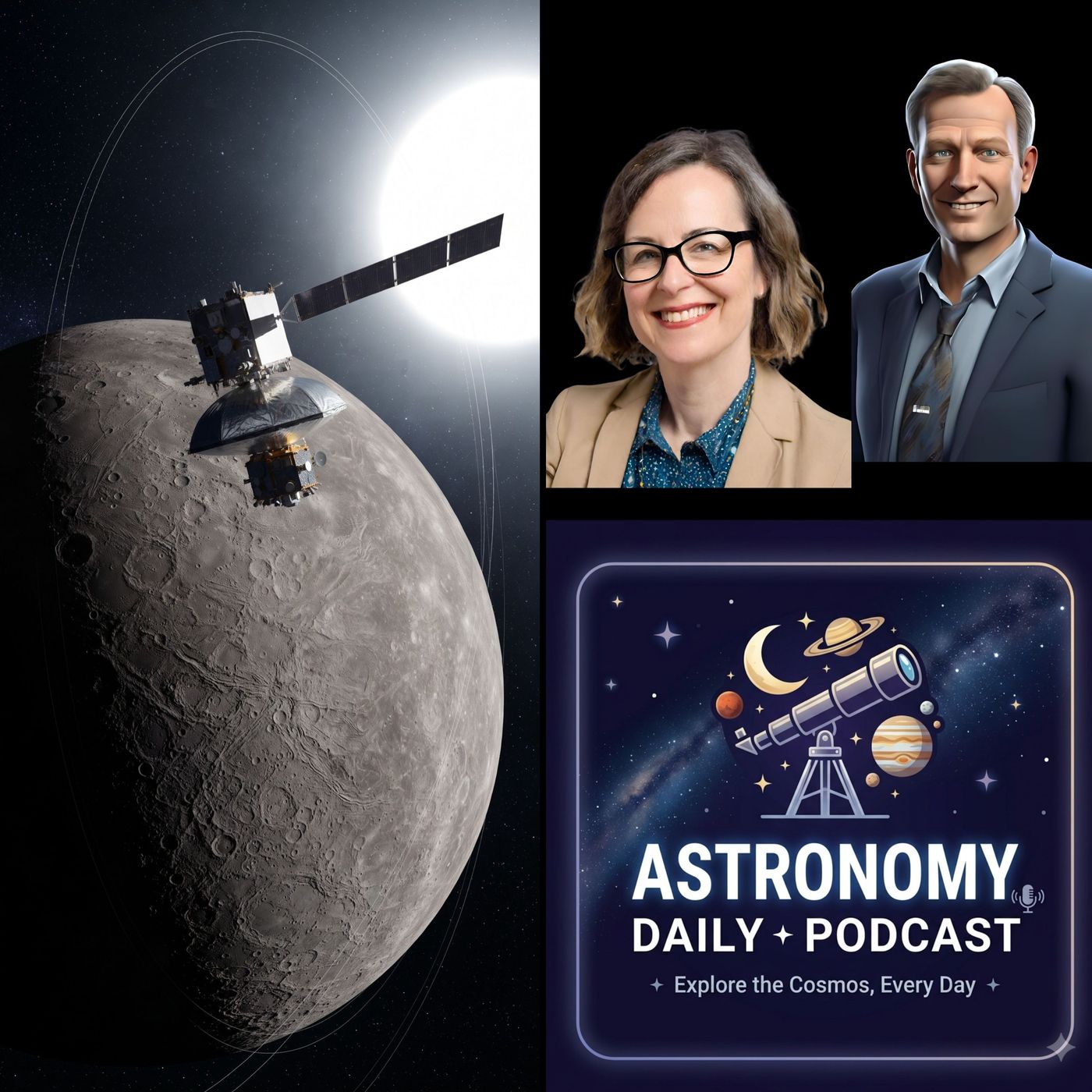
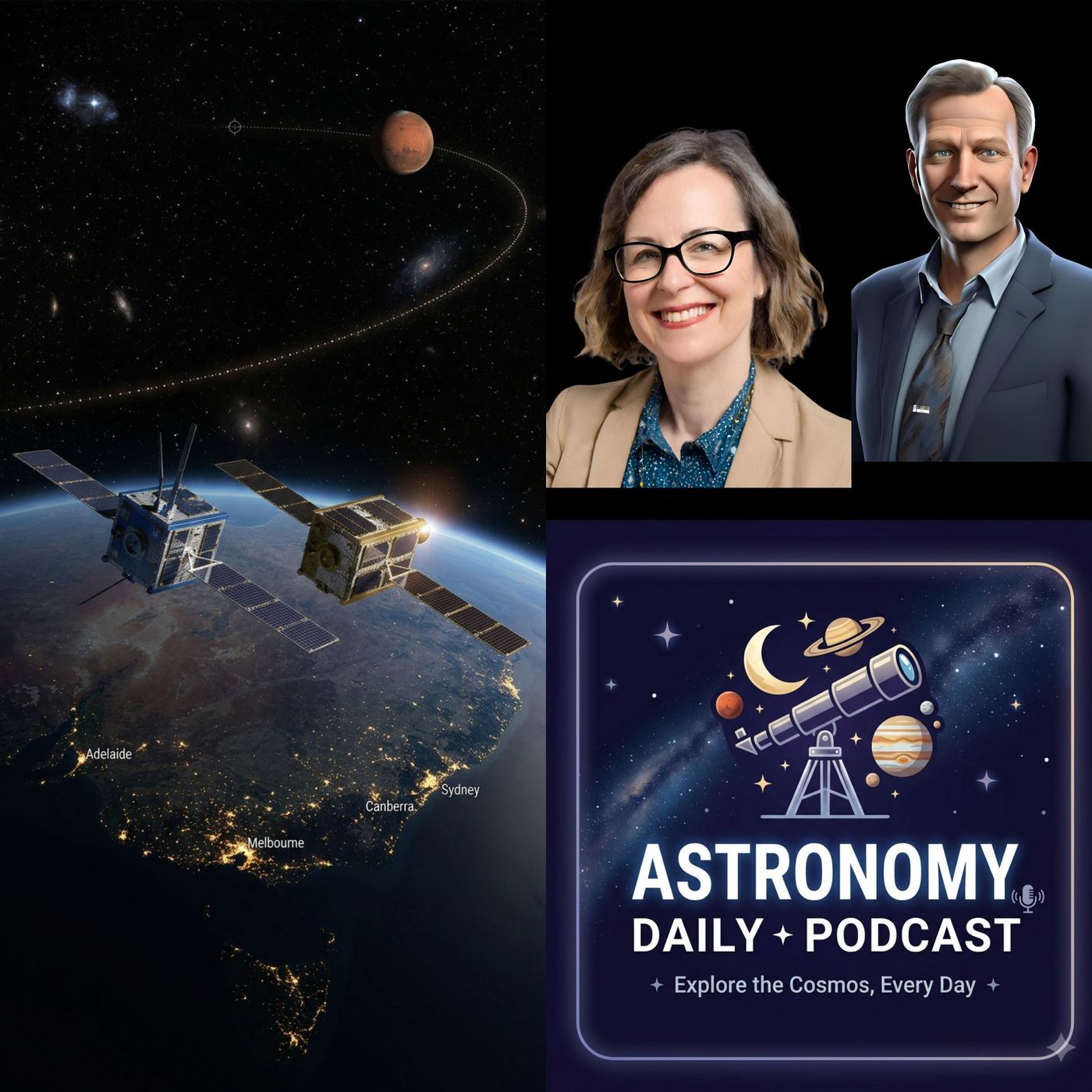
Show notes ESCAPADE's double slingshot over Australia NASA's twin ESCAPADE spacecraft, Blue and Gold, will each fly a powered Earth flyby on their way to Mars: the first around 5 a.m. EST on Saturday 7 November, the second around 6 a.m. EST on Monday 9 November. Each fires its engine for about nine minutes at closest approach, a manoeuvre NASA says no Mars-bound spacecraft has flown successfully before. The burns happen over southern Australia, starting 8:51 p.m. AEDT on the 7th and 9:51 p.m. AEDT on the 9th, and the spacecraft may be visible there through telescopes. Western US observers get their best chance between midnight and 2 a.m. PST. Arrival at Mars: 7 and 9 September 2027. Where did the oxygen go? Hubble's GLOW project (McQuinn et al., The Astrophysical Journal, published 2 November; preprint since August) measured oxygen in 37 nearby dwarf galaxies and found they keep only 4–25% (about 11% on average) of the oxygen their stars made, nearly all of it in gas. Simulations predict several times more. Supernova-driven winds are the likely culprit; where the oxygen ended up is still unknown. Gas data included CSIRO's Australia Telescope Compact Array. CHAPEA 2: a year on a pretend Mars NASA's second CHAPEA crew, Ross Elder, Ellen Ellis, Matthew Montgomery and James Spicer, left the 3D-printed Mars Dune Alpha habitat at Johnson Space Center on 31 October after 378 days, including communication delays of up to 22 minutes. An integrated HERA-plus-CHAPEA study is planned for 2027. Can a black hole split in two? A theory paper in Physical Review D (Cacciapaglia, Del Piano, Sannino & Vellucci, 22 October; preprint June) finds a split is thermodynamically allowed only, possibly, for black holes spinning near the maximum rate. The splitting process itself remains unknown, and no split has been observed. Quick hits Swift's final re-entry (see episode for status at recording); Starship Flight 15 targeted 12 November on an FAA planning slide, no SpaceX date yet; BepiColombo Mercury orbit capture 21 November; Voyager 1 one light-day from Earth around 18 November. Skywatch ESCAPADE telescope challenge over Australia (Sat 8:51 p.m. and Mon 9:51 p.m. AEDT); New Moon 9 Nov; Taurid fireballs; Mars and Jupiter closing to about 1.2° on 16 Nov (UT); thin crescent Moon under 1° from Venus around 10:45 UT on 7 Nov, best from eastern North America; Venus about 1.2° from Spica on the mornings of 9–10 Nov; Mercury at greatest western elongation 20 Nov. Never look at the Sun without ISO 12312-2 certified protection. Sources NASA ESCAPADE blog: Twin ESCAPADE spacecraft to slingshot past Earth (2 Nov 2026) — https://science.nasa.gov/blogs/escapade/2026/11/02/nasas-twin-escapade-spacecraft-to-slingshot-past-earth-on-way-to-mars/ NASA SVS ESCAPADE flyby star charts — https://svs.gsfc.nasa.gov/15114/ JPL Horizons System — https://ssd.jpl.nasa.gov/horizons/app.html#/ UC Berkeley ESCAPADE mission timeline — https://escapade.ssl.berkeley.edu/timeline-news Blue Origin: New Glenn launches NASA's ESCAPADE (13 Nov 2025) — https://www.blueorigin.com/en-US/news/new-glenn-launches-nasa-escapade-lands-fully-reusable-booster NASA: Hubble uncovers case of missing oxygen in nearby dwarf galaxies (2 Nov 2026) — https://science.nasa.gov/missions/hubble/nasas-hubble-uncovers-case-of-missing-oxygen-in-nearby-dwarf-galaxies/ McQuinn et al., GLOW II: A Census of Oxygen in Low-Mass Galaxies, ApJ, DOI 10.3847/1538-4357/ae93a6 (preprint arXiv 2608.07665) — https://arxiv.org/abs/2608.07665 NASA: CHAPEA crew 'returns' to Earth (31 Oct 2026) — https://www.nasa.gov/image-article/nasas-chapea-crew-returns-to-earth/ University of Southern Denmark: Can a black hole split in two? — https://www.sdu.dk/en/om-sdu/fakulteterne/naturvidenskab/nyheder-2026/black-hole-in-two Cacciapaglia, Del Piano, Sannino & Vellucci, Phys. Rev. D 114, 084072 (22 Oct 2026), DOI 10.1103/cx69-t466 — https://journals.aps.org/prd/abstract/10.1103/cx69-t466 NASA Swift blog: Swift Observatory to re-enter atmosphere (2 Nov 2026) — https://science.nasa.gov/blogs/swift/2026/11/02/nasas-swift-observatory-to-re-enter-atmosphere/ Starlust: Starship Flight 15 FAA planning date — https://starlust.org/spacex-starship-flight-15-possible-launch-date-revealed/ Sponsor Details: Ensure your online privacy by using NordVPN. Get the best secure and private email on the planet. Do what we did and use ProtonMail. Commercial free episodes daily are only a click way... This episode includes AI-generated content.
Episode information is provided by the publisher. Listening takes place on the publisher’s service.
Listen at the source ↗