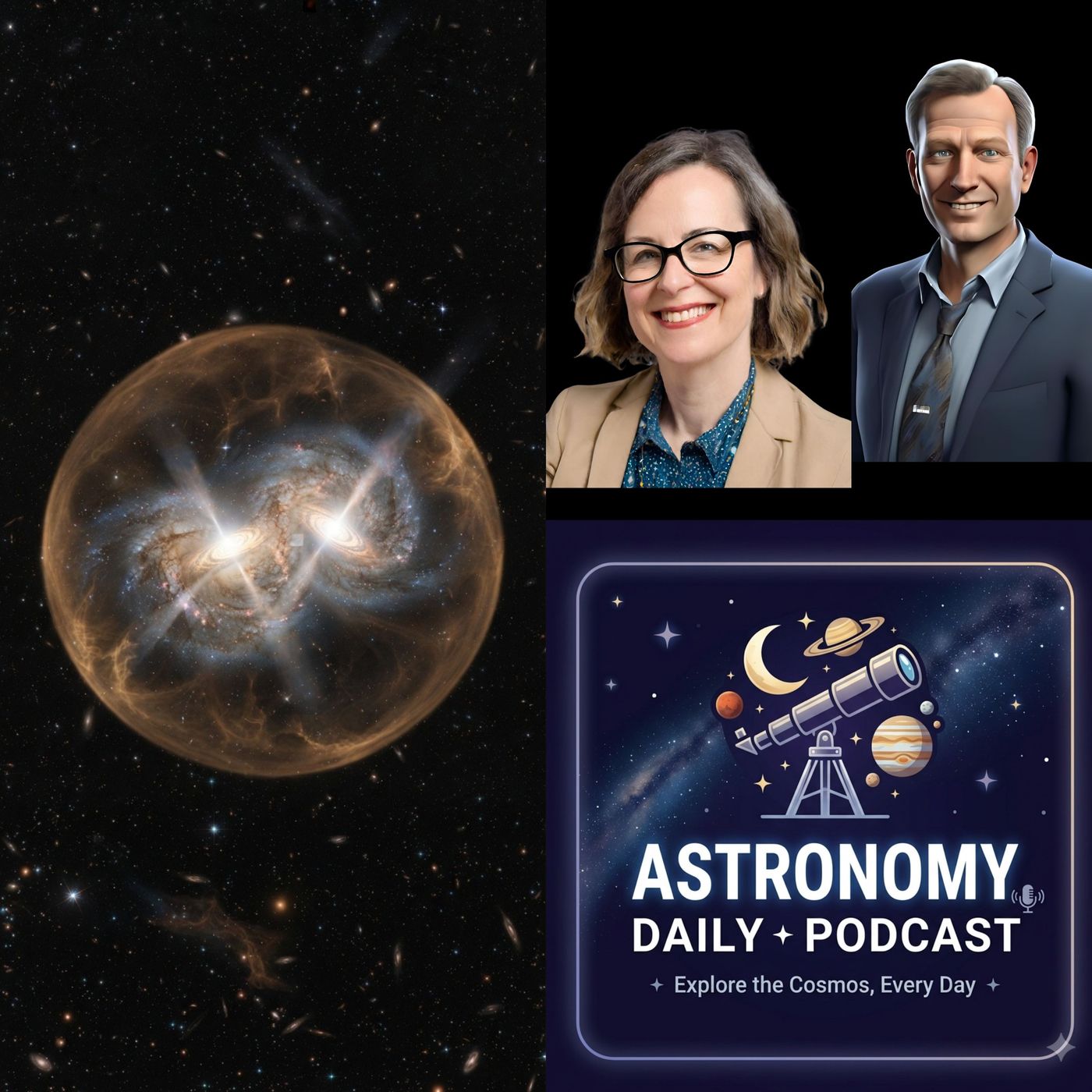
Travelers in the Night Eps. 905 & 906: Hogan's Interesting PHA & Pierazzo Lunar Crater
7 min
Listen through the publisher, then discuss the episode here or arrange an in-person Roundtable. Your city determines where to meet.
Roundtables are designed for groups of four, with a shared subject and room for everyone to speak. Come for discussion, with no dating expectation.
Dr. Al Grauer hosts. Dr. Albert D. Grauer ( @Nmcanopus (https://twitter.com/Nmcanopus) ) is an observational asteroid hunting astronomer. Dr. Grauer retired from the University of Arkansas at Little Rock in 2006. travelersinthenight.org (http://travelersinthenight.org/) From June & July, 2026. Today's 2 topics: - My Catalina Sky Survey teammate Josh Hogan has discovered a 2 football field diameter asteroid that was placed on NASA's Sentry list because it has a tiny minuscule but non-zero chance of impacting our home planet. With this motivation my team the Catalina Sky Survey, the Pan STARRS group in Hawaii, the ATLAS group with telescopes Hawaii, Chile, and South Africa , the Vera C. Rubin telescope in Chile, will be soon joined NASA's NEO Surveyor and groups world wide in a planet wide defense network. - The visually stunning Lunar Crater Pierazzo, named for the late Planetary Scientist Elizabeth "Betty" Pierazzo was observed by the Artemis II Crew as they passed over the Moon's far side. It is a 5.9 mile diameter crater with white streaks or rays which extend more than 50 miles in all directions. Every bit helps! Thank you! ------------------------------------ Thank you! (Haven't donated? It's not too late! Just click (http://cosmoquest.org/Donate)!) ------------------------------------
Episode information is provided by the publisher. Listening takes place on the publisher’s service.
This truck is going to the moon. So we put it to the test… Get an exclusive 15% discount on Saily data plans. Use code CLEO at checkout. Download Saily app or go to https://saily.com/cleo This is the world’s first “space truck.” It’s going to the moon to help us go farther, faster, and discover places we’ve never been… Because humans are about to go back to the moon for the first time in 50 years! And no one but its builders have ever driven it… until today. In this video I'm going to put this brand new space truck to the test in a series of 5 challenges. And I've invited someone who knows a thing or two about challenges: YouTube daredevil and host of Challenge Accepted… Michelle Khare! Let’s go. Chapters: 0:00 This is the world’s first space truck 0:38 Introducing Michelle Khare! 01:04 What is a space truck? 01:52 How do astronauts drive? 02:21 First impressions! 02:47 Moon truck v normal truck 04:47 How fast can you drive on the moon? 05:18 Will we crash? 08:36 Can we break the lunar
PBS Member Stations rely on viewers like you. To support your local station, go to: http://to.pbs.org/DonateSPACE ↓ More info below ↓ Uploaded 21-10-19 Sign Up on Patreon to get access to the Space Time Discord! Check out the Space Time Merch Store Invitation to Time Travelers: https://www.youtube.com/post/UgzeIA0O00-bVioxU4t4AaABCQ Time travel stories are cool because both the past and future are somehow more interesting that the present and because everyone wants a redo. But so far it appears we’re doomed to live consumed by regret in the eternal, boring present. Time marches on, inexorably and only forward. Or so we thought until Einstein came along. His special and general theories of relativity changed the way we think about time forever, and believe it or not, their raw equations permit time travel. They even tell us how to do it. So let’s review the possibilities, and decide how possible they really are. Hosted by Matt O'Dowd Written by Matt O'Dowd Graphics by Leonardo Scholzer
A family trip to Jefferson, Texas, included everything a young paranormal enthusiast could want: a ghost tour, a stay at the historic Jefferson Hotel, and the possibility of experiencing something unexplained. During that first visit, a young boy woke in the middle of the night to something unusual happening in his bed. He was convinced he'd experienced something paranormal, but his mother wasn't nearly as convinced. A few years later, the family returned to the same hotel, this time bringing along paranormal investigation equipment. And once again, strange things began happening, including activity that seemed to respond to their attempts at communication. But perhaps the most interesting discovery came when they began reading through a guestbook filled with experiences from previous visitors. Could other guests have encountered the same mysterious presence they'd experienced years earlier? #RealGhostStoriesOnline #JeffersonHotel #HauntedJeffersonHotel #JeffersonTexas #TexasGhostStori
Where on Earth did life begin? Explore the hydrothermal vents in Earth’s crust as simple compounds gave way to complex life. Uploaded 26-08-19 -- Billions of years ago, simple organic compounds assembled into more complex coalitions that could grow and reproduce. At the time, Earth had widespread volcanic activity and a hostile atmosphere that made it almost devoid of a suitable environment for living things. So where did life begin? Luka Wright searches for the cradle of life that gave rise to the billions of species that inhabit our planet. Lesson by Luka Seamus Wright, directed by Nick Hilditch. Sign up for our newsletter: http://bit.ly/TEDEdNewsletter Support us on Patreon: http://bit.ly/TEDEdPatreon Find us on Twitter: http://bit.ly/TEDEdTwitter Peep us on Instagram: http://bit.ly/TEDEdInstagram View full lesson: https://ed.ted.com/lessons/the-mysterious-origins-of-life-on-earth-luka-seamus-wright Thank you so much to our patrons for your support! Without you this video would not
Eleven billion years ago two quasars blazed side by side, and this week astronomers weighed the invisible gas around them by the shadow it casts on the cosmic microwave background. There is 3.6 times more heat in it than gravity can explain. Plus a triple star 28 light-years away that 'should not exist', a pulsar found in ten hours with an algorithm borrowed from cryptography, The Week That Was, and the weekend sky from both hemispheres. In this episode Lead: Hot bubble around the dual quasar J1549+1245 at z = 2.37, measured with ALMA via the thermal Sunyaev–Zel'dovich effect (Hall, Zakamska et al., Nature Astronomy, 18 Nov 2026). Fresh item: Welopōʻai, the closest known triple with two white dwarfs, 28 light-years away (Artigau et al., A&A, 19 Nov 2026). Week That Was: Starship Flight 15 ship catch, CSIRO GenDIReCT and M87, SN 2026ahvu, failed supernovae in gravitational waves (E230); Voyager 1 one light-day, Beta Pictoris ices, heavy-oxygen water, Roman alignment (E231); Terra ends,
This is a Grave Talks CLASSIC EPISODE! For Melissa Clevenger, the spirit world has never been a distant mystery—it has been a lifelong reality. Since the age of five, Melissa has been able to see and hear spirits. But her early encounters weren’t comforting or controlled. The voices didn’t ask permission. The apparitions didn’t wait for understanding. What began as terrifying childhood experiences slowly evolved into something she could manage—and eventually embrace. As she matured, the chaos of those early years transformed into meaningful communication, guiding her toward a deeper understanding of her abilities and the messages coming through. Today, Melissa shares her journey from fear to purpose, reflecting on what it means to live with heightened sensitivity and dedicate her life to connecting the living with those who have passed on. On this episode of The Grave Talks, we explore the reality of growing up with psychic abilities, the challenges of navigating unseen energies, and t
Explore how the Hubble Space Telescope reveals the Universe, from iconic images to major discoveries, and how it complements the James Webb Space Telescope. "ASTROMAN: the Dark Sky Guardian" is a podcast channel that aims to explore popular science in multiple disciplines and research on interdisciplinary approaches, such as sustainability, dark-sky protection, astrophotography, space exploration, astronomy innovation, inclusive science communication, and STEAM Education by integrating science and arts. Exodus Chun-Long Sit, also known as the ASTROMAN, is a transmedia astronomy educator, popular science author, STEAM educator, and science communicator in Hong Kong. He is recently the National Astronomy Education Coordinator (Chair of Hong Kong, China) of the International Astronomical Union and President of Starrix. He was also an International Committee Member of the Dark Sky International, regularly organizing public lectures at the Hong Kong Space Museum and the Hong Kong Science Mu
From January 18, 2022. Hosted by: Dr. Pamela L. Gay (@CosmoQuest (https://www.youtube.com/@CosmoQuest)) Recent observations of twelve different stellar streams around the Milky Way have revealed the effects of dark matter, similar to how lights on a Christmas Tree reveal the shape of the tree in dark. Plus, globular clusters, volcanoes, and an interview with Dr. Cathy Olkin from the Southwest Research Institute's Lucy mission. Every bit helps! Thank you! ------------------------------------ Thank you! (Haven't donated? It's not too late! Just click (http://cosmoquest.org/Donate)!) ------------------------------------
Hosted by Chris Beckett & Shane Ludtke, two amateur astronomers in Saskatchewan who enjoy teaching astronomy classes and showing the public views through their telescopes. [email protected] In Episode 563 of Actual Astronomy, co-hosts Chris and Shane dive into strategies for visually observing faint deep-sky targets under the stars. The episode features a visual contrast comparison between Messier galaxies M74 and M77, detailing how low-power, wide-exit-pupil techniques prevent low surface brightness objects from slipping into invisibility. Learn step-by-step star-hopping directions to locate M74 using Hamal and Eta Piscium, along with observing highlights captured through a 7-inch refractor. Tune in to refine your visual observing skills and make the most of clear, dark night skies! Challenge object: M31 [OIII] Arc. (Or Strottner-Drechsler-Sainty Object 1 or just SDSO-1) Discovered by a french team using long exposures in 2022 and lit the internet afire in 2023 when announced,
A company's growth matters less than whether its customers receive better service.
Share your view, then see how readers voted. No sign-in required. This poll is shared across stories.
Do you agree or disagree?
Common Quandary
A Common Quandary to discuss
Another conversation to explore, separate from this news story.
You find a rare library book your father kept for forty years. Do you return it anonymously?
While clearing your father's attic, you find a rare book stamped by the local library and due in 1986. The library would be thrilled to recover it, but returning it openly would expose a secret he apparently kept for decades—and might produce a spectacular overdue fine.
Does making an old wrong right require admitting who did it?