English-language podcasts

Astronomy Daily: Latest Space News

A White Dwarf’s Radio Pulse Maps a Star’s Weather, LISA’s Hidden Planets, Starship’s Flight 15...
20 min

Listen through the publisher, then discuss the episode here or arrange an in-person Roundtable. Your city determines where to meet.

Roundtables are designed for groups of four, with a shared subject and room for everyone to speak. Come for discussion, with no dating expectation.

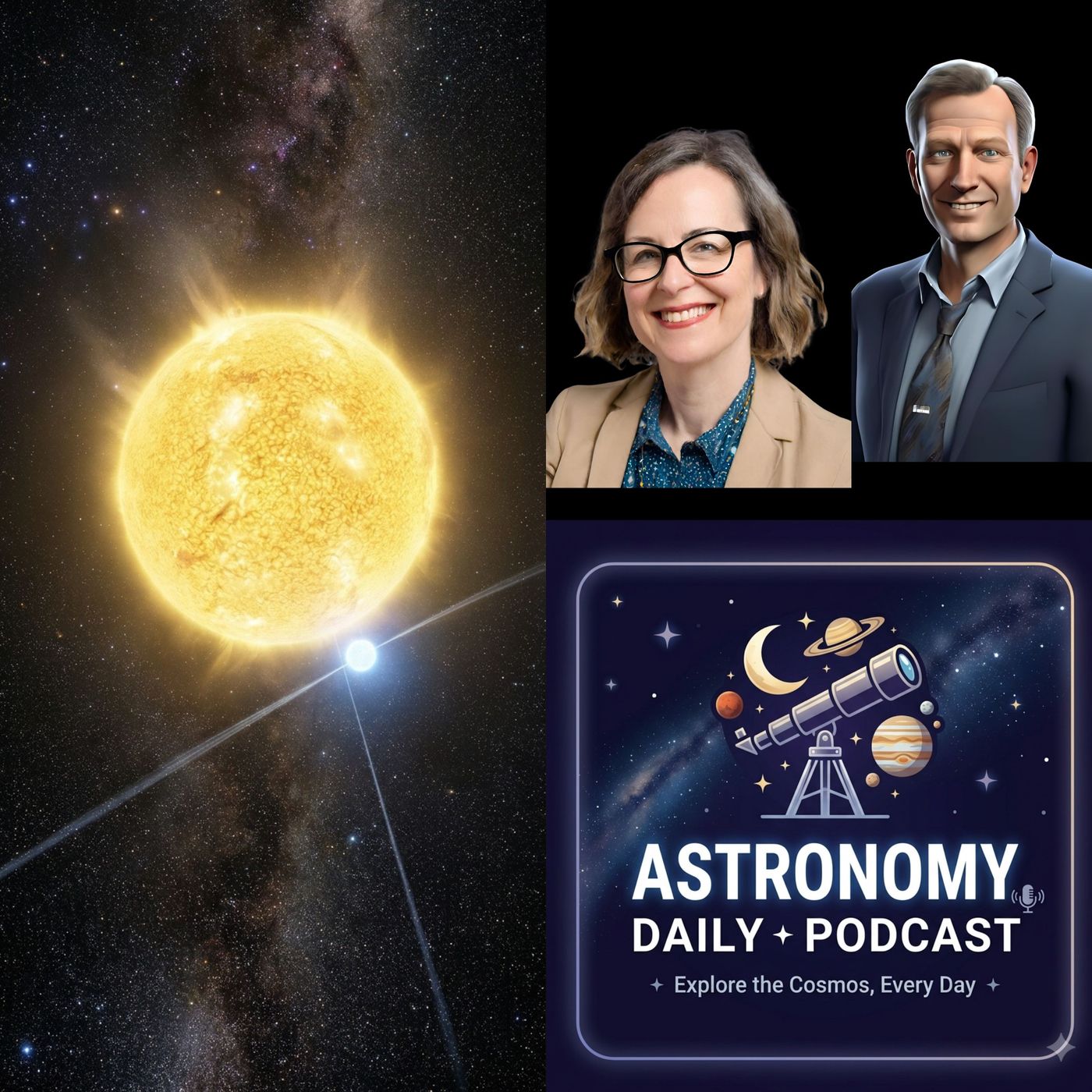
Every 7.9 minutes a radio pulse arrives from Canis Major. This week astronomers at ICRAR-Curtin in Perth traced it to a white dwarf orbiting a star like our Sun, the first pairing of its kind, and found that the pulses carry the weather of the companion star with them. We unpack how the timing gives away which star is talking, and everything this result is not. Then: how the LISA gravitational-wave observatory could find planets around pairs of white dwarfs. In The Week That Was: NASA's nuclear Moon rover built from Curiosity's twin, the hot Jupiter that stopped transiting, Euclid's first big data release, and Starship Flight 15, in orbit with its catch attempt still to come at the time of recording. Plus Mars and Jupiter 1.2 degrees apart, and the Leonids, from both hemispheres. In this episode · Lead: GPM J071507−114153, a long-period radio transient made of a white dwarf and a Sun-like star (McSweeney, Hurley-Walker et al., Nature Astronomy, 12 Nov 2026). · Fresh item: LISA as a planet finder around double white dwarfs (McGrath et al., two papers in The Astrophysical Journal, 10 Nov 2026). · Week That Was: PROMISE nuclear Moon rover, gravitational reconnection, Tiangong 9.7 pK condensate (E226); TOI-2535 b, ice-giant dynamos, MeerKLASS (E227); Euclid DR1-Foundation, ASTRA in-orbit assembly (E228). · Starship Flight 15: launched 13 Nov, booster catch aborted, ship in orbit; ship catch attempt still to come at time of recording. Full coverage Monday. · Arc updates: ESCAPADE en route to Mars; Voyager 1 one light-day (18 Nov); BepiColombo (21 Nov); Hera (25 Nov). · Skywatch: Mars–Jupiter conjunction 16 Nov; Leonids 17–18 Nov; where to find Canis Major; ISO 12312-2 eye safety. Sources · Nature Astronomy, DOI 10.1038/s41550-026-03016-z — 'A long-period transient with a Sun-like companion' — nature.com/articles/s41550-026-03016-z · ICRAR / Curtin University release, 12–13 Nov 2026 — icrar.org · NASA Goddard, 10 Nov 2026 — 'NASA Scientists Show How Gravitational Waves Can Reveal New Worlds' — science.nasa.gov · NASA Science, 9 Nov 2026 — 'NASA's ESCAPADE Completes Powered Earth Flybys, Now En Route to Mars' · Space.com Starship Flight 15 live updates, 13–14 Nov 2026; PBS NewsHour / AP, 13 Nov 2026 · Skywatch figures computed in session with PyEphem astronomydaily.io · @AstroDailyPod · Bitesz.com Podcast Network Sponsor Details: Ensure your online privacy by using NordVPN. Get the best secure and private email on the planet. Do what we did and use ProtonMail. Commercial free episodes daily are only a click way... This episode includes AI-generated content.

Episode information is provided by the publisher. Listening takes place on the publisher’s service.

Listen at the source ↗

Featured places to meet in Palo Alto, CA

Explore these places and arrange a conversation through ThinkMatch.

City guide for Palo Alto, CA

More from Astronomy Daily: Latest Space News

Astronomy Daily: Latest Space News

Quasars Heat the Early Universe, a Triple Star That Shouldn’t Exist, The Weekend Wrap...

21 min

Eleven billion years ago two quasars blazed side by side, and this week astronomers weighed the invisible gas around them by the shadow it casts on the cosmic microwave background. There is 3.6 times more heat in it than gravity can explain. Plus a triple star 28 light-years away that 'should not exist', a pulsar found in ten hours with an algorithm borrowed from cryptography, The Week That Was, and the weekend sky from both hemispheres. In this episode Lead: Hot bubble around the dual quasar J1549+1245 at z = 2.37, measured with ALMA via the thermal Sunyaev–Zel'dovich effect (Hall, Zakamska et al., Nature Astronomy, 18 Nov 2026). Fresh item: Welopōʻai, the closest known triple with two white dwarfs, 28 light-years away (Artigau et al., A&A, 19 Nov 2026). Week That Was: Starship Flight 15 ship catch, CSIRO GenDIReCT and M87, SN 2026ahvu, failed supernovae in gravitational waves (E230); Voyager 1 one light-day, Beta Pictoris ices, heavy-oxygen water, Roman alignment (E231); Terra ends,

Discuss this episode

Astronomy Daily: Latest Space News

BepiColombo’s Mercury Arrival, a Star Swallows Its Companion, Voyager 1 Goes Quiet...

21 min

After more than eight years and nine planetary flybys, the ESA/JAXA BepiColombo mission is due to be captured into orbit around Mercury on Saturday 21 November 2026, the first mission to put two spacecraft in orbit there at once. Anna and Avery explain why the closest planet to the Sun is one of the hardest to reach, how the gentle 'weak stability boundary' capture works, and what happens between now and the start of science in April 2027. Also: Webb and a string of survey telescopes reconstruct a giant star swallowing its companion in the Andromeda galaxy; Voyager 1 reaches one light-day from Earth just as it stops sending data; and Fermi maps 450 sources in the under-explored 'MeV gap', including the globular cluster M2. Quick hits on Rocket Lab's 100th Electron, Shenzhou 24's Pakistani astronaut and the Cygnus 'S.S. Jim Lovell'. Skywatch: Mercury at greatest elongation on BepiColombo's arrival day, Andromeda, and M2 for both hemispheres. In this episode BepiColombo: the long way to

Discuss this episode

Astronomy Daily: Latest Space News

Terra’s 27-Year Earth Record Ends, Vulcan Loses 40 Satellites, China Plans a Callisto Landing...

20 min

After 27 years, NASA's Terra satellite stops collecting science data on 1 December 2026. Anna and Avery look at what the first flagship of NASA's Earth Observing System measured, why its morning orbit mattered so much, what its MODIS fire hotspots meant for bushfire monitoring in Australia, and what replaces them. Also: ULA's Vulcan loses 40 Amazon Leo satellites in the company's first total mission failure; new mapping says Mars's biggest olivine deposit came from magma that cooled underground; and China formally puts a Callisto landing into its Tianwen-4 plans. Quick hits on the date for Roman's first images, BepiColombo's arrival at Mercury and Hera at Dimorphos, and a skywatch with the last of the Leonids, Mars and Jupiter at dawn, Mercury for the north and the Moon passing Saturn. In this episode · Terra signs off after 27 years · Vulcan's first loss: 40 Amazon Leo satellites · Mars's olivine came from below · China targets a Callisto landing · Quick hits: Roman's first images dat

Discuss this episode

Community Poll

Communities should usually repair existing infrastructure before building replacements.

Share your view, then see how readers voted. No sign-in required. This poll is shared across stories.

Do you agree or disagree?

Choose one answer

Common Quandary

A Common Quandary to discuss

Another conversation to explore, separate from this news story.

A coworker tells you their salary in confidence—and proves everyone else is underpaid. Do you share it?

A coworker privately tells you their salary and asks you not to repeat it. You later realize the figure is strong evidence that several equally experienced colleagues are being underpaid.

When does fairness outweigh a promise of confidentiality?

Explore this quandary