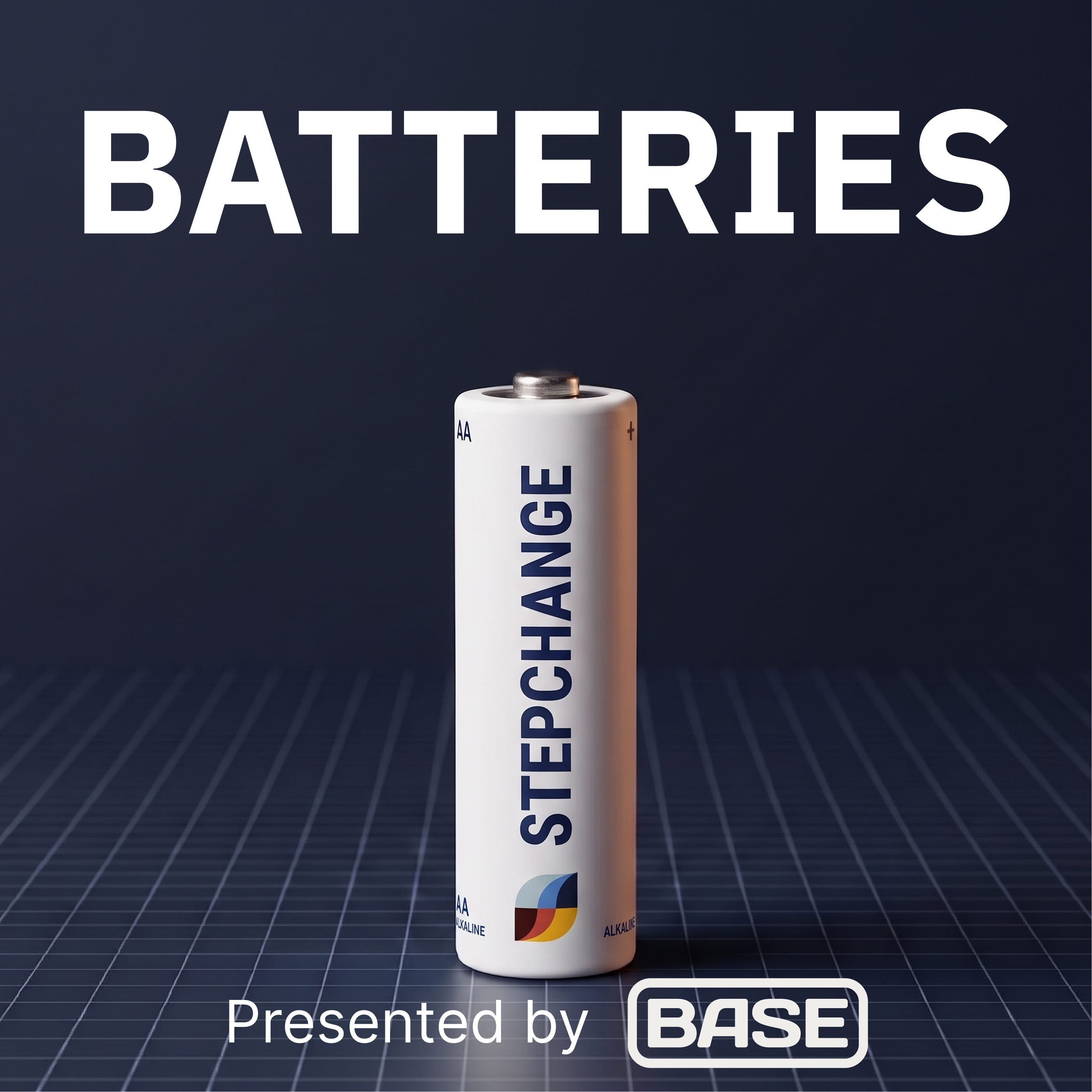
Batteries: The Invention That Untethered the World
Listen through the publisher, then discuss the episode here or arrange an in-person Roundtable. Your city determines where to meet.
Roundtables are designed for groups of four, with a shared subject and room for everyone to speak. Come for discussion, with no dating expectation.
View all sources and a battery visualizer: stepchange.show/batteries (https://stepchange.show/batteries) For most of human history, we had to use energy when and where it was generated. Batteries have changed that fundamental constraint, giving us the remarkable ability to store energy and use it whenever and wherever we need it. Every day we carry these little packages of chemistry. They’re in our pockets, on our wrists, and powering our cars. Batteries are so deeply embedded in modern life that we barely notice them. Yet few inventions have done more to change our relationship with energy. Their story begins with a twitching frog leg. It runs through the lead-acid workhorse that made rechargeable batteries practical, the disposable cells that powered a revolution in consumer electronics, and the electric cars that competed with gasoline at the dawn of the automobile before nearly disappearing. It follows the invention of the lithium-ion cell from an oil-company lab to Oxford to Japan, and ultimately to China, which came to dominate the global battery industry. And now, after two centuries of invention, batteries are having their biggest moment yet. In 2010, the world could manufacture roughly 20 gigawatt-hours of lithium-ion batteries a year. By 2024, it was producing more than 1,000. Battery pack prices have fallen by over 90%. Nearly one in three new cars sold worldwide now plugs in, and more than half in China. Nearly all the battery capacity on the US grid has been built since 2020. Batteries untether energy from where and when it’s generated. They freed our devices from cords, made electric cars a possibility, and are now giving the grid something it has never had at scale: the ability to save electricity for later. What began as a scientific curiosity is becoming essential infrastructure for the modern world. But this transformation raises new questions. Who controls the manufacturing? Where will the materials come from? And who will capture the value as energy storage reshapes the global economy? This is the story of how humanity learned to store electricity—and how that ability is changing the world. Charge up and press play! Read the full transcript and research notes. (https://stepchange.show/batteries) Sponsors Presented by Base Power: Base Power is building a network of home batteries that make the grid cheaper and more reliable. And they’re hiring: basepowercompany.com/careers (https://basepowercompany.com/careers) Volta Foundation - whose phenomenal annual battery report comes out in January: volta.foundation (https://volta.foundation/) Crusoe - the vertically integrated AI company. Get in touch: crusoe.ai/stepchange (https://crusoe.ai/stepchange) Chapters 00:00:00 - Batteries Today: A Battery in the Middle of Everything 00:05:33 - Early Science: Frogs, Piles, and Constant Cells (1780–1927) 00:26:40 - Lead Acid: The First Rechargeable (1859–today) 00:52:15 - Disposables: The Batteries We Throw Away (1909–1991) 01:06:01 - Lithium, Lab to Laptop (1966–2019) 01:38:35 - The EV Revival (1988–2012) 02:03:50 - How China Won the Battery (2009–2025) 02:45:37 - Batteries on the Grid (2007–today) 03:25:24 - What About…: Recycling, Sodium, and Long-Duration Storage 03:43:50 - Themes: Our Takeaways and Reflections Thank you for joining us for the fifth episode of Stepchange. If you’re new here, start with the stories of the grid (https://stepchangeshow.substack.com/p/the-grid-the-largest-machine-ever) and data centers (https://stepchangeshow.substack.com/p/data-centers-the-hidden-backbone); there’s a lot of character and technology crossover. Don’t forget to subscribe (https://stepchangeshow.substack.com/). Building in energy storage? Stepchange Ventures (https://www.stepchange.vc/) invests in early-stage companies accelerating energy abundance and critical infrastructure. We’d love to hear from you. The Stepchange Show is a production of Stepchange Ventures (https://www.stepchange.vc/). Hosted by Ben Shwab Eidelson (https://www.linkedin.com/in/beneidelson/) and Anay Shah (https://www.linkedin.com/in/anayshah/). We would love to hear from you at [email protected].
Episode information is provided by the publisher. Listening takes place on the publisher’s service.
Listen at the source ↗