Bite Size: The Routine Behind One of Cricket’s Great Bowlers | Michael Bevan & Jake Trbojevic
12 min
Listen through the publisher, then discuss the episode here or arrange an in-person Roundtable. Your city determines where to meet.
Roundtables are designed for groups of four, with a shared subject and room for everyone to speak. Come for discussion, with no dating expectation.
Glenn McGrath never told his teammates what time he’d see them in the morning. Everyone already knew where he’d be: in the pool, 90 minutes before the bus left, every match day of his career. Former Australian cricketer Michael Bevan explains why McGrath’s real edge was doing simple tasks well, over and over, and why the gap between good and great players is so rarely about talent. Manly’s Jake Trbojevic shares the trademarks he writes down before every game: the few things he knows he does well, and the rest he refuses to chase under pressure. He’ll tell you which trademarks he chose, and why naming them has made him calmer before kick-off. He also explains what happened when Bevan suggested he trademark the rest of his life. You can find Bevo at his Instagram: https://www.instagram.com/bevo_michaelbevan/?hl=en (https://www.instagram.com/bevo_michaelbevan/?hl=en) You can find Jake at his Instagram: https://www.instagram.com/jaketrbojevic/?hl=en (https://www.instagram.com/jaketrbojevic/?hl=en) - High performance is not about pushing harder. Get in touch through:
Episode information is provided by the publisher. Listening takes place on the publisher’s service.
Remove your personal information from the web at https://joindeleteme.com/SPACETIME One of the most important reasons we go to space is to know our own planet better. Today I'm going to tell you about an orbiting facility that literally watches Earth's biosphere breath and grow and die with incredible resolution. I'll talk about its profound existential and economic importance, and about why it's in danger of being lost. PBS Member Stations rely on viewers like you. To support your local station, go to:http://to.pbs.org/DonateSPACE Sign Up on Patreon to get access to the Space Time Discord! Check out the Space Time Merch Store Pale Blue Dot By Carl Sagan Search the Entire Space Time Library Here: https://search.pbsspacetime.com/ Hosted by Matt O'Dowd Written by Fernando Franco Félix & Matt O'Dowd Post Production by Leonardo Scholzer, Yago Ballarini & Stephanie Faria Directed by Andrew Kornhaber Associate Producer: Bahar Gholipour Executive Producer: Andrew Kornhaber Executive in Charge
For a written breakdown and key references, see the associated letter: https://open.substack.com/pub/staycuriousmetabolism/p/the-carb-loading-myth-is-finally?r=40ekz2&utm_campaign=post&utm_medium=web&showWelcomeOnShare=true (https://open.substack.com/pub/staycuriousmetabolism/p/the-carb-loading-myth-is-finally?r=40ekz2&showWelcomeOnShare=true) Paper: https://academic.oup.com/edrv/advance-article/doi/10.1210/endrev/bnaf038/8432248?login=false Description: Do you really need to carb-load for peak performance, or is that just sports nutrition inertia? In this conversation, Nick sits down with Dr. Andrew Koutnik to break down a new meta-analysis of randomized controlled trials challenging the classic “you need carbs for performance” narrative. The key twist is that the strongest predictor of fatigue across studies isn’t muscle glycogen, but a subtle drop in blood glucose and overall brain fuel. You’ll learn where the carb-loading doctrine came from, what the original studies missed, why gl
The small decisions you repeat every day are quietly shaping your future—whether you realize it or not. Uploaded 24-03-26 In this video, you’ll learn how daily habits, discipline, and consistent choices compound over time to create either progress or stagnation. Success is not built in dramatic moments. It’s built through ordinary actions repeated long enough to produce real results. This lesson breaks down the hidden patterns behind growth, including: How your daily routine determines your long-term direction Why consistency matters more than motivation The difference between choosing comfort and choosing growth How small habits compound into major life outcomes Why results always reflect repeated decisions Most people don’t notice the direction their life is taking until years have passed. By then, those small choices have already created a pattern that’s difficult to change. If you feel stuck, behind, or unsure why progress isn’t happening, this will show you exactly what’s going on
Get the 200+ Page Optimal Living Daily Workbook (PDF) - Free. Want to turn today's episode into an actionable plan? Episode 4233: Kate Galliett explains three reasons we make health, fitness and life harder than they need to be: ignoring how the body works as a connected system, trusting only extreme intensity, and leaking the energy that fuels motivation and discipline. She makes the case that appropriate effort, not maximum effort, is the only sustainable path to lasting results. Read along with the original article(s) here: https://fitforreallife.substack.com/p/why-you-make-everything-harder-than Quotes to ponder: "The better way is to give appropriate effort and get appropriate results. This is the only sustainable way." "If you try and live at the extremes, you will constantly ping-pong back and forth from one extreme to the other." "Just imagine - you might not actually lack discipline after all, you just might be leaking energy that feeds your ability to be disciplined." We spen
Today, Mel is taking 58 years of hard-earned life lessons and is packing them into under an hour, to save you some of the time, frustration, and worry it took her to learn them the hard way. In this episode, Mel is fielding real questions from listeners around the world. From making friends and bouncing back from rejection to feeling stuck in life and wondering if it's all going to work out, Mel is sharing the advice she wishes she'd known sooner. And she's not holding back. You'll hear Mel get personal about her own setbacks, and what she's learned about starting over, going after what you want, and trusting yourself when life doesn't go according to plan. You'll learn: -How to stop worrying about the future when nothing feels certain -How to make big life decisions, including whether or not to have kids -How to make new friends as an adult -What to do when you get rejected from your dream job -What to do when a friend ghosts you -How to stop procrastinating and finally follow through
We attempted nuclear fusion. In Simone’s workshop. Disclaimer: This build was supervised by experts at Helion. Do not try this at home. I still can’t believe this video really happened. Back in May, I interviewed Helion CEO David Kirtley. I was trying to understand nuclear fusion: Is nuclear fusion possible now? How does fusion actually work? And most importantly, is nuclear fusion the future? Then, at the end of the interview, I asked David about headlines I’d seen about people building nuclear fusion devices in their backyards - what were they doing? “Oh,” David replied, “you can build one.” What followed is the biggest adventure yet on Huge If True. Together with the team at Helion and my friend fellow YouTuber Simone Giertz, we BUILT A NUCLEAR FUSION DEVICE to show how nuclear fusion works, what the big remaining challenges are, and how it might help us all in the future. Then, the last step was to try to turn it on… WATCH "FUSION, EXPLAINED: PART 1" HERE: https://youtu.be/piPbnKdv
Your board meeting runs ten minutes over. You walk straight into the next call, and for the first five minutes you're still in the last room. The people on the call can tell. You probably can't. That's what context switching costs when nobody trains it, and you pay it every time one meeting bleeds into the next. Most leaders spend the gaps on their phone or replaying the last conversation, then wonder why the day owned them. Andrew May has spent years training this moment with elite athletes and executives. He watched Matt Comyn, CEO of the Commonwealth Bank, walk out of a board meeting and sit down to record with him a minute or two later, completely present. Matt doesn't let it drift. He decides. Andrew breaks down why switching gets harder the more pressure you're under, and the self-talk tool his athletes use before the moments that count. They've given it a much less polite name. The gaps are already in your calendar. By the end, you'll know which ones are costing you most, and wh
You’ve given the same pitch fifty times. Josh Piterman has played the Phantom more than four hundred. In this Bite Size from episode #156, the West End performer shares the pre-show ritual that keeps him present when the work becomes repetitive. It involves a mirror, a handful of post-it notes and a small act of chance that decides his focus for the night. It sounds too simple to work. It’s why audience number four hundred gets the same performance as audience number one. Steal it for the meeting you could run in your sleep. Listen to Josh'spodcast here:https://shows.acast.com/behind-the-mask (https://shows.acast.com/behind-the-mask) You can find Josh at his website:https://www.joshpiterman.com.au/ (https://www.joshpiterman.com.au/) Or at his Instagram:https://www.instagram.com/joshpiterman/?hl=en (https://www.instagram.com/joshpiterman/?hl=en) High performance is not about pushing harder. Get in touch through:
Most senior leaders have a year in mind when they will finally stop. House paid off, kids launched, a few rounds of golf a week. Dr Norman Swan thinks that date deserves a much harder look. The research he’s been reading points to retirement as a likely cause of cognitive decline, with the same drop showing up across country after country. And the plan most of us have for filling the time, more family, a caravan trip, a few series to binge, doesn’t give the brain the load it needs. Swan, the ABC’s best-known health broadcaster, joined Andrew live in Sydney for Florence Guild to talk about his book The Brain Cliff and the super-agers who stay sharp into their nineties and beyond. What they share is surprising, and it starts with how they handle stress. Contact Dr Norman Swan: https://www.abc.net.au/news/norman-swan/2849474 Order The Brain Cliff: https://www.hachette.com.au/dr-norman-swan/the-brain-cliff 00:00 The retirement date leaders should be suspicious of 03:05 Three super agers wh
Documentaries should disclose editing choices that substantially affect how events are understood.
Share your view, then see how readers voted. No sign-in required. This poll is shared across stories.
Do you agree or disagree?
Common Quandary
A Common Quandary to discuss
Another conversation to explore, separate from this news story.
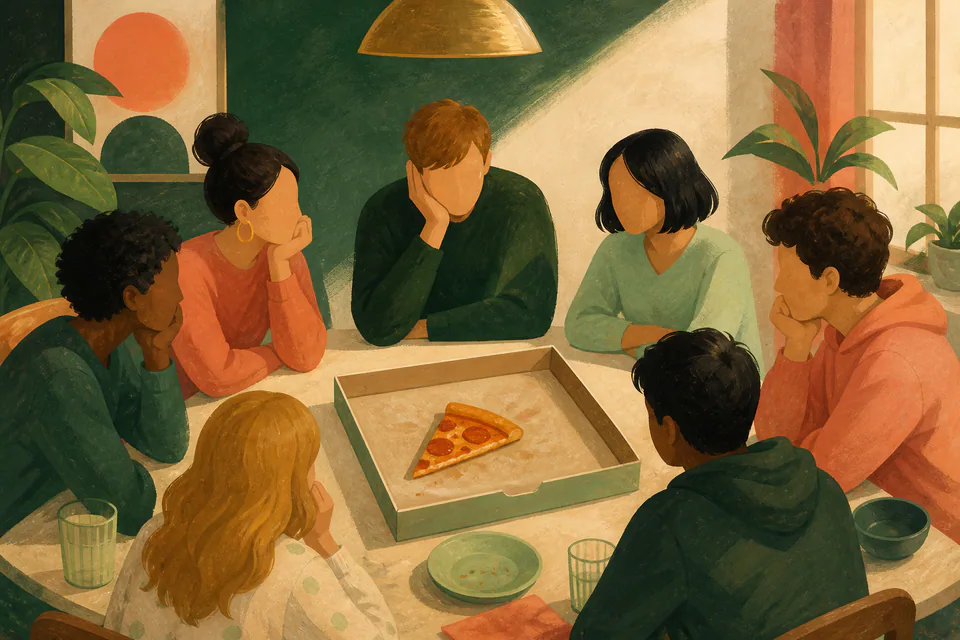
One slice of pizza remains and everyone is pretending not to want it. Can you take it?
Six friends have been circling the last slice of pizza for twenty minutes. Nobody claims it when you ask, yet two people keep glancing at the box. You are still hungry and paid the same share as everyone else.
Does politeness require leaving something that nobody will openly claim?