BN Daybreak: The hidden cost of SA's car industry support — plus Joburg finances, coalition talks
19 min
Listen through the publisher, then discuss the episode here or arrange an in-person Roundtable. Your city determines where to meet.
Roundtables are designed for groups of four, with a shared subject and room for everyone to speak. Come for discussion, with no dating expectation.
Donald MacKay explained why a Mercedes C-Class built in South Africa once sold for less in Manhattan than in Boksburg, and why he believes local buyers pay for the industry's support. William Saunderson-Meyer told Alec Hogg that whoever takes over Johannesburg inherits a city short of cash, and said the parties taking power seemed more interested in the finance portfolio than in stability. Solly Moeng argued that voters had been forgotten in the scramble for metros, and that "Keep Zille Out" was really about keeping the DA out. DA MP Nicholas Gotsell raised questions about a single supplier, a R450 price and expiry dates that vanished from police rape kits. And Reuters reported on a mixed session on Wall Street before Thanksgiving.
Episode information is provided by the publisher. Listening takes place on the publisher’s service.
1852 CHARLES MACKAY MADNESS OF CROWDS Madness of Crowds: Nvidia, AI and the Thanksgiving Market On a chilly Thanksgiving morning in New England, John Batchelor and Jim McTague, former Washington editor of Barron's, open with coastal storms across the region and the 48-hour postponement of the Macy's Thanksgiving Day Parade in New York City, with the Bullwinkle balloon grounded. From holiday weather in Lancaster County they turn to the turmoil over artificial intelligence and chip valuations. They frame it with Charles Mackay's 19th-century classic Extraordinary Popular Delusions and the Madness of Crowds, comparing today's excitement over Nvidia with Dutchtulip mania and the South Sea Bubble. McTague explains how high-frequency trading algorithms on Wall Street trade in milliseconds and get ahead of human day traders, with an estimated 98% success rate. They trace Nvidia from its founding in a diner in 1993 to its place as a tech giant. Chief executive Jensen Huang, an electrical engin
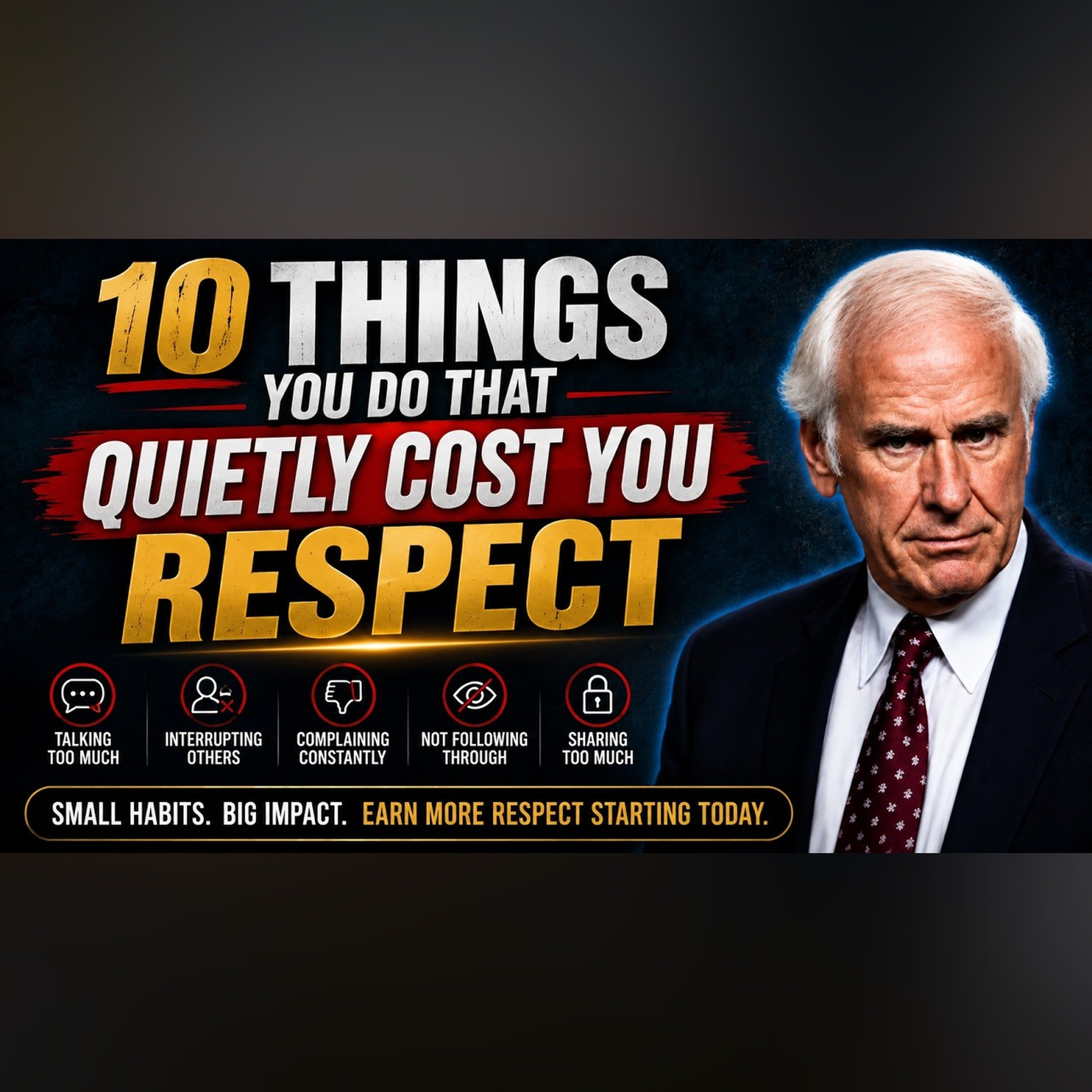
You wonder why you didn't get the promotion. You wonder why people don't take your word seriously. You wonder why your opinion carries less weight in the room than somebody who knows less than you do. Uploaded 30-08-26 Respect is earned in the small things, and it is lost in the small things. It is not built on one grand gesture. It is built on the accumulation of tiny moments where people watch how you behave and quietly decide how seriously to take you. Every time you show up late. Every time you break a small promise. Every time you complain about somebody who isn't in the room. The people around you are taking notes, and they adjust how they see you accordingly. Here is the truth: respect is not about how much you have. It is about how you behave. It is fundamentally about trust — whether people can rely on your word, your judgment, your follow-through. This seminar walks through ten things you must understand about the small habits that quietly drain the respect out of every room
If we want a greater level of peace, if we want the world to be different, it begins with choosing to be different ourselves. In this talk, Sage Robbins shares PEACE, the framework for ignited leadership that has been her North Star at home and in business. Leadership, she reminds us, isn't just in our businesses, we're all leaders, as parents, friends, and family and it's less about our words than the energy we're transmitting. Uploaded 23-08-26 The five keys: Presence (state of being over projection or performance), Embrace (holding your ground in the totality of life, not the absence of chaos), Accountability (leaning in and going first, tidying up our own internal mess), Conscious responses (catching our triggers and asking whether we're contributing to harmony or to the schism), and Extending it outward in service (empowering others to shine). None of it is about being perfect, it's about catching ourselves in real time and choosing love over fear. Because the world isn't changed
This Thanksgiving, we’re taking a break from the news for two stories about people outside the Beltway doing real good. Happy Thanksgiving, everyone. We spend most days on this show digging into the news and holding power accountable, and we’ll be right back at it soon enough. But today is a day to be grateful, so we’re doing something a little different. First, meet Cassie Aran and Lauren Lee. They’ve been best friends since kindergarten, and this fall they climbed into a pair of kids’ toy cars at Independence Hall in Philadelphia and started driving to Boston. Their average speed is about a mile and a half an hour. They’re going for a Guinness World Record for the longest journey by toy car, and they’re doing it to raise money for suicide prevention. They’ve had breakdowns, 3:30 a.m. wake-up calls and wires spliced in the middle of the woods, and they’re still going. Then, as a lot of you sit down to football, we look back at our June conversation with NFL superfan Tom Grossi. He set
Steven Major, a partner at Bennett Jones and occasional actor, joins Alberta Edge to take us behind the scenes of Alberta's six-year legal battle over the Impact Assessment Act, better known as Bill C-69. With Ottawa opting to rewrite the legislation rather than return to court, Major reflects on the challenges of gathering testimonies from industry, the competing Indigenous perspectives on resource development, and the parallels between courtroom advocacy and live theatre. From assembling an 18,000-page evidentiary record to having his carefully prepared remarks interrupted within 20 seconds, to sharing a delightful dinner with opposing counsel, Major offers a rare glimpse into the human side of a high-stakes constitutional dispute. This podcast is generously supported by Don Archibald and Mac Van Wielingen. The Hub thanks them for their ongoing support. The Hub is Canada’s fastest-growing independent digital news outlet. https://tinyurl.com/3a7zpd7e (Apple) https://tinyurl.com/y8akmf
The Petal's New Zealand edition for Thursday 26 November 2026 carries nineteen decisions newly reported from the Supreme Court, the Court of Appeal and the High Court: nine at the desks, four in a short registry. The thread is the right place for each question: doctrine stays with the church, the adjudicated debt is paid first, and a child's future is decided in the home court. Content note: two decisions arising from sexual offending against children, and a child abduction appeal, are reported as legal doctrine only, with no one identified. Public Law Desk Na'amanu v Morisa [2026] NZHC 3651 - courts decline disputes that are, at heart, ecclesiastical unless civil or property rights are engaged; a secular "no criminal record" requirement in a church constitution was not justiciable where it could not be separated from theologically informed criteria and no right of the plaintiffs was affected; declaratory relief under s 10 of the Declaratory Judgments Act 1908 would in any event have b
William Saunderson-Meyer tells Alec Hogg the Gauteng metro deals are a schlenter - legal, but a shady, fast move that buys unfair advantage. The DA topped the poll in Johannesburg, Tshwane and Ekurhuleni, yet an ANC-led pact looks set to take all three when mayors are elected on Friday, and he warns the parties will pay for ignoring voters. Solly Moeng says Witness T's halted Madlanga Commission testimony on drug syndicates inside the criminal justice system is only the tip of the iceberg. Plus a rural KZN drone startup, and JD Vance on Jensen Huang's return to Nvidia.
Every car, kettle and sheet of roofing steel South Africans buy carries a cost nobody voted for, according to trade adviser Donald MacKay. In studio with Alec Hogg, the XA Global Trade Advisors CEO explained how a Mercedes built in East London once sold for less in Manhattan than in Boksburg, and why shielding ArcelorMittal South Africa from imports had hurt the burglar-bar makers and engineering shops that employ 90% of the steel sector. He questioned why the IDC would pay around R10bn for a company the market valued at a fraction of that, with most of the money heading back to the Mittal group in Luxembourg. MacKay also traced how South Africa became a "lobby economy", from apartheid-era boardrooms to Ebrahim Patel's private deals, offered Enoch Godongwana one line for next year's Budget, and said the country was fixable, just not by the party running it.
Before a court set aside the Phala Phala panel report on Wednesday, William Saunderson-Meyer told Alec Hogg that Cyril Ramaphosa had already lost his grip on the ANC's coalition talks, and that flying to Silicon Valley while they played out was a failure of leadership. Donald MacKay asked why the state was preparing to spend about R10bn on a steelmaker the market valued at a fraction of that, and where most of the money would end up. DA MP Nicholas Gotsell described a Cape Flats police unit down to its last two rape kits after five rapes in a day, despite the minister's assurances. And Solly Moeng told Chris Steyn that voters should stop waiting for the next election to make themselves heard.
Students should help shape decisions about what and how they learn.
Share your view, then see how readers voted. No sign-in required. This poll is shared across stories.
Do you agree or disagree?
Common Quandary
A Common Quandary to discuss
Another conversation to explore, separate from this news story.
A pricey AI tutor can turn B students into A students. Should schools let them use it?
An effective AI tutor adapts to each student and dramatically improves performance, but its subscription is expensive. A public school cannot provide it to everyone and worries that allowing its use will deepen existing inequality.
Should access be limited when a beneficial tool cannot yet be shared fairly?