English-language podcasts

PBS Space Time

Can a Particle Be Neither Matter Nor a Force?

28 min

Listen through the publisher, then discuss the episode here or arrange an in-person Roundtable. Your city determines where to meet.

Roundtables are designed for groups of four, with a shared subject and room for everyone to speak. Come for discussion, with no dating expectation.

Get NordVPN 2Y plan + 4 months extra + up to 20Gb Saily data here https://nordvpn.com/spacetime It’s risk-free with Nord’s 30-day money-back guarantee! Check out the Space Time Merch Store Sign Up on Patreon to get access to the Space Time Discord! All particles belong to two large groups: fermions like protons and electrons make everything we consider "matter", while bosons like photons and gluons transmit the fundamental forces. And that about covers the universe: matter moving through space and time under the action of forces. But what if we could create particles in between these two possibilities. Physics says these neither matter nor force anyons can exist, and they may have some pretty incredible uses. They’re called anyons. PBS Member Stations rely on viewers like you. To support your local station, go to:http://to.pbs.org/DonateSPACE Sign up for the mailing list to get episode notifications and hear special announcements! Search the Entire Space Time Library Here: https://search.pbsspacetime.com/ Hosted by Matt O'Dowd Written by Fernando Franco Félix & Matt O'Dowd Post Production by Leonardo Scholzer, Yago Ballarini & Stephanie Faria Directed by Andrew Kornhaber Associate Producer: Bahar Gholipour Executive Producers: Eric Brown & Andrew Kornhaber Executive in Charge for PBS: Maribel Lopez Director of Programming for PBS: Gabrielle Ewing Assistant Director of Programming for PBS: John Campbell Spacetime is a production of Kornhaber Brown for PBS Digital Studios. This program is produced by Kornhaber Brown, which is solely responsible for its content. © 2024 PBS. All rights reserved. End Credits Music by J.R.S. Schattenberg: https://www.youtube.com/user/MultiDroideka Space Time Was Made Possible In Part By: Big Bang Sponsors First Principles Foundation John Sronce Bryce Fort Peter Barrett David Neumann Alexander Tamas Morgan Hough Juan Benet Vinnie Falco Mark Rosenthal Quasar Sponsors Grace Biaelcki Glenn Sugden Ethan Cohen Stephen Wilcox J. Tyacke Mark Heising Hypernova Sponsors Michael Tidwell Chris Webb David Giltinan Ivari Tölp Kenneth See Gregory Forfa Alex Kern Bradley Voorhees Scott Gorlick Paul Stehr-Green Ben Delo Scott Gray Антон Кочков Robert Ilardi John R. Slavik Donal Botkin Edmund Fokschaner Chuck Zegar Daniel Muzquiz Gamma Ray Burst Sponsors Neil Moore Robin Sur Arko Provo Mukherjee Mike Purvis Christopher Wade Anthony Crossland Grace Seraph Parliament Stephen Saslow Robert DeChellis Tomaz Lovsin Anthony Leon Leonardo Schulthais Senna Lori Ferris Dennis Van Hoof Koen Wilde Nicolas Katsantonis Joe Pavlovic Justin Lloyd Chuck Lukaszewski Cole B Combs Andrea Galvagni Jerry Thomas Nikhil Sharma John Anderson Bradley Ulis Craig Falls Kane Holbrook Ross Story Teng Guo Harsh Khandhadia Matt Quinn Michael Lev Rad Antonov Terje Vold James Trimmier Jeremy Soller Paul Wood Kent Durham Jim Bartosh John H. Austin, Jr. Diana S Faraz Khan Almog Cohen Daniel Jennings Russ Creech Jeremy Reed David Johnston Michael Barton Isaac Suttell Oliver Flanagan Bleys Goodson Mark Delagasse Mark Daniel Cohen Shane Calimlim Tybie Fitzhugh Eric Kiebler Craig Stonaha Frederic Simon John Robinson Jim Hudson Alex Gan John Funai Adrien Molyneux Bradley Jenkins Amy Hickman Vlad Shipulin Thomas Dougherty King Zeckendorff Dan Warren Joseph Salomone Patrick Sutton Julien Dubois

Episode information is provided by the publisher. Listening takes place on the publisher’s service.

Listen at the source ↗

Featured places to meet in Palo Alto, CA

Explore these places and arrange a conversation through ThinkMatch.

City guide for Palo Alto, CA

More from PBS Space Time

PBS Space Time

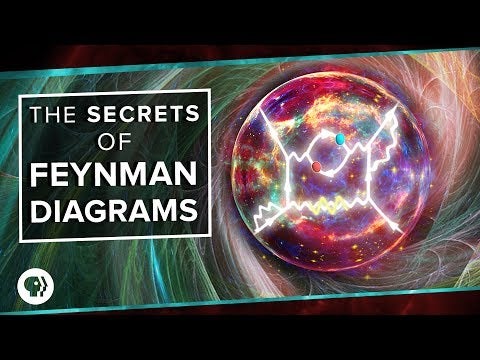
The Secrets of Feynman Diagrams

19 min

Viewers like you help make PBS (Thank you ) . Support your local PBS Member Station here: https://to.pbs.org/DonateSPACE Uploaded 26-07-17 Unlock the secrets of Feynman Diagrams. Part 5 in our Quantum Field Theory series. And if you're submitting an answer to our challenge question email your answer by August 2nd to pbsspacetime [AT] gmail.com with the subject line "Feynman Diagram Challenge." You can further support us on Patreon at https://www.patreon.com/pbsspacetime Get your own Space Time t­shirt at http://bit.ly/1QlzoBi Tweet at us! @pbsspacetime Facebook: facebook.com/pbsspacetime Email us! pbsspacetime [at] gmail [dot] com Comment on Reddit: http://www.reddit.com/r/pbsspacetime Help translate our videos! https://www.youtube.com/timedtext_cs_... Previous Episode: The Real Star Wars Feynman’s path integral shows us that, to properly calculate the probability of a particle traveling from point A to point B, we need to add up the contributions from all conceivable paths between tho

Discuss this episode

PBS Space Time

How Vacuum Decay Would Destroy The Universe

17 min

Sign Up on Patreon to get access to the Space Time Discord! Uploaded 18-08-21 The universe is going to end. But of all the possible ends of the universe vacuum decay would have to be the most thorough - because it could totally rewrite the laws of physics. Today I hope to help you understand exactly how terrified you should be. Check out the Space Time Merch Store Sign up for the mailing list to get episode notifications and hear special announcements! Hosted by Matt O'Dowd Written by Matt O'Dowd Graphics by Leonardo Scholzer, Yago Ballarini, Pedro Osinski, Adriano Leal and Stephanie Faria GFX Visualizations: Ajay Manuel Directed by Andrew Kornhaber Assistant Producer: Setare Gholipour Executive Producers: Eric Brown and Andrew Kornhaber End Credits Music by J.R.S. Schattenberg: https://www.youtube.com/user/MultiDroideka Special thanks to Our Patreon Sponsors Big Bang Supporters Ari Paul Kyle Bulloch Charlie Mrs. Tiffany Poindexter Leo Koguan Sandy Wu Matthew Miller Scott Gray Ahmad Jo

Discuss this episode

PBS Space Time

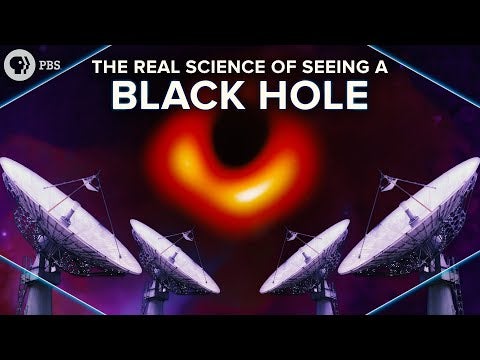
The Real Science of the EHT Black Hole

16 min

You can learn more about CuriosityStream at https://curiositystream.com/spacetime Uploaded 01-05-19 PBS Member Stations rely on viewers like you. To support your local station, go to: http://to.pbs.org/DonateSPACE How do you take a picture of a black hole and what can we learn from it? Our first ever actual bona fide photo of a black hole, made by the Event Horizon Telescope and revealed to the world in a press conference on April 10th. Since then it’s got plenty of coverage, because … I mean look at it. It’s a freaking black hole. It’s black, it’s holey, it’s everything we hoped it would be. Now that the giddiness has subsided and I personally have stopped spending hours on end staring at a black spot, we can take a breath and actually look at the real science here and discuss exactly how a picture like this could be taken and what we can learn from it. Check out the new Space Time Merch Store! Support Space Time on Patreon Need a Black Hole Refresher #Blackhole #astrophysics #spaceti

Discuss this episode

Community Poll

Public contracts should consider quality and reliability, even when the lowest bid costs less.

Share your view, then see how readers voted. No sign-in required. This poll is shared across stories.

Do you agree or disagree?

Choose one answer

Common Quandary

A Common Quandary to discuss

Another conversation to explore, separate from this news story.

The mayor is excellent at the job—and secretly cheating on a spouse. Is that news?

A local official is effective, honest in office, and privately having an affair. A journalist can verify it but finds no misuse of public resources or direct connection to official duties.

Does private dishonesty reveal something citizens are entitled to judge?

Explore this quandary