Listen through the publisher, then discuss the episode here or arrange an in-person Roundtable. Your city determines where to meet.
Roundtables are designed for groups of four, with a shared subject and room for everyone to speak. Come for discussion, with no dating expectation.
PBS Member Stations rely on viewers like you. To support your local station, go to: http://to.pbs.org/DonateSPACE ↓ More info below ↓ Uploaded 18-11-19 Sign Up on Patreon to get access to the Space Time Discord! Check out the Space Time Merch Store The moment you started observing reality, you hopelessly polluted any conclusions you might make about it. The anthropic principle guarantees that you are NOT seeing the universe in most typical state. But used correctly, this highly controversial idea can be extremely powerful. So, how do you correctly use the anthropic principle? Hosted by Matt O'Dowd Written by Matt O'Dowd Graphics by Leonardo Scholzer and Adriano Leal Directed by: Andrew Kornhaber Executive Producers: Eric Brown and Andrew Kornhaber End Credits Music by J.R.S. Schattenberg: https://www.youtube.com/channel/UCRl6-nb4iOnsij-vnpAjp0Q Special Thanks to Dr. Flournoy!!! Check out his lectures Below: Particle Physics: https://www.youtube.com/playlist?list=PLDlWMHnDwylijo0yfs3xUN9ad6-YZjPLT General Relativity: https://www.youtube.com/playlist?list=PLDlWMHnDwyliMevB36wgRbjXhJkoN_RUQ According to the original definitions by Brandon Carter, the weak anthropic principle states that we must live in a place and time in the universe capable of supporting observers - in our case, a habitable biosphere, and the strong anthropic principle, which states that the universe itself must have the conditions necessary for producing environments that, in turn, produce observers. That means the fundamental constants and initial conditions of the universe must be just right to allow nice habitable planets to one day form. Let’s just call it the anthropic principle: we necessarily observe from an environment capable of producing observers; be that environment a planet within a universe or a universe within a multiverse. Thanks to Our Patreon Supporters Big Bang Supporters: Alex Flournoy Alexander Tamas Craig Stonaha David Barnholdt David Nicklas Fabrice Eap John S Juan Benet matt miller Morgan Hough Quasar Supporters Mark Heising Mark Rosenthal Vinnie Falco Hypernova Supporters chuck zegar Danton Spivey Donal Botkin Edmund Fokschaner Hank S John Hofmann John R. Slavik Jordan Young Joseph Salomone Mathew Matthew O'Connor Syed Ansar Timothy McCulloch
Episode information is provided by the publisher. Listening takes place on the publisher’s service.
Explore the phenomenon known as peat fires, smoldering fires that burn underground and can continue for months or even years. -- In 1997, a fire began in Indonesia that would rage for almost a year. Despite being one of the largest fires in recorded history, for months at a time it burned without a flame. This might sound like a uniquely freaky fire, but it’s actually one of many. So, is it possible to snuff out these bizarre blazes? And how do they form in the first place? Emma Bryce explores the phenomenon of peat fires. Lesson by Emma Bryce, directed by Ivana Volda. A special thanks to Guillermo Rein who provided information and insights for the development of this video. Support Our Non-Profit Mission ---------------------------------------------- Support us on Patreon: http://bit.ly/TEDEdPatreon Check out our merch: http://bit.ly/TEDEDShop ---------------------------------------------- Connect With Us ---------------------------------------------- Sign up for our newsletter: http:
Explore how the Hubble Space Telescope reveals the Universe, from iconic images to major discoveries, and how it complements the James Webb Space Telescope. "ASTROMAN: the Dark Sky Guardian" is a podcast channel that aims to explore popular science in multiple disciplines and research on interdisciplinary approaches, such as sustainability, dark-sky protection, astrophotography, space exploration, astronomy innovation, inclusive science communication, and STEAM Education by integrating science and arts. Exodus Chun-Long Sit, also known as the ASTROMAN, is a transmedia astronomy educator, popular science author, STEAM educator, and science communicator in Hong Kong. He is recently the National Astronomy Education Coordinator (Chair of Hong Kong, China) of the International Astronomical Union and President of Starrix. He was also an International Committee Member of the Dark Sky International, regularly organizing public lectures at the Hong Kong Space Museum and the Hong Kong Science Mu
Scientists are rethinking how particles behave when moving at extreme speeds through matter. New research into quark-gluon plasma, the exotic fluid that existed moments after the Big Bang, reveals unexpected patterns in particle motion that challenge traditional physical models. The findings could offer a powerful new way to investigate the properties of the universe’s earliest matter. This episode includes AI-generated content.
In this video, Disability Attorney Walter Hnot of the Disability Resolution Law Firm goes over a comparison between an original 1959 Fender tweed champ, and the ValveTrain 205c tweed amp. America’s Most Viewed Social Security Disability Attorney Like the content? Review us here: https://g.page/r/CcwyektC7nCPEAg/review . If the link does not work, Google: Disability Resolution, P.A. Welcome to the largest Social Security Disability Tutorial Video Library On Earth. PRIVATE ONE HOUR SESSION PHONE CALL THIS IS HOW YOU CAN GIVE BACK TO HELP GROW THE CAUSE: Option 1: Leave 5 |==================5 STAR REVIEWS==================| Google (Search Disability Resolution Orlando, FL)- https://www.google.com/search?authuse... (https://www.google.com/search?authuse...=) AVVO (Search Walter Hnot) - https://www.avvo.com/attorneys/32817-... BBB (Search Disability Resolution Orlando, FL)- https://www.bbb.org/us/fl/orlando/pro... MARTINDALE (Search Walter Hnot Orlando, FL) - https://www.martindale.com/atto
Access the masterclass instantly for free: https://nci.university/learn Uploaded 10-01-26 Your goals don’t fail because you lack discipline — they fail because they were aimed at the wrong system. Optimizing behavior without fixing brain chemistry is like issuing commands to a damaged machine. Until the chemical environment is right, effort just increases friction and burnout. All goals live in the conscious mind — but control does not. Real behavior is governed by the mammalian brain, the ancient systems that decide safety, threat, and energy allocation. Every resolution collapses when those lower systems detect risk, even if you consciously “want” the outcome. Goal-setting ignores this hierarchy — and that’s why it keeps failing. Once you target the parts of the brain actually in charge, change stops feeling like force. Discipline becomes unnecessary when the system itself is aligned. Please note that the content provided in this broadcast is for informational and educational purpose
Wake Up Early, Start Your Day Right – Jim Rohn Motivation #jimrohn #motivation #success #mindset #morningroutine #selfdiscipline ► Speaker: Jim Rohn (AI Voiceover by Jim Rohn Academy) How you start your day determines how you live your life. The most successful people don’t wake up late and rush through their mornings—they rise early, take control, and set the tone for success. Jim Rohn’s powerful wisdom teaches us the importance of a strong morning routine, discipline, and maximizing every day. If you want to change your life, start by changing how you start your mornings. Uploaded 09-03-25 Key Topics Covered: The Power of Waking Up Early: Why early risers achieve more. Morning Habits for Success: Simple routines that transform your mindset. How to Build Discipline: Creating habits that lead to long-term success. The Importance of a Strong Start: How your mornings shape your entire day. How to Stay Motivated Daily: Setting the right tone from the moment you wake up. This isn’t just mo
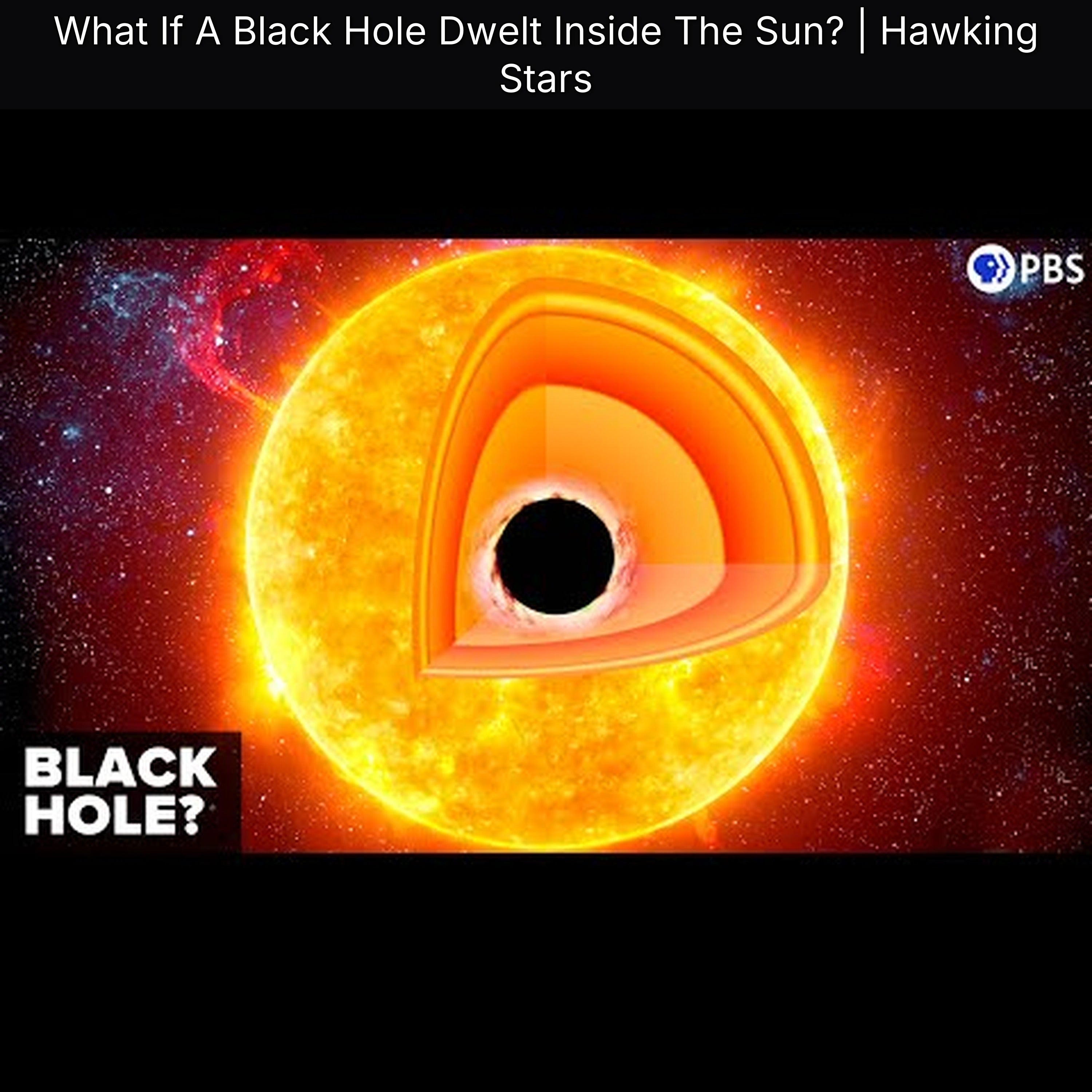
PBS Member Stations rely on viewers like you. To support your local station, go to:http://to.pbs.org/DonateSPACE Sign Up on Patreon to get access to the Space Time Discord! A fun nightmare sci-fi scenario is the sun being consumed by a black hole. Fortunately the chance of a black hole randomly wandering into our solar system is pretty tiny. That’s good news. But what if it’s already here, hiding in the core of the Sun and slowly eating it from the inside out? Hawking Stars Journal Papers: Search the Entire Space Time Library Here: https://search.pbsspacetime.com/ Hosted by Matt O'Dowd Written by Matt Caplan & Matt O'Dowd Post Production by Leonardo Scholzer, Yago Ballarini & Stephanie Faria Directed by Andrew Kornhaber Associate Producer: Bahar Gholipour Executive Producers: Eric Brown & Andrew Kornhaber Executive in Charge for PBS: Maribel Lopez Director of Programming for PBS: Gabrielle Ewing Assistant Director of Programming for PBS: John Campbell Spacetime is produced by Kornhaber
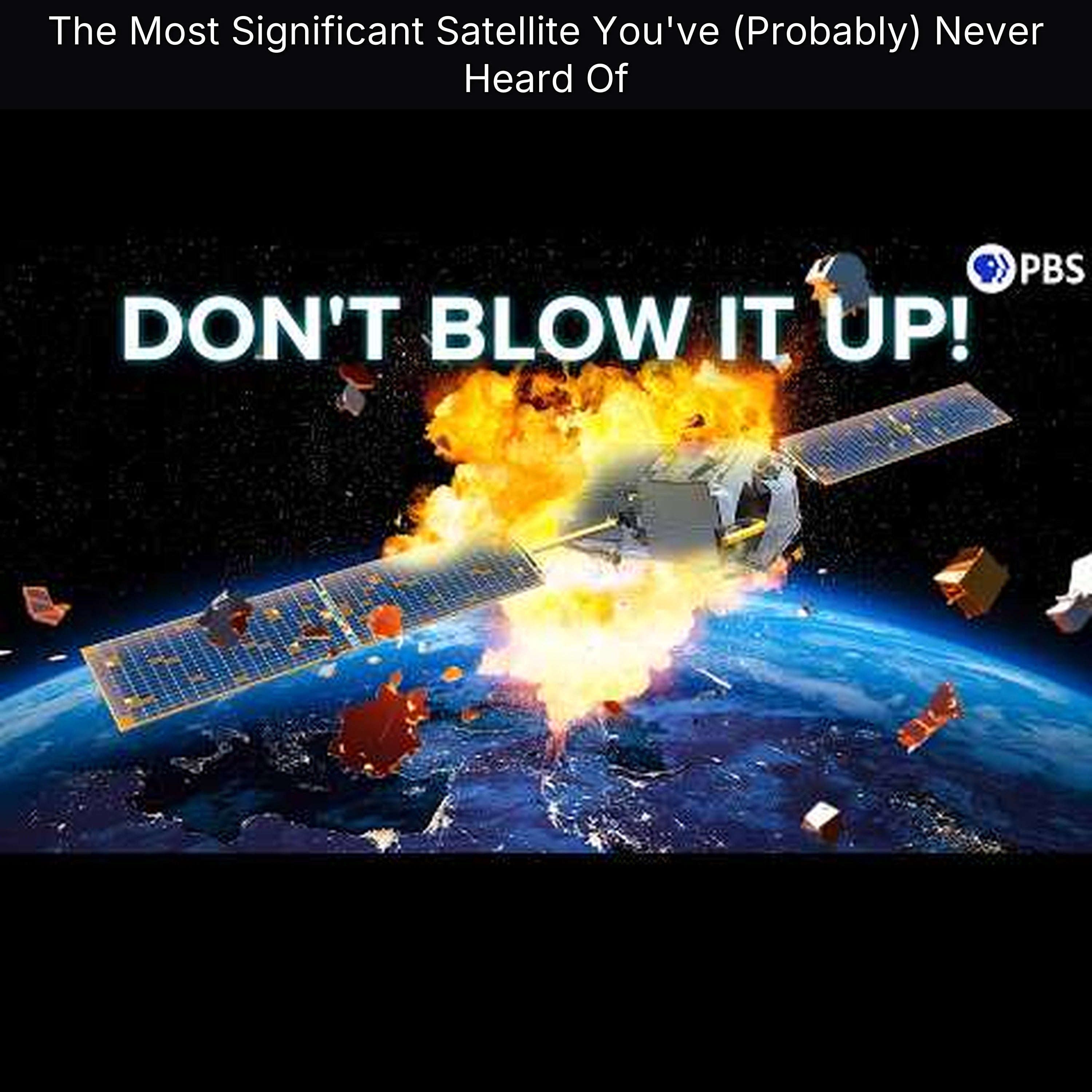
Remove your personal information from the web at https://joindeleteme.com/SPACETIME One of the most important reasons we go to space is to know our own planet better. Today I'm going to tell you about an orbiting facility that literally watches Earth's biosphere breath and grow and die with incredible resolution. I'll talk about its profound existential and economic importance, and about why it's in danger of being lost. PBS Member Stations rely on viewers like you. To support your local station, go to:http://to.pbs.org/DonateSPACE Sign Up on Patreon to get access to the Space Time Discord! Check out the Space Time Merch Store Pale Blue Dot By Carl Sagan Search the Entire Space Time Library Here: https://search.pbsspacetime.com/ Hosted by Matt O'Dowd Written by Fernando Franco Félix & Matt O'Dowd Post Production by Leonardo Scholzer, Yago Ballarini & Stephanie Faria Directed by Andrew Kornhaber Associate Producer: Bahar Gholipour Executive Producer: Andrew Kornhaber Executive in Charge
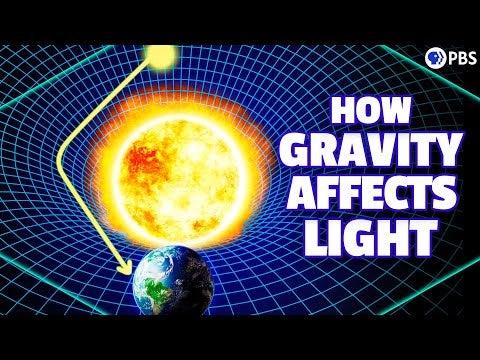
PBS Member Stations rely on viewers like you. To support your local station, go to: http://to.pbs.org/DonateSPACE ↓ More info below ↓ Uploaded 09-03-21 We know that gravity exerts its pull on light, and we have an explanation for why. Actually, we have multiple explanations that all predict the same thing. And at first glance, these explanations seem to describe completely different causes. So what is the true connection between light and gravity, or is truth, in fact, entirely relative? Sabine Hossenfelder's episode "Do we travel through time at the speed of light?" Check out the Space Time Merch Store Hosted by Matt O'Dowd Written by Matt O'Dowd Graphics by Leonardo Scholzer, Yago Ballarini, Pedro Osinski, Adriano Leal and Stephanie Faria GFX Visualizations: Katherine Kornei Directed by Andrew Kornhaber Assistant Producer: Setare Gholipour Executive Producers: Eric Brown and Andrew Kornhaber "FREE GMC Motorhome reimagined low poly" (https://skfb.ly/6XxAN) by Karol Miklas is licensed
Local gatherings should prioritize relationships over attendance numbers.
Share your view, then see how readers voted. No sign-in required. This poll is shared across stories.
Do you agree or disagree?
Common Quandary
A Common Quandary to discuss
Another conversation to explore, separate from this news story.
Your carry-on fits only if you sit on it. Do you try the airport sizer?
Your suitcase is slightly larger than the airline allows, although it has fit overhead on previous flights. Checking it costs extra and risks missing a connection. Other passengers have equally questionable bags and staff are checking inconsistently.
Does uneven enforcement weaken a traveler's duty to follow the rule?