In today's brief: A fingerprint on Mars: NASA's HiRISE camera finds bright boulders lined up in long curving rows on Daedalia Planum, a pattern seen nowhere else on the planet. The light that wasn't Venus: a reader's predawn photo shows Venus and six stars, plus a seventh light no catalog can name. Curses to kill a god: 40 pierced, charred fragments of the 3,400-year-old Apophis ritual turn up in temple rubbish dumps at Thebes. Drawing near-death: 50 people sketched their near-death experiences, and the scenes fell into three shapes. An impossible eruption: the deepest explosive volcanic flow ever found, 6,000 metres down in the Challenger Deep. The Shroud's DNA: a new study finds people, animals, coral and crops on the Shroud of Turin. Quick hits: a Utah motorist's alien sighting, a one-horned "unicorn" deer in Estonia, the cats of Beni Hassan, and the Pentagon's next UFO file release. Every story and source: https://believepod.com/ufo-paranormal-news-26-november-2026/ New episodes ev
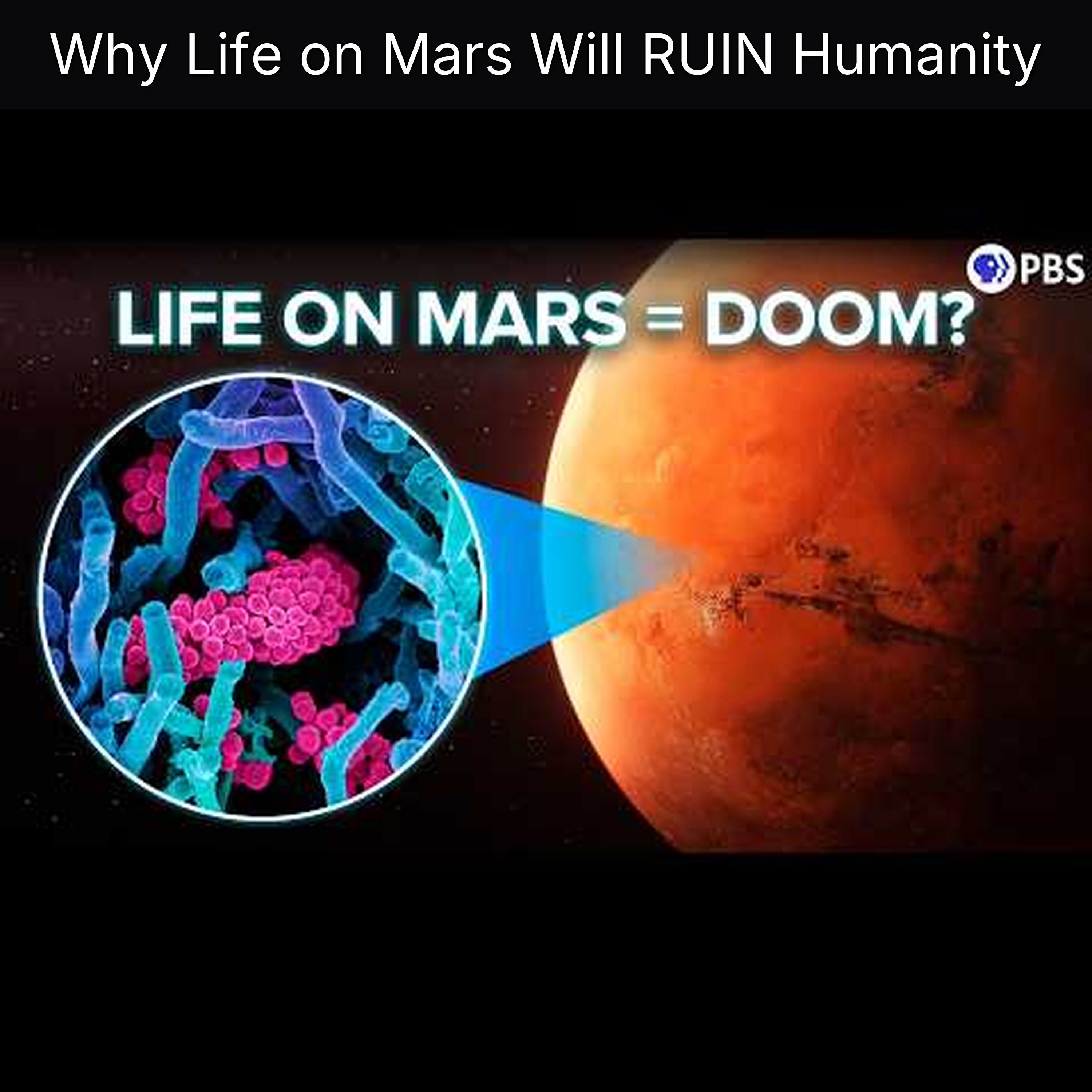
Recent findings have brought us closer than we’ve ever been to confirming life beyond the Earth. As we wait for confirmation or otherwise, let’s think about what this will tell us about life everywhere, and also about our own imminent destruction. Sign Up on Patreon to get access to the Space Time Discord! Check out the Space Time Merch Store Sign up for the mailing list to get episode notifications and hear special announcements! Search the Entire Space Time Library Here: https://search.pbsspacetime.com/ Hosted by Matt O'Dowd Written by Matt O'Dowd Post Production by Leonardo Scholzer, Yago Ballarini & Stephanie Faria Directed by Andrew Kornhaber Associate Producer: Bahar Gholipour Executive Producer: Andrew Kornhaber Executive in Charge for PBS: Maribel Lopez Director of Programming for PBS: Gabrielle Ewing Assistant Director of Programming for PBS: John Campbell Spacetime is a production of Kornhaber Brown for PBS Digital Studios. This program is produced by Kornhaber Brown, which i
Do you want to know the FASTEST way to END SUFFERING? It’s actually very simple... Do this every day and your WHOLE WORLD will change in an instant. Uploaded 29-06-21 Learn the tools you need to turn this around: Prime Your Brain to STOP Suffering - https://youtu.be/60ROjGMqXUQ FULL Priming Routine Tony Uses Daily to Succeed In Life - https://youtu.be/faTGTgid8Uc The Proven HAPPINESS Formula You Need Now - https://youtu.be/AL7Cb2O6Lhk I truly believe that we’re living in the greatest time in HISTORY — creativity, innovation, and opportunity exist like never before. We’re blessed to live in an abundant time, where so many of our desires are met instantly — at the touch of a button, the click of your mouse, the swipe of your thumb. Social media links us to people all over the world — we can count the number of “friends,” and we get a dopamine boost with every , ️, or . The crazy thing is, that most of us believe that kind of instant gratification = happiness. But what we’re really experi
Access the masterclass instantly for free: https://nci.university/learn Uploaded 10-01-26 Your goals don’t fail because you lack discipline — they fail because they were aimed at the wrong system. Optimizing behavior without fixing brain chemistry is like issuing commands to a damaged machine. Until the chemical environment is right, effort just increases friction and burnout. All goals live in the conscious mind — but control does not. Real behavior is governed by the mammalian brain, the ancient systems that decide safety, threat, and energy allocation. Every resolution collapses when those lower systems detect risk, even if you consciously “want” the outcome. Goal-setting ignores this hierarchy — and that’s why it keeps failing. Once you target the parts of the brain actually in charge, change stops feeling like force. Discipline becomes unnecessary when the system itself is aligned. Please note that the content provided in this broadcast is for informational and educational purpose
What if your child already loves learning... and you’re just looking for it in the wrong place? This week, I’m exploring one of the questions I get asked more than almost any other: “My child used to be so curious. What happened?” In today’s episode, I challenge one of the biggest myths in modern parenting: that a love of learning looks like a child happily reading, sitting at a desk, completing homework without complaint, and engaging enthusiastically with educational activities. I explain what the research actually tells us and walk you through the psychology of curiosity, the science of intrinsic motivation, why children become obsessed with Minecraft, dinosaurs, trains, or random facts, and why those interests may be far more important than they appear. I also unpack why children seem to have a built‑in radar for anything that feels educational, why homework battles happen so often, and what the evidence really says about homework in the primary years. If you've ever worried that y
Anthropic makes it easier to turn “Artifacts” into apps, and NASA gets ready to send a nuclear fission reactor to Mars. Starring Tom Merritt and Huyen Tue Dao. Links to stories discussed in this episode can be found here (https://dailytechnewsshow.com/2026/11/25/anthropic-can-output-as-an-app-dtns-5402/). Hosted on Acast.
Dig into the slippery slope fallacy, which assumes that one step will lead to a series of events that lead to an extreme— often bad— scenario. Uploaded 19-08-21 -- It’s 1954. Vietnamese nationalists are on the verge of securing an independent Vietnam under communist leader Ho Chi Minh. U.S. President Eisenhower claims that by virtue of the "falling domino principle," communist control of Vietnam would lead to the global spread of authoritarian communist regimes. Can you spot the problem with this argument? Elizabeth Cox explores the slippery slope fallacy. Lesson by Elizabeth Cox, directed by TOGETHER. Support Our Non-Profit Mission ---------------------------------------------- Support us on Patreon: http://bit.ly/TEDEdPatreon Check out our merch: http://bit.ly/TEDEDShop ---------------------------------------------- Connect With Us ---------------------------------------------- Sign up for our newsletter: http://bit.ly/TEDEdNewsletter Find us on Twitter: http://bit.ly/TEDEdTwitter Pe
View full lesson: http://ed.ted.com/lessons/how-do-we-measure-distances-in-space-yuan-sen-ting Uploaded 09-10-14 When we look at the sky, we have a flat, two-dimensional view. So how do astronomers figure the distances of stars and galaxies from Earth? Yuan-Sen Ting shows us how trigonometric parallaxes, standard candles and more help us determine the distance of objects several billion light years away from Earth. Lesson by Yuan-Sen Ting, animation by TED-Ed.
As machines take on more jobs, many find themselves out of work or with raises indefinitely postponed. Is this the end of growth? No, says Erik Brynjolfsson -- it's simply the growing pains of a radically reorganized economy. A riveting case for why big innovations are ahead of us ... if we think of computers as our teammates. Be sure to watch the opposing viewpoint from Robert Gordon. Uploaded 30-08-13 Talk by Erik Brynjolfsson.
Private companies delivering public services should face the same transparency duties as public agencies.
Share your view, then see how readers voted. No sign-in required. This poll is shared across stories.
Do you agree or disagree?
Common Quandary
A Common Quandary to discuss
Another conversation to explore, separate from this news story.
The best garden plot has been abandoned for months. Who gets to take it?
Garden plots have a three-year waiting list. One member's plot has gone untended for months and messages go unanswered, but other gardeners know they recently faced serious health problems.
How long should a shared resource remain reserved out of compassion?