Listen through the publisher, then discuss the episode here or arrange an in-person Roundtable. Your city determines where to meet.
Roundtables are designed for groups of four, with a shared subject and room for everyone to speak. Come for discussion, with no dating expectation.
Day 59: Rosh Hashanah From a dispute over Yom Kippur to calendars drawn up in concentration camps, Jews keep finding ways to mark the months together. Click here to learn more (https://talmuddaily.org/give/). We really do want to hear from you! Learn more about 18Forty (https://18forty.org/) Sign up for the 18Forty Newsletter (https://18forty.org/join/)
Episode information is provided by the publisher. Listening takes place on the publisher’s service.
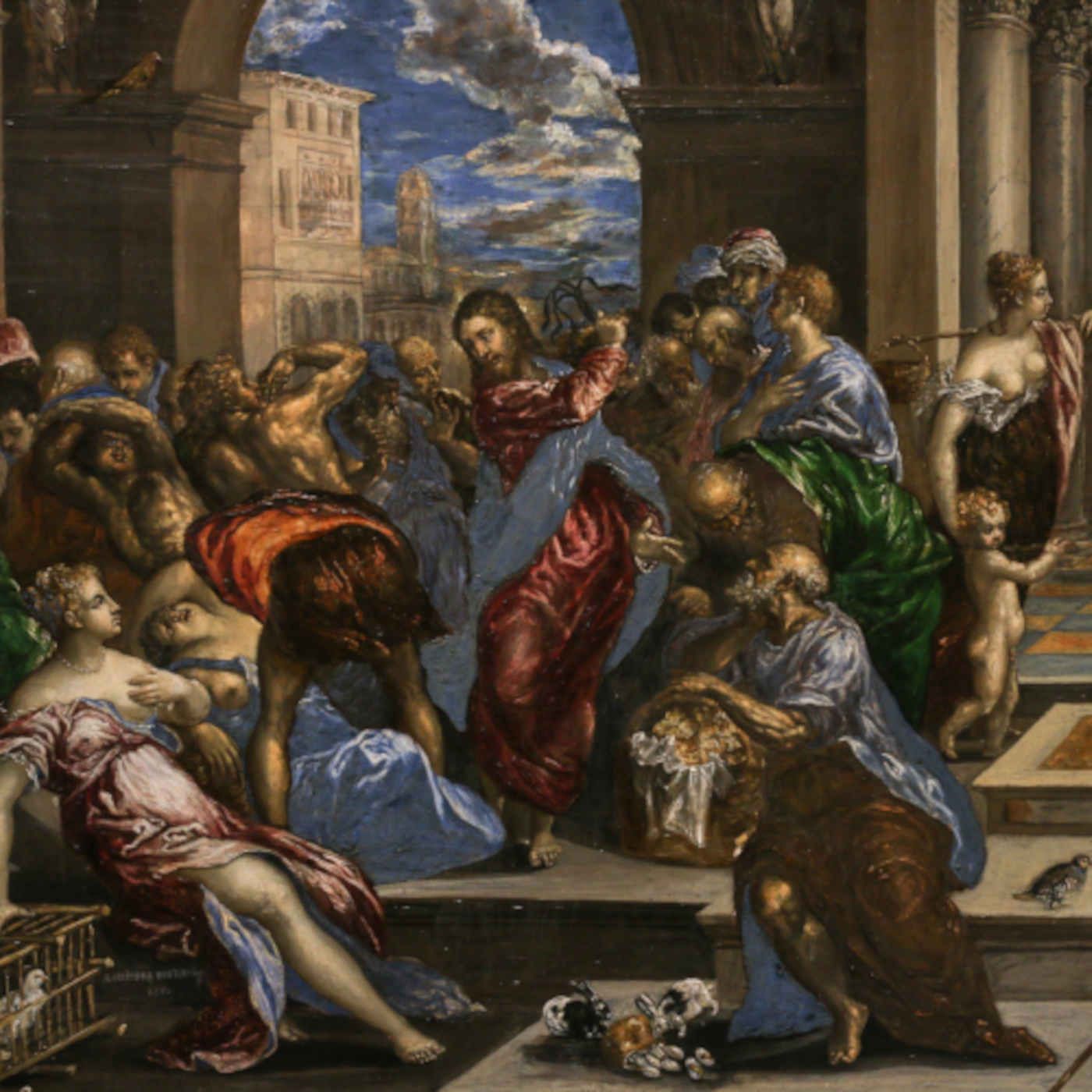
Read Online (https://catholic-daily-reflections.com/2026/11/19/restoring-sacred-worship/) Restoring Sacred Worship Jesus entered the temple area and proceeded to drive out those who were selling things, saying to them, “It is written, My house shall be a house of prayer, but you have made it a den of thieves.” And every day he was teaching in the temple area. Luke 19:45–47 Today’s Gospel opens what is arguably the most dramatic and consequential week in human history. Jesus arrives in Jerusalem for the weeklong Feast of Passover, welcomed with jubilation by the crowds who had become His disciples over the previous three years of public ministry. The city is alive with expectation. Many wonder if this is the moment He will assert His Kingship and restore the United Kingdom of Israel. However, on the first day of the feast, Jesus takes a startling action: He enters the Temple and drives out the merchants, rebuking them for turning His Father’s house into a “den of thieves.” Passover was
Good morning, “I’m the king, and she’s my queen… she doesn’t get to usurp the throne.” Not words from a Shakespearian tragedy, but the words of Aaron Edwards, the Christian theologian and father of seven who features in a new documentary on the BBC this week. Edwards and his wife Molly are one of the families in filmmaker Poppy Jay’s Young British and Tradwife, exploring women embracing traditional gender roles, often showcased on Instagram. For some, this is more than a choice to stay at home rather than go to work – feminism’s aim was to give women choice, after all. But rather for some it’s also a belief rooted in their reading of the Bible that wives should submit to their husbands. As a Christian feminist, I won’t get into the debate here, but what struck me was how questions of sovereignty, submission and power are finding their ways into much of our public debate. In the home, in the Church, in the nation, in our politics, we’re asking: who exactly is in charge? Who should submi
This is a Grave Talks CLASSIC EPISODE! PART TWO Steve and Judy Skinner weren’t searching for a dream home. They were searching for a haunted one. After a paranormal experience in Eureka Springs changed the way they viewed the unexplained, the lifelong skeptics decided they wanted answers. For Steve, a doctor with a scientific mindset, that meant finding a place where paranormal activity could be studied firsthand—without outside influence or manipulation. In 2018, they found exactly what they were looking for in the small town of Brumley: the infamous Haunted Castle House. The home’s violent history, tragic past, and reputation for intense paranormal activity quickly proved this was no ordinary house. Apparitions, unexplained voices, knocks, shadows, and eerie encounters soon became part of everyday life inside what many now call the “Most Haunted House in the Midwest.” Dr. Steve Skinner shares what really happens inside the Haunted Castle House—and why some mysteries refuse to stay bu
An 18-year-old at Columbia wrote a rebuttal defending Jane Austen, and her teaching assistant was livid. Thomas Mann went unmentioned in her four years there, not even once. And she says literary circles don't like Dostoevsky, because he points readers toward faith. Liza Libes on what happened to the study of great literature.Liza talks about growing up on Russian classics in a Soviet-immigrant home, Edward Said and Cloud Nine at Columbia, why she found 2026 Nobel laureate Anne Carson's poetry empty, Cormac McCarthy being mocked in MFA classrooms, and why authors like Dostoevsky, T.S. Eliot, Thomas Mann and Vladimir Nabokov still point readers toward beauty and redemption.Liza Libes is an author, poet and the founder of Pens and Poison (pensandpoison.org), her Substack, YouTube channel, Instagram and podcast dedicated to restoring literature as an art form. She holds a BA and MA in English and Comparative Literature from Columbia University and is the founder and CEO of Invictus Prep.
Money. Validation. Likes. Who you're “supposed” to be. What if the things you've been chasing are actually blocking your manifestations? Human Design expert Jenna Zoe joins Lacy and Jessica to explore how to manifest in the new paradigm, where the gap between cause and effect is shrinking and the universe is clearing away anything that isn’t soul-driven. Jenna explains passenger consciousness, why you can’t solve everything with your mind, and how being radically honest with yourself (even about the job, home, or relationship you’re questioning) allows life to redirect you before you hit rock bottom. Together, they explore the four transformations in Human Design: digestion, environment, perspective, and motivation. Jenna shares how your perspective can reveal what's pulling you off your path, why your personal frequency matters more than productivity, and how to use your strategy and authority to tap into your intuition. Plus, Lacy has a live aha moment about where her soul is guiding
What if God's love for you isn't merely an abstract theology, but the relentless, heartbreaking devotion of a faithful spouse refusing to walk away from an unfaithful partner? In Hosea and Joel, we meet two prophets whose words cut through the noise of superficial religion. Through an astonishing marriage that mirrors the covenant and apocalyptic visions of swarming locusts, the Lord reveals how He transforms our "No Mercy" into everlasting lovingkindness. Summary: In this poignant study of Hosea and Joel, we launch into the Minor Prophets, discovering why the Lord raises up prophetic witnesses during seasons of acute political, social, and spiritual collapse. While Isaiah spoke in majestic poetry and Jeremiah endured public stocks, Hosea's very home became the message. Paired with Joel's piercing trumpet blasts toward the Day of the Lord, these books offer a roadmap back to intimate covenant connection. An Emodied Parable of Mercy: In Hosea 1–3, Hosea is commanded to marry Gomer and t
Day 65 | Taanis Rabbi Shmuel Silber turns to the shiva house, Tisha B’Av, and Rabbi Akiva’s laughter at the ruins of Jerusalem to explore how Jews carry grief and make room for hope. Click here to learn more (https://talmuddaily.org/give/). We really do want to hear from you! Learn more about 18Forty (https://18forty.org/) Sign up for the 18Forty Newsletter (https://18forty.org/join/)
Day 64 | Taanis From the droughts of Tractate Taanis to the cholera outbreaks of the nineteenth century, how have Jews prayed, protected life, and kept learning Torah in times of crisis? Click here to learn more (https://talmuddaily.org/give/). We really do want to hear from you! Learn more about 18Forty (https://18forty.org/) Sign up for the 18Forty Newsletter (https://18forty.org/join/)
Day 63: Taanis Taanis offers three ways to meet a crisis while the outcome is still uncertain. A Jew can turn to God in prayer, share in another person’s grief, and look for one good deed within reach. Today's learning is sponsored by Pia & Raphael Bildirici. Click here to learn more (https://talmuddaily.org/give/). We really do want to hear from you! Learn more about 18Forty (https://18forty.org/) Sign up for the 18Forty Newsletter (https://18forty.org/join/)
Long-term environmental commitments should require public review before a new government abandons them.
Share your view, then see how readers voted. No sign-in required. This poll is shared across stories.
Do you agree or disagree?
Common Quandary
A Common Quandary to discuss
Another conversation to explore, separate from this news story.
One coffee, four hours, last table. Can the café ask you to leave?
A neighborhood café has become a popular remote workplace. Some guests buy one drink and occupy tables for hours, while families and friends regularly leave because they cannot sit together.