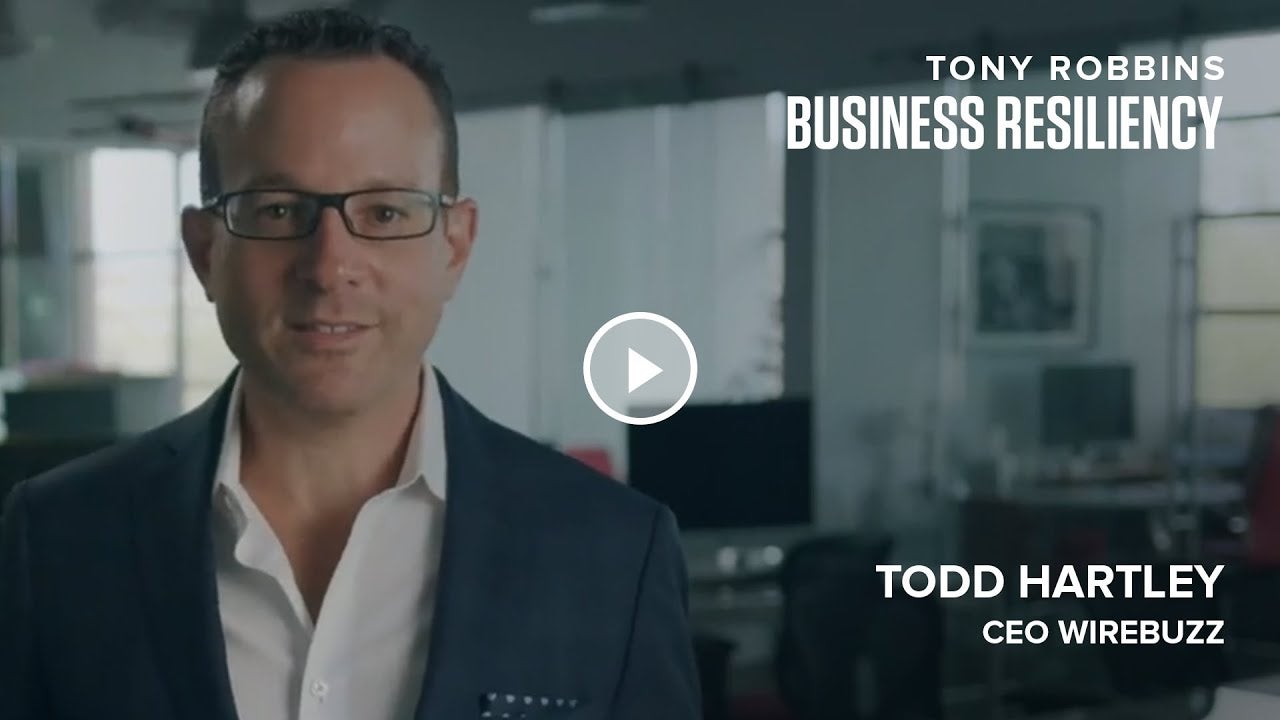
Todd Hartley, CEO and Founder of WireBuzz, an award-winning marketing and video production company, shows you how to make connections with your buyers and help them build consensus among their team using the power of video. Uploaded 27-04-20 In today’s marketplace, no one makes major buying decisions alone. They have buying coalitions, stakeholders whose approval and buy-in they need to get before moving forward on your proposal. There’s the CFO, who cares about efficiency and budget. There’s the CEO, who wants innovation and competitive differentiation. There’s marketing, who cares about customer experience. And there are countless other stakeholders, depending on the product or service you offer. Tony shared his top tips for mastering sales in a podcast available at https://www.tonyrobbins.com/podcasts/episode-9. But how can you help your internal champion go down the hall and influence these team members to buy-in to your product or service? Todd found that creating a high-level ove
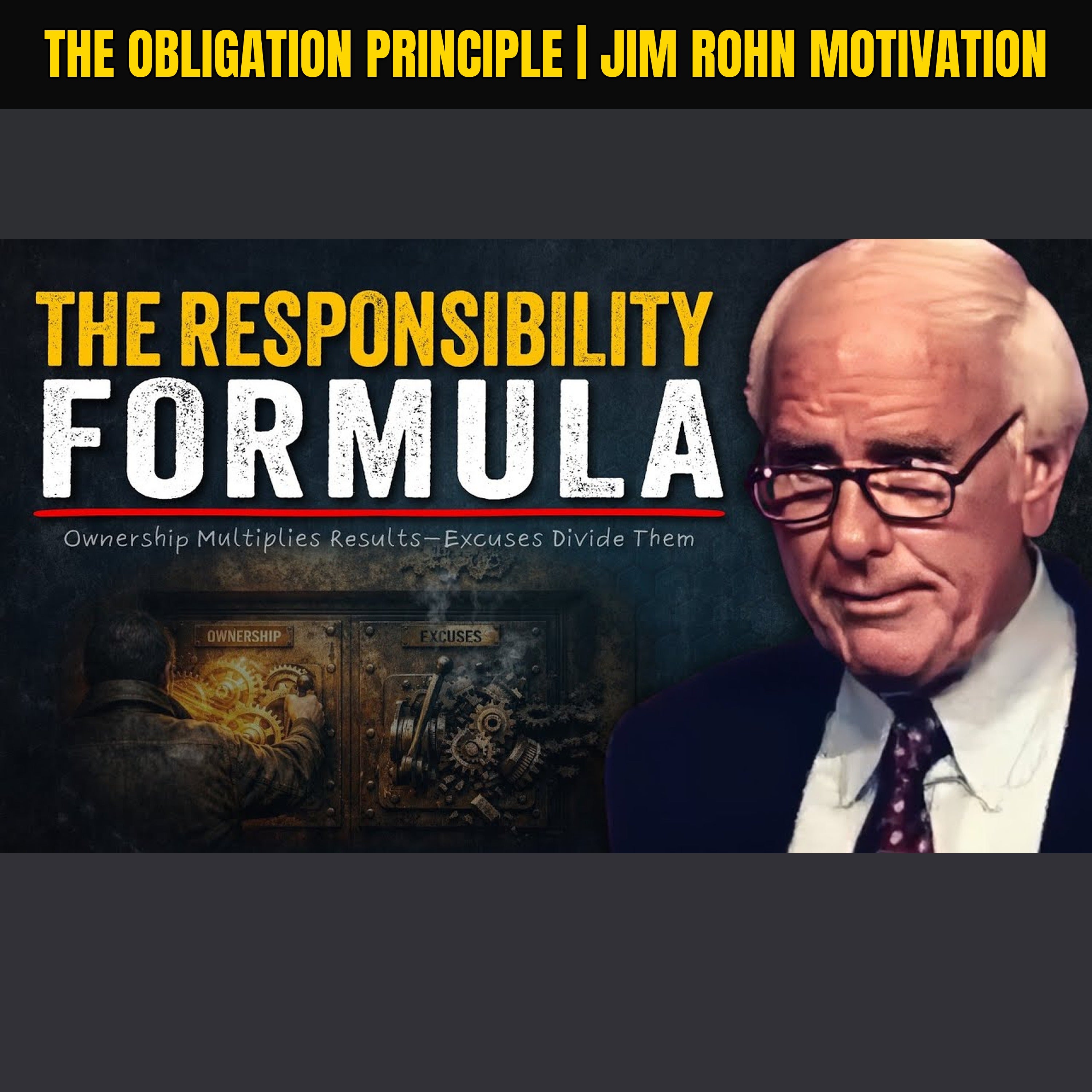
#JimRohnMotivation #JimRohn #JimRohnSpeech In this Jim Rohn Motivation video, discover the powerful equation that unlocks the secret to personal change: Responsibility = Ownership × Awareness × Action. This life-altering formula isn't just theory — it's the roadmap to results, freedom, and purpose. Key Topics From This Motivational Video: The true meaning of responsibility and how it empowers How to multiply results using the Ownership × Awareness × Action formula Why blame subtracts power and discipline multiplies it The connection between responsibility and personal freedom How responsibility influences relationships and leadership In this thought-provoking Jim Rohn motivational video, you'll uncover why results in life don’t happen by accident — they happen by formula. When you take ownership of your circumstances, bring awareness to your habits, and act consistently, life begins to respond in powerful ways. This message reminds us that the path to success, clarity, and freedom star
PBS Member Stations rely on viewers like you. To support your local station, go to: http://to.pbs.org/DonateSPACE ↓ More info below ↓ Uploaded 10-08-20 The second in our two event series about Theories of Everything! Watch the first one: https://www.youtube.com/watch?v=_izocEgArtQ Please subscribe to Brian Keating's YouTube Channel to watch one-on-one interviews with the guest speakers and more: https://www.youtube.com/DrBrianKeating Existing Theories of Everything have not yet produced experimental evidence that solves the fundamental challenges facing physics. That lack of progress has opened up a sea of controversy, from disagreements about the very necessity of TOEs, to questioning the cost/benefit of mega-billion dollar particle accelerators in search of them, to the emergence of competing TOEs from physicists outside of the academic community. In this 90 minute chat we dive into the existential questions around TOEs. Special thanks to Brian Keating, Lee Smolin, Sabine Hossenfelde
Tejas Bhakta, CEO of vertically integrated inference provider Morph, joins Madison Kanna to discuss orchestrating up to 12 concurrent AI agents using custom terminal muscle memory, eye tracking, and voice-to-text. He breaks down why startups get trapped in toxic GPU prepay contracts, how AI kernel writing is suddenly making AMD viable for inference, and why frontier models are forcing software engineers into “ego death” while creating more fake jobs post-AGI. MTS chronicles the singularity, live. Monitoring the situation of tech and AI. Follow MTS: Spotify |https://open.spotify.com/show/4HUNNmV1pjV7CW6Lphm1rM Apple |https://podcasts.apple.com/us/podcast/mts/id1891088763 – Brought to you by: Mongo DB - Anyone can prototype an agent. Lovable - Turn ideas into software people love with Lovable. Start today at https://lovable.dev/ Visithttps://factory.com/ Neon (by Databricks) - Scale your startup on Neon. The Postgres backend for apps and agents. Head over to http://getvcx.com (http://get
The size of a congressional majority decides what can pass, who chairs the committees, and how defense policy moves for the next two years. For today’s conversation, Ken Miller sits down with Madison Arcangeli (https://www.linkedin.com/in/madison-arcangeli-3079a767/) and Katy Nazaretova (https://www.linkedin.com/in/katynazaretovalopresti/) ofForza DC (https://www.forzadc.com/) to break down the results of the U.S. midterm election and what the new Democratic majorities in the House and Senate mean for governing. Together, they discuss the new margins and leadership races, what Congress still has to finish before the session ends (including the National Defense Authorization Act and appropriations), and why the electromagnetic warfare community needs to keep educating new members as Rep. Don Bacon retires from Congress. We invite you to share your thoughts, questions, or suggestions for future episodes by emailing host Ken Miller at [email protected] or by visiting us on our Ins
Age doesn't mean decline. Believing it does could cost you seven and a half years. Gina sits down with Lyndsey Simpson, CEO of 55/Redefined and author of The Age Rebellion: Supercharge the Second Half of Your Life, to tear up the old script: work hard, retire, fade out. Lyndsey explains the Yale research on how negative thoughts about aging shorten your life. When you tell yourself you can't do something at your age, "your brain believes you and restricts your body." She also explains why stopping work all at once may be one of the worst things you can do for your health. Lyndsey also shares everyday learning habits that keep your brain sharp as you age. Your age isn't a countdown. It's a level, and you're still unlocking new ones. Where to Find Lyndsey: Instagram: https://www.instagram.com/simpson.lyndsey Her book - The Age Rebellion: Supercharge The Second Half Of Your Life: https://www.the-age-rebellion.com/ This podcast aligns with Day 73 of our Fall Program, members can find video
Dig into the slippery slope fallacy, which assumes that one step will lead to a series of events that lead to an extreme— often bad— scenario. Uploaded 19-08-21 -- It’s 1954. Vietnamese nationalists are on the verge of securing an independent Vietnam under communist leader Ho Chi Minh. U.S. President Eisenhower claims that by virtue of the "falling domino principle," communist control of Vietnam would lead to the global spread of authoritarian communist regimes. Can you spot the problem with this argument? Elizabeth Cox explores the slippery slope fallacy. Lesson by Elizabeth Cox, directed by TOGETHER. Support Our Non-Profit Mission ---------------------------------------------- Support us on Patreon: http://bit.ly/TEDEdPatreon Check out our merch: http://bit.ly/TEDEDShop ---------------------------------------------- Connect With Us ---------------------------------------------- Sign up for our newsletter: http://bit.ly/TEDEdNewsletter Find us on Twitter: http://bit.ly/TEDEdTwitter Pe
View full lesson: http://ed.ted.com/lessons/how-do-we-measure-distances-in-space-yuan-sen-ting Uploaded 09-10-14 When we look at the sky, we have a flat, two-dimensional view. So how do astronomers figure the distances of stars and galaxies from Earth? Yuan-Sen Ting shows us how trigonometric parallaxes, standard candles and more help us determine the distance of objects several billion light years away from Earth. Lesson by Yuan-Sen Ting, animation by TED-Ed.
As machines take on more jobs, many find themselves out of work or with raises indefinitely postponed. Is this the end of growth? No, says Erik Brynjolfsson -- it's simply the growing pains of a radically reorganized economy. A riveting case for why big innovations are ahead of us ... if we think of computers as our teammates. Be sure to watch the opposing viewpoint from Robert Gordon. Uploaded 30-08-13 Talk by Erik Brynjolfsson.
An essential service should remain open until a workable alternative is available.
Share your view, then see how readers voted. No sign-in required. This poll is shared across stories.
Do you agree or disagree?
Common Quandary
A Common Quandary to discuss
Another conversation to explore, separate from this news story.
Your family wants an AI to settle an old argument. Would you hand over the group chat?
A recurring family dispute has reached the point where nobody agrees on what was actually said. Your cousin proposes uploading five years of the family group chat to an AI that can reconstruct events, flag contradictions, and recommend a fair resolution. Nearly everyone agrees—but one relative refuses.
Can a tool make a family argument fair without turning intimacy into evidence?