Reed Manly tells FBI Agent Ryan Powers exactly why he won’t hand over his company’s jump records. If Ryan reads them, he’ll have to arrest him. It’s the most honest thing anyone at Timelane has said all morning. Unfortunately for Ryan, he’s standing on the wrong side of Manly’s desk when he says it. Eighteen hours later, Ryan wakes strapped to a chair in a room barely big enough to hold it. His watch says he’s still in Pasadena. Manly’s voice comes through a speaker overhead, pleased with how well the first experiment went. For the next one, he intends to send Ryan two hundred years into the future. His colleagues have yet to work out how long they should leave him there. Ryan’s supervisor knows where he went. There’s a signed subpoena. Under ordinary circumstances, someone would already be looking for him. But Ryan makes his living investigating people with access to the past, and he understands exactly what that means for the last person who remembers seeing him alive. FEATURED STORY
The UK content business has gathered at the Barbican to work out how to break out of TV silos and into the wider digital world. Whilst there, we meet beehiiv co-founder and CEO Tyler Denk on publishers diversifying into newsletters and beyond. Also on the show: Gold Wala MD Faraz Osman brings the big takeaways from GrowthLab's stages - and we grab people in the Barbican's corridors for the real state of the industry. All that plus: The Audio Network Media Quiz, where we test our guests' grasp of the week's news... with a licence to quiz. The Media Quiz is sponsored by Audio Network. Alex selects the music to score each episode and he and the team can do it for you too athttps://www.audionetwork.com/audionetwork.com (https://www.audionetwork.com/) What The Media Club has been reading this week: GrowthLab London 2026 (https://www.weareindielab.co.uk/growthlab-london-2026) Megaphone brings video to Apple Podcasts (https://support.megaphone.fm/en/articles/18183175-video-distribution-to-app
DESCRIPTION / SHOW NOTES: How old is TOO OLD to go clubbing?! Concrete says he's done with loud music, staying out until 2 AM, and younger partygoers calling him "Unc." He'd rather listen to old-school hip-hop, grab a hot dog, and head home early! The crew debates whether 40 is the cutoff, while callers Gil and Maria share their experiences partying in their late 30s and 40s, including the brutal recovery time afterward. Chismation gets into viral allegations that Michael Jordan was cheap during his Chicago Bulls prime. The crew debates whether a superstar should be expected to spend money on someone he's dating or whether his money is his business. Petty Police covers Doja Cat's frustration over reportedly being left off the GTA 6 soundtrack. Could her public complaints hurt her chances of getting music added later? Don't You Know I'm Local covers an alleged $22.5 million Southern California freight train theft ring involving Nike sneakers, Milwaukee tools, and suspects accused of doc
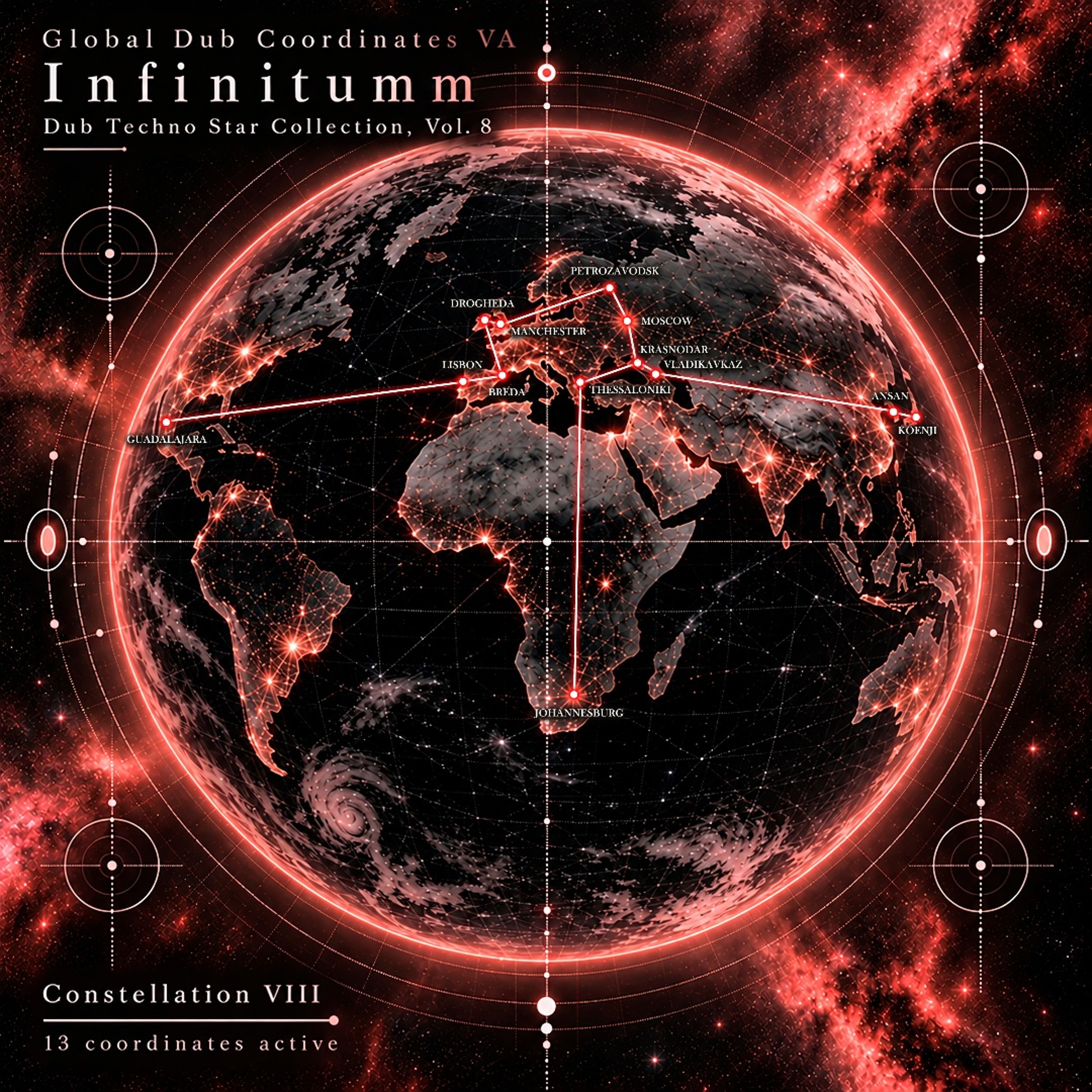
[PIRANHA SIBERIA DUB] is tremendously pleased to present the 120th release — Global Dub Coordinates VA: Infinitumm Dub Techno Star Collection, Vol. 8 The eighth constellation of Global Dub Coordinates is called Infinitumm. Only two volumes remain before the global geometry is complete, and thirteen more coordinates connect the United Kingdom, Ireland, Mexico, Spain, Russia, South Africa, the Republic of Korea, Greece, Portugal, and Japan. In Infinitumm, the memory of place is felt especially strongly — growing up in Manchester, a rainy day in Guadalajara, the forests and lakes of Karelia, an almost deserted shore of the Black Sea, urban echoes, and places that continue to exist within a person long after they have left them behind. Here, distance gradually ceases to be the main measure: what matters more is how deeply a particular place has managed to preserve itself within memory. :::Juan Moreno (@juanmorenomusica) — Rainy Day In Guadalajara comes from Guadalajara, Mexico, and capture
Howard Deutch, director of Pretty in Pink, offers a candid look at the making of the 1986 John Hughes classic, starring Molly Ringwald, Jon Cryer, Andrew McCarthy, James Spader, Annie Potts and Harry Dean Stanton. Deutch shares his unlikely path to the director's chair, from a two-week attempt at veterinary school at Ohio State and a string of record-business jobs to the United Artists mailroom. He went on to run UA's advertising department, working on campaigns for Rocky, Annie Hall and James Bond, and then built one of New York's top trailer companies. That work led him to John Hughes and a music video for Sixteen Candles. He explains why he risked everything to move to California for his first feature, how he begged a reluctant Molly Ringwald to play Andie, and why he couldn't stand James Spader at his audition. He also talks about the moment Jon Cryer won the role of Duckie, Annie Potts's ad-lib on the very first shot, and an unforgettable reunion with Harry Dean Stanton years late
Written by Rob Hirst, and completed by his daughter Lex, the new book, World Is Almost At Peace, moves through the many songs Rob wrote and recorded and shares remarkable detail about the writing of a lifetime of music. Lex Hirst and Rob’s wife, Lesley Holland join Andy to share their memories of Rob and their reflections on his life and his music. Hana Stretton’s first album, Soon, was a response to isolation - with Covid and Australian bushfires looming in its background. On her latest, tiarn (https://hanastretton.bandcamp.com/album/tiarn-2), Hana has been folding ever more into her compositions: more voices, more instruments, more ideas, but it retains much of that shimmering, distant sound and remains inspired by the natural world around her. Hana is performing 8 Dec at Phoenix Central Park, Sydney; 9 Dec at Lansdowne Hotel, Sydney; 10 Dec at Thornbury Theatre, Melbourne; 11 Dec at Oregon Hall, Beechworth; 13 Dec at Meredith Music Festival Music heard in this program: Title: StoveA
Disney adults get a bad rap, which is probably why some creators started using the term “Disney cool girl” to differentiate themselves from the stereotype. Instead, it ended up creating division, and when The Cut published a piece (https://www.thecut.com/article/disney-cool-girl-style-tiktoks.html) about these so-called “cool girls,” none of them were happy about it. On today’s episode, host Kate Lindsay is joined by culture writer Kyle Raymond Fitzpatrick (https://1234kyle5678.substack.com/) to discuss why everyone in the community knows the term “Disney cool girl” but nobody wants to claim it, and why writing about any fandom almost always ends up going wrong. This podcast is produced by Vic Whitley-Berry, Daisy Rosario, and Kate Lindsay. Hosted on Acast.
Owen Ramsingh first came to the U.S. from the Netherlands when he was a kid and was a legal green-card holder for decades. But in February of 2026, a felony drug-dealing offense on Owen’s record from when he was 16 flashed up when he was reentering the country from a trip abroad. He was arrested, detained for months, and eventually deported. This week on the show, Owen talks about the life he’d built in the States, the poor conditions he endured in immigration detention, and having to live apart from his American kids while his wife moves back and forth. He also talks about how he eventually landed in Mexico and is piecing together a new life there with the support of his family and community in Columbia, Missouri. We first heard about Owen from reporter Addison Zanger, from a story she reported for NPR (https://www.npr.org/2026/05/05/nx-s1-5805229/detained-and-deported-a-missouri-man-must-make-a-new-life-in-the-netherlands) last summer. We also hear from Elora Mukherjee (https://www.l
How should Asian people feel about white people in Asian grocery stores? That’s the question creatorMadeline Qi (https://www.tiktok.com/@say_qis?lang=en) didn’t even mean to ask when she posted her now-viral video, which resulted in call-outs, doxxing, and, ultimately, a conversation too nuanced for TikTok. Writer and comedian Youngmi Mayer attempted to make sense of the discourseon her Substack (https://youngmimayer.substack.com/p/white-people-inside-asian-grocery), which ended upgoing viral on Instagram (https://www.instagram.com/ymmayer/?hl=en). She joined host Kate Lindsay to share what people misunderstand about the controversy, and how her own experience being mixed white and Asian contributes to her perspective. This podcast episode was produced by Vic Whitley-Berry, Daisy Rosario, and Kate Lindsay, with help from AC Valdez. Hosted on Acast.
Publicly funded stadiums should provide clear, measurable benefits to local residents.
Share your view, then see how readers voted. No sign-in required. This poll is shared across stories.
Do you agree or disagree?
Common Quandary
A Common Quandary to discuss
Another conversation to explore, separate from this news story.
A better public school is one borrowed address away. Would you use it?
Your child is struggling at the assigned school. A grandparent lives inside the boundary of a much stronger public school and offers to let you use their address. The desired school has limited places and verifies residency unevenly.
Can a parent's duty justify taking an opportunity allocated by an unfair boundary?