Destressing Toolkit (1/5): The anxiety that comes from being treated like an outsider | Valerie Purdie-Greenaway
14 min
Listen through the publisher, then discuss the episode here or arrange an in-person Roundtable. Your city determines where to meet.
Roundtables are designed for groups of four, with a shared subject and room for everyone to speak. Come for discussion, with no dating expectation.
The stress you may feel being otherized or stereotyped can take a significant toll on your health and well-being. In this thoughtful conversation, social psychologist Valerie Purdie-Greenaway reveals the true source of this anxiety (hint: it isn't the individual) and shares strategies on building resilient systems of support for ourselves and others -- so that we can build a more inclusive, empathic and just world. (This conversation, hosted by TED curator Cloe Shasha Brooks, is part of TED's "How to Deal with Difficult Feelings" series.) Hosted on Acast.
Episode information is provided by the publisher. Listening takes place on the publisher’s service.
Does your relationship feel like home, or does it feel like standing on the edge of something you might lose? In Part 3 of our Relationship Anxiety series, clinical hypnotherapist and former paramedic Martin Hewlett guides you through the process of teaching your nervous system that love doesn't have to hurt to be real. We explore the physical manifestations of anxiety—the tight chest, the 2:00 AM racing mind, and the "stomach drop" when a text takes too long—and provide the tools to "turn down the alarm" of your internal survival response. If you are ready to stop "cherry-picking" evidence of disaster and start building a foundation of trust, this session is for you. In This Episode, We Cover: The Science of Safety: Understanding how your nervous system confuses love with danger. Guided Visualization: A journey into your own "safe room" where you are already enough. Rewiring the Brain: Moving from worst-case disaster reels to the reality of small, daily kindnesses. Breaking the Cycle:
What actually works when it comes to detecting lies, and why are so many popular ideas about reading people and nonverbal behavior at odds with the scientific research? I talk with Aldert Vrij, one of the world's leading deception-detection researchers, who has spent almost four decades studying these topics. We discuss why what people say is far more revealing than their body language; why the perceived “sexiness” of reading nonverbal behavior has contributed to widespread myths and misconceptions; whether vocal behaviors like pitch, volume, and hesitation contain meaningful clues; and whether there's value in analyzing minor word choices and turns of phrase, as is done in so-called “statement analysis.” We discuss Paul Ekman's legacy as a source of faulty ideas about deception, micro-expression-based deception detection training, and the strategies that popular “body language experts” use to appear scientifically credible while simultaneously promoting ideas that conflict with the sc
"Are You Being Assertive… or Just Pushy?" - Listen to my Morning Monologue: I’m sharing my take on pressing issues, enlightening research on human behavior, answering questions I get by email, and my favorite, most instructive interactions with callers. It’s the free therapy you need! Got a dilemma? Follow on social media: Facebook.com/DrLaura (http://facebook.com/DrLaura) YouTube.com/DrLaura (http://youtube.com/DrLaura) Join the Dr. Laura Family!! >> Receive my weekly newsletter, perks, and more! Sign up now, it's FREE > DrLaura.com (https://www.drlaura.com/) Hosted by Simplecast, an AdsWizz company.
Today, I’m honored to connect with Dr. Troy Badger. He is a board-certified cardiologist and interventionalist and the founder of Cardiostrong, a concierge preventive cardiology clinic in Provo, Utah, focused on reducing cardiovascular risk, optimizing metabolic health, and improving strength and cardiorespiratory fitness for executives and athletes. In today’s conversation, we discuss Dr. Badger’s gender- and age-specific approach to heart health, including treatment differences for men and women, and diagnoses such as INOCA, SCAD, vasospastic disease, and Takotsubo. We examine emotions and their influence on heart health, coronary ischemia and cardiomyopathies, labs and diagnostics, how Dr. Badger assesses risk in his patients, and the differences between a CAC and a CCTA. Dr. Badger also shares the labs he finds essential for all patients and discusses the role of VO2 Max, cardiovascular training, and lifestyle—specifically nutrition, the use of GLP-1 drugs, and a multidisciplinary
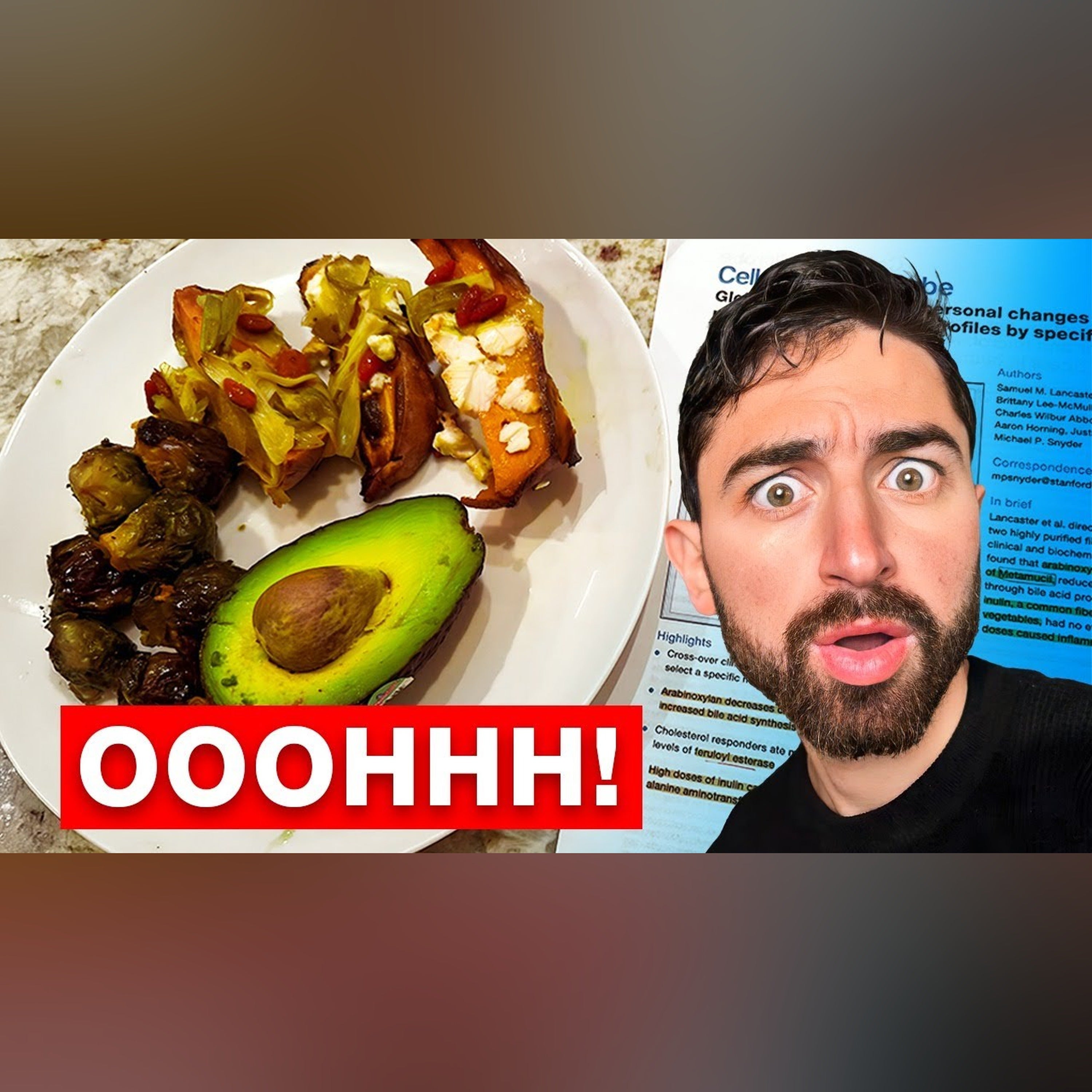
For extra details and all the references, see this letter: https://staycuriousmetabolism.substack.com/p/fiber-is-good-for-you-is-lazy-science?r=40ekz2 Winnow Microplastic Binding Probiotic: https://www.winnowlabs.com/STAYCURIOUS Microplastics and Heart Health, Letter https://staycuriousmetabolism.substack.com/p/microplastics-in-my-heart-its-worse?r=40ekz2 Description: Fiber gets treated like one simple “good for gut health” nutrient… but that’s a massive oversimplification. In this video, I break down a high-resolution Stanford human crossover trial comparing two “soluble fibers” that produced radically different outcomes: arabinoxylan vs inulin. Same category label, completely different biology. You’ll see why dose matters, why host response matters, and how “fiber is good” or “fiber is bad” is so oversimplified these statements are effectively full-blown misinformation. For extra nuance, references, and commentary from the senior author, check out the Stay Curious Metabolism newslett
Happy Sunday! Welcome to Heal Squad’s The Sunday Set Up. Life lessons to help you start the week. How much of success comes down to simply showing up? This week, we talk keeping an open mind, taking chances, and recognizing the doors that open along the way. From Olympic athletes appearing on national television alongside Mercedes Moné to performers who keep showing up week after week hoping for their big break, we explore why success isn't always about talent or luck. Sometimes it's about making connections, putting in the effort, and being willing to try without knowing what we'll get in return. We talk knowing when to stop investing time in people who aren't willing to help themselves, and why even experiences that don't work out can teach us something valuable. The takeaway: don't wait for the perfect moment or expect someone else to make things happen. Be willing to take a chance, walk through the doors that open, and remember that half of life is just showing up. Plus, a little b
In crowds, at meetings, get-togethers with friends, everyday interactions: social anxiety can show up as an unwelcome guest at any time. But why? Psychologist Fallon Goodman digs into the source of social anxiety, setting the record straight about this common condition with practical solutions to help you feel the most authentically "you" while out and about. After the talk, mental health specialist Dr. Jessi Gold joins Shoshana in a sweeping conversation on social media’s impact on social anxiety and how we can best support ourselves and others. Hosted on Acast.
Countless poets and writers have tried to put words to the experience of a panic attack— a sensation so overwhelming, many people mistake it for a heart attack, stroke, or other life-threatening crisis. Studies suggest that almost a third of us will experience at least one panic attack in our lives. So what exactly is a panic attack, and can we prevent them? Cindy J. Aaronson investigates. [Directed by Aim Creative Studios, narrated by Bethany Cutmore-Scott, music by André Aires]. Hosted on Acast.
What if you could transform your anxiety into something you can actually use during your work day? Neuroscientist Wendy Suzuki shares two evidence-based activities -- breathing and movement -- that can soothe your nervous system and fuel creativity and connection. Hosted on Acast.
People should receive a clear explanation before consenting to personal-data use.
Share your view, then see how readers voted. No sign-in required. This poll is shared across stories.
Do you agree or disagree?
Common Quandary
A Common Quandary to discuss
Another conversation to explore, separate from this news story.
A parent clearly built the winning science project. Who should lose the prize?
An elementary student submits an elaborate science project far beyond their apparent ability. The parent proudly describes working together all weekend, and the child clearly learned something, but other students completed simpler projects themselves.
What is a fair response when help improves learning but distorts achievement?