Listen through the publisher, then discuss the episode here or arrange an in-person Roundtable. Your city determines where to meet.
Roundtables are designed for groups of four, with a shared subject and room for everyone to speak. Come for discussion, with no dating expectation.
On the Season 2 premiere, Todd Fox sits down with Dr. Agustín Carstens, renowned economist and member of the Visa Economic Empowerment Institute (VEEI) Advisory Council. Throughout his career, Dr. Carstens has held positions at a variety of institutions operating at both the domestic and international level. During his time as Banco de México, Dr. Carstens helped guide the Mexican economy though financial crisis—eventually serving as Governor from 2010 until 2017. He then took on the role of General Manager at the Bank for International Settlements (BIS), where he oversaw the establishment of the BIS Innovation Hub in 2019. During their conversation, Dr. Carstens draws on his experience to address some of today’s most pressing questions in global finance and payments. For more content from the Visa Economic Empowerment Institute, please visit https://visa.com/veei
Episode information is provided by the publisher. Listening takes place on the publisher’s service.
In this paid subscriber-only edition of The Roundtable, Rudyard Griffiths and Sean Speer examine Quebecor’s proposed takeover of Telus and what it reveals about Canada’s economic model. They trace the history of the “fourth carrier” policy, debate whether this merger signals the end of telecom competition, and explore how government regulation creates what they call “Laurentian capitalism”—a system where state power and corporate interests intertwine. The discussion also addresses sovereignty arguments, media consolidation, and whether Canada is abandoning market-based competition for state-managed oligopolies across key industries. If you are enjoying free versions of the Hub Roundtable, subscribe to become a Hub Hero or Fellow to access the full version every week: https://thehub.ca/join/ The Hub is Canada’s fastest growing independent digital news outlet. https://tinyurl.com/3a7zpd7e (Apple) https://tinyurl.com/y8akmfn7 (Spotify) Watch a video version on YouTube: https://www.youtube
The D.C. Circuit considers whether the President can remove members of the National Credit Union Administration’s board at will. The agency supervises credit unions, insures their members’ accounts, and provides emergency liquidity. In April 2025, President Trump removed two board members, Todd Harper and Tanya Otsuka, before their appointed terms had ended. They sued to return to office. The district court held that the law protected them from removal without cause and ordered agency officials to let them carry out their duties. The government challenges that ruling. The unusual feature is that the statute does not expressly say board members may be removed only for cause. But in 1978, Congress replaced a single administrator with a multimember board and deleted language saying the leadership served at the President’s pleasure. The members say those changes were meant to protect the agency’s independence; the government says they do not override the President’s removal authority. The
Dr. Sarah Kapnick, Global Head of Climate Advisory at J.P. Morgan, joins Navin Girishankar on Betting on America to discuss how the next economic order will depend on the next energy order. She explains that resilient energy systems more than ever will be a source of national power as countries seek to keep energy flowing amid increasingly frequent disruptions such as climate shocks like El Niño, war in the Middle East and Ukraine, and surging power demand from AI. Dr. Kapnick explores the global landscape for resilient energy systems, the strategies countries are deploying, and the role of energy diplomacy as a source of geopolitical advantage.
The Petal's New Zealand edition for Thursday 19 November 2026 carries 7 decisions newly reported, two from the Supreme Court and five from the High Court, all aired as six items. The thread is substance over labels: youth, mental illness, poverty and a counterclaim each count for what they actually did, not for what they are called. The two Supreme Court decisions arise from the deaths of young children and are reported as legal doctrine only, with no one named on air. Criminal Law Desk (first story). Thompson v The King [2026] NZSC 178 - reported as legal doctrine only. The proposition derived from R v Rapira [2003] 3 NZLR 794 (CA), that manifest injustice under s 104(1) of the Sentencing Act 2002 is extremely difficult to establish, is not good law, nor do personal circumstances displace the 17-year presumption only in rare cases; the threshold is flexible and case by case, and a status-based s 104(1A)(h) circumstance does not automatically make a murder one of the worst. Background,
This week, Scott was joined by his Lawfare colleagues Senior Editors Anna Bower, Michael Feinberg, and Molly Roberts to talk through the week’s big national security news stories, including: “Occam’s Router.” It’s been a rough week for the systems that keep the country running. On Friday, the FAA ordered a rare nationwide ground stop after a communications failure disrupted radar and radio links at air traffic control centers across the country—just a day after a global Microsoft outage knocked Outlook and Teams offline. On Monday, customers at Chase and other big banks found themselves unable to log in or move money. And on Tuesday, the NSA’s classified internal network went dark, forcing the agency to stagger employees’ arrivals at Fort Meade. Officials insist none of these incidents was a cyberattack, and the explanations offered so far—a misbehaving router, a latent software bug, a routine patch gone wrong—are decidedly mundane. But the clustering has fueled plenty of anxiety and s
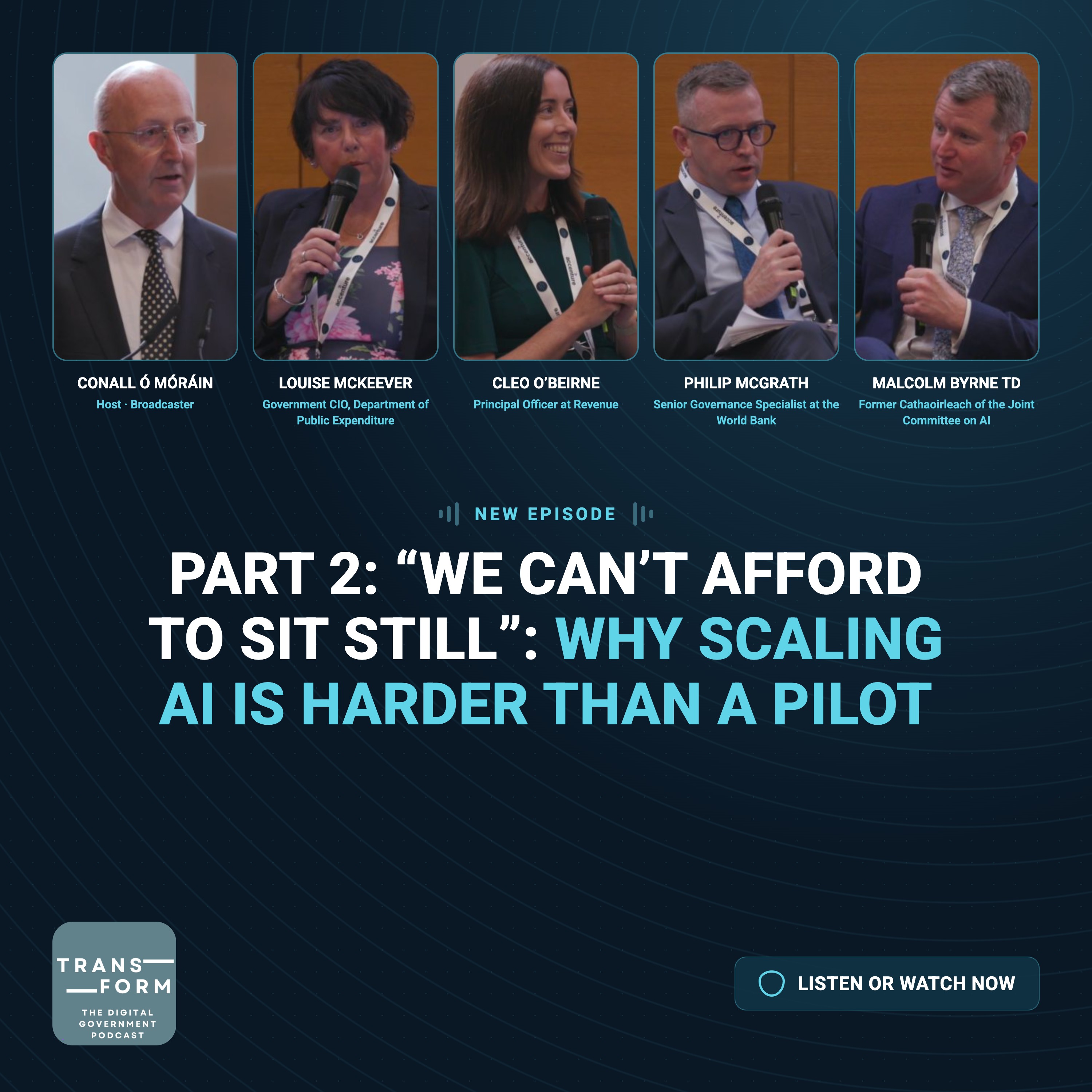
The pilot worked. Now what? In Part 2 of this panel discussion, four leaders explain how they're taking AI from pilot to scale, and what it takes to get data and governance right. This panel discussion took place at the Ireland eGovernment Awards and Leadership Summit 2026 on 24 September 2026 at UCD's O'Reilly Hall. We bring together Louise McKeever, Government CIO; Cleo O'Beirne, Principal Officer at Revenue; Philip McGrath, Senior Governance Specialist at the World Bank; and Malcolm Byrne TD, former Cathaoirleach of the Joint Committee on AI. The panel is chaired by Conall Ó Móráin. If you're taking AI beyond the pilot, here's what to do: Start small, prove it, then scale. Revenue tested agentic AI on a small application first, stage by stage. Redesign the whole process, not one stage. Individual productivity gains only go so far. Plan for lost knowledge, and recovered knowledge. As AI scales, people may know less, but AI can also capture knowledge that has already been lost. Reuse
Students should help shape decisions about what and how they learn.
Share your view, then see how readers voted. No sign-in required. This poll is shared across stories.
Do you agree or disagree?
Common Quandary
A Common Quandary to discuss
Another conversation to explore, separate from this news story.
Your neighbor saves a public parking spot with an orange cone. Do you move it?
Street parking is scarce after a snowstorm. Your neighbor spent an hour digging out the space in front of their home and now guards it with an orange cone, even though curb spaces legally belong to everyone. You arrive tired and the cone is blocking the only open spot.
Can effort create a personal claim to something public?