E94 | The reality of starting a business with AuDHD
63 min
Listen through the publisher, then discuss the episode here or arrange an in-person Roundtable. Your city determines where to meet.
Roundtables are designed for groups of four, with a shared subject and room for everyone to speak. Come for discussion, with no dating expectation.
In this episode, we're taking you behind the scenes of WTF Journals and sharing what it's actually been like for two neurodivergent sisters to turn an idea into a real-life product and business. What started as Paige's personal quest to create a journal that actually worked for her brain,turned into a four-to-five-year journey of designing, refining, sampling, sourcing, launching and, eventually, getting our first journals into the hands of you - our awesome community! We thought it might be helpful to share a bit of insight from our last few months because we've encountered more hurdles than we could have anticipated - manufacturing mishaps, international shipping logistics, cashflow challenges, perfectionism, people pleasing, the list goes on - and of course, the emotional rollercoaster of it all! We also chat about how our very different AuDHD brains have approached the process, navigating decision paralysis, learning to trust ourselves, letting go of control and reflecting on the bits we're proud of. Hopefully, there's something in our experience that encourages you to give yourself the inspo to start something of your own. (We promise this isn't meant to be a promotion, but since you're here... check out WTF Journals here! (https://wtfjournals.com/)) @wtfisaudhdpodcast @wtf.journals Hosted on Acast.
Episode information is provided by the publisher. Listening takes place on the publisher’s service.
In this video, I finally open up about my diagnosis with Temporal Lobe Epilepsy and possible Mesial Temporal Sclerosis, conditions that have disrupted my life behind the scenes. This revelation comes after years of battling symptoms in secrecy, from memory loss to severe neurological episodes. My decision to come forward is driven by a desire to illuminate the challenges of living with a brain disease, the struggles of maintaining a façade of normalcy, and the personal acceptance of a life-altering reality. Uploaded 06-04-24 Why share this now? Because knowledge is power, but shared knowledge is empowerment. By documenting my journey, I aim to demystify these conditions, provide solace to those silently suffering, and initiate a conversation on the importance of mental and neurological health. This video is just the beginning. I promise to document my experiences, the good days and the bad, in hopes that my journey can offer understanding, hope, and support to those facing similar batt
For most of my life, I believed that resting was something you did when you were lazy, getting older, or simply didn't have the drive to keep going. As an athlete and someone who's always pushing to be productive, I thought taking a break meant falling behind. But I've come to realize just how wrong I was. Through my relationship with God and my own experiences with stress, I've started to understand that rest isn't a weakness. It's essential for our physical health, mental clarity, and overall well-being. And I'm not just talking about getting enough sleep or taking a day off from the gym. You can be sitting on your couch doing absolutely nothing and still not be resting. If your mind is constantly occupied with negativity, distractions, and worries, your body never truly gets a chance to recover. In this episode, I want to challenge the way we think about rest, explain why constantly pushing ourselves can do more harm than good, and share what I've learned about slowing down, reconne
Dr Anna Lembke is one of the world's foremost authorities on addiction – a professor of psychiatry at Stanford, chief of its Addiction Medicine Dual Diagnosis Clinic, and the author of the international bestseller Dopamine Nation, which sold more than 1.5 million copies and changed the way the world understands pleasure, pain and dependence. Her new book, Radical Surrender, goes a step further than Dopamine Nation. Its argument is that we have become addicted not just to pleasure, but to control – that in a world of endless levers to press, we now pursue control for its own sake, and that when reality refuses to cooperate, our instinct to try harder tips us into denial, anxiety and despair. It is one of the most important and useful books I've encountered in the making of this podcast. But Anna's understanding was forged through almost unbearable personal loss. Her infant son, Lucas, died of leukaemia. What emerged was an acceptance of human limitation and the hard-won understanding th
Ep 400: A birthday hike in Hawaii ends with a woman bloodied on a cliffside. She claimed her husband tried to kill her, but he had a very different story. This is the Arielle Konig story. A birthday hike on Oahu ends with a woman bloodied on a cliffside, screaming that her husband tried to kill her. He tells investigators something very different. This is the case of Arielle Konig, a Westinghouse nuclear engineer turned project manager at TerraPower, and her husband Dr. Gerhardt Konig, a University of Pittsburgh anesthesiologist who had moved the family to Maui for what he called their dream life. Megan and Amy trace the marriage from the outside-in: the careers, the two young sons, the emotional affair that unraveled things, and the monitoring and surveillance that followed. Then comes March 2025, the narrow ridges and sheer drops of the Pali Puka Trail near the Nuuanu Pali Lookout, two hikers who heard screaming, and an eight-hour search of the mountain. At the Honolulu trial for att
How would you describe your 2026 year so far? Around us, there seems to be so much happening in the world today, with wars, a shaky economy, and political issues in the government. Personally, you might have had something unexpected happen like a sudden death or a serious health crisis. A friend of mine used this word to describe how things felt around her. She said things felt ‘uncertain’. I couldn’t agree more. In some ways, it seems remarkable that we have even made it this far! Well, if things have been feeling stressful and uncertain for you, let’s take a DEEP breath together now. In this episode, let’s look back on this year and have a moment of quiet reflection. I’ll also share some top thanksgivings from my clients who are eating plant-powered to inspire and encourage you. I hope you’ll see that our health doesn’t need to suffer or get sidelined, despite the external circumstances. So, if you’re ready to pause for a moment of reflection and gratitude with me, pull up a chair wi
You might know Nix Adams from social media- she has 3 million followers across Tik Tok, Facebook and Instgram. Or maybe you know her as the winner of 2026 Celebrity Treasure Island. Or perhaps you have never heard of her at all- I guarantee you will be a fan after hearing her story. Nix has a new book out too, "Nothing to Lose" which you can check out at all the usual book stores. Nix was raised around gang members in Northland. She became a teenage mum. She moved to Australia, got out of a violent relationship and started a business out of her garage. Then her little boy, Alaska, died. We talk about the years spent addicted to meth after Alaska died, losing custody of her other kids, turning to sex work to fund her drug habit and the circuit breaker of prison to get her clean. She started making videos for Facebook in the hope that her kids might see them and know their mum was doing okay. And that has grown into her becoming one of the country’s top content creators with her often hi
In this episode, we're chatting about the ongoing conversation around ADHD and autism being "overdiagnosed", and why these seemingly harmless comments can be so damaging to people who have spent their lives feeling different, misunderstood or like something was wrong with them. This came off the back of our listener posting in our Reddit community (https://www.reddit.com/r/WTFisAuDHD/) about the discourse currently happening in the UK, and how it's making them apprehensive to share their diagnosis. We chat about the difference between having a few traits and meeting diagnostic criteria, why we're seeing more people diagnosed (particularly those who have historically been overlooked), and how the narrative around overdiagnosis can reinforce internalised ableism, make unmasking harder and leave people questioning their own lived experiences. Plus, we speak about another post in our Reddit community about ADHD medication, including stimulants vs non-stimulants, finding the right combinati
In this episode, we thought it was a good time to talk about the "ADHD (and autism) are a superpower" narrative, after Paris Hilton recently hosted her UNSTOPPABLE event for neurodivergent creators (https://www.businesswire.com/news/home/20261016756187/en/Paris-Hilton-Unites-200-Neurodivergent-Creators-for-UNSTOPPABLE-a-First-of-Its-Kind-ADHD-Creator-Summit). While we appreciate any awareness and advocacy (especially from people so well known), a lot of the discourse from that event has reignited the rhetoric that our disabilities are superpowers. The sentiment is often well-intentioned, but does calling our disability a superpower actually resonate with everyone? Does it empower us, gloss over the challenges, or maybe do a bit of both? We discuss our thoughts on Paris Hilton's recent advocacy, our own feelings on the "superpower" topic, and reflect on how you - our listeners - feel about it. Join our Reddit to be part of the convo! (https://www.reddit.com/r/WTFisAuDHD/) Plus, we've go
The term 'accommodations' can sometimes sound like a big, unattainable thing - especially when you're conscious of asking others to help. But this week, we want to chat about how you can learn to make your own life easier, even without a diagnosis. We're talking about accommodations: what they are, why they're not just for people with a formal diagnosis, and how small adjustments to your everyday life can make a big difference. You don't need a diagnosis, permission or a complicated support plan to accommodate yourself. The first step is identifying your needs (arguably the hardest part!). Once you know what you need, sometimes it's as simple as finding a workaround, changing the way you approach a task, or giving yourself permission to do things differently. We asked you, our listeners, to share the accommodations you've made in your own lives, and the responses are full of clever, practical and simple ideas that you might want to steal for yourself! P.S. We end up talking about pleas
Public contracts should consider quality and reliability, even when the lowest bid costs less.
Share your view, then see how readers voted. No sign-in required. This poll is shared across stories.
Do you agree or disagree?
Common Quandary
A Common Quandary to discuss
Another conversation to explore, separate from this news story.
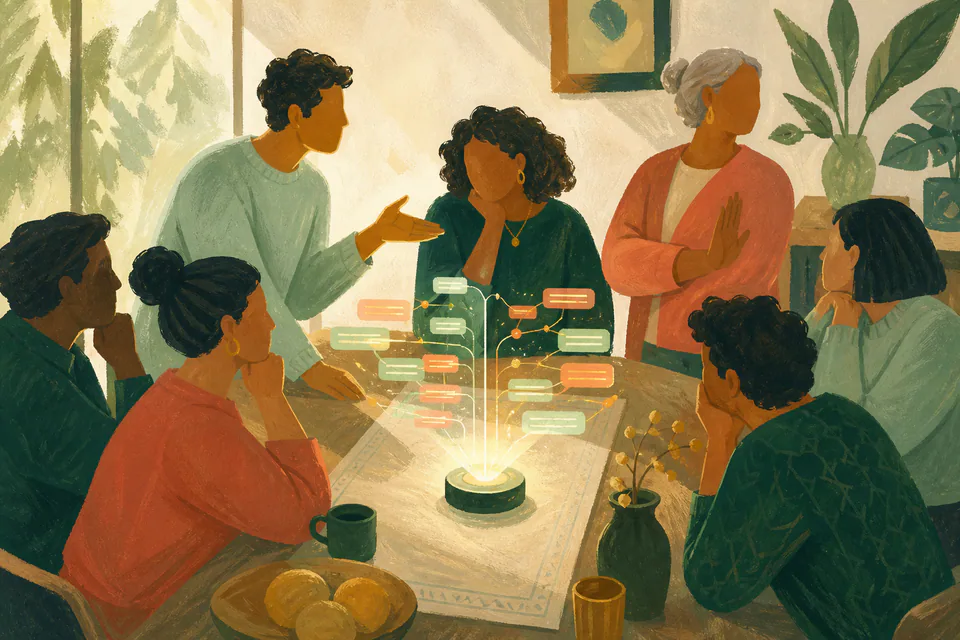
Your family wants an AI to settle an old argument. Would you hand over the group chat?
A recurring family dispute has reached the point where nobody agrees on what was actually said. Your cousin proposes uploading five years of the family group chat to an AI that can reconstruct events, flag contradictions, and recommend a fair resolution. Nearly everyone agrees—but one relative refuses.
Can a tool make a family argument fair without turning intimacy into evidence?