Einstein Called Quantum ‘Spooky’ and Google Is Building It - The Story
40 min
Listen through the publisher, then discuss the episode here or arrange an in-person Roundtable. Your city determines where to meet.
Roundtables are designed for groups of four, with a shared subject and room for everyone to speak. Come for discussion, with no dating expectation.
Can quantum computing cure cancer? Charina Chou, Chief Operating Officer at Google Quantum AI, believes it just might. But what exactly is quantum computing, and how does it work? Charina breaks down the technology for Oz, from the real-world problems it could solve to why breakthroughs may be just five years away. Even though no one fully understands how quantum mechanics works…
Episode information is provided by the publisher. Listening takes place on the publisher’s service.
Project Synapse: Markets in Freefall, Fragile Infrastructure, and AI's Perfect Storm The hosts banter through the show's intro before focusing on a sense that "things are out of control," citing a WallStreetBets suicide-hotline post amid a market crash and discussing cascading system failures involving Microsoft, the FAA, and a reported NSA internal communications outage. They argue politicians and leadership lack technical competence and clear messaging, increasing panic, while emphasizing that many problems stem from aging, underfunded infrastructure and complex, brittle software (PHP, NGINX, Java), not proven AI attacks—more a "perfect storm" of crises. They debate whether AI should help fix complexity, stressing critical thinking, accountability, and using multiple AIs to verify each other. In a lightning round they cover Anthropic's IPO performance, mixed reactions and token limits with ChatGPT 6.2 (favoring "Sol" over "Astra"), Google's cheaper Neon model and confusing UX, Loblaw
What if your AI agent could find the people you should know before you even start looking? Cosign is building a professional network around reputation and trusted recommendations, and now agents can use that network too. MTS host Sophia Dew sits down with a16z’s David Booth and Cosign’s Bella Nazzari to discuss what they’ve learned since launching Cosign, why traditional profiles often miss the operators doing the most important work, and how the Cosign Awards are surfacing talent through the people willing to vouch for them. They also explore an emerging behavior: people connecting their agents to Cosign to continuously find relevant people, lists, and opportunities, and what professional networking could look like when both humans and their agents participate. Resources: Follow David Booth: https://x.com/davidbooth Follow Bella Nazzari: https://x.com/nazzari Follow Sophia Dew: https://x.com/sophiadew Learn more about Cosign:https://cosign.co/ Connect your agent to Cosign:https://cosi
My guest today is Hayden Field, The Verge’s senior AI reporter, and we’re discussing the Anthropic IPO for our third and final episode in our series about AI in real life. The numbers are gigantic, but not really that important. The real story is what happens now — and whether Anthropic can continue to thread the needle of caring about and investing in AI safety while also being a public company beholden to shareholders. So you’ll hear Hayden and I dive into this tension, and what to make of Anthropic’s unique corporate governance structure in the wake of the Jensen Huang saga. Read the full interview transcript on The Verge. (https://www.theverge.com/e/1038701) Links: With biggest IPO of all time, Anthropic’s ‘good guy’ reputation is on the line | The Verge (https://www.theverge.com/ai-artificial-intelligence/1037459/anthropic-ipo-safe-ai-reputation-power-structure) Anthropic starts trading on Wall Street | The Verge (https://www.theverge.com/ai-artificial-intelligence/1035384/anthrop
Trump palled around with dictators while we sweated out the tech crisis. Put some more Jim and JAMM in your search results. (https://www.google.com/preferences/source?cs=0&hl=en&q=nytimes.com) Add JimAcosta.com as a preferred source on Google› (https://www.google.com/preferences/source?cs=0&hl=en&q=JimAcosta.com) And don’t forget: The Jim Acosta Show is a reader-supported publication. To receive new posts and support my work, consider becoming a free or paid subscriber. Things moved fast this week, so don’t feel bad if you missed something — the Daily Update Digest has you covered! Monday: Trump Hid as Airports Froze Tuesday: America’s Systems Keep Crashing. Trump’s Overseas Wednesday: Democrats Hit 56 Senate Seats as Probes Loom Thursday: Trump Gets Giddy With Putin as the World Watches Friday: Trump Aides Seized Reporters’ Phones on China Trip Catch the Daily Update every morning. The Jim Acosta Show is a reader-supported publication. To receive new posts and support my work, conside
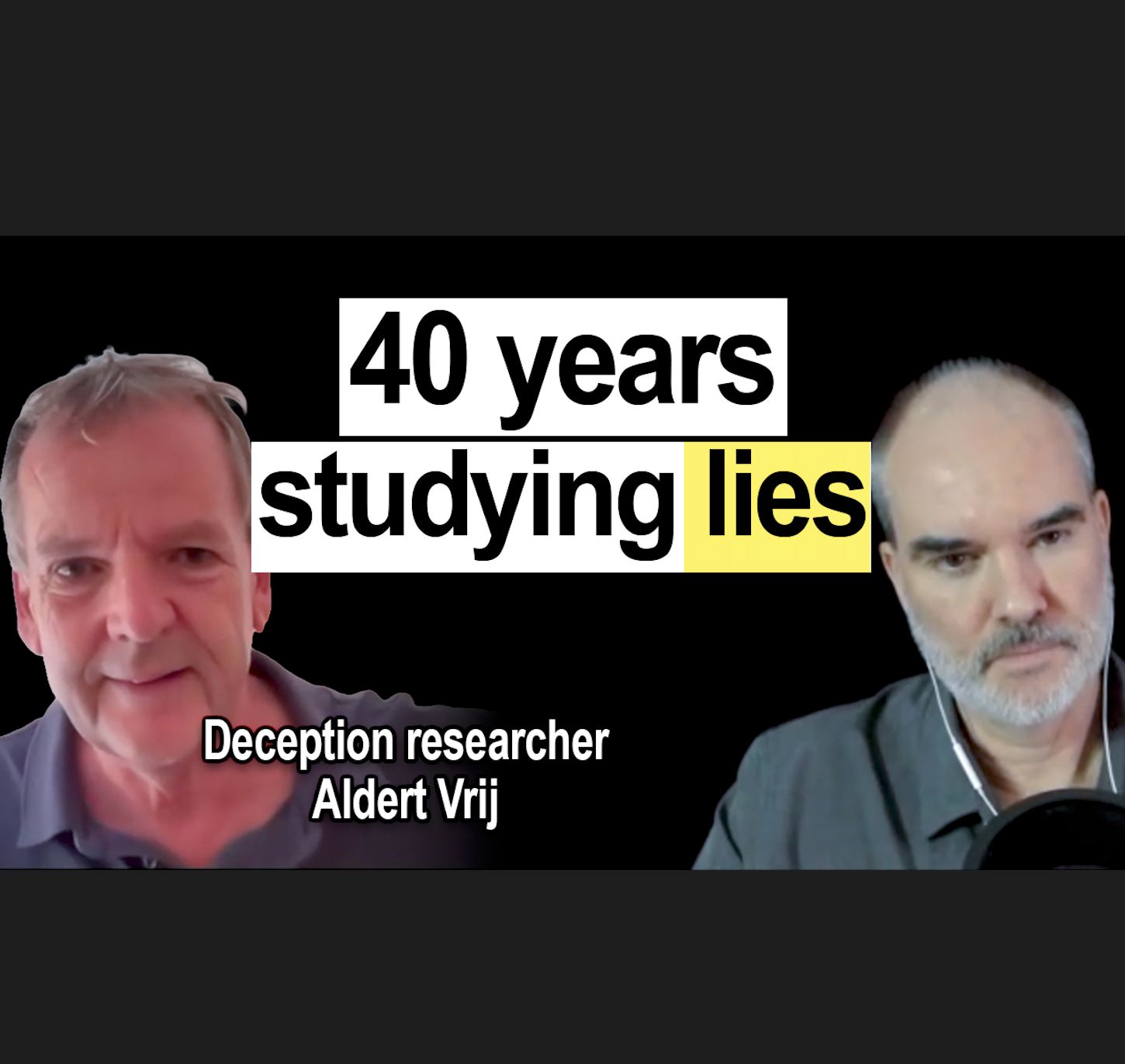
What actually works when it comes to detecting lies, and why are so many popular ideas about reading people and nonverbal behavior at odds with the scientific research? I talk with Aldert Vrij, one of the world's leading deception-detection researchers, who has spent almost four decades studying these topics. We discuss why what people say is far more revealing than their body language; why the perceived “sexiness” of reading nonverbal behavior has contributed to widespread myths and misconceptions; whether vocal behaviors like pitch, volume, and hesitation contain meaningful clues; and whether there's value in analyzing minor word choices and turns of phrase, as is done in so-called “statement analysis.” We discuss Paul Ekman's legacy as a source of faulty ideas about deception, micro-expression-based deception detection training, and the strategies that popular “body language experts” use to appear scientifically credible while simultaneously promoting ideas that conflict with the sc
How does ballet convey narrative, emotion, and character? Dive into “The Sleeping Beauty” to see how a ballet creates its essential elements. Uploaded 20-04-20 -- A baby cursed at birth. A fierce battle of good and evil. A true love awoken with a kiss. Since premiering in 1890, “The Sleeping Beauty” has become one of the most frequently staged ballets in history. So what makes this piece so beloved? And what exactly does ballet bring to this— or any other— story? Ming Luke shares what makes ballet the perfect medium for stories old and new. Lesson by Ming Luke, directed by Visorama. Animator's website: http://www.visorama.tv/ Sign up for our newsletter: http://bit.ly/TEDEdNewsletter Support us on Patreon: http://bit.ly/TEDEdPatreon Find us on Twitter: http://bit.ly/TEDEdTwitter Peep us on Instagram: http://bit.ly/TEDEdInstagram View full lesson: https://ed.ted.com/lessons/what-s-the-point-e-of-ballet-ming-luke Thank you so much to our patrons for your support! Without you this video wo
Could Alzheimer’s become a treatable disease by 2035? Former UK Prime Minister David Cameron believes it’s possible. After losing his mother to Alzheimer’s, he’s more determined than ever to help end the disease for good. Lord David Cameron sits down with Oz to discuss the breakthroughs bringing scientists closer to a cure, from new drugs to early detection methods, and why he believes we’re on the brink of a major turning point. Plus, we hear an excerpt from his new podcast, Ending Alzheimer’s, in which Lord David Cameron and his sisters reflect on their mother’s devastating decline and the challenges of caring for her. And we hear from Senator Andy Kim about his own experience caring for a parent with Alzheimer’s. Additional Listening: Ending Alzheimer's | Apple Podcasts (https://podcasts.apple.com/us/podcast/ending-alzheimers/id6820241157)
Could Jensen Huang’s sex scandal be AI’s death knell? Reed Albergotti (Semafor and Future Proof), Margaux MacColl (Vanity Fair), and Taylor Lorenz (User Mag) break down the spicy NVIDIA scandal and its potentially far-reaching consequences. The group breaks down why China hawks in Washington are celebrating Huang’s exit, what’s behind the allegations that Alice Huang is a Chinese spy and who could be next in Congress’s crosshairs. And, of course, we couldn’t ignore the conspiracy theories circulating on X accusing Anthropic of orchestrating Jensen Huang’s downfall…
We're excited to share the sixth episode of The Builders. In this series, bestselling biographer Walter Isaacson sits down with the most consequential names in AI and tech to understand the futures they're racing to build. TechStuff listeners will want to tune in because on Friday, 11/20 we'll discuss the 6th and 7th episodes of The Builders and hear from journalists who've covered these personalities for years. To outsiders, Alex Karp seems an unlikely choice to lead Palantir. A philosopher by training, the billionaire co-founder has built his business at the intersection of intelligence, warfare and AI. To supporters, his software helps defend open societies. To critics, it gives governments troubling power to surveil and control. In this interview, Karp tells Walter how dyslexia helped him bring together the impossible at Palantir, how Silicon Valley broke its contract with the rest of Americans, and why there needs to be a better way to re-distribute wealth. A conversation about na
People of different beliefs should be able to cooperate without agreeing on fundamental questions.
Share your view, then see how readers voted. No sign-in required. This poll is shared across stories.
Do you agree or disagree?
Common Quandary
A Common Quandary to discuss
Another conversation to explore, separate from this news story.
The sign says twelve items and you have fourteen. Is the express lane still yours?
The regular checkout lines are long and the express lane is empty. You count fourteen small items, two over the posted limit. A shopper approaches behind you carrying a single carton of milk as the cashier waves you forward.
Are small rules optional when enforcing them would seem fussier than breaking them?