Favorite Episode: Sandro Botticelli – The Birth of Venus: The Rebirth of Beauty
15 min
Listen through the publisher, then discuss the episode here or arrange an in-person Roundtable. Your city determines where to meet.
Roundtables are designed for groups of four, with a shared subject and room for everyone to speak. Come for discussion, with no dating expectation.
We’ve got some exciting things in the works for Inside the Masterpiece, and we’ll have more to share soon. Stay tuned! In the meantime, we’re bringing back one of our most popular episodes: Sandro Botticelli’s The Birth of Venus. Enjoy your trip to Renaissance Florence! The narration for this episode was produced using artificial intelligence. Sandro Botticelli’s The Birth of Venus is perhaps the most celebrated icon of the Renaissance, yet it remains a profound exception to the artistic rules of its time. Painted for the private villa of the powerful Medici family, this masterpiece captures the moment Greco-Roman mythology returned to the heart of European culture. In this episode, we dive into 1480s Florence—a city caught between the pursuit of classical wisdom and a rising religious fervor. We examine Botticelli’s unique aesthetic, which famously sacrificed anatomical precision for an ethereal, weightless grace. We also explore the tragic legacy of Simonetta Vespucci, the Florentine "it-girl" whose memory haunted the artist’s canvases long after her death. From the use of lavish gold leaf to the painting’s narrow escape from the fanatical fires of the "Bonfire of the Vanities," discover how this vision of beauty survived centuries of obscurity to define our modern understanding of the rebirth of art. Additional Resources • The Original in Florence: The Uffizi Gallery – Official Website (https://www.uffizi.it/en/artworks/birth-of-venus) • Explore the Painting in Ultra-High Resolution: Google Arts & Culture (https://artsandculture.google.com/asset/the-birth-of-venus-sandro-botticelli/MQEeq50LABEBVg?hl=en) • Deepen Your Knowledge: Wikipedia Entry on the Painting (https://en.wikipedia.org/wiki/The_Birth_of_Venus) Contact & Support: We truly appreciate it. Business: [email protected] Hosted on Acast.
Episode information is provided by the publisher. Listening takes place on the publisher’s service.
Johannes Vermeer painted about three dozen pictures that we know of. He had eleven children, died in debt in 1675, and was more or less forgotten for two centuries. And yet, the Girl with a Pearl Earring, The Milkmaid, his View of Delft have become some of the most famous paintings in history. Reflecting on seeing Vermeer's interpretation of the Dutch city Proust said "Ever since I saw the View of Delft in the museum in The Hague, I have known that I had seen the most beautiful painting in the world." But it's not just beauty that the painter imbued onto the world, art critic Andrew Graham Bell says that Vermeer "is the painter who holds up the beacon to humanity of where humanity should go, and that has been forgotten." In this episode our art critic Michael Prodger is joined by Andrew Graham-Dixon to discuss his latest book - Vermeer: A Life Lost and Found. Hosted on Acast.
The Adventures of Philip Marlowe presents “The Pelican’s Roost,” originally broadcast on CBS on June 28, 1950. This is episode 90 of the series, starring Gerald Mohr as Raymond Chandler’s hard-boiled Los Angeles private detective. Model Lynn Russell hires Marlowe over fears about a persistent former suitor, but the trail soon runs from a Wilshire Boulevard beauty salon to the Four Bell Jump nightclub and the Santa Monica waterfront. A drummer’s death, a marina, a cabin cruiser, and an isolated fishing pier draw Marlowe into a dangerous case. Produced by Norman Macdonnell and sponsored by Wrigley’s Spearmint Chewing Gum. Old Time Mystery Radio presents the original broadcast with a newly produced contextual introduction, a short closing announcement, and gently cleaned and mastered audio for a more consistent listening experience. Chapters: 00:00 Victor Sterling Introduction 00:42 Original Broadcast 30:10 Closing
1946 MAO AND GENERAL MARSHALL Psychological Trauma, Intergenerational Silence, and National Amnesia in Modern China — Part Two Tania Branigan, author of Red Memory: The Afterlives of China’s Cultural Revolution, visits mental health professionals in Shanghai to examine the psychological legacy of “eating bitterness” and Maoist delusion. She concludes that official censorship and deep personal trauma together perpetuate a lingering national amnesia across Chinese generations. (8)
We're back from London and sharing highlights from our trip, including why The Real Housewives of London is reality TV gold and deserves a spot on your watchlist! Plus, we're diving into the latest Real Housewives of Salt Lake City drama as tensions between Angie Katsanevas and Mary Cosby reach a boiling point, while Bronwyn Newport calls out Todd. Visit Seagrass Co. (https://seagrassco.com/) Watch Up and Adam! (https://youtube.com/@UpandAdamLive) Socials Instagram: https://instagram.com/upandadamlive/ Facebook: https://facebook.com/upandadamlive Twitter: https://twitter.com/upandadamlive TikTok: https://www.tiktok.com/@upandadamlive Merch https://shop.upandadamlive.com (https://shop.upandadamlive.com/) Inquiries [email protected] Disclaimer All content is protected under Fair Use (Copyright Act 1976).
Activate your feminine energy with this 11-minute guided meditation designed to help you reconnect with your intuition, softness, and inner strength. Whether you’re feeling disconnected, overwhelmed, or out of balance, this practice will guide you gently back to your natural feminine essence — a place of grace, love, and magnetic presence. Through mindful breathwork, affirmations, and gentle visualization, you'll awaken the qualities of receptivity, compassion, and divine flow within you. This is more than a meditation — it’s a spiritual reset, a chance to return to the beauty of who you are. Perfect to start or end your day, or anytime you need to recharge your feminine power. Put on your headphones, close your eyes, and allow yourself to receive. You are worthy. You are powerful. You are radiant. #FeminineEnergy #GuidedMeditation #DivineFeminine #MeditationForWomen #Empowerment #11MinuteMeditation #FemininePower #HealingMeditation #InnerGoddess #SelfLove feminine energy guided medita
One of the most beautiful images of a guardian angel I’ve ever seen is an icon of an old woman standing in the snow. Beside her, an angel bends down to tie her shoelaces. I love that detail. It reminds me that even the smallest things in our lives matter. In this Sunday Reflection, I explore what the Franciscan tradition teaches us about guardian angels. What does it mean to have a companion who walks beside us through difficulty? And when did you last ask your guardian angel for help? I also reflect on the seraphim, the angels we describe as being on fire with love, and on how St Francis shared that same warmth with those around him. I invite you to take a quiet moment today to ask for a little of that love in your own heart, for yourself, for others and for the whole of creation. Peace be with you. Timestamps 00:00 Angels and the image of a love that burns 01:20 Guardian angels and unseen companionship 03:09 The angel tying an old woman’s shoelaces 04:02 An invitation to open ourselv
Starting today, Inside the Masterpiece is getting a new voice. We are excited to introduce our new narrator, Ryan, and we hope you’ll enjoy our upcoming episodes—both freshly re-recorded and brand new ones. Thank you for all of your love and support and for being a loyal listener! In Henri Matisse’s visionary masterpiece, the archaic joy of a timeless round dance and the radical departure into artistic Modernism merge into a pulsating unity. "La Danse" transports us to a hill of pure green beneath a sky of deepest blue, where five bodies unite in an ecstatic circle, speaking a universal language of movement. Against the backdrop of a conservative Europe still bound by the chains of tradition, a liberation of pure color unfolds. Its radical simplification and unfiltered energy shattered the established order of the art world, proclaiming a message that still makes the longing for human connection and freedom tangible today. In this episode of Inside the Masterpiece, we dive into the yea
Roy Lichtenstein forced the art world to ask what art is. The narration for this episode was produced using artificial intelligence. New Jersey, summer of 1961: a boy points to a Mickey Mouse comic and bets that his father can't paint as well as that—and the father, a painter still waiting for his breakthrough, takes the bet. A look behind this work reveals how a weeping woman from a romance comic became one of Pop Art's most famous paintings, why the press asked whether Lichtenstein was the worst artist in America—and why the man who drew the original never became famous. Additional Resources The painting at the museum: Museum of Modern Art – Drowning Girl (https://www.moma.org/collection/works/80249) The painting and its source: Wikipedia – Drowning Girl (https://en.wikipedia.org/wiki/Drowning_Girl) The artist: Wikipedia – Roy Lichtenstein (https://en.wikipedia.org/wiki/Roy_Lichtenstein) The painted printing dots: Wikipedia – Ben-Day Dots (https://en.wikipedia.org/wiki/Ben_Day_proces
Communities should usually repair existing infrastructure before building replacements.
Share your view, then see how readers voted. No sign-in required. This poll is shared across stories.
Do you agree or disagree?
Common Quandary
A Common Quandary to discuss
Another conversation to explore, separate from this news story.
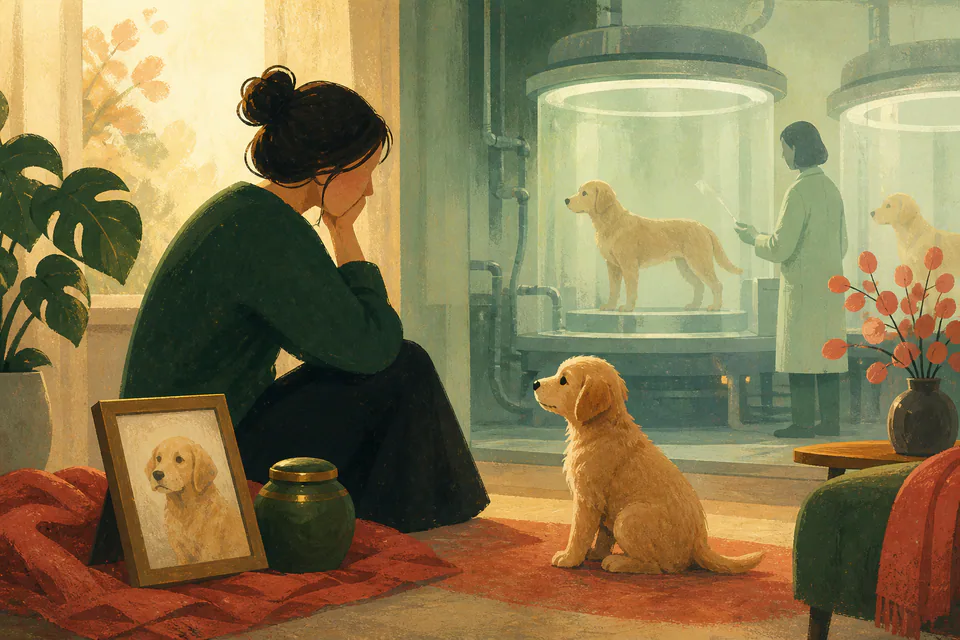
You can clone the best dog you ever had. Would you?
After a beloved dog dies, its owner can afford to have it cloned. The procedure is legal and improving, but it uses animals as surrogates and will not recreate the original dog's memories or personality.
What do our obligations to animals permit us to create for our own comfort?