Feeling All the Feels: Crash Course Psychology #25
16 min
Listen through the publisher, then discuss the episode here or arrange an in-person Roundtable. Your city determines where to meet.
Roundtables are designed for groups of four, with a shared subject and room for everyone to speak. Come for discussion, with no dating expectation.
In this episode of Crash Course Psychology, Hank talks about these things called "Emotions". What are they? And why do we need them? Want more videos about psychology? Check out our sister channel SciShow Psych at https://www.youtube.com/scishowpsych! -- Chapters: Introduction: Emotions 00:00 Theories on Emotions 2:11 Cognition & Emotion 3:35 The Spillover Effect 4:22 Top-Down vs Bottom-Up Approaches to Cognitive Processing 6:09 The Autonomic Nervous System 8:10 Optimal Arousal 8:39 Review & Credits 10:03 -- Crash Course is on Patreon! Want to find Crash Course elsewhere on the internet? Facebook - http://www.facebook.com/YouTubeCrashCourse Twitter - http://www.twitter.com/TheCrashCourse Instagram - https://www.instagram.com/thecrashcourse/ CC Kids: http://www.youtube.com/crashcoursekids
Episode information is provided by the publisher. Listening takes place on the publisher’s service.
Best books for Prompt Engineering with GPT-3 and LLMs - Crash Course in AGIEpisode release date: 27 Dec 2022Spreading awareness about the works of some of the leading educators in the AI revolution. Core Ideas: Metamodernism: Narratives and emergence view of reality - Reduce suffering - Increase prosperity - Increase understanding mantra: Seek knowledge. ELABORATE: Add depth and detail to understanding, weaving comprehensive and nuanced explanations.DISCLAIMER: This is a community-driven show. ----------------Best books for Prompt Engineering with GPT-3 and LLMs - Crash Course in AGIEpisode release date: 27 Dec 2022Spreading awareness about the works of some of the leading educators in the AI revolution. Core Ideas: Metamodernism: Narratives and emergence view of reality - Reduce suffering - Increase prosperity - Increase understanding mantra: Seek knowledge. ELABORATE: Add depth and detail to understanding, weaving comprehensive and nuanced explanations.DISCLAIMER: This is a community
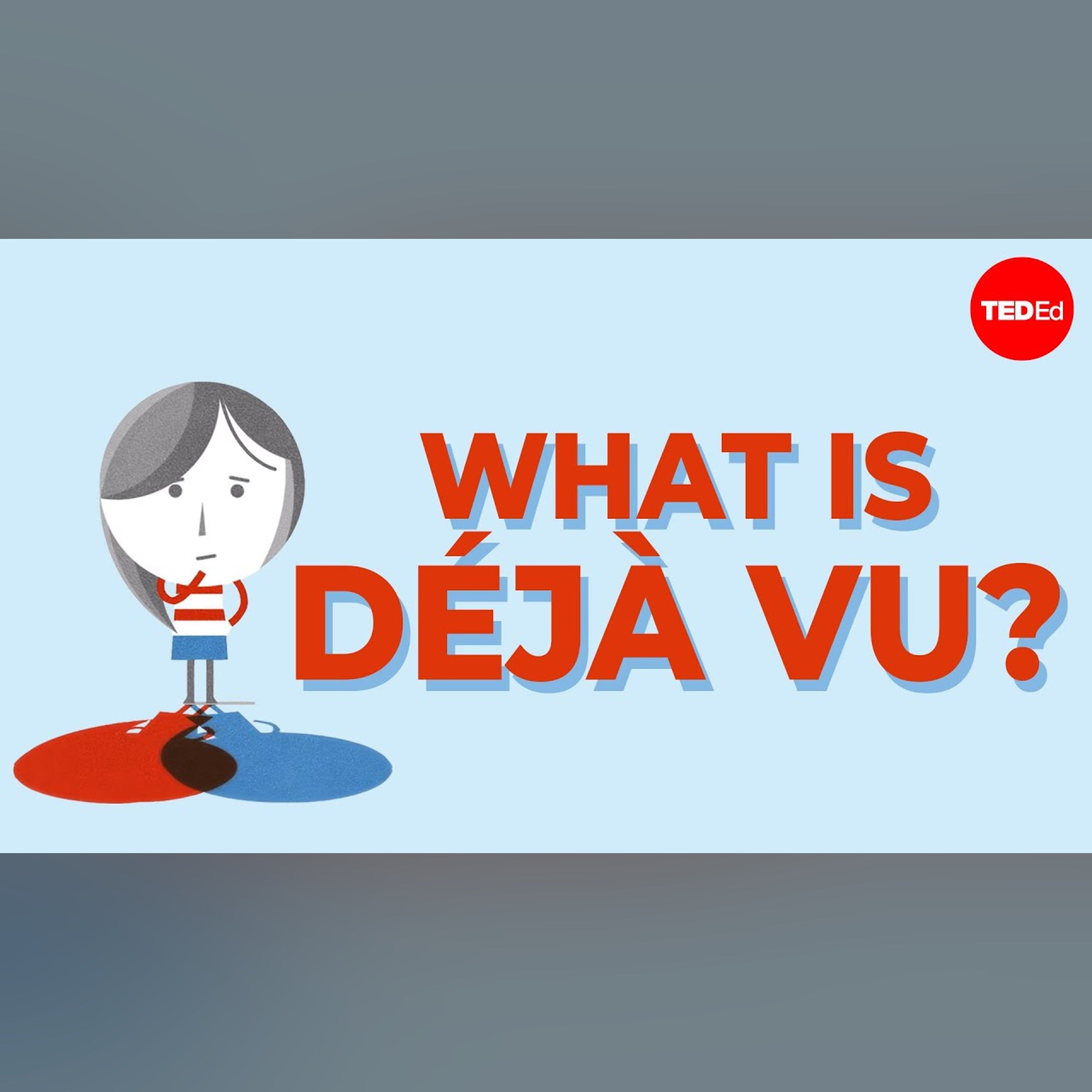
What causes the sensation of déjà vu? Dive into the theories and psychology that could explain why you’re having that feeling… again. Uploaded 28-08-13 -- You might have felt it -- the feeling that you've experienced something before, but, in reality, the experience is brand new. There are over 40 theories that attempt to explain the phenomenon of déjà vu. Michael Molina explains how neuroimaging and cognitive psychology have narrowed down the theories that could explain that feeling you're having...again. Lesson by Michael Molina, animation by Josh Harris. Sign up for our newsletter: http://bit.ly/TEDEdNewsletter Support us on Patreon: http://bit.ly/TEDEdPatreon Find us on Twitter: http://bit.ly/TEDEdTwitter Peep us on Instagram: http://bit.ly/TEDEdInstagram View full lesson: http://ed.ted.com/lessons/what-is-deja-vu-what-is-deja-vu-michael-molina
The gate doesn't have a lock. It doesn't have a key. There's nobody standing on the other side waiting to wave you through. Uploaded 09-09-26 The gate was open the whole time. You just couldn't see it, because you were staring at the ground, waiting for your feet to feel light. You've been standing there for years, warming up for a race you never run. Here is the truth: readiness is not a feeling you receive. It is a decision you make. The people who built the things you wish you'd built didn't feel more ready than you do — they just stopped waiting to feel it. This seminar unpacks the single mechanic behind why you never feel ready — and why willingness, not readiness, is what actually builds a life. CHAPTERS 0:00 Intro — The gate was open the whole time 2:04 The classroom lie: prepare, then perform 4:24 Fear wearing the mask of wisdom 6:36 Readiness is a quality you bring, not a state you arrive at 8:24 The glass never fills — skill comes from use 11:36 The cruel arithmetic of the wa
A kiss can be wonderful. It can create an instant connection, spark romance, or make you feel closer to someone. But a kiss can also have the opposite effect — and sometimes ruin everything. So what makes kissing so powerful, and why can one kiss make such a difference? There's some fascinating science behind it. https://www.scientificamerican.com/article/why-we-kiss/ We spend an enormous amount of time worrying about what's going to change. What's next? What's coming? How do we prepare? But what if we're paying attention to the wrong things? Some of the most important forces shaping our lives never change, and understanding them may be far more valuable than trying to predict the future — something humans are notoriously bad at. Morgan Housel, partner at The Collaborative Fund and author of Same as Ever: A Guide to What Never Changes (https://amzn.to/3SwWn6u) (https://amzn.to/3SwWn6u)), joins me to explain why the things that stay the same may be the most important things to understan
Master the skills that change lives — enroll in your free human behavior course today: https://nci.university/learn Uploaded 09-01-26 You were never reacting to chaos — you were responding to structure. Outcomes don’t appear suddenly; they’re assembled long before you notice them. Understanding how pressure is built changes how the world feels immediately. All influence follows patterns once you know where to look. Reality doesn’t break — it gets reshaped in layers. Every system depends on predictable human responses. Given the right conditions, behavior becomes almost automatic. Once you see the architecture, panic loses its leverage. Detection beats reaction — every time. Please note that the content provided in this broadcast is for informational and educational purposes only and should not be construed as legal, medical, financial, or professional advice. No material in this communication establishes any form of professional relationship that is privileged or confidential. The insi
PBS Member Stations rely on viewers like you. To support your local station, go to: http://to.pbs.org/DonateSPACE ↓ More info below ↓ Uploaded 11-11-20 Sign Up on Patreon to get access to the Space Time Discord! Physicists have a long history of sticking our noses where they don’t belong - and one of our favorite places to step beyond our expertise is the question of consciousness and free will. Sometimes our musings are insightful, sometimes incoherent, and usually at least somewhat naive. Which a fair description of this show, so of course Space Time needs to weigh in physics and free will.. Check out the Space Time Merch Store Hosted by Matt O'Dowd Written by Matt O'Dowd and Bahar Gholipour Graphics by Leonardo Scholzer, Yago Ballarini, and Pedro Osinski Directed by: Andrew Kornhaber Assistant Producer: Setare Gholipour Executive Producers: Eric Brown and Andrew Kornhaber End Credits Music by J.R.S. Schattenberg: https://www.youtube.com/channel/UCRl6-nb4iOnsij-vnpAjp0Q Special Thank
The majority of the universe is made up of a currently mysterious entity that pervades space: dark energy. We don’t know exactly what it is, but we do know that dark energy accelerates the expansion of space. We think this means the Universe will expand forever, even as our view of it shrinks while space expands faster all the time. Check out the Crash Course Astronomy solar system poster here: http://store.dftba.com/products/crashcourse-astronomy-poster If you want to learn more about the creation and death of the universe, watch Crash Course Big History here: https://youtube.com/playlist?list=PL8dPuuaLjXtMczXZUmjb3mZSU1Roxnrey -- Chapters: Introduction: The Expanding Universe 00:00 The Expansion of Space is Accelerating 2:17 What is Dark Energy? 4:19 Will the Universe Expand Forever? The Geometry of the Universe 5:20 The Cosmic Horizon of the Observable Universe 6:50 Review 10:20 -- GEOMETRY OF THE UNIVERSE RESOURCES Geometry: Expanding faster than light: General expansion: -- PBS Di
Have you ever wondered where cured meats like salami or pepperoni get their bright red color? Of course its from organic chemistry! A chemical called nitric acid gives them that bright color, while also increasing their shelf. It's also involved in some other interesting reactions. In this episode of Crash Course Organic Chemistry we'll see how nitrous acid reacts with primary amines to form diazonium salts, we'll learn about alkyldiazonium salts and aryldiazonium salts, and see what conditions are necessary for nucleophilic aromatic substitutions. Series Sources: Brown, W. H., Iverson, B. L., Ansyln, E. V., Foote, C., Organic Chemistry; 8th ed.; Cengage Learning, Boston, 2018. Bruice, P. Y., Organic Chemistry, 7th ed.; Pearson Education, Inc., United States, 2014. Clayden, J., Greeves, N., Warren., S., Organic Chemistry, 2nd ed.; Oxford University Press, New York, 2012. Jones Jr., M.; Fleming, S. A., Organic Chemistry, 5th ed.; W. W. Norton & Company, New York, 2014. Klein., D., Organ
Like a trendy dance, a fighting combo, or a secret handshake, organic reactions can be broken down into simpler steps. In this episode of Crash Course Organic Chemistry, we’ll specifically be looking at alkene addition reactions, and with each new reaction ask ourselves three questions to help us puzzle through the mechanism and understand what’s going on. Episode Sources: Le Couteur, P, Burreson, J. Napoleon’s Buttons: 17 molecules that changed history., Penguin, New York, 2004, Chapter 1. Whipps, H., “How the Spice Trade Changed the World,” https://www.livescience.com/7495-spice-trade-changed-world.html Last accessed, 3/28/2020. Henriques, Martha, “How spices changed the ancient world,” http://www.bbc.com/future/bespoke/made-on-earth/the-flavours-that-shaped-the-world/ Last accessed, 3/28/2020. Hashimoto, K., Yaoi, T., Koshiba, H., Yoshida, T., Maoka, T., Fujiwara, Y., Yaamoto, Y, Mori, K., “Photochemical Isomerization of Piperine, a Pungent Constituent of Pepper”, Food Sci. Technol.
Art should be available in ordinary community spaces, not only specialist venues.
Share your view, then see how readers voted. No sign-in required. This poll is shared across stories.
Do you agree or disagree?
Common Quandary
A Common Quandary to discuss
Another conversation to explore, separate from this news story.
Your friend asks for an honest review after every date. Do their dates deserve privacy?
A close friend sends detailed post-date reports and expects your advice about every message, kiss, and awkward silence. One recent date is someone you know professionally, who would be embarrassed to learn how much you have heard.
Where does friendship's need for advice become gossip about an unsuspecting person?