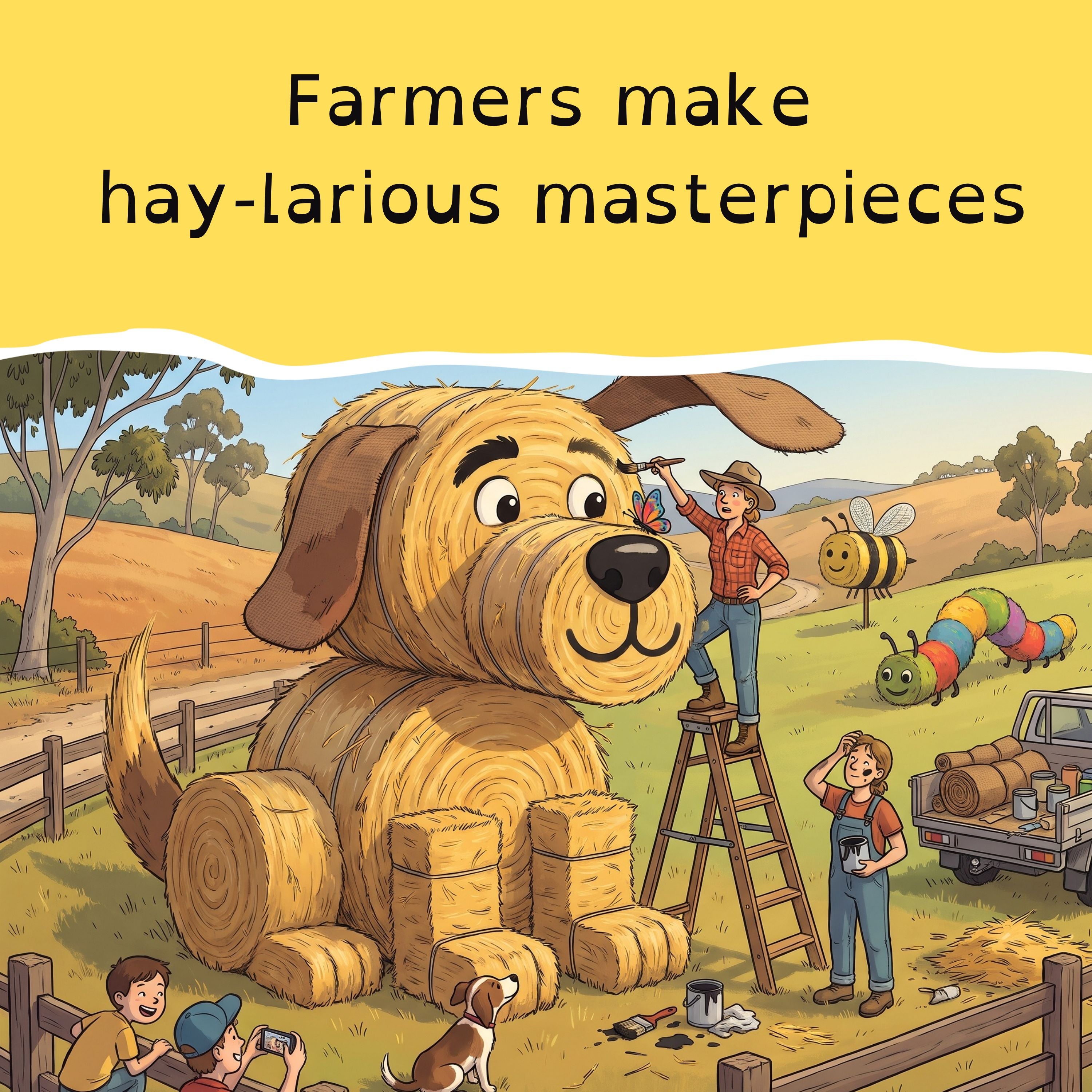
Your daily kids news podcast. Why ‘human’ is word of the year; Whale speed limits in Tahiti; AFLW grand finalists decided; and Toy Story hay sculptures. Cambridge Dictionary has crowned human its Word of the Year for 2026! One incredible photograph of a humpback whale's eye (https://www.bbc.com/future/article/20261118-the-tragic-tale-of-sweet-girl-the-whale-death-that-changed-the-law) is making a big splash in Tahiti! North Melbourne's Kangaroos are one win away from an AFLW three-peat after beating the Sydney Swans! What a cricket cracker! Australia chased down England's total with just one ball to spare, thanks in part to Nikhil Chaudhary's explosive 66 runs and two wickets. Victorian farmers have turned ordinary hay bales into giant cartoon characters (https://www.abc.net.au/news/2026-11-22/upper-murray-hay-bale-art-trail-fire-flood-recovery/107390424)! For the full episode transcript, click here (https://www.squizkids.com.au/wp-content/uploads/2026/11/261123-Quiz-Transcript.pdf). R
Physicists have developed a new theoretical framework that challenges conventional understanding of radioactive decay. Their research explores an unusual quantum process involving the simultaneous emission of different particles, potentially resolving a decades-old mystery in nuclear physics. The findings could reveal new insights into the complex interplay of fundamental forces inside unstable atomic nuclei. This episode includes AI-generated content.
Microplastics in my Heart Letter: https://staycuriousmetabolism.substack.com/p/microplastics-in-my-heart-its-worse?r=40ekz2 Stanford Fiber RCT, Letter https://staycuriousmetabolism.substack.com/p/fiber-is-good-for-you-is-lazy-science?r=40ekz2 Microbiome Reset, Letter https://staycuriousmetabolism.substack.com/p/how-im-rebuilding-my-microbiomeafter?r=40ekz2 Description: Microplastics are everywhere—in our food, water, and inside our bodies—and avoiding them completely is nearly impossible. In this conversation, I sit down with Dr. Matthew Dunn PhD, a molecular biologist working at the intersection of biotechnology and human health, to unpack what the science actually says about microplastics and how they may be linked to cardiovascular disease, reproductive health issues, and gut inflammation We break down the landmark human data, the animal and cellular studies that help explain possible mechanisms, and dissect the state of the data. We also explore a potential inside-out solution: usi
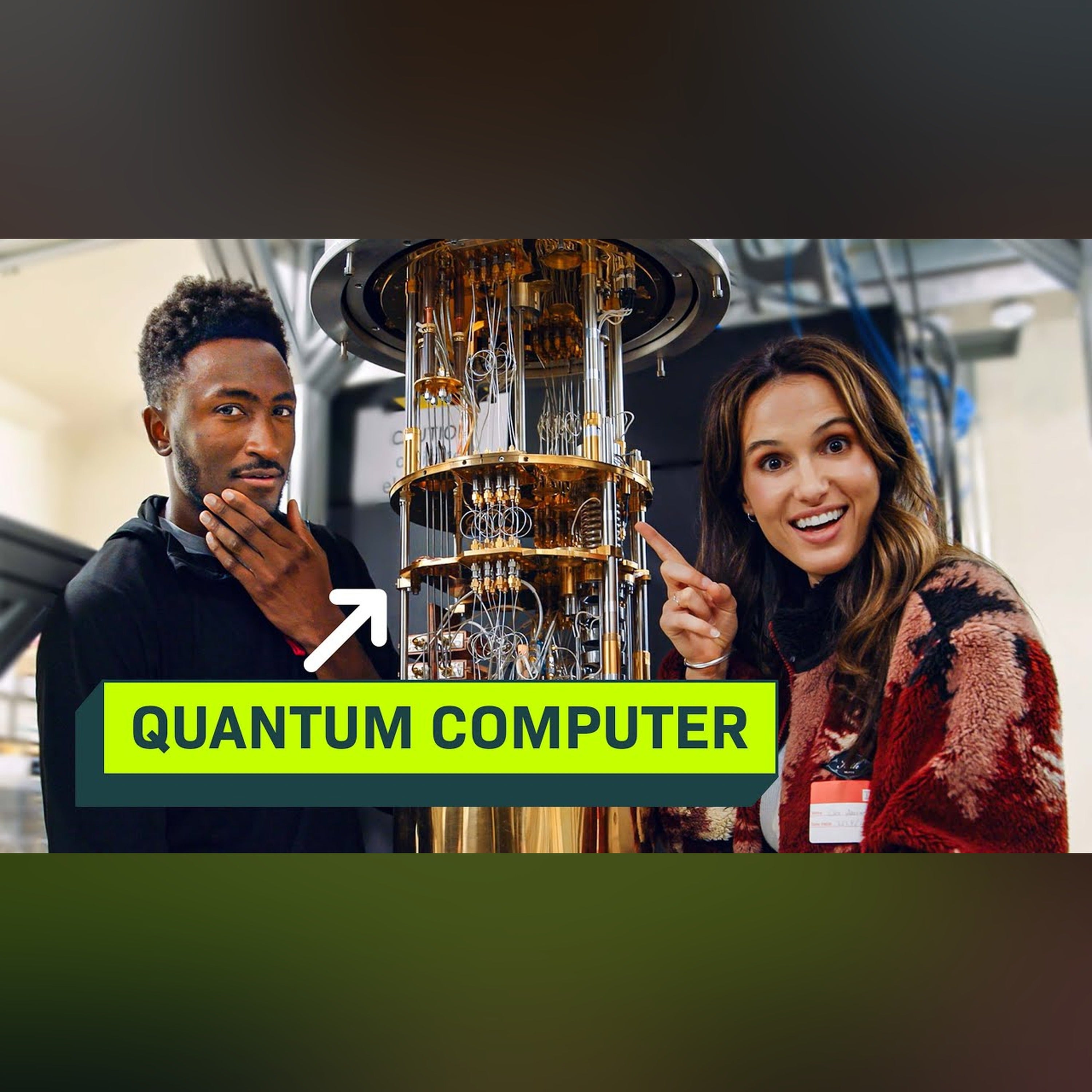
Quantum computers aren’t what you've been told... You’ve heard about quantum computers. Maybe you’ve seen the “race for quantum supremacy” between governments and companies, or read that quantum computers will break all encryption, or heard terms like “qubits” or “superposition” or “quantum mechanics” in a confusing tv segment. But you might be wondering… what does a quantum computer actually DO? And how could it actually affect my life? @mkbhd and I had the same questions. Marques and I both realized quantum computing was this big important technology… that we didn’t really understand. So we decided to go on an adventure to learn the truth about quantum computers. And we're taking you with us, to show you what we learn as we learn it. But more importantly, to show you how these crazy computers might actually impact YOUR life... sooner than you think. Chapters: 00:00 What is a quantum computer? 02:00 Why is quantum computing important? 04:00 The Quantum Video Game analogy 07:40 What do
Viewers like you help make PBS (Thank you ) . Support your local PBS Member Station here: https://to.pbs.org/DonateSPACE Uploaded 03-10-18 On this Space Time Journal Club we look at how gravitational waves can be used to search for extra dimensions of space! To learn more about CuriosityStream you can go to: https://www.curiositystream.com/space... and use the code "spacetime" during the sign-up process. "Limits on the number of spacetime dimensions from GW170817" Pardo, Fishbach, Holz and Spergel 2018 You can further support us on Patreon at https://www.patreon.com/pbsspacetime Get your own Space Time t-shirt at http://bit.ly/1QlzoBi Tweet at us! @pbsspacetime Facebook: facebook.com/pbsspacetime Email us! pbsspacetime [at] gmail [dot] com Comment on Reddit: http://www.reddit.com/r/pbsspacetime Help translate our videos! Previous Episode: Quantum Gravity and the Hardest Problem in Physics Hosted by Matt O'Dowd Written by Matt O'Dowd Graphics by Luke Maroldi Assistant Editing and Sound
A.I. for Finding a New Job: Navigating the Search Without It Taking Over Your Life, a practical, beginner-friendly look at how artificial intelligence can help you navigate the search without it taking over your life. Finding a New Job? Press play on Episode 428 of A.I. for Beginners and learn exactly how artificial intelligence, especially ChatGPT, alongside LinkedIn and Teal, can help you navigate the search without it taking over your life. WHAT YOU WILL LEARN IN THIS EPISODE - Why finding a new job is so hard to handle alone, and what is actually going on underneath it - A specific way to use LinkedIn to work through it, step by step - An example prompt you can copy word for word: "Here is a job description, help me tailor my CV to match what they're actually asking for" - A second practical technique, with another ready-to-use prompt: "Help me prepare clear, confident answers for the questions I'm most nervous about in an interview" WHO THIS EPISODE IS FOR - Anyone currently worki
In this episode: 00:25 Voyager 1 goes farther than any human-made object has gone before Nature: Voyager 1 achieves a cosmic first: one ‘light day’ from Earth (https://www.nature.com/articles/d41586-026-03672-1) 04:37 Genomic analysis reveals how vampire bats stomach their gory diet Nature: Secrets of the vampires: genomes reveal how these bats live off blood alone (https://www.nature.com/articles/d41586-026-03706-8) Hosted on Acast.
More needs to be done to combat climate change, but what? We discuss some big ideas to rein in emissions. Projections of future climate change show a relatively cooler world thanks to the growth of renewable energy. And yet the world is still on track to reach around 2.6˚C of warming by the end of the century — far beyond what many climate scientists say we need to avoid the worst impacts of climate change. So, what are we going to do about it? In the second episode of Cooked? I talk to experts around the world about their big ideas of what we can do to tackle climate change. We talk about energy, food, economics and how the world needs to adapt to a warmer world. 00:00 How can we save the world? 04:27 The synergistic solutions to climate change and other big challenges 12:03 Can we end humanity’s addiction to meat? 21:49 How to make economics work to fight climate change 33:30 Why the world needs to adapt 43:40 Preview of next time Further reading: Not the End of the World (https://ww
In the first of our new podcast series, a Nature reporter looks for reasons for hope in the face of overwhelming climate anxiety. The past year has been... a lot. Record-breaking temperatures, devastating floods and catastrophic wildfires have brought the realities of climate change into sharp focus for people around the world. At the same time, many governments and organisations have scaled back on their climate action. If you’re anything like me you might be feeling it’s all a bit ‘doom and gloom’. So in this series I decided to face my climate anxiety head on and set out in search of reasons for optimism. In this first episode of Cooked? I talk to experts around the world about what the data really show and why there are still reasons to hope. 00:00 How climate change feels overwhelming 04:27 What the data say about renewables 11:23 Will AI stall climate progress? 21:49 How are the world’s nations doing on climate change? 35:13 Preview of next time Further reading: Nature: COP31 kic
Security claims about important digital products should face independent testing.
Share your view, then see how readers voted. No sign-in required. This poll is shared across stories.
Do you agree or disagree?
Common Quandary
A Common Quandary to discuss
Another conversation to explore, separate from this news story.
An old friend refuses to use someone's new name. Do you correct them at the reunion?
At a reunion, an old friend repeatedly uses the name a former classmate had years ago. They say shared history gives the old name affectionate meaning; the classmate has clearly introduced themselves with a different name.
When does preserving your shared past deny who someone is now?